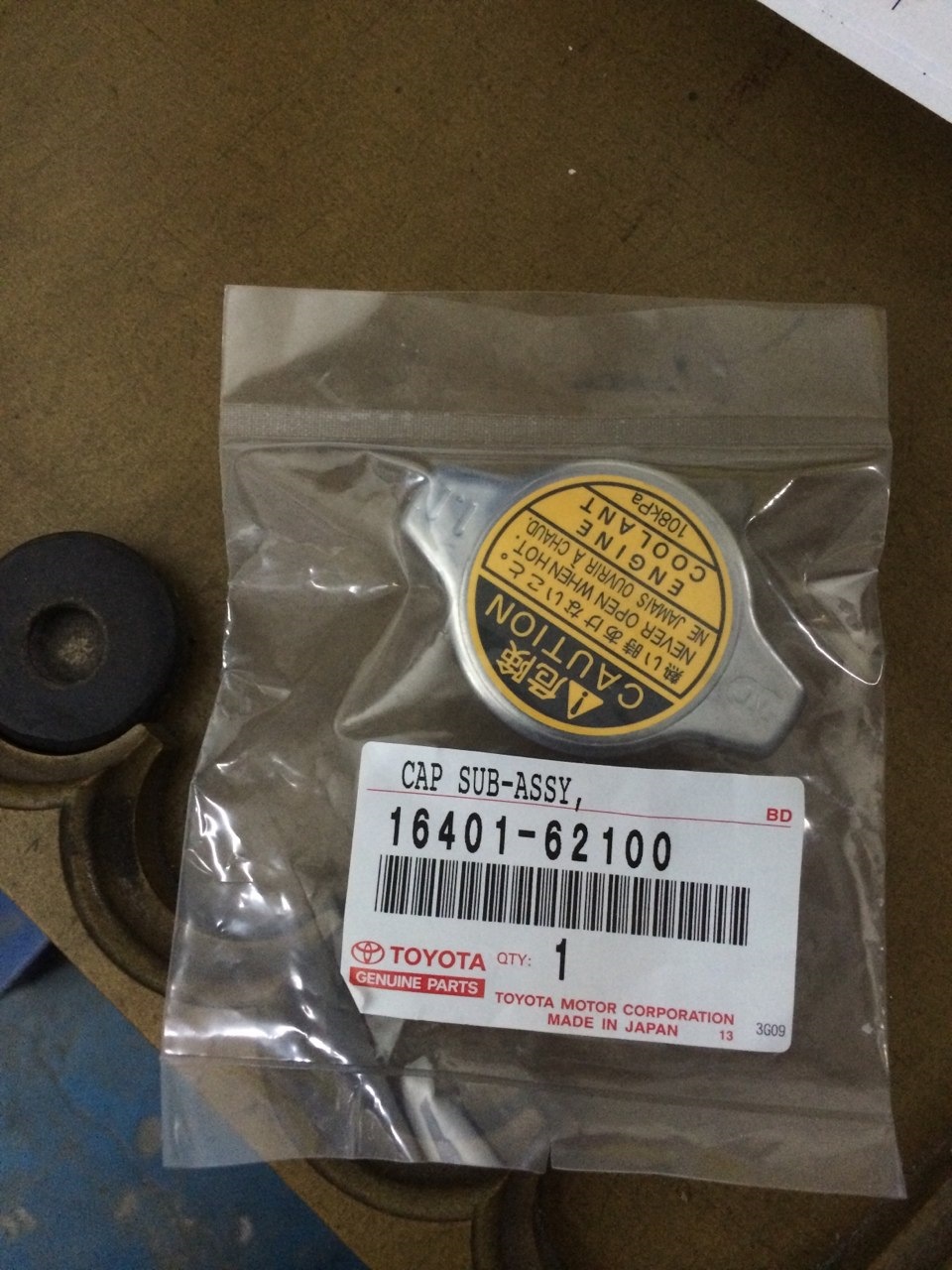
Radiator Cap Rating - 13 or 16 psi?

BoomerBob

New member
After blowing my engine from overheating by installing a new 16 psi radiator cap which caused my top radiator hose to blow off; I'm nearing the completion of the full top end rebuild with new hoses and radiator. I want to verify I'm using the right lb rating so I don't do this again.

Does anyone know for sure which one it is. Yes, I can buy the Toyota cap, but I may get one with the temp gauge built in so I visually see the temp of the coolant.
 
Register to hide this ad
After blowing my engine from overheating by installing a new 16 psi radiator cap which caused my top radiator hose to blow off; I'm nearing the completion of the full top end rebuild with new hoses and radiator. I want to verify I'm using the right lb rating so I don't do this again.

Does anyone know for sure which one it is. Yes, I can buy the Toyota cap, but I may get one with the temp gauge built in so I visually see the temp of the coolant.

I don't think even Toyota really knows. I can absolutely guarantee that my rig came from the factory with a 0.9 Bar (13psi) cap; the pressure was stamped right on the turning tab.

91250d1158262156-f-s-oem-radiator-cap-and-oil-filler-cap-r_cap-1.jpg


The 2001 and 2002 MY came with a 1.1 Bar cap.

2f8fc14s-960.jpg


That is almost 16 psi.

The FSM says it the range centers around 0.9 Bar (13psi), but the range is 10.7 - 14.9 psi. So why were they selling 1.1 Bar caps for our rigs? At one point, they were selling the 1.1s as replacements for the 0.9s for all years. Now they just sell 0.9. (16401-20353).

http://www.teamtoyota4x4.org/archivio/1996%20to%202002%20Toyota%204Runner%20Repair%20and%20Wiring%20Manuals/techinfo.toyota.com/ileaf/02toyrm/02toypdf/02rmsour/2002/024runne/co5vzfe/radi/ovi.pdf

2. INSPECT RADIATOR CAP
NOTICE:
If the radiator cap has contaminations, always rinse
it with water.
When performing steps (a) and (b) below, keep the radiator cap tester at an angle of over 30° above the horizontal.
Before using a radiator cap tester, wet the relief valve
with engine coolant or water.
(a) Using a radiator cap tester, slowly pump the tester and
check that air is coming from the vacuum valve.
Pump speed: 1 push/(3 seconds or more)
NOTICE:
Push the pump at a constant speed.
If air is not coming from the vacuum valve, replace the radiator
cap.
(b) Pump the tester and measure the relief valve opening
pressure.
Pump speed: within 1 second/1 push
NOTICE:
This pump speed is for the first pump only (in order to close
the vacuum valve). After this, the pump speed can be reduced.
Standard opening pressure:
74-103 kPa (0.75-1.05 kgf/cm2, 10.7 - 14.9 psi)

Minimum opening pressure:
59 kPa (0.6 kgf/cm2, 8.5 psi)

Note: This is from the 2002, but my '99 FSM says the exact same thing.

Anyway, I stick with the 0.9 Bar (13psi) currently sold by the dealers.

This has all been debated over the years if you really want to search.

I doubt anything bad will come from using the 16 psi cap given that it was the original spec for 2001-2002, although your experience suggests differently.
 
Last edited:
Wow, I had no idea about the pressure differences between the model years. I'd most definitely go for the lower PSI, like you said at 16 PSI old hoses will find a way to fail. I know technically, a 16 PSI cap will increase the temperature the coolant will boil at but I don't think it's worth the trade-off if it means blowing a hose and running the engine dry.
 
I don't think even Toyota really knows. I can absolutely guarantee that my rig came from the factory with a 0.9 Bar (13psi) cap; the pressure was stamped right on the turning tab.

91250d1158262156-f-s-oem-radiator-cap-and-oil-filler-cap-r_cap-1.jpg


The 2001 and 2002 MY came with a 1.1 Bar cap.

2f8fc14s-960.jpg


That is almost 16 psi.

The FSM says it the range centers around 0.9 Bar (13psi), but the range is 10.7 - 14.9 psi. So why were they selling 1.1 Bar caps for our rigs? At one point, they were selling the 1.1s as replacements for the 0.9s for all years. Now they just sell 0.9. (16401-20353).

http://www.teamtoyota4x4.org/archivio/1996%20to%202002%20Toyota%204Runner%20Repair%20and%20Wiring%20Manuals/techinfo.toyota.com/ileaf/02toyrm/02toypdf/02rmsour/2002/024runne/co5vzfe/radi/ovi.pdf


Note: This is from the 2002, but my '99 FSM says the exact same thing.

Anyway, I stick with the 0.9 Bar (13psi) currently sold by the dealers.

This has all been debated over the years if you really want to search.

I doubt anything bad will come from using the 16 psi cap given that it was the original spec for 2001-2002, although your experience suggests differently.


Great info! Thanks! I did several searches for "radiator cap rating" but nothing turned up specifically. Maybe those debates were embedded in different threads that were about something else.

One would think the rating would be the same across all years of this engine but I guess not.

I can say it has been quite an experience rebuilding this engine. Today I did something dumb while assembling the front of the engine. The cam sensor wire got caught between the fan housing and the engine. When I torqued it down I cut the wire. Goodbye $81 plus I now have to wait on the part for at least 2 days.
 
Wow, I had no idea about the pressure differences between the model years. I'd most definitely go for the lower PSI, like you said at 16 PSI old hoses will find a way to fail. I know technically, a 16 PSI cap will increase the temperature the coolant will boil at but I don't think it's worth the trade-off if it means blowing a hose and running the engine dry.

I'm wondering if the spring clamp on the hose had gotten weak over the years. The rig is 18-19 years old now. To be on the safe side I'm going to add regular screw type hose clamps to go along with the spring clamps. I can see the benefit of the spring clamps since they self tighten over time but the screw clamps don't weaken.
 
Great info! Thanks! I did several searches for "radiator cap rating" but nothing turned up specifically. Maybe those debates were embedded in different threads that were about something else.

One would think the rating would be the same across all years of this engine but I guess not.

I can say it has been quite an experience rebuilding this engine. Today I did something dumb while assembling the front of the engine. The cam sensor wire got caught between the fan housing and the engine. When I torqued it down I cut the wire. Goodbye $81 plus I now have to wait on the part for at least 2 days.

Gentlemen, Check Your Radiator Cap

https://www.toyota-4runner.org/3rd-gen-t4rs/158702-radiator-cap-question.html#post1581363

OEM Radiator Cap

ProTip: To find discussions about the right part, search on the first half of the part number: 16401 in this case.
 

Members online

Forum statistics

Threads
278,315
Messages
3,554,104
Members
248,016
Latest member
Advally Service

Trending content

Back
Top