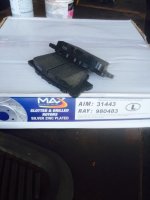
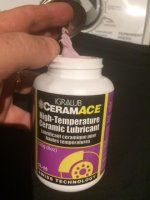
FYI: Brake Lube - ceramic/synthetic technology, is the new kid on the block.
The following is a top performer, in restoring brake caliper pin & overall brake function.
/Larry
----------------------------------------------------------------------------------------------------------------
IGRALUB LUBRICANTS
Igralub Lubricants | Autosphere
CermacAce, CarbonLub and BSS are new products for brake installation and maintenance. (Photo: Jil McIntosh)
It’s tempting to think that one brake lube product is the same as the next, but not all formulations are the same.
Three products new to the Canadian marketplace—CeramAce, CaronLub, and BSS Brake Silencer Spray—provide superior results due to their formulas, according to their Canadian distributor Kang Rich International. The new products were on display at the AAPEX aftermarket show in Las Vegas.
BSS Brake Silencer Spray has solid lubricant fractions that press into the metal surfaces when the brakes are activated, filling any minute depressions and increasing braking power by almost nine percent, while extending the life of the rotor and pad. It prevents squealing, dissipates heat, and is temperature-resistant from -100C to plus 1300C. It also helps to prevent the formation of brake dust.
CeramAce is a high-temperature fitting and release anti-seize paste containing more than 30 percent solid ceramic base.
Waterproof and resistant to salt water, acids and alkalis, the paste protects against corrosion and does not get gummy.
CarbonLub is an anti-seize paste for extreme high-heat and high-pressure applications, providing long-term protection against corrosion and seizure with its anti-oxidation properties. It’s specially formulated for heavy-duty applications including trucks, semis, trailers, and construction equipment, and parts can be easily dismantled even after years of use.
All of the products are Swiss formulations, and are made in Switzerland and Canada. For information on suppliers, visit
Kang Rich International Corporation |.
-----------------------------------------------------------------------------------------------------------------------
How to Test Brake Caliper Guide Pins
Diagnosing Brake Caliper Guide Pin Problems - How to Test Brake Caliper Guide Pins | HowStuffWorks
If you're having issues with your brakes, the culprit could be the guide pins, but a careful inspection is the only way to know for sure.
Problems to look for include caliper pins that are corroded, or ones that aren't properly lubricated. Also, the pins could be stuck in the rotor or they won't go in all the way after the pads have been replaced.
----------------------------------------------------------------------------------
Brake Caliper Service
Brake Caliper Service | Know Your Parts
----------------------------------------------------------------------------------
Stop the ‘Warped’ Rotors Myth and Service Brakes the Right Way
ABS: Why Winter Is Hard On Your ABS Brake System
Myths take hold *because either
A) they seem completely logical or
B) they are so often repeated that they just become common knowledge. The warped rotor myth is a little bit of both. A rotor that contributed to a pulsation condition certainly appears “warped.” Plus, everyone says it — even technicians that know the rotor isn’t *really warped will say it as shorthand.
Rotors are cast in extreme heat — three to five times greater than the most aggressive braking situation. Physically “warping” a rotor would require a similar application of extreme heat, which is impossible.
Obviously rotors aren’t invincible. They can crack, break and develop irregularities that lead to pulsation, but all of those problems start to develop in other ways that need a technician’s touch.
Starting today, remove “warped rotor” from your vocabulary. Instead, you should be both looking for and educating your customers about these terms:
Lateral runout
Runout is a measurement of the difference between the high and low spots in the hub and on the rotor.
On each revolution of the wheel, as the high spot of the rotor scrapes unevenly with the hub or applies friction unevenly with the pad, the results for the rotor’s face are just that — uneven.
Root causes of runout include:
• Runout from the hub mounting face;
• Runout from the wheel bearing;
• Sloppy resurfacing/machining procedures;
• A buildup of rust and corrosion between the rotor, hub and wheel;
• Uneven torque on the lug nuts;
• Wheel loading distortions; and
• Variations in manufacturing tolerances.
Other vehicle components can exacerbate the problems with runout. For example, if a vehicle’s floating or sliding calipers aren’t sliding as they should, that will prevent the caliper housing from moving, and any runout can cause pulsation. The caliper piston will move in and out as the rotor rotates resulting in fluid movement and pedal pulsation.
Fixed-caliper vehicles are sensitive to runout induced pedal pulsations as well. Fixed calipers have pistons on both sides of the rotor due to the stationary caliper housing. Excessive runout will cause piston movement and can result in pedal pulsation.
New: Over the past 30 years, factory runout specification have fallen from as high as .015″ to .000″ (or no detectable runout) for some vehicles. These tightening of the tolerances is due to changes in suspension design, friction formulations and caliper designs. When runout moves beyond specification set by the manufacturer, the uneven application against the pad will lead to disc thickness variation.
Disc Thickness Variation
This is the real culprit behind most of your “warped rotor” claims. A normal braking event requires a brake pad to be applied squarely against the rotor. Each time this happens, a tiny layer of friction is removed from the pad and is deposited on the face of the rotor.
A rotor with runout beyond the specs cannot receive that even application of friction, which means it starts to receive an uneven deposit of friction on its surface. Disc thickness variation is just that — the rotor is now thicker in some spots thanks to the extra layers of friction, which all started because of lateral runout. The DTV is the thickest area minus the thinnest area of the rotor.
The thickness variation is subtle, but all of these details add up. When the thick part of the rotor is forcing itself through the caliper, the torque of the brake and the pressure in the caliper rise. When the thin spot passes through, the torque drops and pressure drops. Very small amounts of DTV can create a significant problem. More late-model vehicles are built with a thickness variation of less than 0.00078”. Thickness variations in excess of 15 microns (0.00059”) can easily generate driver complaints.
Factors to take into account:
• The suspension. Unibody vehicles with strut suspensions are more sensitive than those with a separate frame and body.
• Wheel bearings. Unitized bearings, in particular, are preloaded and have zero play, which means there is no wiggle room for runout. Any high and low spots will scrape the brake pads with every revolution of the rotor — braking and non-braking.
• Calipers. Some have lower running clearance and higher initial mounted lateral runout.
• Abrasive lining materials.
The rotor can also show friction variation around its circumference. Any spot that has more slip or stick to it relative to the rest of the rotor will result in different levels of torque. Variations in friction will generally be the result of corrosive or contamination effects. There will most likely also be DTV, but the friction variation is possible without DTV. Friction variations can occur when a vehicle has sat undriven for extended periods of time.
measuring runout and dtvCold brake roughness
Cold brake roughness
Cold brake roughness manifests in a similar feel of pedal pulsation or steering wheel vibration, and in severe cases, there will be speed-related surges in deceleration felt during normal driving and light braking. This phenomenon is caused by lateral runout that exists when the rotors are initially mounted on the car. Over time, this gradually turns into disc thickness variation due to inconsistencies in the lining only touching the higher spots of the rotor during off-brake driving.
The problem with myths is that are convenient. Assuming you need to wear a hat in winter to avoid catching a cold because your grandmother told you that a thousand times is much easier than actually researching the science behind it. Just put a hat on and hope for the best.
That mentality is troublesome when it comes to servicing brakes — saying a rotor is warped easily puts the blame on an ineffective part that needs to be replaced when that isn’t the case. Understanding that a warped rotor is a myth is to understand that there are other causes for the braking condition and additional work is needed to do the job right. This may seem like a matter of semantics, but mischaracterizing the root problems of pulsation just perpetuates the myth.