Recommendation for a portable air compressor and air down gauge

Speaking of the dual compressor;

It adds weight to an awkward place on the vehicle--most are mounted in the engine bay. I'm not a fan of adding anything to the engine bay that isn't directly engine related. If it isn't mounted in the engine bay, it presents other challenges like access with the hose, running power, etc..

If you're interested in adding the air tank to the setup, that presents a mounting challenge (and weight issue) also. My portable compressor, and recovery gear, have always sat right behind the front seats, on the floor board, between the axles.

Mostly, I like the versatility of a portable compressor. I can loan it to someone with a tire issue for quick refills, use an air tool, etc., while on the trail and I don't have to be pulled up next to them in order to reach it.

While I stated earlier that if I were to do it again it would be an engine mounted unit. I must say these are very good points. Thanks for the insight.
 
exactly^^^... for portable the viair 400p is awesome and does my 33" fairly quick...
if I was to do it over, or when viair gives out finally...I'll be doing a engine mounted unit.

Stauns deflators is what I use for airing down...stooopid simple and quick
Your 400p will probably never give out. I burned out several MV-50s and finally bought a 400P back in 2012, IIRC. I air up several times a week at least, often several times a day.

Around 2013 I mounted my 400P in my engine bay with a pressure switch, check valve, manifold, along with an additional 400h to give me a bit over 5 cfm to a quick connect fitting on my front bumper.

With my aftermarket TPMS that has a display for each tire pressure, airing up is as easy as a quick connect at the bumper and lock on chuck at the wheel, then watch the display from in the cab.

I have bought lots of deflators... All crap. Best way to air down is to pull a valve core, wait 20-30 seconds, pull the other on same side, start checking the first and reinstall the core when at desired pressure, rinse/repeat.

Carry spare valve cores, you should anyway
 
Speaking of the dual compressor;

It adds weight to an awkward place on the vehicle--most are mounted in the engine bay. I'm not a fan of adding anything to the engine bay that isn't directly engine related. If it isn't mounted in the engine bay, it presents other challenges like access with the hose, running power, etc..

If you're interested in adding the air tank to the setup, that presents a mounting challenge (and weight issue) also. My portable compressor, and recovery gear, have always sat right behind the front seats, on the floor board, between the axles.

Mostly, I like the versatility of a portable compressor. I can loan it to someone with a tire issue for quick refills, use an air tool, etc., while on the trail and I don't have to be pulled up next to them in order to reach it.

Sound points, thank you. But as someone who doesn't have a compressor yet, my questions in response are:

1. How much does the ARB dual compressor weigh vs a portable one and is it enough to make a difference as to where it's mounted/stored?

2. I can imagine having the compressor in the engine bay frees up storage/sitting space in the cabin? If you store a compressor on the floor behind the front seats, where do people's legs and/or other gear go?

3. What is the air-up time of your portable compressor vs the ARB dual?
 
2. I can imagine having the compressor in the engine bay frees up storage/sitting space in the cabin? If you store a compressor on the floor behind the front seats, where do people's legs and/or other gear go?

Can't answer your other questions but my Viair 88P portable compressor's bag is around the size of a kleenex box, maybe a few inches taller. It's easy to stash in my 56qt Plano Sportsman box along with my tools, jumpercables, a folded tarp, tire gauge and deflators, and some other misc stuff. Stays in my hatch area full time.
 
Can't answer your other questions but my Viair 88P portable compressor's bag is around the size of a kleenex box, maybe a few inches taller. It's easy to stash in my 56qt Plano Sportsman box along with my tools, jumpercables, a folded tarp, tire gauge and deflators, and some other misc stuff. Stays in my hatch area full time.

The viair looks like ~1.5 CFM which seems low compared to others I see mentioned like the Smittybilt or the 400p. How do you find airing up with this smaller one - how long does it actually end up taking you?
 
The viair looks like ~1.5 CFM which seems low compared to others I see mentioned like the Smittybilt or the 400p. How do you find airing up with this smaller one - how long does it actually end up taking you?

Seems to work fine on my stock size tires. Takes probably around 60-90 seconds to air up from ~23-32 PSI for each tire. I haven't actually timed it but it doesn't take forever for sure. And for $65 it works for me.
 
1. How much does the ARB dual compressor weigh vs a portable one and is it enough to make a difference as to where it's mounted/stored?

2. I can imagine having the compressor in the engine bay frees up storage/sitting space in the cabin? If you store a compressor on the floor behind the front seats, where do people's legs and/or other gear go?

3. What is the air-up time of your portable compressor vs the ARB dual?

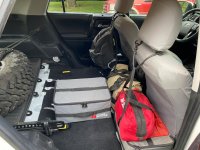
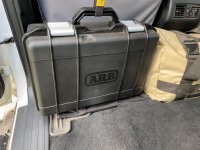
- It's the same compressor, just in a plastic box with the air tank and accessories. The portable 'package' weighs more because of the air tank, but I can put the whole thing where it suits my use better.

- Good question. My 4Runner is a dedicated wheeler. I don't have rear seats so no legs back there--but plenty of gear space.
(Pic - The portable compressor is under the backpack, behind the driver seat. The Front Runner box in the middle isn't usually there)

- Another good question, but honestly I don't know or care. There is so much discussion about how fast some product airs down or how fast another airs up. So what?! I've never been on a trail ride with a group and someone caught heat because they were the last to air down or up. It's just internet noise.

Hope this helps.
 

Attachments

  • Storage.jpg
    Storage.jpg
    135.5 KB · Views: 1,733
Last edited:
Seems to work fine on my stock size tires. Takes probably around 60-90 seconds to air up from ~23-32 PSI for each tire. I haven't actually timed it but it doesn't take forever for sure. And for $65 it works for me.

Ya if you’re stock size then it’s fine. That’s also only 9psi it needs to air up. I have a little electric Kobalt compressor in my garage that can probably do 9psi in 2 minutes. If you go up in tire size you’ll likely need a bigger one.

I’m around 90 seconds to go from 18-40 but that’s the big Smitty 8721 at 5.65 cfm
 
-
- Another good question, but honestly I don't know or care. There is so much discussion about how fast some product airs down or how fast another airs up. So what?! I've never been on a trail ride with a group and someone caught heat because they were the last to air down or up. It's just internet noise.

Hope this helps.

Kinda depends on what you're doing. It wasn't that long ago that the only available 12v compressors were more like this:
81ORMdhzNDL._AC_SL1500_.jpg


It was kind of a big deal if you wanted to run big tires - especially the bigger 38's and 40+ inch sizes - to have a faster compressor. The same would be true now if you wanted to use an ARB CKSA12 to fill tires, you'd be there for maybe an hour? or more. The difference between 5 minutes and 8 minutes? Not really meaningful to me. If it weren't for those old really slow units - things like the powertank wouldn't exist.

The other benefit to high volume is re-seating a bead. It's not always easy to get it to seal well enough. High air flow from the compressor really helps. And again - there was a time not that long ago that beadlocks meant re-centered H1's with big PVC pipe slices. Now they're a dime a dozen.

I think that's why the speed is still a relevant consideration. Among the good compressors it's probably not a big deal. They're all fast enough.
 
Another good question, but honestly I don't know or care. There is so much discussion about how fast some product airs down or how fast another airs up. So what?! I've never been on a trail ride with a group and someone caught heat because they were the last to air down or up. It's just internet noise.

If you're talking about another ARB compressor you keep in a box that hooks up to the battery with jumper cables, that's one thing. But if you're talking about some Amazon air pump, that's another. Which is it?

The Smittybilt 2781, which was recommended in this thread, has a max airflow of 72 L/m. The ARB dual is 174 L/m. On paper, that's a big difference. No idea what that is in practice though. But 90 seconds per tire vs 5 minutes is a big deal for me when I'm getting eaten alive by mosquitos or it's pouring.
 
To air down I use the ARB E-Z Deflator $42:
s-l1000.jpg


I run Milwaukee tools at home and use the M12 compact inflator ($75) w/ a 6.0 battery to top off my cars + airing up from 15psi to 36psi. Not as fast as the $$$ compressors but it works for me. Set it and forget it.
s-l1000.jpg
 
If you're talking about another ARB compressor you keep in a box that hooks up to the battery with jumper cables, that's one thing. But if you're talking about some Amazon air pump, that's another. Which is it?

The Smittybilt 2781, which was recommended in this thread, has a max airflow of 72 L/m. The ARB dual is 174 L/m. On paper, that's a big difference. No idea what that is in practice though. But 90 seconds per tire vs 5 minutes is a big deal for me when I'm getting eaten alive by mosquitos or it's pouring.

:lmao:
 

Attachments

  • IMG_0429.jpg
    IMG_0429.jpg
    137.8 KB · Views: 1,661
But 90 seconds per tire vs 5 minutes is a big deal for me when I'm getting eaten alive by mosquitos or it's pouring.

Get a Coilhose Pneumatics CH15 Closed Lock-On Chuck for the end of your air hose - it locks on to the valve stem like a quick connect air fitting. If you've timed how long it takes to air up, you can hop back in the cab for that long before checking pressure and moving on to the next tire.
 
I missed this earlier, else I would have commented. I have a set of these, maybe I got a bad batch. The first time I used them I set them to 25lbs, installed them, they didn't shut off until between 10 and 15lbs all four! None were accurate, at all a couple pounds sure but 10 or more? I tried these a few times, same issues they don't stop deflating when they were "supposed to". Took them apart, cleaned, assembled, tried again, still issues. These are nicely made, doesn't really matter if they don't work, sadly at this point it was a waste of $100.

Have you checked your pressures after you used these? Were they accurate?

Hi jrandom! We are sorry to hear about the issue you are experiencing. Has someone from J.T. Brooks provided you with assistance? If not I would be more than happy to help.

Based on your description, it appears the desired PSI is set to the top of the lock ring, as opposed to the top of the body. This would account for the 10 PSI variance. Would you be able to confirm this is the case? Happy to assist further if you send us an email at [email protected].

Thank you!
 
I know most of us on here either have Viair, ARB or Smittybilt. I personally have the Viair 400p, but told myself if it ever stopped working, I would get the ARB Dual for faster air up. That was until I discovered a cheaper and faster alternative. I see that Summit has a 300lpm compressor for around $175, but it doesn't seem like a lot of people use them.

On paper, the Summit has nearly double lpm and half the cost. Has anybody here had experience with the Summit one?

Summit Dual Air Compressor - Summit Off-Road Wheels
 
Hi jrandom! We are sorry to hear about the issue you are experiencing. Has someone from J.T. Brooks provided you with assistance? If not I would be more than happy to help.

Based on your description, it appears the desired PSI is set to the top of the lock ring, as opposed to the top of the body. This would account for the 10 PSI variance. Would you be able to confirm this is the case? Happy to assist further if you send us an email at [email protected].

Thank you!

Sorry, I forgot to edit my original post. Yes, you guys were super fast to respond and explained exactly the issue! They work great and have been very happy with them ever since!
 
I just picked up the Viair 450P and love it. I use the Staun deflators and like those also. The deflators get mixed reviews on Amazon but so far I like them. I’ve used them 3 times on the trail and a few of my buddies use have them. They weren’t preset to 18psi from the factory like stated but it didn’t take me long to get them to within a .5 psi of each other. I haven’t timed the fill time but it’s quick. I can fill my tires from 15 to 32 psi in one duty cycle. You could probably do more but by then the compressor is pretty warm so I like to let it cool down on between trucks.
 
Looking for a good deflator w/ pre-set PSI shut-off

It seems that the VIAIR 300P is good option for portable compressors. Are there any good suggestions for a deflator that has an option to set a specific PSI to shut off at?
 

Members online

Forum statistics

Threads
278,316
Messages
3,554,122
Members
248,016
Latest member
Advally Service

Trending content

Back
Top