Recovery Gear Options

Thanks [MENTION=118321]Jetboy[/MENTION],


A friend of mine pulls with his hitch and a pin this way.


I'm going to work on getting a 2nd recovery point just like the one that's there already on the left corner of the frame, installed in the back where the threaded holes already exist. I'll see if I can get the part from Toyota and then have the tailpipe moved to behind the wheel. It may all cost less than one of these hitch blocks. Then using a bridle and snatch block I'll have an equalized pull from two corners of the frame.


You could probably get a used one from someone here who installed an aftermarket rear bumper and took that part off. I'd be willing to bet it's the same part on FJ Cruisers and possibly 4th generation 4Runners too. I've got one in my toolbox that I'm pretty sure came from an FJC and it looks identical to the one already on the back of the 4Runner. I've been meaning to do the same thing as you but I haven't looked for an exhaust shop to move the pipe.

FYI, TJM also makes a hitch-mounted recovery point and it can be mounted with the shackle in either orientation. I have one and it's a nice piece.

The bridle certainly isn't a bad idea but probably overkill for most situations. If you're that badly stuck you'll probably need more than the hand winch to get you going again.
 
Last edited:
Right, but what difference does the orientation of the shackle make? All recoveries should be as straight as possible or risk becoming a YouTube sensation...

I'd be more worried about destroying the integrity of the Hitchlink.
you typically wont get to choose in which orientation you get stuck. often its NOT a direct line pull to get out.

Thanks @Jetboy,

A friend of mine pulls with his hitch and a pin this way.

I'm going to work on getting a 2nd recovery point just like the one that's there already on the left corner of the frame, installed in the back where the threaded holes already exist. I'll see if I can get the part from Toyota and then have the tailpipe moved to behind the wheel. It may all cost less than one of these hitch blocks. Then using a bridle and snatch block I'll have an equalized pull from two corners of the frame.
is you are using the OEM recovery points, that's probably not a bad idea.

but for a quality aftermarket attachment, its unnecessary. though, it is nice to have multiple connection points to give you some options. ive yet to see a time I needed to hook to BOTH at the same time due to strength requirements.
 
Rear recovery points

you typically wont get to choose in which orientation you get stuck. often its NOT a direct line pull to get out.


is you are using the OEM recovery points, that's probably not a bad idea.

but for a quality aftermarket attachment, its unnecessary. though, it is nice to have multiple connection points to give you some options. ive yet to see a time I needed to hook to BOTH at the same time due to strength requirements.

Thanks [MENTION=84120]nevada[/MENTION] and [MENTION=105875]96r50[/MENTION],

I think the best reason for having two recovery points in the rear, on each corner of the frame, is to provide a balanced, straight pull from both corners so you can try to pull the stuck truck (yours) in a straight line in reverse. When being pulled from one corner the truck will tend to pull at an angle. Of course, turning the wheels may compensate for this.

Many years ago I was being pulled in reverse to get a truck out of a barn and the steering wheel spun, smashing my thumb. I was 14 at the time and maybe it was my fault for not holding onto the wheel with a better grip but the old pickup truck tried to turn with the direction of pull.

Using both recovery points may eliminate the need for bringing that 6 to 7 pound ingot of steel to fit the hitch, along with the cost of the item. The recovery point is there and can be hooked up with a D-ring shackle whenever it's needed. Pulling sideways is a cinch too, pun intended. As some have said above, you can't always pull in a straight line behind the vehicle.
 
What are some good options for recovery points for those of us with stock front bumpers. I have used the stock points before but am a little worried that they can't handle the stress of a stuck vehicle.
 
What are some good options for recovery points for those of us with stock front bumpers. I have used the stock points before but am a little worried that they can't handle the stress of a stuck vehicle.

If you can break the stock recovery loops, you'll be the first.
 
The D-ring becomes a projectile if anything else in the rigging line fails. If you use it between two straps, a very simple example, and one of the two straps fails, it goes flying as the other strap recoils. All the videos on how to rig say not to use a D-ring out in the rigging line. It can be used on the car or on a tree saver.
you've mentioned this several times now. in theory, you are correct. but in reality, if you are being smart, and using quality gear, its highly unlikely.

the same issue applies to winching. if the other end of the strap fails, you will have the same problem.


I have done a LOT of off road extractions. many that would probably make most of the people on this site cringe. some of it was because I was young and dumb and in experienced. some of it, because that is what the situation required. it was the BEST option for what we had available. other than a few broken chains/straps/cables nobody was ever hurt.
"but did you die?!"
we did have a chain break, and the hook flew back and smashed into a windshield. that's the closest we ever got to something "bad" happening.

if you cant reach a recovery point with your winch, but you have several straps, enough that would get you there, then that is what you do. assuming all the hardware is up to the task, as well as the anchors, you wont have any problems.
 
Shackles as projectiles

you've mentioned this several times now. in theory, you are correct. but in reality, if you are being smart, and using quality gear, its highly unlikely.

the same issue applies to winching. if the other end of the strap fails, you will have the same problem.

... it was the BEST option for what we had available...
"but did you die?!"
we did have a chain break, and the hook flew back and smashed into a windshield. that's the closest we ever got to something "bad" happening. ...

Hi [MENTION=84120]nevada[/MENTION],

I'll let others comment on your post. I'm trying to learn from everyone here. You have more experience with extractions than I do but there are many more people here who know what you're talking about. As for using shackles out in the middle of a recovery line, all of the videos I've seen say not to do it.

I think a winch cable has very little stretch to it under load so it's not going to recoil if something fails. If the tree saver strap, a kinetic recovery rope or a snatch strap or anything else fails beyond the end of the winch line that part may have some recoil. With a rope it has less mass than a cable and shackle and it won't go far before the weight of the winch cable slows it down.

A chain has more mass but it has very little elongation under load so it's not going to recoil very far in a static pull. As [MENTION=96008]Engineer[/MENTION]1 pointed out, if you're yanking on a chain it can recoil, but that would not be the way most people use a chain. Common sense would tell you to slowly take up any slack before applying a static load.

I can't imagine how you got a chain to snap back into a windshield but if it had hit a person in the head they'd be seriously hurt. It's "highly unlikely", as you say, but you only need one bad accident to ruin your life. Head injuries are life-changing events. :crazy:

The BEST solution is to have a variety of gear with you that you can employ to rig a safe pull. I've added two soft shackles to my gear. I'll be looking at a way to dampen rigging lines at multiple points. I see the damping blankets from ARB etc but I hope to use something that has other uses, like a blanket, tarp, or something heavy, soft and bulky.

Thanks for your reply. I'm learning from everyone here. :car:
 
I think a winch cable has very little stretch to it under load so it's not going to recoil if something fails. If the tree saver strap, a kinetic recovery rope or a snatch strap or anything else fails beyond the end of the winch line that part may have some recoil. With a rope it has less mass than a cable and shackle and it won't go far before the weight of the winch cable slows it down.
winch cables stretch a LOT, that is a big reason for the move over to synthetic winch rope.
when there is a failure when rigging with a winch cable, it becomes a deadly whip. with the rope, there is very little stretch, so it basically just falls to the ground. note, there is still SOME stretch, but nothing remotely close to cable.


they do make nice cable weights, specifically for winching. we usually just use a heavy coat, or a spare strap or 2 to weight the line.


also, there will be some type of connection device on the end of the winch cable/rope. im pretty sure that my Pro-link and 3/4" shackle weigh as much as the entire length of 125' or rope, if not more. if that disconnects for some reason, it is going to fly until it hits the end of the rope...


so, what would YOU do? if you're stuck, and the winch cable wont quite reach an anchor. but you have multiple straps and D rings that WOULD make up the difference? would you just stay stuck? or would you use what you have to extract yourself?

I am sincerely asking. I know what I would, and have done. im curious what you would actually do given that situation.


im in no way trying to argue, this is just something im fairly passionate about, and i enjoy the conversation. :D
 
Stress/strain, winch lines stretch

winch cables stretch a LOT, that is a big reason for the move over to synthetic winch rope. ...
...

so, what would YOU do? if you're stuck, and the winch cable wont quite reach an anchor. but you have multiple straps and D rings that WOULD make up the difference? would you just stay stuck? or would you use what you have to extract yourself? ... :D

Hi Nevada,
Thanks for the reply. I'm really glad to see this thread garner so many useful responses. I really need to know and this gear is expensive.

I had no idea a cable stretches under load. That makes a big difference. And there is always a shackle, hook or link at the end of the winch that adds weight to the rigging line. Now I see the advantage of the rope lines on a winch.

For the cable damper, I saw one knucklehead in a recovery video using his child's car seat hung over the cable. In the video it slowly rocked back and forth and then fell off. :brick:

What would I do? I have no plans to get a winch at this time. I'd have to alter the bumper, replace it with a steel off-road bumper or add a front hitch and winch plate, all of which are expensive and alter the look of the T4R. Add to that the cost of a winch and you're spending right around $2000. We just don't have a lot of times we need them in the southwest. Maybe for rock crawling in Moab but there's much less need in the So Cal desert.

For the occasional times we need to self-recover from being stuck, I plan to buy a quality come-along winch with synthetic rope like the Wyeth-Scott or American Power Pull. It's got a shorter pull length and is a lot slower than a winch but it will work in a pinch.
https://www.wyeth-scott.com/index.asp

For most cases, a pull from another vehicle is the quickest and easiest. For that we've got a snatch strap. D-ring shackles would secure the strap ends to the vehicles at each end. If you need to double the length with two straps they can be fed through each other without using any shackles. Be sure to put something between the loops, like a rolled up magazine, so you can get the two straps apart later. They could be joined by soft shackles. I think those open up to wrap around things. I see Southeast Overland makes a 1/2" rope soft shackle with tons of capacity. It's huge and beefy. Most of them are 7/16" rope.

That's all I know. I am going to get the gear I just ordered (listed above) and practice a few scenarios with my 4 wheeling friends. :confused:

Thanks again for your feedback.
Dave
 
2nd Recovery point in rear

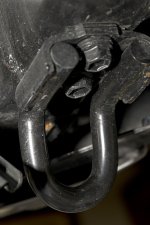
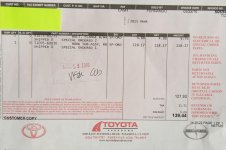
Well, after a long delay due to work and life, I bought and installed a 2nd recovery point for the right rear corner. The same loop we have on the left rear corner also fits two pre-existing threaded holes on the right rear frame. I bought the loop from Toyota but have since found out from someone here that it can be purchased for a about half what I paid ($139) from an independent parts supplier.

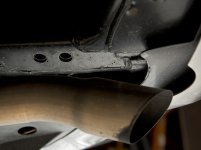
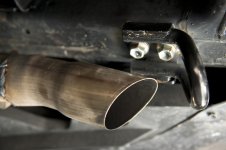
The exhaust tailpipe has to be moved to install the loop. I had my favorite local muffler shop shorten the tailpipe ($40). I really wanted it turned to exit out the side behind the tire and mudflap. I think my muffler shop guy, Kirk has been having a bad year and wanted to install it shorter instead. He's been having pain in his left arm that's sapping his strength due to a pinched nerve that won't go away and the doctors can't fix. He didn't have the patience to tell me what it would take to keep the tailpipe in stainless steel and exit out the side. Oh well. I may have it redone but it works for now (see photos).

Here are a few photos of the recovery loop and muffler tailpipe. (is that redundant?) I'll post a few more in the next post.

Tomorrow I'll post photos of the recovery gear I've collected since I started this thread.

Photo captions:
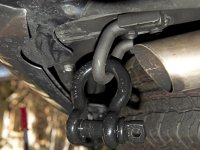
The left rear original corner recovery loop
The original exhaust tailpipe location & right rear frame with threaded bolt holes
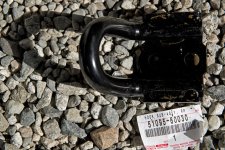
The recovery loop part & part number
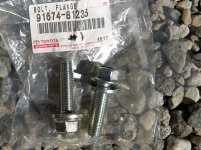
The recovery loop anchor bolts & part number
The invoice for the parts, with part numbers and price
 

Attachments

  • Recovery7198.jpg
    Recovery7198.jpg
    127.4 KB · Views: 2,530
  • Recovery7518.jpg
    Recovery7518.jpg
    100.4 KB · Views: 2,170
  • Recovery7531.jpg
    Recovery7531.jpg
    151.5 KB · Views: 2,184
  • Recovery7529.jpg
    Recovery7529.jpg
    143.2 KB · Views: 2,225
  • Recovery7533.jpg
    Recovery7533.jpg
    137.8 KB · Views: 2,162
Last edited:
Recovery gear

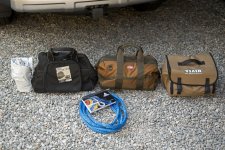
Here's a teaser for the recovery gear I purchased in the stow bags. I'll show what's inside tomorrow.
Mystery quiz. What's inside the white plastic bag on the left? It's just a shipping bag I got something in to illustrate the point that we can
Reduce, Recycle and Reuse

The 2nd photo below shows the finished location for the new recovery loop and the shortened tailpipe. The 3rd photo shows the hook with a thick coat of Rustoleum paint to the loop and surrounding frame. It shows the loop with a shackle in place, oriented so it can rotate towards the rear when it gets pulled. I don't leave it there. I'd attach it when I need it.
 

Attachments

  • Recovery7541.jpg
    Recovery7541.jpg
    151.3 KB · Views: 2,286
  • Recovery7538.jpg
    Recovery7538.jpg
    119.2 KB · Views: 2,204
  • Recovery7554.jpg
    Recovery7554.jpg
    131 KB · Views: 2,662
Last edited:
Recovery gear

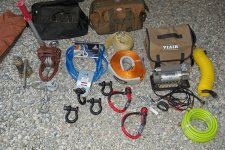
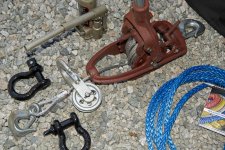
Here's what's inside the gear bags shown in the post above. Those tool bags work well to keep the gear organized and contained.
The Mystery plastic bag held the bottle jack. I got another cheap tool bag to fit it today. There's the cylinder jack beside the come-along.

So there's all the gear laid out together.

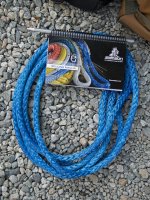
The blue rope is Samson Amsteel Blue 1/2" diameter 12 strand single braid rope with a breaking strength of about 34,000 lbs. and a minimum strength of 30,600 lbs. ¿Who knows what the factor of safety should be and what the working strength should be? Everyone that uses this rope in various sizes rates it at the lesser value, w/o a F of S reduction.
The book is a Samson splicing manual. The aluminum tube fid is inside the spiral binding. The book has good illustrations and methods for making a simple tapered eye splice, or looped end. Another good book is "The Splicing Handbook" by Barbara Merry and John Darwin, which shows a more complex but possibly stronger woven eye splice. Both books are available from Amazon.
I plan to make a 1/2" diameter bridle for pulling from two recovery points on the front or back. Using a snatch block that can handle 1/2" line I'll be able to equalize the load to both points.
Southeast Overland makes a bridle out of 3/8" diameter rope of the same type. I hope to have one that's much stronger for less cost by making it myself. S.O. also makes a 1/2" diameter soft shackle using a crown knot. I hope to figure out how to tie that knot and make one myself.

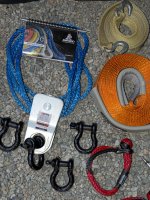
There's a photo of the blue rope through the large Snatch block with a shackle in place where you'd tie of a snatch strap or tow strap. 4 of the 3/4" D-ring shackles and two of the Gaitor 7/16" soft shackles. The ARB 2"x30' snatch strap and a strap with hooks that I've had for a dozen years or more. Steel hooks on straps are dangerous but I can use this as a tree saver with a couple of wraps around or around a big desert rock with a full wrap around the rock. Maybe by tying the hooks together it would slow down the flying hooks if one side of the wrap around fails.

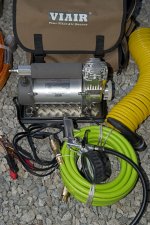
I chose the Viair 400P Automatic compressor. Then when I saw the cheap yellow coil tube that all of these compressors come with I went out and bought a 3/8" x 25' air hose and QR new couplings for under $20. It's a lot easier to use and lays flat when uncoiled. There are plugs in the ends to keep the dirt out. I had the parts so what the heck.

There's the American Power Pull come-along winch with cable. I may replace that cable with an Amsteel Blue rope to reduce the risk of recoil if something fails. The Wyeth-Scott is another brand that's almost identical. I won't use this very often here in So Cal. It's a lot slower and harder to use than a winch and the length is limited to about 18 feet, but it's a lot cheaper ($150) than a new bumper and good Warn winch ($2000?).

On my list is 2 or 3 inexpensive tow straps to lengthen the line for a self recovery when the anchor point is more than 30 feet away or multiple anchors are needed. I think they can be looped together by feeding the loop ends over each other to form a longer line.

I still haven't figured out how to add these captions between the photos... :doh:
 

Attachments

  • Recovery7545.jpg
    Recovery7545.jpg
    150.7 KB · Views: 2,110
  • Recovery7543.jpg
    Recovery7543.jpg
    152.3 KB · Views: 2,088
  • Recovery7547.jpg
    Recovery7547.jpg
    148 KB · Views: 2,080
  • Recovery7548.jpg
    Recovery7548.jpg
    147 KB · Views: 2,070
  • Recovery7555.jpg
    Recovery7555.jpg
    152.9 KB · Views: 2,158
Strap with hooks

I'd throw out that strap with the two hooks on it

[MENTION=113833]e60ral[/MENTION] Yes, the strap is dangerous. Please read what I said in my post above and tell me what you think of using it that way.

I do plan to replace it with a tow strap or winch extension line, but I'll keep it for tough to reach anchor points. In the dry So Cal desert sometimes the only thing you have to grab onto for a self-recovery is a couple of big boulders.
 
There's nothing wrong with hooks - if used correctly. If they bother you - cut them off and add a couple soft shackles.

Also - FWIW I think I've said this before, but soft shackles are super easy to make yourself for a few dollars worth of dyneema SK75. I don't carry them for vehicle recovery, but I do use them on my sailboat regularly. If I needed one in the field really badly, I'd cut a foot off my winch rope and make one. Lots of youtube videos on how to do it. They work for some stuff, but not very well for sharp corners.

The only item I find that I sometimes wish I had more of is a snatch block. I carry one. There are times when 2 or more of them would be useful. I've been thinking about making up one or two of these as alternatives to having a bunch of heavy snatch blocks. They're low friction rings and work much like a block. I have a few small size ones and they're great for low cost and light weight alternative to blocks. Anyway just something many people might not know even exist. A 14,000lb version is about $30-40.

11859543.jpg
 
Last edited:
All I've ever needed:

Recovery_zpsdurflghv.jpg~original


Been carrying and using these for about 15 years now. Also a shovel, axe and limb lopper for when I'm in trees (not very often).

Almost 100% of recoveries are in sand around here - two trucks a must have.
 
Recovery loop

All I've ever needed:

Been carrying and using these for about 15 years now. Also a shovel, axe and limb lopper for when I'm in trees (not very often).

Almost 100% of recoveries are in sand around here - two trucks a must have.

Ron,
I like your system, Simple and compact. I'll be half way to Las Vegas this weekend. meet me and I'll show you some interesting terrain. I could use a 2nd vehicle for recovery. :-) :p

[MENTION=118321]Jetboy[/MENTION]

That rope ring loop looks great. Where do you find them? What are they called? :rapture:

Yes, snatch blocks are heavy and bulky to carry.

I saw one video about using a winch and 3 snatch blocks to pull a vehicle backwards using the front winch. I was amazed how well it worked once he got it rigged right. His initial attempt did not work because his shackles had too much resistance to allow the winch cable to slide through.

My source for the Samson Amsteel Blue Dyneema SK75 rope is a marine supply store in Bellingham, WA; LFS Marine and Outdoor. I was actually in the store last September when my Brother in law was looking for something for their sail boat. They live in Bellingham.
 
I'd throw out that strap with the two hooks on it

Thanks [MENTION=113833]e60ral[/MENTION]

I'm planning to acquire several beefy tow straps with fabric ends to replace the strap with hooks. Until I do I will carry the strap with hooks and use it very carefully as an anchor point, wrapping around whatever I use and tying off the hooks with a 2nd line. I've always been extremely careful when using that strap. :rain:

Thanks for your feedback. Most people would agree with you. :smash:
 
One thing I would be concerned about is it's rating, I'm only familiar with straps like that from off-brand companies (kind of strap you would buy at wal-mart or pep-boys) so I wouldn't fully trust their rating. Does it have a rating tag sewn onto it?
 

Members online

Forum statistics

Threads
278,316
Messages
3,554,105
Members
248,016
Latest member
Advally Service

Trending content

Back
Top