
Removing exhaust cam shaft of a 3rz-fe questions

Pyral

Member
I chipped the valve lifter while doing my shim adjustments. I am considering replacing the valve lifter but to do so I have to remove the cam shaft on the exhaust side. I'll post a photo of the damage later.

I was reading the FSM for how to do that and Toyota's wording is a bit strange.

The first question I have is what does Toyota mean when they say "since the thrust clearance of the camshaft is small, the camshaft must be kept level while it is being removed."

By kept level do they mean that I should remove the bolts uniformly a little at a time (in the order given in the FSM) so that no part of the camshaft is being held down more? Or is there something else that I have to do to keep the camshaft level?

Is the service bolt enough to eliminate torsional spring force on the sub gear?


When I remove the exhaust cam shaft should I have it in TDC with the 1:2 dots aligned on the timing gears?

Will removing the exhaust camshaft change the: thrust clearance, camshaft oil journal clearance, valve clearance on other cylinders, or the backlash of the exhaust and intake timing gears?

My last question is will I have to fight the engine valve spring (the same spring that keeps the shim against the camshaft) as I put the camshaft back in?
 
Register to hide this ad
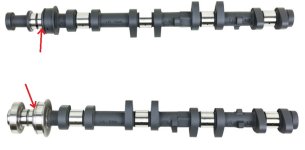
This is how I interpret the issue. In the picture below I've pointed to a thin flange on each camshaft. This flange has a bearing adjacent to it, the idea of the flange being to limit the camshaft's lateral motion.

That bearing cap is aluminum, and the flange is very thin. Any tilting of the camshaft while it is being removed puts a strain on the flange and the cap, possible breaking one or the other or both.

The strain would be worse if the springs exerting the force were at the far end, cylinder #4. More leverage.

So, for removal the cam is positioned (read the FSM's directions on aligning dots on the sprockets) to exert the least amount of pressure, ie the most valves fully closed. And those valves that are open to whatever degree are in the center of the camshaft, ie cylinder 2 or 3.

Everyone has seen a magician levitating his assistant as she lies, supine on his table. Imagine that's what you're doing as you loosen the bearing caps, and the lovely lady will die if she gets even one degree from absolutely level.

You don't want her blood on your hands.
 

Attachments

  • camshafts.JPG
    camshafts.JPG
    54.5 KB · Views: 2,051
Last edited:
Okay so it seems like the procedure for removing the exhaust cam shaft is this: (the following steps is not a how to, use the factory service manual if you plan on doing this)

1. Align the dots on the timing gear to get the engine to TDC and mark where the gears line up too
2. Put a service bolt in the sub gear to link it to the main gear of the exhaust cam shaft (you can use one of the valve cover bolts)
3. Loosen the 10 bolts that hold the bearing caps down gradually in the crossing pattern detailed in the FSM. Do this step very gradually to avoid causing uneven forces on the camshaft
4. Remove the 5 bearing caps carefully (because the bearing caps are replaced as a set with they cylinder head)

INSTALLATION
5. After applying grease to the thrust portion of the camshaft align the timing gear with the intake gear
6. Install the bearing caps in the correct orientation as before
7. Apply engine oil to the threads of the bearing cap holes
8. Tighten down the bearing caps gradually using the pattern listed in the FSM to listed torque spec
9. Remove service bolt

Special considerations when removing camshafts:
Many of the parts removed are unique to an engine. Most cast engines were a single piece of metal, the bearing caps are usually broken off after casting and have a unique mating surface. This not only means that the orientation of everything in the engine must be kept the same (for oil clearance), but it also means that mistreatment of something as small as a bearing cap can lead to a new cylinder head and a very expensive teardown. Toyota doesn't sell replacement bearing caps, this is not something you can swap out from another engine and expect it to work the same.

Keeping the tolerances is important, approximating a torque spec can get you in trouble real fast. Using a torque wrench is required if you hope for the engine to work. All the parts of a camshaft have a clearance that must be kept within range to allow oil in while keeping vibration down.

Clean everything as you put it back together, contamination of surfaces has harsher consequences than usual.
 
Take a paint pen and number your camshaft bearing caps. Mark a direction arrow as well. Take a picture of it before you remove them.
 
SSdY6lv.jpg

Yes I know my spark plug tube is misshapen
JHqQyAK.jpg


What should I do about the slight indentations on the cam lobe from running into the shim bucket?

Previous posts on the Tacoma forums say smooth off with an emery cloth. Should I do that?
 
Last edited:
By lifter you mean shim bucket? Is the chip going to affect the cam in any way? I wouldn't touch those cam chips personally, can try running your finger over them but most likely they're concave. Sanding creates a burr next to every trough created by the aluminum oxide particles, and you'll inevitably wind up with small pieces of ao lodged in the shaft that will then rattle around your engine for a while. Probably wouldn't make a noticeable difference in wear either way, but more work for lesser product.
 
What should I do about the slight indentations on the cam lobe from running into the shim bucket?

Previous posts on the Tacoma forums say smooth off with an emery cloth. Should I do that?

I also agree with the above, I would leave it alone. If it needs to, it will smooth over time with the engine oil acting as a lubricant to keep it from chipping. The camshaft lobes are extremely hard - I doubt you'd even be able to smooth the edge down at all.

I think you figured out the rest of your questions. You'll find that if you follow the FSM, you'll see that when you remove it none of the lobes will be compressing and of the valve springs. If they are, just rotate the engine a tiny bit to get them off. Once the camshaft is off, don't rotate the engine at all and you'll be able to drop it back into place just as it was. I also recommend putting paint marks on the gears where they line up FACING YOU (only bonehead Toyota mistake on these) so putting it back in isn't an ordeal trying to get those dots matched up. Maybe this is less of a headache on the 3RZ than the 5VZ.

Remove the cam brackets in a pattern similar to the head bolts. Outside most brackets first but only a few turns at first. Then, working your way to the center, slightly loosen all bolts. Then start again at the outside most bolts and do it again. Do this until they are loose enough to turn by hand and remove them all. When you install, you'll start with the center cam bracket and work outwards. What you want to avoid is completely tightening a bracket and then having one side fully seated and the other side bending upwards - it could break.

Last question, yes the service bolt is enough to hold the gear in place. I found that a valve cover or ignition coil 10mm bolt works perfect to hold it in place. That way you'll know for sure if you removed the bolt as you'll be short one when you put it all back together if you forget.
 
If you don’t install the service bolt you will have a valve clatter that will have you thinking your valves are loose.


Sent from my iPhone using Tapatalk
 
I successfully removed the cam shaft. It is extremely unnerving because the slightest discrepancy in how much you've unscrewed each of the bearing cap bolts can mean the difference between being able to remove the camshaft or not.

My first attempt I let out the front bearing caps too much, so I was unable to remove the rear bearing caps. I screwed down the center bearing cap and the front bearing cap, and with some persuasion I was able to remove the rear bearing cap with my fingers. I was extremely careful, didn't use any prying tools. I'm so glad nothing went snap.

I had one snag. I used the valve cover bolt for my service bolt, but the end of the bolt is too thick and it blocks be from being able to spin off the front bearing cap. The service bolt is all the way torqued down, and I want to remove the front bearing cap so I can clean the bearing surface when I put it back together. Any suggestions?
 
I successfully removed the cam shaft. It is extremely unnerving because the slightest discrepancy in how much you've unscrewed each of the bearing cap bolts can mean the difference between being able to remove the camshaft or not.

My first attempt I let out the front bearing caps too much, so I was unable to remove the rear bearing caps. I screwed down the center bearing cap and the front bearing cap, and with some persuasion I was able to remove the rear bearing cap with my fingers. I was extremely careful, didn't use any prying tools. I'm so glad nothing went snap.

I had one snag. I used the valve cover bolt for my service bolt, but the end of the bolt is too thick and it blocks be from being able to spin off the front bearing cap. The service bolt is all the way torqued down, and I want to remove the front bearing cap so I can clean the bearing surface when I put it back together. Any suggestions?

I keep mine half way torqued and it fits in between the oil gap in the head and the spark plug tube so I can even rotate the engine over with the bolt in and it doesn't hit anything. 3RZ might be a bit different but it doesn't have to be threaded all the way so the head of the bolt is touching the gear, if that makes sense at all.
 
How necessary is it for me to check the camshaft bearing clearance?

I have plastigauge, but if I am using a torque wrench to crank down the bolts should I worry about the oil clearance between the bearing caps and the bearings changing?
 
How necessary is it for me to check the camshaft bearing clearance?

I have plastigauge, but if I am using a torque wrench to crank down the bolts should I worry about the oil clearance between the bearing caps and the bearings changing?

No need to check clearance. If you follow the procedure and pattern for removing the bolts and tightening, the clearance will be unchanged from before.
 
If you don’t line the cams up before removal, the valve spring tension will cause the cam bearing bolts to rip the threads out of the head.


Sent from my iPhone using Tapatalk
 

Members online

Forum statistics

Threads
278,315
Messages
3,554,124
Members
248,016
Latest member
Advally Service

Trending content

Back
Top