Rocks & Flops: a 1-Ton SAS Build

Team_Jake

Member
Hey there boys and girls! Have you ever had the desire to turn your 3rd gen 4Runner from something that's respectable, desirable, high value, a decent off-roader, and a great family vehicle, into something that's not? Then this is the thread for you.

This build, which I'm dubbing "Rocks & Flops", will document the process of taking nearly everything Toyota masterfully engineered, throwing it out the window, and building a completely custom front and rear suspension using one ton axles on a truck never meant for it. Sit back and enjoy the show!
 
Register to hide this ad
This truck is a model year 1999 with Limited Trim and a factory E-Locker. This is how it looked shortly after I purchased it, honestly looking back on it now I feel pretty bad for cutting up such a nice 4Runner.

img_1359-jpg.1051568


I wanted a capable crawler I could take my family in and do so in comfort. This rig could do the "comfort" and "family" part just fine, but it needed a little help with the "capable crawler" part. I started by getting rid of everything related to the independent suspension. Using a Sawzall, I cut the frame just behind the mount for the LCAs/crossmember (above the steering rack).

img_7635-jpg.1051569

img_7637-jpg.1051570
 
The new frame is made from 2"x3" rectangular tubing (3/16" wall). Getting as much up-travel as possible will be a constant theme of this build - the frame kinks up high to clear the axle and to give room for the panhard bar, drag link, and tie rod.
img_7666-jpg.1051571


I picked up an IFS steering box from a local junkyard (from a 1994 4x4 4Runner). The box will be straight up and down (as opposed to angled like the 1st gens/mini-trucks), and pushed as far forward as possible without interfering with the body mount. This is so I can get the drag link as far forward as possible (to provide enough room for the panhard bar). The sleeves for the steering box are made from 0.75" OD x 0.12" wall DOM, and the steering box mounting holes were drilled out to accept 1/2" grade 8 hardware.
img_7674-jpg.1051573

img_7675-jpg.1051572


I then added fish plates (3/16" steel) and cut the body mounts off the old frame to weld onto the new frame.
img_7851-jpg.1051574

img_7869-jpg.1051575

img_7929-jpg.1051576
 
Last edited:
To tie it into the rest of the frame, I notched it and made pie cuts (to narrow the frame to 2"), then capped it.
img_7829-jpg.1051589

img_7836-jpg.1051590


Then I lined up the new frame and welded it, then I added 3/16" thick fish plates (both on the outside and inside of the frame rails) to make it permanent.
img_7960-jpg.1051591

img_7961-jpg.1051592

img_7962-jpg.1051593

img_7970-jpg.1051594
 
Hey there boys and girls! Have you ever had the desire to turn your 3rd gen 4Runner from something that's respectable, desirable, high value, a decent off-roader, and a great family vehicle, into something that's not? Then this is the thread for you.

This build, which I'm dubbing "Rocks & Flops", will document the process of taking nearly everything Toyota masterfully engineered, throwing it out the window, and building a completely custom front and rear suspension using one ton axles on a truck never meant for it. Sit back and enjoy the show!

:wow: This gonna be a fun one to follow

What geometry are you planning for the front and rear?
 
:hatsoff:

Front will be a 3-link + panhard, rear will be a triangulated 4-link.

Given any thought to front and rear double triangulated 4-link and move away from the panhard and steering box all together to get more articulation out of the front. How far do you plan to move the front axle forward.
 
Given any thought to front and rear double triangulated 4-link and move away from the panhard and steering box all together to get more articulation out of the front. How far do you plan to move the front axle forward.

I have given thought to that, but I will be staying with the 3-link front. There are a few issues with a double triangulated 4-link front:
  1. The exhaust is in the way of adding an upper-link to the passenger side, I could modify the exhaust, but I plan to drive this on the street and I plan to keep this rig smog legal.
  2. Because I will be driving it around on the street, I want to keep the steering mechanically connected (so no full hydro). I could go down the route of some of those crazy Ultra4 4500 class steering systems but that’s a rabbit hole I don’t want to go down :D
  3. The engine is in the way to triangulate the uppers, which means the lowers need to be triangulated more to compensate, which means the roll-center/oversteer numbers suffer, the 3-link numbers come out much better in comparison

The 3-link should have just as much articulation as a 4-link so I’m not worried about that. The articulation will be limited by the shocks (14” travel btw) and not the suspension geometry.

I’ll have to measure how far forward the axle will be, I’ll get back to you on that.
 
I have given thought to that, but I will be staying with the 3-link front. There are a few issues with a double triangulated 4-link front:
  1. The exhaust is in the way of adding an upper-link to the passenger side, I could modify the exhaust, but I plan to drive this on the street and I plan to keep this rig smog legal.
  2. Because I will be driving it around on the street, I want to keep the steering mechanically connected (so no full hydro). I could go down the route of some of those crazy Ultra4 4500 class steering systems but that’s a rabbit hole I don’t want to go down :D
  3. The engine is in the way to triangulate the uppers, which means the lowers need to be triangulated more to compensate, which means the roll-center/oversteer numbers suffer, the 3-link numbers come out much better in comparison

The 3-link should have just as much articulation as a 4-link so I’m not worried about that. The articulation will be limited by the shocks (14” travel btw) and not the suspension geometry.

I’ll have to measure how far forward the axle will be, I’ll get back to you on that.

Definitely a number of issues to work out but nothing you couldn't get through with ur skills, I have been very happy with the way my rig drives and handles on and off road after I went down said rabbit hole, but as you said a rabbit hole and a very deep one at that.

IMO you should really move away from the 3.4L and Toyota Tcases with all the weight you'll be adding to set up a capable off-road family vehicle but that just an opinion, my 3.4L really fell on it's face with the added weight I a different build and had to work through many different ways to keep the transmission cool (but I did get said worked out).

looking forwad to seeing your build come to life...
 
Definitely a number of issues to work out but nothing you couldn't get through with ur skills, I have been very happy with the way my rig drives and handles on and off road after I went down said rabbit hole, but as you said a rabbit hole and a very deep one at that.

IMO you should really move away from the 3.4L and Toyota Tcases with all the weight you'll be adding to set up a capable off-road family vehicle but that just an opinion, my 3.4L really fell on it's face with the added weight I a different build and had to work through many different ways to keep the transmission cool (but I did get said worked out).

looking forwad to seeing your build come to life...

The front axle will be pushed forward ~4”, and the rear axle will be pushed back ~2.5”, which will put the wheelbase at ~112”.

Have you done a SAS? I’ve talked with a few guys that have said similar things about 5VZ but they all have an automatic transmission. I have a manual which shouldn’t be as bad, it’ll still be a dog though on 40s.
 
The stock oil pan won't work in a SAS, so I picked up a rear sump oil pan and pickup tube from the local junkyard (from a 2WD 5VZ T100). The dip stick had to be cut just below the full mark to fit with the pan.
img_8007-jpg.1051595

img_8008-jpg.1051596
 
I replaced the old IFS pitman arm with one from Sky's Off Road (the 3/4" less drop version with a 3/4" bore for a heim joint, part number TOY-11142). I had to make a relief cut to the old pitman arm to get that sucker off (be sure to NOT go all the way through when making the cut!!).
img_8003-jpg.1051607

pitmanarms-png.1051609
 
For the motor mounts, in order to maximize up-travel, I needed the mount on the driver side to be as high as possible (to give room to the axle-side upper-link from the 3-link suspension). From the old motor mounts, I cut out the ends using a 2" hole saw and an angle grinder. I then welded in a DOM sleeve to be paired with a poly bushing from Barnes 4WD (part number B4WK1070-1, x2).
img_7681-jpg.1051633

img_7682-jpg.1051634

img_7683-jpg.1051635

img_7957-jpg.1051606
 
I picked up a set of Superduty axles from the local junkyard. They are both from the same truck, a 2004 F250 (Dana 60 front and Sterling 10.5 rear).
img_7029-jpg.1051613


I chose these axles (over built Toyota axles, or the popular 1-ton swap 2005+ Superduty axle / 14 bolt combo) for a few reasons:
  1. Scope - I’ve talked with a few people about their SAS 4Runners/Tacomas, many on built Toyota axles, who had wished they had gone 1-ton from the beginning. My thought on this is: If it’s worth doing, then it’s worth overdoing, I might as well overbuild it from the get go.
  2. Strength - These axles in stock form are just as strong as built Toyota axles, and have plenty of room to upgrade in case I need more strength.
  3. Price - These axles are cheap, I got both complete hub to hub (including brakes) for under $600.
  4. Width - On these axles, the front WMS-WMS measures 69.25" and rear measures 68.5", that is fairly wide for 4Runner standards, but also fairly narrow for 1-ton standards (they are not near as wide as the 05+ SD60 axles which are 3” wider). Paired with a set of wheels with decent backspacing I think the stance should be perfect.
  5. Prep - The 99-04 SD60 axles are much easier to prep than the 05+ SD60 axles (those castings on the 05+ axles are just stupid).
  6. Brakes - The Sterling 10.5 uses disc brakes and has an integrated e-brake.
  7. Bolt Pattern - Both axles are 8 x 170mm (no mismatched wheels or needing to buy 8 x 6.5" unit bearings)
  8. Lockers - Starting in 2011, Ford offered an e-locker on the Sterling 10.5, which is backwards compatible with all previous Sterling 10.5/10.25 carriers. Used E-lockers can be found for fairly cheap (I got mine for $325).
 
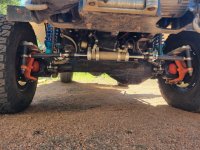
I have the Dana 60 shoved up an high as it can go before it interferes with the oil pan (no body lift and I’m not going to raise the engine) so I’m mocking up everything at full bump. Here I’m figuring out how the drag link, panhard bar, and tie rod (all are 1.5" OD x 0.25" wall DOM) are all gonna fit. I had to add slight bends to the panhard bar and drag link to clear the pumpkin, oil pan, and A/C tensioner pulley.
img_8115-jpg.1051614

img_8116-jpg.1051615

img_8117-jpg.1051616

img_8118-jpg.1051617
 
Last edited:
have you done a sas? I’ve talked with a few guys that have said similar things about 5vz but they all have an automatic transmission. I have a manual which shouldn’t be as bad, it’ll still be a dog though on 40s.

20250708_0941499.jpg
 

Attachments

  • 20250708_0941499.jpg
    20250708_0941499.jpg
    127.9 KB · Views: 1,148

Members online

Forum statistics

Threads
278,312
Messages
3,554,085
Members
248,016
Latest member
Advally Service

Trending content

Back
Top