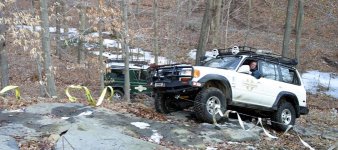
Rookie recovery gear recommendations?

I am sort of new to this. Did it as a kid in AZ but that was decades ago. Did it a few times as a young adult with now care towards recovery equipment (young dumb and superman).

Now a little older, a bit wiser (very possible less mature...LOL) this is what I put together. I pieced it.

Vehicle:
winch $550
2 d shackles (3/4") $17
tow hitch recovery shackle $23
snatch block $35
2 sets of gloves $35
spare battery winch control $2
winch control backup cable
4 xbull/boar offroad recovery boards $140

ordered:
tree saver
tow strap (30')
kinetic recovery rope (30')
line dampener (x2)


personal:
flash light $23

first aid kit:
band aids
asprin
emergency blanket
tourniquet
gloves
pressure bandage
trauma sheers
4 triangles


Yes last weekend actually had to use some of it to get some kids in a truck out of a ditch. They were a safety hazard to themselves and others on the trail with where they where stuck. To add to it, light was fading fast, and temps were dropping. 2 hour operation.

1/2 though a guy in a jeep pulls up, says I have a winch, but I don't know how to use it. learn how to use your equipment, practice it. so this guy in his jeep had a nice $1200 anchor on his bumper. Learn your equipment, practice with your equipment

*** always put safety first. You can do no good if you become a victim yourself. ***
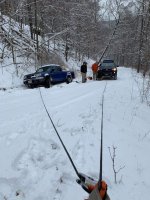
 

Attachments

  • FB_IMG_1547504401946.jpg
    FB_IMG_1547504401946.jpg
    139.5 KB · Views: 455
That said… wheeling alone, which I have done on a solo road trip, is pretty unnerving. You will change how you move across land, avoiding challenges and questionable obstacles will become a survival method. I didn’t drive over something complicated if I didn’t have to. If I was with friends, I would have been pushing myself and my truck.

To each their own, but driving solo is not exactly crazy. Maybe in Alaska?

We have been almost always solo. I have never driven an AZ trail with someone else, actually. And I did not get a satellite communicator (two-way) until two years ago (maybe three?).

Yes, it was unnerving at first, but ever since it has felt liberating. I don't depend on anyone or their schedules. I do whatever the kids and I want. My only wheeling buddies live in Moab. Which is of course convenient.

But yes, my SoP is to avoid any optional difficult stuff though I do not go off trail to bypass stuff either. We have driven 45-mile muddied Utah roads at the wrong time of the year but I have stopped doing that as it is pushing it. So we simply avoid the deep mud or snow and do not touch any clay surfaces in the rain. Avoiding mud and deep snow around here is easy. As for rocks, we are well armored. We drive trails rated difficult in the 4R, but nothing crazy.

When further off-pavement than we can walk in a day, we always carry water for several days, food for a few days, and warm clothing and/or sleeping bags. In those cases I also let a friend know where we are going and when we expect to be back. I do not stray off schedule when in remote areas for this reason.

Also, my vehicles are maintained as best as they can be, with preventive parts replacement when in doubt. Driving typically solo is a major reason why Jeeps have not been seriously on the table.

But driving a new/ish Toyota (or a Subaru in less challenging terrain) solo is not as crazy as doing that in old vehicles or in unreliable vehicles.

Having said that, maybe I will get in trouble on my next trip and you will find me mummified somewhere! But if I waited for company, I would have driven a fraction of the trails I have seen.

Of course trails from mid-range difficult up to extreme are another story. But while those are famous, they are few and many of them are only driven for the heck of it as they are easy hikes or offer average, if any scenery and are driven solely for the obstacles.

As for gear:
Two-way satellite commuicator
Viair 88P air compressor
Power unit/jump starter/secondary air compressor
Foldable shovel
ARB 17,600 snatch strap with two Bubba Rope soft shackles and two traditional rated shackles.
Rugged Ridge load distribution strap
Whatever tow strap.
TRED 1100
No name Ebay air jack (works). I threw away the exhaust hose and just use it with the air compressor.
All basic tools, plus all sorts of sockets, plus extensions (flexible, too).
Zip ties! Glue, various types of tape, Silicon tape! Used it to help another person we found with a burst hose.
Camping axe, hammers of two sizes, WD40
Rain clothing, Sand Tarp, Harbor Freight Movers blanket
Offroad lights on magnets, one small bar and one round light. The latter is great for reversing.
Batteries of all kinds.
Tire repair kit.

When we were in the Maze in Utah and had stock rear lower control arms still, I carried a Mevotech spare just in case (someone wants it? unopened!)

I do not currently carry fluids, but I used to carry AT fluid and engine oil. More than 1qt each for remote trips.

All of the above does not take too much space and is not all that heavy.
 
Last edited:
[MENTION=306890]MAST4R[/MENTION]

I get what you are saying, but I was talking more from my direct experience in my solo overland journeys in the past 2-3 years. Having done it, the most unnerving experience generally was when in a new area with a lack of communications.

Since I made that last post... I didn't own a Satellite communicator... Just cell and ham radio.

I recently learned about the Iridium satellite constellation and just had to get one myself.

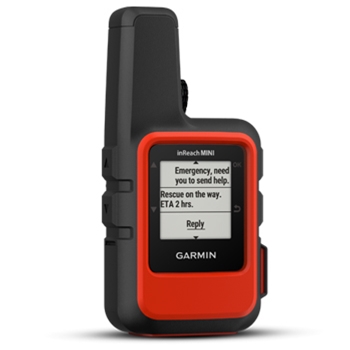
Few months ago I bough a Garmin 2-Way InReach Sat Com and a monthly subscription to go with it.

From a security / piece of mind standpoint, it really allows to adventure solo with confidence.

I like that it still functions as a stand alone device, but can also be used as a satellite modem for a cell phone for email and text. I really wish I knew about these things sooner.

Garmin-inReach-Mini-Red.jpg
 
[MENTION=306890]MAST4R[/MENTION]

g[/IMG]

I bought my InReach shortly before Garmin bought that company, whatever it was called. I subscribe to the basic plan. I have used it a couple times to communicate with family and it has worked fine. I bought the version without navigation; I have a Magellan 5 offroad navigator.

As for the Magellan 5, I found out it works well with a cheapo phone holder, one of those that attach to a vent. I was stoked because that makes it feel almost like a factory unit except for the cable (as opposed to a suction cup on the already small windshield).

I am sure one day I will be in trouble and will pay a hefty price to get out of there, but I fear more returning Sunday night on the freeway....
 
Anyone try a small battery powered or 120V chainsaw like these? Thinking about picking one up for some light trail work since I don’t want to beat the body of my ‘17 up.

The places I go, I would never need a chainsaw. But a folding camp saw comes in handy for clearing branches or shrubs on an overgrown trail. I also used it hack off a piece of damaged bumper cover once, too.
 
Lots of great tips here! I carry much of this, but not everything. I never go out alone.

I carry a kinetic recovery rope, but would like to add a snatch block and tow rope. Any suggestions on brands that will hold up well and won't crush my wallet?

Also, what is a "line dampener"?

I always carry a chainsaw in the areas I go. The east coast mountains are full of trees that like to fall over the trail. I went up a trail during one of my trips to the top of a mountain, when traversing back down the mountain a tree had fallen blocking the trail. In just the couple of hours since I had been up, this tree blocked my return path. Glad I had my saw that day.
 
Lots of great tips here! I carry much of this, but not everything. I never go out alone.

I carry a kinetic recovery rope, but would like to add a snatch block and tow rope. Any suggestions on brands that will hold up well and won't crush my wallet?

Also, what is a "line dampener"?

I always carry a chainsaw in the areas I go. The east coast mountains are full of trees that like to fall over the trail. I went up a trail during one of my trips to the top of a mountain, when traversing back down the mountain a tree had fallen blocking the trail. In just the couple of hours since I had been up, this tree blocked my return path. Glad I had my saw that day.

A line dampener or "parachute" is anything SOFT placed over a winch line -BEFORE it goes live - to help absorb energy released in the event of a line snapping. You can use coats, other straps, a blanket, or even floor mats. SUperwinch and others make dedicated "line dampers" but other straps work very well. They are REQUIRED when working with steel cable as it has A LOT more mass than synthetic rope as well as it's tendency to recoil wildly!!!!! IF you've ever scene this happen you know what I mean. Synthetic is lighter (less mass) and doesn't recoil like a spinning steel phone cord BUT getting slapped by a broken synthetic rope is like being whipped with a, well, rope!
 
Notice the tree straps being used on all live lines in this pull? They are being used as line dampeners....

We would stop and secure the vehicle and reposition the dampeners away from the fairleads as necessary.
 

Attachments

  • superwinch2.jpg
    superwinch2.jpg
    67.6 KB · Views: 262

Members online

Forum statistics

Threads
278,316
Messages
3,554,112
Members
248,016
Latest member
Advally Service

Trending content

Back
Top