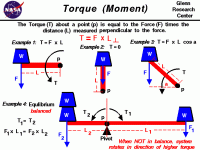
Semantics of Torque Distribution

Finally! everyone is starting to understand that torque can't go somewhere when there is no resistance or opposing force.

In my explanations, I chose to ignore friction, gear losses, etc. for clarity (why muddy the water. )

It may be a semantics issue, but I would disagree with your first statement. Torque is a rotational force. We just happen to use linear terms (lb-ft etc) to measure it or specify it.

Semantics be dammed. The engineer in me will not back down from this one.
 

Attachments

  • IMG_1434.gif
    IMG_1434.gif
    15.1 KB · Views: 659
Finally! everyone is starting to understand that torque can't go somewhere when there is no resistance or opposing force.

A simple experiment will illustrate why this rule is true.

1. Jack up the car until the wheels are off the ground and can spin freely (no brakes, transmission in neutral, etc)

2. Take your trusty torque wrench and try to torque the wheel nuts. Can't be done; the wheel will just spin because there is no opposing force and the torque wrench will read zero.

In the original scenario, any wheel that is not touching the ground gets no torque and will just spin freely. The argument of torque splitting, which direction torque will go is meaningless: the tires off the ground receive no torque.
 
Semantics be dammed. The engineer in me will not back down from this one.

You are both correct and this argument of torque is a force or torque is a moment is mostly semantics. Or, maybe from a scientific standpoint, it is a matter of relativity.

Torque is the rotational analogue of linear force.

Linear Work = Force x Linear Displacement. Rotational Work = Torque x Rotational(Angular) Displacement.

Not all force is torque, but all torque is rotational force.

All squares are rectangles, not all rectangles are squares.

All bourbons are whiskey, not all whiskey is bourbon.
 
Last edited:
All bourbons are whiskey, not all whiskey is bourbon.[/QUOTE]


And most importantly All Bourbons are from Kentucky. End of discussion
It's Friday, I need Bourbon
 
Um, yeah. A delightful discussion of physics and engineering principles, but they don’t answer my question, which is: if the transfer case splits the torque 50/50 front/rear, how can does 100% of the torque get to a single rear wheel?
 
Um, yeah. A delightful discussion of physics and engineering principles, but they don’t answer my question, which is: if the transfer case splits the torque 50/50 front/rear, how can does 100% of the torque get to a single rear wheel?

It might help to think this through as available torque vs actual torque and how this flows through the system. Torque is available 50/50 at the tcase but it isn’t actually felt by the front or rear dive shafts and then axels unless traction exists at each tire. The differentials complicate this because if a dif is open and one wheel doesn’t have traction then the available torque goes to the spinning wheel instead of the one with traction. This is why we have lockers.

In the scenario where 100% of the torque goes to one wheel you would need the other three wheels to have zero traction and then have the differential locked at the axel. Now that we have mechanically locked the wheel with traction it must rotate and because it has traction the available torque goes to this tire only.

Think of the scenario above but replace the driveshafts and axels with helical springs. Which springs will feel twist under load and which ones spin freely without resistance? The driveshaft and the axel upstream of the tire with traction are the only springs that twist up and experience torque under load. The other springs spin freely but dont feel twist at all. This is 100% of the torque going to the tire with traction (Ignoring drivetrain losses and waste)

For semantics of torque we are all saying the same thing but I think it’s still important to note that:
torque = force * distance = moment = “rotational force”
Torque ≠ force
Ft * lbs ≠ lbs

Both are vectors but bodies can be under both force and moment and it’s important to distinguish the two during analysis.
 
Um, yeah. A delightful discussion of physics and engineering principles, but they don’t answer my question, which is: if the transfer case splits the torque 50/50 front/rear, how can does 100% of the torque get to a single rear wheel?

I agree mostly with El Dusty. Perhaps it is all in nomenclature and semantics, but torque is a rotational force; a force is a force, no matter whether your push in a strait line, or twist.

Captain Spalding, I think you are locked into the mindset that torque must be split 50/50. That is true if all tires have the same amount of traction, but not true if there are wheels without traction. Power, torque, or a push only goes some where if there is resistance: push against an object and you can feel the returning pressure on your hand; push against air and you feel little returning force.
 
Um, yeah. A delightful discussion of physics and engineering principles, but they don’t answer my question, which is: if the transfer case splits the torque 50/50 front/rear, how can does 100% of the torque get to a single rear wheel?

Because it's a locker.

"Torque distribution" is a term used for differentials, like subaru's center diff, our Torsen center diff, etc. Our Torsen, for example, sends 40/60 F/R normally, and close to 29:71 when turning, 53:47 when rear loses grip. Because that's the amount of torque that the differential is capable of sending, maximum 71% rear, and maximum 53% front. If center diff is unlocked on an AWD 4runner, when rear axle loses all traction, front can only get 53%, as stated above.

When you lock all 3 diff locks, the "torque distribution" is no longer determined by the vehicle, but the surface that you drive on. If you're driving perfectly straight on a perfectly flat road, with 4 tires equally worn, with same friction (μ, if you read papers like nerds do. Just kidding), your torque is indeed 25% across 4 wheels. However, because you do not have a "differential" any more, the system is able to send 100% of torque from the T-case to any of the wheels, given that wheel does not break traction, and other wheels have 0 traction (μ=0, which never happens, seriously). The torque distribution is now completely dynamic, as it'll "assign" torque to the wheel that has the most traction. That's why "torque distribution" does not apply to lockers.

The "50:50 torque distribution" statement is really just helping people to understand a center diff lock, or traditional part time 4wd. For lockers, the statement itself is misleading, as torque distribution is completely dynamic (in a good way). If a center diff always has 50:50 torque distribution, it cannot send 100% of the torque to any of the wheels, because it's actually an open diff.
 
Um, yeah. A delightful discussion of physics and engineering principles, but they don’t answer my question, which is: if the transfer case splits the torque 50/50 front/rear, how can does 100% of the torque get to a single rear wheel?

I think the answer is: It doesn't. If only one side of any differential has traction but the differential can bias the torque to move the vehicle - 100% of the torque is going to the side of the differential with resistance (traction in this case). The 50:50 split in the marketing material is really a (inarticulate) reference to the ratio of the gears driving the front and rear axles. They are often not the same. Often in RWD biased designs they'd be designed to send 70% or so of the torque to the rear axle. In FWD it would be reversed. The torque split value is relevant to how the car feels on dry pavement. In any other condition - the stated torque bias is basically meaningless.

There is also often a torque limit to one axle or the other. In the Lexus IS for example it's 30:70 Front:Rear in normal driving but can send as much as 50% to the front and IIRC 100% to the rear. What that means in real terms is that the design will only send 150 Ft/lbs forward if the rear tires have no traction. That could be both correctly stated as of the applied torque to the front and also correctly stated as 50% of the input torque being applied to the front. Both are correctly describing two different things using the same words that make it confusing. The torque limit is likely an inherent property of the center differential gear ratios and helical gear helix angle, not an electronic limit. It's designed so that the maximum force applied to the front is half of input torque due to a friction limit in the engineering of the helical mesh.

In the case of the IS awd - if you were on dry pavement full throttle and the engine has 300 ft lbs of torque (it's a lot more due to transmission gearing, but I'm ignoring that for now), 100 ft lbs goes to the front, 200 goes to the rear. If the rear is on rollers, 100% goes to the front, but it would not exceed 150 ft lbs of torque going to the front. So, it would be both 100% relative to the torque out of the transfer case, but 50% relative to the input.
 
Last edited:
There is also often a torque limit to one axle or the other. In the Lexus IS for example it's 30:70 Front:Rear in normal driving but can send as much as 50% to the front and IIRC 100% to the rear … The torque limit is likely an inherent property of the center differential gear ratios and helical gear helix angle, not an electronic limit. It's designed so that the maximum force applied to the front is half of input torque due to a friction limit in the engineering of the helical mesh.
Interesting. I seem to remember reading that in the case of a Limited with an unlocked center differential, the explanation for the asymmetrical torque split was because of the difference in size between the ring gear and the sun gear (it’s my understanding that the Limited’s center diff, though made by Torsen, uses a planetary gear set, rather than the classic Torsen diff that uses three pairs of helical gears rotating around center gears.)
 
Interesting. I seem to remember reading that in the case of a Limited with an unlocked center differential, the explanation for the asymmetrical torque split was because of the difference in size between the ring gear and the sun gear (it’s my understanding that the Limited’s center diff, though made by Torsen, uses a planetary gear set, rather than the classic Torsen diff that uses three pairs of helical gears rotating around center gears.)

I haven't looked at one in a while. But my recollection is that the 4Runner Limited uses the VF4BM transfer case. It is both a planetary center differential AND a Torsen limited slip. Here's a link to more detailed info on it. IIRC it has a 50/50 torque split default gear ratio.

https://www.clublexus.com/forums/at...s-troubleshooting-460_transfer_case_vf4bm.pdf
 
I haven't looked at one in a while. But my recollection is that the 4Runner Limited uses the VF4BM transfer case. It is both a planetary center differential AND a Torsen limited slip. Here's a link to more detailed info on it. IIRC it has a 50/50 torque split default gear ratio.
That link is a great resource. Thanks!
Yes, the the t-case has a planetary gear for the high/low gearing, and a Torsen differential, which isbased on a second planetary gear set. I think it’s the gear ratio within that second planetary gear set that is responsible for the torque split.

Per the linked document:

“iii. The torque distribution during straightline driving is 40/60 (front/rear), which is helpful for an appropriate steering response during the initial stage of a turn. During the acceleration stage of a turn, the torque distribution increases in the rear wheels.

iv. This center differential consists of a center differential case, sun gear, ring gear, coupling, 8 pinion gears, clutch plates, and planetary carrier.”​

So I guess it’s 60/40. With an open differential.
 
That link is a great resource. Thanks!
Yes, the the t-case has a planetary gear for the high/low gearing, and a Torsen differential, which isbased on a second planetary gear set. I think it’s the gear ratio within that second planetary gear set that is responsible for the torque split.

Per the linked document:

“iii. The torque distribution during straightline driving is 40/60 (front/rear), which is helpful for an appropriate steering response during the initial stage of a turn. During the acceleration stage of a turn, the torque distribution increases in the rear wheels.

iv. This center differential consists of a center differential case, sun gear, ring gear, coupling, 8 pinion gears, clutch plates, and planetary carrier.”​

So I guess it’s 60/40. With an open differential.

I'm fairly confident that it is a limited slip differential rather than an open differential. The differential assembly starting at about 24:00 mark in this video is *I think* a VF4BM or very similar Aisin center torsion differential. might be a VF3AM or other similar model. But they're all very close.

Center Differential Transfer Cases - YouTube
 
Haha I just rewatched that video again last night. You are correct. I misspoke. Another semantic issue. In my mind any differential that isn’t locked is open, and a limited slip diff is a subset of the open diff.

John Kelly may be a little monotonous, but he’s meticulous and thorough in his instruction. He’s got other videos of the workings if the transfer case in situ, and of the ADD. And a great one explaining planetary gears.
 

Members online

Forum statistics

Threads
278,310
Messages
3,554,079
Members
248,016
Latest member
Advally Service

Trending content

Back
Top