Setting PSI Correctly

Mytoy4

New member
Would someone help me understand psi and it’s possible pro/cons when it may not be set correctly.

I purchased my wheels and tires used (aprox 4000 miles on them). Not sure if that matters. Anyways, my 4runner states inside the door panel that psi all around should be set at 32. Would this be referring to stock only?

The previous owner stated that he ran them at about 40psi. I currently have them set at 35psi.

I’ve been told that if I air them up too much that they become more unstable, which makes sense.
I’ve also read that setting it at an adequate psi for your driving conditions (street only, right now) will help increase your gas mileage. And actually the way I really read that is, if I don’t have them set adequate for my driving condition, that I could be losing gas mileage. I'm averaging between 16.4-16.8 right now.

Cooper Zeon LTZ 285/60R18 is what I’m running.
Thoughts?
 
Register to hide this ad
There's actually a surefire method to dialing in tire pressure, but it requires some time, some materials, and a big flat open space (like an empty parking lot).

Materials:
Chalk, pen and paper, tire inflation system (this can be an on-board compressor, stand alone tank like this one, or even a coin operated one though that could get expensive).

Procedure:

Basically you air up and record the pressure. Then draw a straight line across your tread with the chalk. Then you drive your truck in a straight line forward, then backward about a hundred feet or so. It's really a trial and error method. What you want to see is all the chalk gone at a given pressure and that is your optimal pressure. If you've got chalk left toward the sides of your tread, you need to go down in pressure. If there is chalk left in the center of your tread, you need to go up.

Optimal tire pressure is important for so many reasons like you mentioned about: fuel economy, ride quality, handling, tire life, and I'm sure there are plenty more that I'm missing.

Hope that all makes sense.

Anyway, I'm dealing with the same issue, and I'm just playing around with different pressures, and just going with what feels right. My new tires ride a lot stiffer than the last set since they are load "E" rated. I started out running 40 psi, now I'm at 36 and it feels a lot better. I can probably stand to run it lower. I went down to 25 last time I was off road and they barely flattened out. I wanted to go to 20 but since it was my first time with this set-up I didn't want to risk blowing a bead, so I went easy.

Hope this helps. Let me know if you got any questions.
 
Stick between what is posted inside your door and up to what is stated on your tire. Superman's process is only good for low speed off road driving. Your tire changes shape as it goes faster. More air equals better gas mileage and longer tire life. You also get a rougher ride some might call that less stable. Less air equals more comfortable cadillac type ride. Try riding a bicycle and play around with the air pressure. That will give you a good physical idea of the difference air pressure makes.
 
I found that 36psi seems to be a good number for our vehicle, I currently run that in my 285/75R17's and it returns good results.
 
There's actually a surefire method to dialing in tire pressure, but it requires some time, some materials, and a big flat open space (like an empty parking lot).

Materials:
Chalk, pen and paper, tire inflation system (this can be an on-board compressor, stand alone tank like this one, or even a coin operated one though that could get expensive).

Procedure:

Basically you air up and record the pressure. Then draw a straight line across your tread with the chalk. Then you drive your truck in a straight line forward, then backward about a hundred feet or so. It's really a trial and error method. What you want to see is all the chalk gone at a given pressure and that is your optimal pressure. If you've got chalk left toward the sides of your tread, you need to go down in pressure. If there is chalk left in the center of your tread, you need to go up.

Optimal tire pressure is important for so many reasons like you mentioned about: fuel economy, ride quality, handling, tire life, and I'm sure there are plenty more that I'm missing.

Hope that all makes sense.

Anyway, I'm dealing with the same issue, and I'm just playing around with different pressures, and just going with what feels right. My new tires ride a lot stiffer than the last set since they are load "E" rated. I started out running 40 psi, now I'm at 36 and it feels a lot better. I can probably stand to run it lower. I went down to 25 last time I was off road and they barely flattened out. I wanted to go to 20 but since it was my first time with this set-up I didn't want to risk blowing a bead, so I went easy.

Hope this helps. Let me know if you got any questions.

that is an excellent tutorial! thanks!
 
superman has it right.

The correct tire footprint is determined by the weight of the vehicle. To obtain the correct footprint you adjust the tire air pressure.

For the stock tires I run about 2lbs over what is recommended. Tires seem to last a long time and I don't see any adverse wear on the tires. Gas mileage is increased a little and handling is a little more responsive. But much more then 2lbs and handling becomes a problem and the middle of the tires will start to wear out prematurely.
 
When load rating is a concern, also remember that the sidewall load rating is only at the sidewall max inflation. The load capacity decreases from there as inflation pressure decreases.

-E
 
Your tires will heat up and gain PSI as you drive as well, especially at freeway speeds. :)

I usually just read the side of the tire, then kinda 'feel" how the car reacts after I air up/down and dial it in from there.
 
So a very grey area, I see. Seems that there are several ways of doing it. My tire states a max of 44, my door panel states 32... huge difference.
What superman stated makes sense, I would be curious to try it just to see what number I get.

Natey says that he reads the side of the tire and kinda 'feels' how they car reacts.
So that leads me to another question. What does it feel like when you have a tire aired too high or too low?
 
When load rating is a concern, also remember that the sidewall load rating is only at the sidewall max inflation. The load capacity decreases from there as inflation pressure decreases.

-E

Eli, could you explain what you mean. I'm sorry. I'm new to all this so I'm really trying to learn as much as I can. I'm not sure what load rating is.
 
Eli, could you explain what you mean. I'm sorry. I'm new to all this so I'm really trying to learn as much as I can. I'm not sure what load rating is.

There's a spot on the sidewall near the tire size information that indicates what the maximum weight rating that particular tire can hold at a max given pressure. If you air down the tire to say half that max rating, you would be running the risk of damaging the tire or a blowout should you try to put the max weight at the wrong tire pressure. Unfortunetly I am not sure if the formula is linear or exponetional, i.e. if cutting the psi by half reduces the weight rating by half or just a little bit.
 
Ah! Got it. Makes sense! So would this be more so for off-roading? I was told that when I take it off-road that I should drop it between 20-25. I understand I need to look to see what my tire max rating is but I could potentially do damage if I aired it down too far, correct?
 
So a very grey area, I see. Seems that there are several ways of doing it. My tire states a max of 44, my door panel states 32... huge difference.
What superman stated makes sense, I would be curious to try it just to see what number I get.

Natey says that he reads the side of the tire and kinda 'feels' how they car reacts.
So that leads me to another question. What does it feel like when you have a tire aired too high or too low?

On many tires, it's not easy to visually see if you're over or under inflated.

Under inflated will feel some loss in steering precision and cornering stability as the side walls will be more likely to deflect.

Over inflated will result in an un-yeilding and harsher ride. It can also cause your tires to be more suceptable to damage from say, potholes, since there is no give. Which is why we air down on the trail. Basically you want to stay well below the max tire pressure printed on your sidewalls for normal driving.

Hope that answers your question. As far as driving by feel, you just sort of have to dial it in by running various pressures and sticking with what feels good to you in regards to handling and ride quality.
 
Ah! Got it. Makes sense! So would this be more so for off-roading? I was told that when I take it off-road that I should drop it between 20-25. I understand I need to look to see what my tire max rating is but I could potentially do damage if I aired it down too far, correct?

Its more so for if you're doing something like loading up the vehicle with a lot of weight. i.e. our 4Runners are something like 5200lbs GVWR (Gross Vehicle Weight Rating) with a GAWR (Gross Axle Weight Rating) of about 2600lbs. Which means at the 4 corners of your vehicle, or at the tires, each tire is supporting roughly 1300lbs. most of the tires for our vehicle seem to have a max load rating of about 2500lbs -ish so airing down to 20~25psi would probably still be within the tire's operating weight, but like I said I am unsure of the formula for calculating load rating when airing down. For all I know, we've all been screwing up and putting our trucks in danger all these years.

And the whole airing down thing is somewhat complicated, but basically its to improve your contact patch/footprint and allow the tire to conform to the terrian to gain better traction off-roading since you normally aren't going very fast and thus don't have to worry about high speed instability vs, bettering uneven traction.
 
Last edited:
Basically you want to stay well below the max tire pressure printed on your sidewalls for normal driving.

Thanks, PD!
So when would one want to have their tires aired as high as it indicates. In my example 44psi.

I have another question now.
So say that you find out the 'proper' psi.. which is 37 (figuratively speaking), then I add a Shrockworks front bumper. Does that change how the psi should be set? Does that make sense?
 
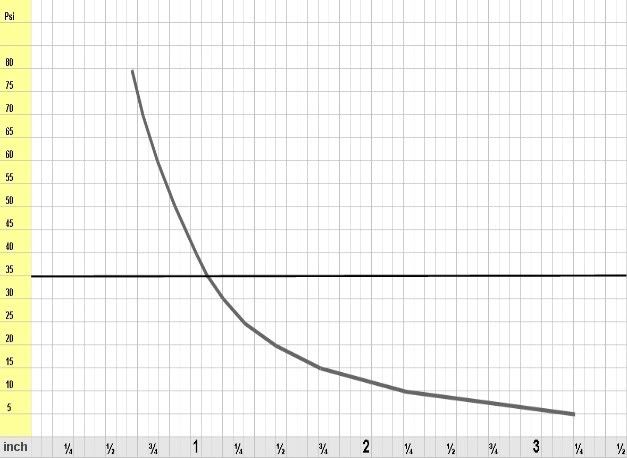
Unfortunetly I am not sure if the formula is linear or exponetional, i.e. if cutting the psi by half reduces the weight rating by half or just a little bit.

It's fairly linear in the normal ranges but starts to get less and less so as zero psi is approached. The pic is just for load. Obviously speed is related and should be taken into consideration.

http://www.toyota-4runner.org/gener...tires-need-more-air-pressure.html#post1128845

Deflectioncurve.jpg~original
 
Last edited:
I understand I need to look to see what my tire max rating is but I could potentially do damage if I aired it down too far, correct?

Yes, you absolutely could do damage from airing down too far. You can damage the tire itself because you can push the ply-ability of the side walls beyond their limits which compromises the structural integrity and causes it to break down. Many times damage might not even be externally visible. It's what happens when you see those big bubbles on the side-walls of low profile sport tires. Imagine taking a sheet of stiff rubber, folding it in half more than it wants to fold and rolling back and forth over it with a steel rim and the weight of a truck on top of it. Not good right?

Beyond that, airing down too low puts you at risk of unseating your tire from the rim, more commonly known as "blowing a bead", in which case you can damage a whole world of things depending on where you are and how fast you're going.

Thanks, PD!
So when would one want to have their tires aired as high as it indicates. In my example 44psi.

I have another question now.
So say that you find out the 'proper' psi.. which is 37 (figuratively speaking), then I add a Shrockworks front bumper. Does that change how the psi should be set? Does that make sense?

My vote, is you'd never want to run at max pressure unless you basically knew that you were going to run at your trucks max payload or towing capacity. Which is risky business anyway. I know that there is a factor of safety built in to all of these numbers, but it's labeled "Max" for a reason.

Regarding the 2nd portion, I guess the short answer is "yes". You would need to at least re-evaluate it. I'm sure most that add the extra weight may not take the time to look at tire pressures, but it definitely will have an effect. Just like your suspension may need to be re-dialed in after added weight. It's all a balancing game. So the old physics adage of Newton's 3rd law holds true here in that "For every action there is an equal and opposite reaction".
 
What does it feel like when you have a tire aired too high or too low?

No answer can replace experience. Luckily for you, in this case experimentation is easy.

Just don't go bombing down the freeway and around corners at 15psi.
 

Members online

Forum statistics

Threads
278,304
Messages
3,554,041
Members
248,016
Latest member
Advally Service

Trending content

Back
Top