Spark Plugs

Thanks for all the excellent replies. Typically when it comes to OEM ignition and electronic operating systems throughout todays vehicles, I tend to stick with the OEM p/n's. And this is mainly due to there not really being any further performance gains without going in a playing with the computer, which in my case will never happen. At my first plug change at 30k, I too had the split NGK/DENSO combo.
I don't remember which unit of the two I used at 60k. For chits and giggles, I thought I would toss the question of plugs out there for the masses in case someone found something that works well.
Thanks again for all the responses. And like someone mentioned above, I am one of those guys who likes to keep up on and know what the motor/drivetrain ect is trying to tell me. By spending extra time pre and post trip, looking closely at everything in and under all my rigs helps keep my stuff safe and sound. I fall into that percent of heavy users, but not an abuser, which calls for more and closer inspections. My neighbors think Im crazy because between my three vehicles, its seems like Im always in my garage. But hmmm, who do they always call when their vehicle goes down. lol

:cheers:

Something to be said for keeping a routine eye on your rig. I couldn't tell you how many things I've spotted BEFORE they became a problem and fixed on my terms.

Some more nuggets on spark plugs: When installing new plugs I HIGHLY recommend painting on a thin coat of Permatex anti-seize lubricant (the metallic high temp paste) and you'll never have a plug seize problem. Even with factory installed long-life plugs I usually end up pulling them in the first 12k-30k miles just to get a peek into how the engine has been running and then I apply anti-seize lube and reinstall.

Below is a picture of one of the OEM factory installed long-life iridium spark plugs from my '05 CR-V at 50k miles (I think they happened to be Denso). I sold it to my parents when I bought my 4Runner so they could use it as a toad for their RV and I did a once-over and pulled the plugs so I could apply some anti-seize and check so see if anything was out of line. Upon inspection I noticed a very faint carbon track on the insulator of one of the plugs which turned out to be a very fine crack! (the picture makes it look more visible than it really was to the naked eye) There didn't appear to be any mechanical damage to the plug that would have indicated it had been dropped prior to installation or that something had rattled around in the cylinder and caused damage. If that insulator would have dropped off and into the cylinder I hope it would have just bounced and been blown out the exhaust valves but it sure could have stuck around, especially in small pieces, and served to scour the cylinder! Had it gone another 50k miles I have no idea what would have happened but by checking I found it before any damage had been done.


You do NOT want to put anti-seize on NGK plugs.

http://www.ngksparkplugs.com/pdf/tb-0630111antisieze.pdf

Hopefully the Denso plugs had anti-seize put on when the engine was installed.

What ever happened to using a torque wrench to properly tighten spark plugs?

As difficult as I've found long-life plugs to remove if they've been there for a long time (yes, even the previously mentioned plated NGKs) so I'm going to stick with a thin coat of anti-seize unless I see a widespread problem with broken plugs that's worse than the issues many have seen with trying to remove a plug that's been in the head for the past 100k miles.
 
What ever happened to using a torque wrench to properly tighten spark plugs?

Torque wrench isn't going to solve the problem of the 100k plugs being stuck. In the 40+ years of doing tune-ups I've NEVER EVER used a torque wrench and never had a problem. And I don't know of ANY professional mechanic who's ever used a torque wrench when installing plugs.
 
Torque wrench isn't going to solve the problem of the 100k plugs being stuck. In the 40+ years of doing tune-ups I've NEVER EVER used a torque wrench and never had a problem. And I don't know of ANY professional mechanic who's ever used a torque wrench when installing plugs.

And this is why we have a tech bulletin from NGK! Last I checked there was a published torque for EVERY vehicle I've ever laid hands on so therefore the proper procedure would be to torque according to spec.

I guess my maintenance practices come from a whole different world (Military aviation and missile systems) where assuming torque can and has resulted in the death of the wrong men and the loss of assets. As an engineer and as a building contractor I know very well that there is all too often a difference between what a "professional" mechanic does and what the published procedures are. I think NGK's TB is to deal with the fact that all too often the "professionals" don't follow the published procedures.
 
Torque wrench isn't going to solve the problem of the 100k plugs being stuck.

Nope, but anti-seize sure seems to do the trick. Count the number of threads that carbon has made it up on a plug at 100k miles and then compare this to one that had anti-seize properly applied (very thin coat). Plugs come back out without any sort of galling of the aluminum and go back in with ease.
 
And this is why we have a tech bulletin from NGK! Last I checked there was a published torque for EVERY vehicle I've ever laid hands on so therefore the proper procedure would be to torque according to spec.

There's a published torque for EVERY SINGLE NUT/BOLT on EVERY VEHICLE made in the past 50 years. Trust me...the ONLY bolts that a professional mechanic will use a torque wrench on are critical bolts (aka head bolts) or lug nuts and a few others. No one uses a torque wrench for spark plugs. Do you use a torque wrench for your oil pan bolt?? - because there's a torque spec for it. I surely don't.
 
Do you use a torque wrench for your oil pan bolt?? - because there's a torque spec for it. I surely don't.

If it's someone else's vehicle then yes, I always do. If it's my own gear and the oil pan is aluminum then without exception I do. If it's a piece of equipment I'm not familiar with then I always do. Again, different mentality in our maintenance backgrounds.
 
The other thing you have to worry about with 100k mile plugs...is removing them after they've been in there for 100k miles. Some people have had issues with stripped threads.

Would stripped threads be caused by a length of time/mileage, or would it be caused by improper installation? I removed my original plugs on my V8 after 140k miles and they resisted a small amount, but came out nice and smooth on the threads.
 
Hey guys, I replaced my plugs today with 8 new NGK iridium IX. My 2004 limited has 211 000km and was purchased @ 165 000km 4 years ago. Its been harder on gas than usual recently, so I decided she needed a little tune up. Popped in a air filter and changed my plugs today.

First, My plugs came out a lot harder than any other vehicle I've changed plugs on, but the new ones went in pretty well so I'm not all that concerned.

2nd, this concerns me, the 2nd last cylinder on either side came out really black. The firing tip area looks fine and like others, but at the bottom of the threads and around the seal its all burnt out with what looks like oil residue??

I'm no mechanic, but I never shy away from trying to fix shit and I'm usually fairly successful, but I have no idea of how bad or how nothing this all could be?!

Thanks ahead of time for anyone's 2 cents.
 
As best as I'm aware, they came with copper plugs. 3 Denso and 3 NGK were in my rig as well..

I guess both the dealers I called trying to find plugs indicated OEM replacement was iridium were wrong. I ended up ordering the parts online since neither dealer had 6 in stock and I didn't want to drive to 2 places. I haven't used a copper plug in 15+ years. Mostly been platinum, this is my first use of iridium plugs.
 
Picked up the copper plugs for my 2007 T4R last week from Toyota parts department. Their service manual shows copper plugs used up until 2008. Then, for 2009 model, the iridium plugs were specified as an option.

Gentleman in parts department told me the ignition systems are finicky when it comes to coil voltages, spark plug resistance, etc and recommended only genuine Toyota spark plugs. He also stated the concern of trying to remove a spark plug that's been installed in an aluminum head for 100,000 miles.

I really don't have an opinion either way as this is my first Toyota. Just thought I'd share my experience.
 
Gentleman in parts department told me the ignition systems are finicky when it comes to coil voltages, spark plug resistance, etc and recommended only genuine Toyota spark plugs.

Toyota does NOT make spark plugs. They never have. The OEM spark plug for Toyota is Denso or NGK. Buy either of those from an independent parts store and they are the EXACT SAME PLUG the dealer sells (with the exception of Toyota printed on the plug).
 
I just buy at the dealer since I still get employee discount and I don't have to worry if it acts up.
 
I just buy at the dealer since I still get employee discount and I don't have to worry if it acts up.

Since most of us don't work at a dealer...and have to pay the 3x markup on sparkplugs. Last time I was pricing plugs at the Toyota dealer...their prices were over 3 times what I could buy the EXACT SAME PLUG for at a local chain.

I don't have to worry if it acts up

Any mechanic who told you that not buying Toyota plugs but instead buying from the OEM manufacturer (Denso or NGK) could cause it to act up.....has no business working on cars.
 
For those worried about removing the plugs after 100K make sure you remove them with the engine at room temperature. Using a torque wrench on the install is a little overkill IMO. If it makes one feel better, have at it. After turning wrenches for a living for close to 30 years you develop a pretty good feel for how tight you are getting things.
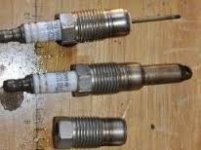
Try replacing plugs on a Ford 4.6 or 5.4 Triton engine if you want difficulty. Those plugs are just about the worst design I have ever seen. Ford will quote the job at about $400.00 because of the possibility and difficulty of breaking the plug in the head. Look at the freakin things.
 

Attachments

  • Plug 1.jpeg
    Plug 1.jpeg
    5.5 KB · Views: 682
  • plug 2.jpg
    plug 2.jpg
    85.4 KB · Views: 692
Mike, the spark plugs I purchased from Toyota were OEM Denso copper plugs. My mistake referencing they were actually made by Toyota. Thank you for correcting me. I should clarify the gentlemen in the Toyota parts department told me that trying to use anything like Autolite, etc. might not work out so well. We had a nice chat and I told him this was my first Toyota. We discussed future maintenance items like differential/transfer fluid changes, transmission fluid changes, and belts / hoses. He wasn't trying in the least bit to sell me on anything, which I appreciated.

I purchased my 07' V-6 from a Toyota dealer a few months ago. It had pretty thorough maintenance records and from what I could tell, the plugs had never been changed. So today at 52,000 miles I changed the spark plugs. The car ran fine before but I was curious to see what they plugs looked like. While they did have wear, I wouldn't have considered them completely shot.

I must say, I had my reservations though taking these plugs out. I swear while trying to remove each, they were going to break or seize. Just a weird feeling I had while gripping the ratchet. I think part of it was these plugs use a crush washer and I've never owned anything but older GM V-8's with cast iron heads prior to this 4Runner. Each plug came out ok with no thread damage.

The whole job took about an hour and the plugs were quite accessible in my opinion if you use the proper socket extensions. I'm glad I used a torque wrench to install them. I would have never tightened them enough going by "feel" only.
 
I should clarify the gentlemen in the Toyota parts department told me that trying to use anything like Autolite, etc. might not work out so well.

I agree 100% with that. If you use Autolite or Champion or Bosch...etc... plugs you'll be wondering what the heck happened. Stick with either NGK or Denso. They were both designed for that engine. You can even find AC/Delco plugs for your vehicle. I'd use AC/Delco for a GM product...but NOT for Toyota.
 
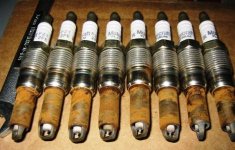
How do these look? They are laid out as if you were looking in the engine bay from the front bumper. Not sure why some have oily looking threads?

eme8eneb.jpg

pude9eme.jpg

u4ynegyd.jpg
 

Members online

Forum statistics

Threads
278,308
Messages
3,554,059
Members
248,016
Latest member
Advally Service

Trending content

Back
Top