Stock rim pressure limit?

Thank all you guys for your help! I thought they were giving me a bunch of hooey. Then again now that I think about it, I wasn't talking to my usual guy, I was talking with the guy they give to all the soccer moms and octogenarians who come in. I'm guessing not all employees have the same understanding of what's really going on!

Of course this has made me revisit the P-metric vs LT debate, even though I've gone through this several times in the past couple weeks. This is the first time I've really done the math on this.

The P tires will more than support the max GVWR of 6450 lbs. According to the sticker on the interior drivers side B pillar that's to be distributed 3000 lbs front, 3450 lbs rear. Meaning 1500 lbs/tire on front axle, and 1725 lbs/tire for a max loaded vehicle.

Now given the manufacture spec for the P rated tire of max load 2535lbs. Even accounting for the 10% reduction as required for use of P rated tires in SUV/LT applications, that's 2281lbs, still more than the max GVWR would require at 1725lbs.

Jumping over to the LT E rated max 3195lbs at 80psi. The 1750lb requirement for max GVWR is barely half of that tire can do (53%). Assuming a linear relationship between tire pressure and load carrying capacity, at max GVWR the appropriate tire pressure would only be ~43psi. Of course that won't save me if some idiot fills the tires to max pressure during a rotation.

So both tires have more than enough ability to carry the load. The LT will win durability hands down no question, more tread to start with, heavier duty sidewalls, etc. They also look beefier and better. Handling and ride comfort will go to the P metric. Stability is a question mark. Would the LT will be slightly more sure-footed as a result of the stiffer sidewalls, or less because it would be more likely to slip than to have scrub like the P?

Being honest about how I use my vehicle, off road puncture considerations are rather low. Most of my off road driving is in quite sedate grassland or established trails. And while I enjoy the occasional trip off road, most of my time is spent on pavement as a DD. Now the road I drive as that DD is rather rough, severely potholed and always littered with dirt/rock and other debris. It has already claimed 2 P tires from my former car with sidewall bruises and slices from potholes and debris, so I'm more likely to get a puncture on road than off of it. This is the fun of driving past a quarry and a garbage dump to work. So I don't exactly need an LT tire. But the beefier look and longer life makes me want an LT. The fact that the tires I'm looking at only come in P-metric or LT load class E makes it interesting as I like a smooth ride. I'm hoping that the suspension and KDSS will take up the slack and ride much smoother than that old Bronco suspension when I went from P to flotation tires on it.


Yes, that may be so, however neither of these are on my short list. The KO2 is too new for a proper review, and I've heard many complaints about the Duratac for road noise. While I understand moving from a highway tire to an all terrain means more road noise, and more again for a P to LT conversion, I'm trying to minimize this. Also I'm starting the ball rolling to move north before winter comes again, so snow/ice traction will be a major concern. It will very likely be one of the first two, but my short list contains:
Hankook DynaPro ATM RF10
Toyo Open Country II
Cooper Discoverer AT3
Dick Cepek Fun or Trail Country (possible but not likely)

I have run LT tires many times. I have run many different types and brands in my 36 years of driving. I drive around 25 K a year and go off road more than the average guy. I now only run P rated AT tires as they are the best compromise tire. Tire "looks" are way down the list after a ten hour drive. Good luck.
 
I have run LT tires many times. I have run many different types and brands in my 36 years of driving. I drive around 25 K a year and go off road more than the average guy. I now only run P rated AT tires as they are the best compromise tire. Tire "looks" are way down the list after a ten hour drive. Good luck.

That is not a compromise - I would say C load LT is best compromise (when available).
 
I can't imagine running a P rated tire, but I push my truck pretty hard off-road even when I'm taking it easy. It's not really smart or logical, but many things that are fun are not.

Tires are too important to skimp out on, but then again if you only do dirt roads... no reason to run way more tire than you need.

Different strokes for different folks. 4 runner owners are clearly all very different.
 
The KO2 is too new for a proper review.....
It will very likely be one of the first two, but my short list contains:
Hankook DynaPro ATM RF10
Toyo Open Country II
Cooper Discoverer AT3
Dick Cepek Fun or Trail Country (possible but not likely)

Apparently I was wrong about the KO2, the Canadians have had them for a little longer, put them through the paces, and apparently love them them for snow/ice. After watching this, they just moved to the top of my list, especially because they come in C load class for the factory size. Sadly my desired LT275/70R17, only comes in E, and is almost 10 lbs heavier than the 265/70R17 in C load. Oddly enough TreadDepot has the larger heavier size $5 cheaper? But I'll probably be looking VERY hard at the KO2 in C load now.


While the Discoverer AT3 does come in the P/LT 275/70R17 size, it's gotten horrible enough reviews in winter conditions that Cooper went back and made the ATW. I discovered this over in a J##@ forum, and also that the ATW didn't have the same durability as the AT3 during warmer months. While it's in a J##@ forum, I'm inclined to remove both from my list.

The Hankook and Toyo are so close to each other that they seem a toss up. Both have decent reviews in snow, and fair-poor ones on ice. With plans to move up to Dayton area looming for this winter, and the fact that these only come in P or LT/E have me leaning towards the KO2 at the minute. I'll be looking for more reviews as time passes, as I plan on saving this tire purchase for fall or winter after I make the move north. No sense in not wearing out crappy (stock) highway tires over the summer months right?

The thought crossed my mind to have each a summer and winter set of tires, but that means extra cost and storage. If I were staying in my current location with a garage AND a nice big workshop, then no problem. But the new location will probably not have a nice workshop with it, and I'll have to spend money to get one first. That is after paying for the move and dealing with the $11k/yr less at the new location.
Women are evil, vile things that talk us into doing things normal sane single men would never consider! Ahhhh the things we do for these :girl:
 
That is not a compromise - I would say C load LT is best compromise (when available).

Everything in life is a compromise. I don't like Coors but if it's the only beer in my fridge....

If I were smarter I would design a tire that could change tread pattern depending on terrain and conditions, be impervious to any damage, last forever, grow to meet ground clearance needs, get narrow for interstate efficiency, get smaller sidewall for handling and cost ten bucks. Unfortunately that tire is not available right now because nobody else is smart enough either. So unless you have that tire, any other choice is a compromise, which means every tire available for sale right now is a compromise.
 
I can't imagine running a P rated tire, but I push my truck pretty hard off-road even when I'm taking it easy. It's not really smart or logical, but many things that are fun are not.

Tires are too important to skimp out on, but then again if you only do dirt roads... no reason to run way more tire than you need.

Different strokes for different folks. 4 runner owners are clearly all very different.

Absolutely. My 4Runner is my primary vehicle. My other vehicles are for other members of my family and until I get the last one out of grad school (two years, c'mon man..) I will only have one vehicle that I drive. I took the 4Runner off road last week for work to go observe a machine operation. Sure it was only a half mile or so but it was nasty slushy wintery mud. Next week I take that same 4Runner on a ten hour interstate drive to Chicago. I don't know about you but I have made a ten hour interstate drive in a vehicle with oversize heavy LT tires that can never be balanced perfectly and has a whine at about 70 mph that sounds like a train in a tunnel. It's no fun lol. So for me personally I need a tire that can do most things sorta good. If I have a dedicated trail rig then I would be looking for tires just like you are. BTW, I think you have little ones right? My daughter graduated with her BSN last May and it was over $200K for her four years. My son will be a senior working on his BSME this fall and already applied to grad school to get his MBA. Lord knows what that bill will look like. Right now I am pretty lucky I have a 4Runner. Save up!

OP, the Cooper AT3 (I have run two sets now) does just fine in the snow. I did a review here http://www.toyota-4runner.org/5th-gen-t4rs/114342-tires.html and the good stuff starts on page two. There are like a million people here running AT3's. Maybe not a million but you get my point. Post #60 is the snow post. Reading a Jeep forum you need to take what they say with a grain of salt. They bought a Jeep right....
 
Last edited:
I've had the KO2 Es for a couple months now and really like them. No snow yet for me. Though I did read a review of winter tires and the new KO2 scored best of all the AT tires they tested.

It's a little unfortunate for BFG, the KO2s really need to prove themselves all over again. The KO is such an old tire and everyone has such set opinions or experiences with them that the KO2 needs to overcome (if it can).

"Hard to balance" - New KOs seem to be exceptionally easy to balance, garnering spontaneous comments from tire fitters.

"Terrible in rain or snow" - New KOs have a far more aggressive siping pattern that has improved their rain/snow performance massively. Of course no non studded tire is "magic" in all snow/ice conditions, but the new KO2 seems to be pretty good.

"Terrible in mud" - Ok this one is probably still largely true, they are not a mud tire.

"Chips and wears from rock/gravel use" - New KOs use a completely new/modern rubber compound that is especially resistant to that sort of abuse now.

"Thin sidewalls" - New KOs have extremely thick sidewalls. I actually felt this myself as my tires and an older set of KOs were sitting side by side on install day. I felt the inside of both and the new KO is very thick.

Then finally the "I don't want E rated tires" (If you are at any size other than 265) - I was really "scared" of what these would do to my ride after all the opinions I read. In the end? I can BARELY tell the difference from my P metric when at 42-45 on road and 30 offroad. I /think/ that if you were driving gravel/highway as a daily commute and you didn't want to air up/down twice a day then maybe the E might be a little rougher on the gravel road than a p metric. But otherwise, it's been really nice, not harsh whatsoever!

Course I've only had them a couple months, so I need to see how they are doing 2 and 4 years from now... but for right now, I am extremely happy with them.
 
Last edited:
The Hankook and Toyo are so close to each other that they seem a toss up. Both have decent reviews in snow, and fair-poor ones on ice. With plans to move up to Dayton area looming for this winter, and the fact that these only come in P or LT/E have me leaning towards the KO2 at the minute.

It turns out one of the guys I work with has a set of the Toyo Open Country AT2 on his Chevy 1500HD, and a set of the Hankook Dynapro ATM on his wife's FJ. He installed both within the same month about 4.5 years ago, and was able to give me an honest evaluation of both. Original install on 1500HD was Toyo Open Country AT, then replaced with AT2 version. This is also to be taken in context, I'm betting that 1500HD is much heavier than the FJ, hence more weight, wear, and traction requirement on tires. Both tires are LT/E rated.

Hankook has more road noise (growl) than the Toyo.
Original Toyo AT wore quicker than Hankook ATM's. Toyo AT2 seems to be wearing about the same as Hankook ATM.
While Toyo has slightly better on road handling, Hankook has better grip in most all situations, rain, snow, ice, and even the greasy mud. Although he did say that if you could keep the vehicle moving either one would be able to get through it.
All of that has me leaning more towards the Hankook ATM's over the Toyo AT2.

I also went up to the local tire shop yesterday and while they were balancing my stock crap, I spoke with my usual guy about tires. He didn't balk at all about putting E load LT's on my factory wheels.

The shop had a KO2 on the showroom floor, along with all the promotional literature. He said they haven't heard anything much back good or bad about them. Like everyone else he's heard they're supposed to be better than the KO's, but didn't have any real data yet. While I was initially afraid that they were just going to be too beefy, even the E load didn't look as stiff as the DC FC-II's that I had on the Bronco. I just checked and both the C (265) and E (265 & 275) load come with 15/32 of tread, so the only real difference is the extra layers of construction and size.

I've already decided I wouldn't need the extra strength and no point in making my ride a little rougher with the E. The only point I was considering the E load was to get the 275/70R17 size, but I've read elsewhere that any aftermarket tire already has more tread width than the stock highway. I'm thinking that is simply a function of design between any highway tire against an AT design? Highway are supposed to be more efficient with a smaller contact area and tread width for less friction right? So an AT in the same section width should be designed with a wider tread width, prioritizing grip over efficiency. So I'm thinking that I should probably stick with the stock 265/C over the 275/E.
EDIT: I just checked specs on tread width. KO2 8.8"(265) 9"(275), ATM(265) 8.2", factory(265) 8.3"

The BFG KO2's are also a few hundred dollars cheaper than the Toyo I had been pricing in LT sizes. I'm almost certain I don't want E load, so that means the decision is really between C load BFG KO2's and P-metric Hankook ATM's. I don't think I could go wrong with either one. More to come later.

EDIT: Go figure. Every time I eliminate one option I add another. I went back and looked at the specs on the Cooper AT3's. Both 265 & 275 come in LT/C. Tread width is 8.6" on both, and come with 16.5/32 tread depth. Why did I scratch these off my list? Poor ice reviews in a Jeep forum? Jeeps weren't built for the road, but for trails, so why am I paying attention to them? [MENTION=66316]1engineer[/MENTION] any update on your winter handling now that you've worn the tires down further?
 
Last edited:
It turns out one of the guys I work with has a set of the Toyo Open Country AT2 on his Chevy 1500HD, and a set of the Hankook Dynapro ATM on his wife's FJ. He installed both within the same month about 4.5 years ago, and was able to give me an honest evaluation of both. Original install on 1500HD was Toyo Open Country AT, then replaced with AT2 version. This is also to be taken in context, I'm betting that 1500HD is much heavier than the FJ, hence more weight, wear, and traction requirement on tires. Both tires are LT/E rated.

Hankook has more road noise (growl) than the Toyo.
Original Toyo AT wore quicker than Hankook ATM's. Toyo AT2 seems to be wearing about the same as Hankook ATM.
While Toyo has slightly better on road handling, Hankook has better grip in most all situations, rain, snow, ice, and even the greasy mud. Although he did say that if you could keep the vehicle moving either one would be able to get through it.
All of that has me leaning more towards the Hankook ATM's over the Toyo AT2.

I also went up to the local tire shop yesterday and while they were balancing my stock crap, I spoke with my usual guy about tires. He didn't balk at all about putting E load LT's on my factory wheels.

The shop had a KO2 on the showroom floor, along with all the promotional literature. He said they haven't heard anything much back good or bad about them. Like everyone else he's heard they're supposed to be better than the KO's, but didn't have any real data yet. While I was initially afraid that they were just going to be too beefy, even the E load didn't look as stiff as the DC FC-II's that I had on the Bronco. I just checked and both the C (265) and E (265 & 275) load come with 15/32 of tread, so the only real difference is the extra layers of construction and size.

I've already decided I wouldn't need the extra strength and no point in making my ride a little rougher with the E. The only point I was considering the E load was to get the 275/70R17 size, but I've read elsewhere that any aftermarket tire already has more tread width than the stock highway. I'm thinking that is simply a function of design between any highway tire against an AT design? Highway are supposed to be more efficient with a smaller contact area and tread width for less friction right? So an AT in the same section width should be designed with a wider tread width, prioritizing grip over efficiency. So I'm thinking that I should probably stick with the stock 265/C over the 275/E.
EDIT: I just checked specs on tread width. KO2 8.5"(265) 9"(275), ATM(265) 8.2", factory(265) 8.3"

The BFG KO2's are also a few hundred dollars cheaper than the Toyo I had been pricing in LT sizes. I'm almost certain I don't want E load, so that means the decision is really between C load BFG KO2's and P-metric Hankook ATM's. I don't think I could go wrong with either one. More to come later.

EDIT: Go figure. Every time I eliminate one option I add another. I went back and looked at the specs on the Cooper AT3's. Both 265 & 275 come in LT/C. Tread width is 8.6" on both, and come with 16.5/32 tread depth. Why did I scratch these off my list? Poor ice reviews in a Jeep forum? Jeeps weren't built for the road, but for trails, so why am I paying attention to them? [MENTION=66316]1engineer[/MENTION] any update on your winter handling now that you've worn the tires down further?

I put around 45K on them before I traded for the '15 4Runner. Around 35K they got a bit noisy but that's to be expected. No problems in the snow. Not as good as a dedicated winter tire and not as bad as an all seasons tire. They did fine especially in the deeper snow. I will either get a set for this 4Runner soon or I might try a different tire. Change or die said the mice in "Who Moved My Cheese."
 
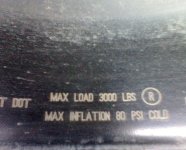
I don't think I misspoke.I know Split rims like some trailer wheels have max pressure ratings. One piece and alloy and steel don't that I know of. Bending forces yes. If you have some documentation though I would love to see it. I will make a few calls tomorrow.

after a bit more reading, it seems as tho they also are sometimes stamped inside the air chamber. so the tire would have to be dismounted to see it.

I looked, but couldn't find anything solid. just hearsay.
but, I do know that when I was busting tires for a living, that I did in fact see pressure ratings stamped on wheels. 65psi comes to mind. but I was unable to even find a picture showing that.
just to confirm this.


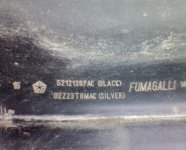
these are from a 2015 dodge 3500. from a few months ago. I forgot they were on my phone.

I knew I wasn't crazy, and had seen wheels rated before also.
 

Attachments

  • 1027151436a.jpg
    1027151436a.jpg
    136.6 KB · Views: 276
  • 1027151437a.jpg
    1027151437a.jpg
    128.1 KB · Views: 247
If this can handle 140psi - I think a typical OEM wheel is just fine at 80psi. But it is an interesting question.
notubes-grail-gravel-cx-tubeless-cxmagazine-img_5008-c_1.jpg
 
just to confirm this.


these are from a 2015 dodge 3500. from a few months ago. I forgot they were on my phone.

I knew I wasn't crazy, and had seen wheels rated before also.

You're right.

Back in the day, when I worked on consumer vehicles, I also saw plenty of wheels that were marked with a maximum PSI rating for the wheel itself.

Back before TPMS sensors became common place, rubber valve stems also had a maximum PSI rating. They still do, for older vehicles without TPMS sensors.

I'm amazed at how many tire store employees are clueless about the products they sell.

On Saturday, I found myself educating a 15 year Discount Tire store manager on the fact that P-rated tire load capacity is to be de-rated by a factor of 1.10 (fairly close to 10%) when they are used on Light Trucks and SUV's, according to Federal Motor Vehicle Safety Standards.

He claimed to have no knowledge of that, so I had him Google it. Imagine his surprise when he found I was right.
 
just to confirm this.


these are from a 2015 dodge 3500. from a few months ago. I forgot they were on my phone.

I knew I wasn't crazy, and had seen wheels rated before also.

Any wheel can fracture and/or explode under pressure, just to get that out there. My whole point was "reasonably." Will it fracture or explode before the tire does? No way, unless, as I said before, the two piece split rims or the old two piece welded rims. Also depends on the rim construction, material, damages, etc. Don't worry about the rim before you worry about the tire is the point.
[MENTION=118321]Jetboy[/MENTION], sure those bike rims will handle 140 psi. One big reason it there is a lot less "i's" to square even with a lot of "p's" lol compared to a big truck rim.
 
Interesting thread, I am going with -

*Any tire that an average consumer can get their hands on and fits the OEM wheel size will blow out long before you deform the wheel due to the air pressure. *

Good discussion btw, learned something
 
Interesting thread, I am going with -

*Any tire that an average consumer can get their hands on and fits the OEM wheel size will blow out long before you deform the wheel due to the air pressure. *

Good discussion btw, learned something

I think I'd agree - but I really have no basis other than that I've never heard of a wheel failing from overpressure and lots of tires do.

I'd be kinda curious to see what it would actually take to make a wheel fail and where/how the failure would occur. My guess based on nothing other than guessing is that somewhere along the flat part of the rim hoop would "pop" before the rim lip area would fail.
 
just to confirm this.


these are from a 2015 dodge 3500. from a few months ago. I forgot they were on my phone.

I knew I wasn't crazy, and had seen wheels rated before also.

I would call that more of a copout than a maximum pressure. E rated tires have a max PSI of 80psi. Only real reason to go past max pressure of most tires is in seating the bead, but I can't imagine any reasonable tire needing more than (or anywhere near) 80 psi.
 

Members online

No members online now.

Forum statistics

Threads
278,316
Messages
3,554,111
Members
248,016
Latest member
Advally Service

Trending content

Back
Top