Suggestions for Icy roads?

A lot of strange answers on this one!

A few people have said this, but not many. On ice, a tire won't make much of a different unless they're studded or have chains around them. I've run most tires in snow and ice, and all perform the same on ice with the exception of studded or chained. Driving slower, and braking further in advance will help, but that has zero to do with the tires. Adding weight is questionable since that helps with gaining traction in the rear rather than helping when sliding on ice.

Just my .02

Mike
 
A lot of strange answers on this one!

A few people have said this, but not many. On ice, a tire won't make much of a different unless they're studded or have chains around them. I've run most tires in snow and ice, and all perform the same on ice with the exception of studded or chained. Driving slower, and braking further in advance will help, but that has zero to do with the tires. Adding weight is questionable since that helps with gaining traction in the rear rather than helping when sliding on ice.

Just my .02

Mike

Agreed. Perhaps people's definition of ice on the road is different. When there is ice on the roads in Kansas City, you are absolutely insane to drive because the road is a sheet of ice, nothing else. You've got no control. Hell, you can't even walk on it without falling down.

Maybe when people say ice, it's a combo of rough ice and snow. In that case, it is possible to drive on it, albeit very slowly and cautiously.
 
Based on years of personal experience, I can tell you that all other things being equal, a narrower Snow and Ice rated tire will do better on hard packed snow and ice than a wider tire. The theory is that you maximize the number of pounds per square inch of contact surface to dig in. Just look at any World Rally Car (WRC) set up for a snow and ice race and you'll see that in motion.

On the other hand, if you're breaking trails in deep snow out in the middle of nowhere, a wider tire (and lower inflation pressure) will do better because it allows you to "float" up on top of everything. Just Google the Top Gear UK episode where they drove specially prepared Toyota 4x4 trucks to the North Pole. And yes, they made it.

This makes a lot of sense. So for street in town driving you’re generally better off with narrow tires where off-road you’re better off with wide tires.

Thanks!
 
This makes a lot of sense. So for street in town driving you’re generally better off with narrow tires where off-road you’re better off with wide tires.

Thanks!


Sometimes. It depends on the specific terrain and situation.
 
Yes I’m quite aware of that. There will always be exceptions to the rules. That’s why I said you’re “generally” better off off and not “always”

I would say just the opposite, "generally".

In most 4wd trail situations, I prefer skinny tires. On-road, my best handling car has very wide, sticky, low-profile tires.

Which is why I said it depends.
 
If you have a different opinion that fine but you didn’t state that in your original comment which was vague and it didn’t really tell me anything.
 
Last edited:
Since this thread has gotten so long I figure I would give some input with my experience so far.

I got rid of the stock dunlops at 50 miles and have been on K02's since 2018 until this winter. They performed fine in snow and light ice in 4hi as long as I drive mindfully.

I would say in comparison to my 07 camry that I used to have blizzaks on, the handling was very similar but the blizzaks wear out quickly and are considered degraded when tread is at 50% due to the foam compound. The 4runner still handled better and more predictably and does not have understeer in snow/slush like the camry did.

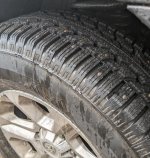
This winter I put Nokian LT3 studded tires on the oem wheels and have been using them. I would say in snow/slush performance is about 20% better than k02's. On ice probably 30% better and much more predictable. The studs are not super aggressive and there are not a ton of them, so driving on bare(but cold) pavement does not suffer. Much more planted and predictable for winter driving. I can still break traction in sharp turns but it is much more controllable.

I see other people with normal tires or MT's slipping and sliding around or not stable and it feels like normal driving for me with the snow tires. k02's were good but there is a definite difference mostly on ice or with stopping distances.
 
Yes, I'm surprised this one is still going as well. It's very difficult, if not impossible to beat a set of dedicated winter tires with studs for snow and ice driving. That being said, even they don't work GREAT on ice. You still need to be very careful, but you'll be FAR ahead of anyone without them.
 

Attachments

  • PXL_20220203_141157006.jpg
    PXL_20220203_141157006.jpg
    135.2 KB · Views: 271
Modern electronics work well. But not as well as mechanical linkage. It would require time travel for electronic brake force distribution to equal mechanical linkage.

It starts with a basic idea of the threshold of motion. At any level of brake force applied to the tire/road interface before it skids, the friction force equals the applied force. And 2wd and 4x4 cars will stop similarly. That holds true until you reach the threshold of motion. The threshold of motion is the point at which the applied force exceeds the maximum static friction - this is where you start to skid. Once you start to skid you are now in a state of kinetic friction with the surface. The the graph at the bottom shows this threshold at different deltas between static and kinetic. On snow and ice the delta is significant. Often 10:1 or greater.

Braking system on most vehicles is friction surfaces actuated by hydraulic pressure. Each tire’s brake operates largely independent of the other tires brakes and the vehicle using software and mechanical systems attempts to apply approximately similar normal force adjusted (weight on the tire) braking force. The idea being if there is a uniform road surface and brake force is adjusted to match the weight on the tire, it'll reach the threshold of motion about the same time as the other tires.

The assumption of uniform surface does not hold in snow and ice conditions. At any given time on snow and ice each tire may have significantly different contact patch conditions with the underlying surface. This would be represented on the graph as having the peak static friction (or threshold of motion) being different for each tire and varying rapidly with time/movement as the tire rolls over the variable snow and ice road surface. And that is something that an ECU cannot know, calculate, or adjust for until a tire has already slipped and the signal from the hall effect sensor in the ABS system registers a slip. (This is why it would require time travel for a current ABS system to match mechanical linkage - it would have to detect actual slip in the future, then adjust before it happens.)

The common rotational velocity deceleration with mechanical linked tires (4x4) means all the tires will decelerate together and importantly they will reach the max static friction at the same time. That's the key to stopping faster in this situation. With uncoupled systems (2wd) the first tire to reach max static friction will slip and then the ABS will flutter about the peak friction point giving some less than full braking force as it slips, releases brake force, tires spins again, re applies brake force, and slips again. My guess is the best systems might reach 70%, but I haven't measured it. Might be 50% might be a bit higher. But it's always below 100%.

So to put some really simplified math in here if you have 4 tires that have 5, 10, 15, 20 as the units of static friction at each of the 4 tires and the kinetic friction is 10%, then the linked 4X4 system can achieve the entire combined 50 units of friction with the surface before slipping. The non-linked system will apply uniform brake force to each tire (not the ground after one type slips). So after all 4 tires reach 5 (20 combined) tire 1 slips and starts to slide. Keep applying more brake and at 10 (31 system) tire two slips. And you can keep going to a max of 15 (33 combined units) before tire 3 slips and you’re going to then drop to about 18 combined units. Peak braking friction force applied to stop the car for the uncoupled car is roughly 33 units. Compared to 50 for the coupled system. Under certain conditions the difference is quite large.

The greater the difference between static and kinetic friction and the greater the variability in the road surface the greater the benefit in braking of the mechanical connection. In some conditions it'll be small. In others it'll be quite large. The above represents a snapshot in time, but actual braking is the integral of summation of every moment along the entire stop. And throughout a stop a vehicle may experience points where it has very uniform surface and points where it's significantly varied between each tire's contact patch. Over a stop where there's half a dozen patches of ice and some dry road and some mixed areas - the stopping distance of the 4x4 will end up measurably shorter.

And that's what you see in basically every test of a mechanically linked 4x4 or awd system vs an ABS system. The worst of all would be uncoupling all of the tires if you could shift the transfer case into N at speed as that would effectively disconnect the two rear wheels from each other.

This also does not apply to clutch based awd systems that are open clutch or any other design that is not a mechanical linkage like the Rav4 hybrid that has two independent drive systems. It only works with a true mechanical linkage. It does not have to have locking differentials, because it's transferring torque from traction to non-traction tires, it works in reverse of applied torque from the engine and open diffs work the same as locked in this case. So an awd limited 4Runner will act the same as it would with the center diff locked under braking.

The complete formula for braking distance with static and kinetic friction includes an integral of 4 subfunctions each with a jump discontinuity that varies in magnitude and point of occurrence, so it's very complicated and it would take me a while to even figure out how to write it out on a forum like this. Adding in an abs functionality would make it even more complicated because we'd have to make a bunch of assumptions about the ABS system, processing speed, etc. Maybe I can hand write and take a picture if someone really needs it for some reason.

I'd just rely on empirical results. - go test it. Best part of this is that we can all test it. Any of us who has a 4x4 4Runner can find an icy parking lot and go try it.


Thank you for actually responding with the details and not just writing me off. I submit to your superior wisdom! I hadn't considered the instant/constant mechanical linkage and available friction at each tire versus uniform brake pressure that is filtered after slipping has already occurred.

I definitely plan to try this out.
 
I'm just echoing what some other people have said, but snow tires will drastically improve your handling and stopping. Four wheel drive will help get you moving in snow/ice, but it'll do nothing to help slow you down or stop. Snow tires are well worth the expense IMO even if they wear out faster. I have been in a car that lost control on hard pack snow (when going about 25 mph) and ended up flipping my car into a ditch. I wasn't injured but that shook me up pretty good and I still probably have some sort of PTSD from that accident.

I'm in Denver and frequently make trips up to the mountains. I put Blizzaks on my 4Runner this year and they've been fantastic. I haven't even been able to get the ABS to kick in because the tires grip so well. I've also driven in terrible snow storms over mountain passes and these tires have worked fantastic. I will put snow tires on all my cars every single winter from here on out, it's a little extra insurance to ensure I don't get in accident and mess up my 4Runner or myself or my passengers.
 
i put on coopers st maxx's 50,000 ago. hands down best tires ever. i use 4wd a lot less. tires barely spin, yes they do on ice, but nowhere near other tires i have had, and i tried just about all of those listed here

they are the only commercial off road tires i have ever heard of, and i am sticking with them
 
Agree on dedicated snow tires. I put Blizzak on my new rig after reading the reviews. They are ok. I am not a new driver or aggressive but I find they are not great with any little bit of ice. I struggle to get out of my driveway in 2wd with just a small layer of ice or hard pack. They are fine in 4wd. Just had 16" of snow and it got me through it.

My last 4runner was full-time 4wd which of course helped but I likely will go back to a studded tire next time
 
Thank you for the great explanation on why! I found it quite interesting.

From a physics standpoint, how does vehicle weight relate to snow and ice performance? Everything else being equal, would a heavier vehicle perform better or worse than a lighter vehicle. It would seem that heavier would mean increased traction due to the increased force on the tires and surface, but it would also mean more mass to try to stop, turn, etc.

This depends a lot on the conditions. On packed snow or ice, the weight of the vehicle should be offset by the increase in friction force. In the very simplistic friction model - a weight doesn't matter. Heavy and light vehicles have the same stopping distance. That's what you'd see in a physics 101 type analysis. And it does tend to fit with experience on uniform surfaces like dry pavement. It's why a very heavy Tesla can still accelerate faster than most supercars on relatively narrow tires.

That modeling rarely represents real world conditions for snow and ice that are far more complex and variable.

In the real world snow and ice have a great deal of variability. There is some mechanical keying where the tires sipes and tread block edges might grip or dig into the snow or ice. So there's probably situations where either one would be better than the other. Heavier vehicles with the same tires might push the biting edges deeper into the surface texture and improve stopping. OTOH a light vehicle might cause less localized temperature rise and end up with less melting water film or some other benefit. Based just on intuition from experience, I would guess in general that lighter vehicles will perform better in most cases.

In deeper snow than a few inches - lower ground pressure is the answer almost universally. I'm not aware of any scenario where a heavier vehicle or narrower tires would perform better in deep snow than wider ones. Snow chains or studded tires also have no meaningful benefit in deeper snow. You'll never see them used on arctic trucks or other vehicles setup for deep snow.

So there's probably no easy answer except for deep snow where the answer is lighter is always better.
 
I live in the Tetons. We have severe winter for about 6 months ever year. They also don’t plow much, so our roads are ice for about 5 months out of the year. Here you have to start slowing down for intersections as soon as you see them.

Get Nokian Hakkepellita (or however you spell it) studded and use your 4wd except on dry pavement. And start stopping wayyyy before the intersection.
 

Members online

No members online now.

Forum statistics

Threads
278,312
Messages
3,554,083
Members
248,016
Latest member
Advally Service

Trending content

Back
Top