TC Acutator - To use or Not to use

drallan

New member
All,
Recently purchased (early jan 15) an 04 v8 w/ the full-time AWD and Lo / Diff lock TC. During the test drive I got underneath and didn't see any leaks or fluids anywhere and other than a CV boot it passed MD inspection (for those not familiar w/ MD inspections, they are pretty rigorous). I asked the PO how often she used either the diff lock or Lo, and she said that it in the 7-8 years she owned the vehicle she hadn't touched the switch/button. I then drove it off into a field and switched into 4Lo and locked the diff to make sure the actuator wasn't stuck. Both operated and worked as expected. I buy the truck. Yay all is happy!!

Fast forward a few weeks - I start to notice spots under the vehicle and identify them as gear lube drops from the TC actuator. I check the fluid level and end up adding 1/2 a quart. Being the middle of winter (no garage) and not wanting to hear from my wife grief about having to do major work to a car we just bought I decide to try the White Shepard / Blue Devil fix. And what do you know, after about a week or 2 the drops stop. I leave the stuff in for 2 weeks and do a complete drain/fill w/ Valvoline Synthetic and maybe a 1/4 oz of WS (used a meat injector syringe).

Fast forward to now. So it has been 6-8 weeks and I haven't had any major leakage issues. No driveway drops I've checked the fluid every couple of weeks and it's always been full (light dribble comes out of fill plug). I have NOT used either the 4lo or Diff lock since the initial test drive. Fortunately the AWD has worked well enough for wife to get around, and I still have my '99 that we use for heavy stuff.

So, to my question. Now that it looks like the weather should start turning (after we get past this last storm), should I try and use the 4Lo or Center diff lock?

Half of me says "If it ain't broke, don't fix it". It's not leaking and as it is my wife's DD, I doubt she ever really need either. Worst case scenario if I start messing with it is that the actuator gets stuck or the seals start leaking again.

The other half of me hates knowing that something is wrong and not doing anything about it. Worst case scenario I leave it alone and Murphy's law kicks in and the seals decide to go on their own in the worst possible time, like a long road trip etc.

I've read the write ups and it doesn't look like that complicated of a job. I'm fairly competent mechanically and it looks like if you take your time shouldn't be to difficult. Hardest part might be getting TC on an off w/ my limited tools. I have all the seals - 2 actuator orings (got an extra), 4 shift fork seals from colonial seal (got extras) and 2 new output shaft seals.

I am more concerned about the seals holding than I am the actuator sticking (as long as its stuck unlocked in 4Hi). If it continues to hold fluid but I don't get to use the diff or lo I'm fine with that. Opinions? Should I cycle the actuator and try to keep the gears lubed and seals fresh or leave it alone?
 
Register to hide this ad
I would think that not cycling the actuators would help the seals last longer; they wouldn't have to seal against a sliding surface, and they'd still have a face that's routinely bathed in oil so I doubt they'd dry out. I haven't really seen any posts for or against cycling the actuators to preserve the seals, but I'm pretty sure I have seen a few posts about the TC leaking even when the actuators are rarely / never used. If your seals are going bad it could help to not cycle the actuators, but it might still leak anyway.

That being said, avoiding use of the actuators is a good way to ensure they won't function in few more years. Once the weather improves a bit, why not cycle them several times and see if the seals continue to hold? Your blue devil fix may keep working, and it sounds like you already have the seals and the determination to dive in and fix the actuator if it starts leaking again. While you're pretty sure you won't need the center diff lock / 4lo anytime in the future, needing it and pressing the button to find out it's not there is not a fun situation to be in even once.

I wouldn't worry too much about the seals failing during a long road trip or other inopportune time; they seem to leak a small amount at a time, so you wouldn't suddenly hemorrhage all of your gear oil.

And if you do decide to tear into the TC actuator, please take pictures and post a writeup - including reassembly and installation! All the ones I've seen cover removal and teardown, but nothing about how to time the actuator shafts with the actuator drive gears (maybe it's obvious from removal, I haven't had to do mine yet).
 
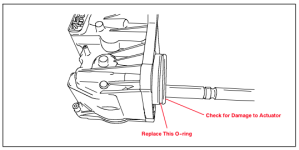
Usually the problem with the acuator leak is the o-ring, not the seals. I would get under there and see if you can identify exactly where the leak is coming from. If you see oil where the actuator goes into the TC then it is the o-ring. If not then it is the seals and leaking from inside the TC through the actuator seals and out the actuator where the cover is screwed on. You may be able to take the cover off and see if it is dry inside but I'm not sure if that cover holds anything in place inside the actuator so study up before you do that. Mine leaked at the o-ring and when I took the TC apart and actuator off the seals were fine, o-ring was shot.

If it is the o-ring then exercising the actuator should have no impact on the leak. If it's the seals then you may want to hold off on exercising the actuator which wouldn't be a big deal.
 
Usually the problem with the acuator leak is the o-ring, not the seals.

What other seals are there aside from the o-rings sealing the shafts? I've never had mine off so I'm a bit uneducated here, the o-rings were what I was referring to by "seals" in my previous post. Sorry for any confusion!
 
Thanks for the replies. I'll probably wait a few more weeks until the weather is clear and cycle her a few times. Doesn't sound like if it starts leaking again that it would be a catastrophic failure as long as I keep an eye on it during extended trips. But I have read a few threads about people not being able to get them to shift out of 2lo when not used regularly. Does the vehicle have to move in order for the shifting to occur? I know you put it in park befor dropping into low, but does it take a few turns for that to happen? I'd like to do it in the driveway (no driving, just shifting) That way if something goes wrong or the motor decides to lock up, I'll be able to take care of it without getting towed.

Not really sure where the leak is coming from, tried to get a look but was difficult to say. If I had to guess I'd say it's not from one of the shift fork shaft seals and more likely the Oring because it appears on the surface to be leaking where the motor meets the case and not from inside the motor. That being said, I'm not sure why using the actuator after a years of no use would cause that Oring to leak because nothing moves on that seal. I was thinking that some of the rubber seal was stuck to a shaft and it tore a bit when it moved. But I could be wrong. It's possible the motor is filled with fluid and just leaking the motor housing up front. Not really sure I want to open the motor on the vehicle and risk having parts fall out.

http://www.toyota-4runner.org/4th-gen-t4rs/135727-installing-used-transfer-case-actuator-motor.html
I have linked a different thread w a diagram. If you look in the top right corner of the diagram you see the motor (might want to blow it up). There is a seal that goes on each of the shafts and then a larger Oring that goes around that larger circle they come out of. On top of that there are seals that connect to each of the driveshafts.

I can't find the thread right now, but there is a good one on this forum where someone removed the whole Tcase, cracks it open and properly replaces the seals. I'll see if I can find it. I'm not doing the ones where they attempt to do it from the outside while still on vehicle. It Doesn't look like a difficult job, just a long one to make sure everything is done right. It also looks like if you properly remove the actuator and don't open the motor up timing isn't an issue. The shift shafts should be pretty obvious where they bolt. The timing issues appear to be from when people try to mess with the motor and all the little gears inside it.

I've done a few timing belts, water pumps and oil pumps in my day (on different cars) so I don't figure this to be much worse. If anything might be easier if I can get the whole unit inside with good room and lighting and take my time.
 
Last edited:
Thanks for the replies. I'll probably wait a few more weeks until the weather is clear and cycle her a few times. Doesn't sound like if it starts leaking again that it would be a catastrophic failure as long as I keep an eye on it during extended trips. But I have read a few threads about people not being able to get them to shift out of 2lo when not used regularly. Does the vehicle have to move in order for the shifting to occur? I know you put it in park befor dropping into low, but does it take a few turns for that to happen? I'd like to do it in the driveway (no driving, just shifting) That way if something goes wrong or the motor decides to lock up, I'll be able to take care of it without getting towed.

Not really sure where the leak is coming from, tried to get a look but was difficult to say. If I had to guess I'd say it's not from one of the shift fork shaft seals and more likely the Oring because it appears on the surface to be leaking where the motor meets the case and not from inside the motor. That being said, I'm not sure why using the actuator after a years of no use would cause that Oring to leak because nothing moves on that seal. I was thinking that some of the rubber seal was stuck to a shaft and it tore a bit when it moved. But I could be wrong. It's possible the motor is filled with fluid and just leaking the motor housing up front. Not really sure I want to open the motor on the vehicle and risk having parts fall out.

http://www.toyota-4runner.org/4th-gen-t4rs/135727-installing-used-transfer-case-actuator-motor.html
I have linked a different thread w a diagram. If you look in the top right corner of the diagram you see the motor (might want to blow it up). There is a seal that goes on each of the shafts and then a larger Oring that goes around that larger circle they come out of. On top of that there are seals that connect to each of the driveshafts.

I can't find the thread right now, but there is a good one on this forum where someone removed the whole Tcase, cracks it open and properly replaces the seals. I'll see if I can find it. I'm not doing the ones where they attempt to do it from the outside while still on vehicle. It Doesn't look like a difficult job, just a long one to make sure everything is done right. It also looks like if you properly remove the actuator and don't open the motor up timing isn't an issue. The shift shafts should be pretty obvious where they bolt. The timing issues appear to be from when people try to mess with the motor and all the little gears inside it.

I've done a few timing belts, water pumps and oil pumps in my day (on different cars) so I don't figure this to be much worse. If anything might be easier if I can get the whole unit inside with good room and lighting and take my time.

You're looking for this thread I assume?

http://www.toyota-4runner.org/4th-gen-t4rs/182074-fixing-transfer-case-shift-motor-leak-within.html

I actually added it to the http://www.toyota-4runner.org/4th-gen-t4rs/132953-toolbox-how-use.html#post1272380 Sticky a while back because it was such a well done write-up!

Which reminds me I need to get around to updating some of that information and adding some more write-ups to that section eventually... :spider:
 
What other seals are there aside from the o-rings sealing the shafts? I've never had mine off so I'm a bit uneducated here, the o-rings were what I was referring to by "seals" in my previous post. Sorry for any confusion!

The o-ring is P/N 90301-56009. The location on the actuator where it goes is shown in the attached diagram. Read up on the thread in the prior post and you will see what I am referring to. The seals that seal the actuator shafts are different.
 

Attachments

  • Screen Shot 2015-03-07 at 8.23.27 PM.png
    Screen Shot 2015-03-07 at 8.23.27 PM.png
    39 KB · Views: 301

Members online

Forum statistics

Threads
278,312
Messages
3,554,089
Members
248,016
Latest member
Advally Service

Trending content

Back
Top