Thread w/ Q's & INFO on towing... (Different from others!)

pjbrownva

New member
This thread is for advice and data-based suggestions regarding towing.

There are four parts to this initial post:

I) GOAL OF THIS THREAD

II) MY EQUIPMENT

III) MY QUESTIONS

IV) TIPS & INFO ABOUT TOWING

so here we go!!! :zoom:

-------------------------

I) GOAL OF THIS THREAD :crazy:

I have several questions that I'd like to get input on....

I hope to ask questions and get & provide information in a way that helps me & others determine the best answer for their situation, and to shed some light on how to determine the "best" answer.

This thread is different (I hope) from the many other threads on towing, because I hope to go a little deeper than just asking:

"can I tow XX pounds with my 4R?",
"do I have an aux tranny cooler?", or
"can I add the tow package to my T4R"​


--------------------------

II) MY EQUIPMENT :car:

--> 2008 V8 Limited 4x4 w/ sealed 5 speed auto transmission.

--> Factory auxiliary transmission cooler.
(Open the hood & look in front of the factory radiator to check)
(If this thread gets enough posts... I may return to edit this post
to include a photo of the cooler to help others see if they have it too.)

--> Factory tow hitch and wiring harness
(plus pre-wired for trailer brake controller w/ included wiring adapter)

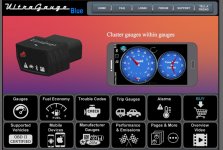
--> Aftermarket OBDC II Tranny Temp gauge w/ indicator showing when torque converter is locked and unlocked.

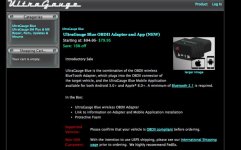
(I have the Ultra-gauge blue, an OBDCII bluetooth dongle that uses my smart phone to display the tranny temp & whether the torque converter is locked or unlocked... plus lots more info. I contacted customer support, and they updated their servers to include tranny temp info for my model T4R -- they were VERY helpful & responsive.)

--> 5th Gen Brake upgrade -- Calipers, Rotors, Akebono ceramic pads, & Stainless steel brake lines --all six lines. (Search forum for more info. Use 4th gen for rear rotor. Everything else use 5th gen parts. Pads are the same for 4th & 5th gen, but upgraded pads can perform better and last longer)


-->Transmission fluid replacement -- 12 quarts Toyota WS Fluid, 2 quarts at a time, via the aux transmission cooler line. (Search this forum for info on the procedure... or if this thread gets enough traction, I'll update this post w/ a link)


----------------------------------------------

III) MY QUESTIONS :shrug:

I'm looking for input and advice to determine:

1) Is the factory aux transmission cooler sufficient for towing my 4000 lb boat & trailer (total weight)?

2) How to empirically determine if/when I need more cooling for the transmission?
(This is the more generic version of question 1, which will help more people).

3) To provide & solicit other tips and advice on towing.


-------------------------------------------

IV) TIPS & INFO ABOUT TOWNING :horn:

(I'll add some tips & info in my next post)
 
Last edited:
Register to hide this ad
This thread is for advice and data-based suggestions regarding towing.

IV) TIPS & INFO ABOUT TOWNING :horn:

(I'll add some tips & info in my next post)

To get the ball rolling..
(and because -- if you haven't already noticed -- I love quoting myself. It makes me feel special! :nod: :crazy: )​

**)Every 4th gen that came with a factory tow bar is rated for a maximum towing amount. It differs based on V6 vs V8, and 2wd vs 4wd.

I don't know about 4th gens w/o a factory tow hitch. If anyone has better data, maybe they could post a table or a chart showing more detailed specs broken down by version of the 4th gen.

**) I've had two 4th gens (a 2004 V6 SR5 4x4, & now a 2008 4x4 V8 Limited, and both had factory tow hitches. Both also had a factory aux transmission cooler. Look under your hood. If you have it, it will be plainly visible, in front of your radiator, slightly right of center (towards the passenger side). It looks just like a small radiator, and it is a separate unit in front of the main radiator).

**) I know that the V8's are rated to pull more than the V6's. I don't have the specs available right now. I also believe that the 2wd are rated slightly higher than the 4wd. Also, IIRC, the fine print in the Toyota literature lists max towing capacities, and then has a foot note referring to "when properly equipped" or "with proper equipment" (something like that) -- but I haven't seen specifically what they mean by that.

**) My trailer has one axel w/ two tires and a boat. The whole thing weights about 4000 lbs. When I towed with my V6, it was sometimes unstable at speeds above 60 MPH. Sometimes the trailer would sway from side to side or start to make the back of the 4R bounce up and down excessively. Slowing down always helped fix the problem.

**) Towing the same trailer with my V8 limited is MUCH better. Although I have a bigger engine, I suspect that the real difference is my suspension. My V6 had factory springs and shocks and 100K+ miles.

While my V8 has 100K+ miles, as soon as I bought it (used), I upgraded the suspension by adding:


* Blistien 5100 shocks all around (fronts set on the 2nd from lowest perch)
* FJ Cruiser Coil Springs front & rear
* 1.5" rear daystar spacer
(driver's side only. IT helps level the height left-to-right)
* 5th Gen brake upgrade -- calipers, rotors & Akebono ceramic pads
* Stainless Steel brake lines (all six lines)
* Brake line fluid flush -- using stainless steel speedbleeders & dot 5.1 fluid
* Transmission fluid replacement via aux cooler line method. 1 case, genuine Toyota WS fluid
* Airride rear coil booster springs (but they leak... so they don't work... yet).
* Poly urethan sway bar bushings front & rear (the ones with a grease nipple so I can add more lube to prevent squeaking noises)
* Heavy duty sway bar end links (front and rear) purchased from [MENTION=98153]MStudt[/MENTION] (see this link). (My sway bar links were worn out... so I figured I'd buy MStudt's. I like them. They are very heavy duty. I don't really know if heavier duty improves the handling or not... but I needed new ones anyway, and these look like they'll last forever... plus they MIGHT increase handling... I don't really know).


Of these upgrades, I suspect that the towing improvement is primarily due to the Bilstien 5100 shocks and genuine Toyota FJ cruiser springs (which are heavier duty than the factory T4R). The sway bar bushings and upgraded sway bar end links might also help. The trailer doesn't sway at all, and the bouncing is almost nonexistent.

**) Transmission Temp -- I believe that monitoring the transmission temperature is the best way to determine if you need an auxiliary transmission cooler, or if you need a larger or additional one. My ultra-gauge blue tells me the trans temp, and tells me when the torque converter is locked and when it is unlocked. Normally, in mild weather (up to 60 degrees F), my transmission is about 150F to 170F. When towing in weather up to 70F, I've seen it approach 200F. I haven't towed on hot days (yet), and I haven't towed where there are many steep hills or mountains, so I don't yet know my tranny temps under those conditions.

I have observed that temps can be lower at highway speeds than on regular streets and roads. I guess there is more air for cooling. I also *thinK* i've observed that my torque converter stays unlocked if I change my shift lever from "D" to "4" or "3". I've read that your tranny heats up faster when the torque converter is unlocked. I have to tow under more conditions and continue to observe.

QUESTION
Anyone have input on what tranny temp range should make me consider putting in a larger aux trans cooler, or even a second one? In July, I plan to tow about 1200 miles round trip, and will go through some "mountains" in CT & RI (out West, you would call these small hills!).

I'm thinking that if my trans temp EVER gets about 215F, that I want to make some changes to allow it to run cooler, but I don't know if that is a realistic range, both in terms of the ability to keep the trans under 215 F while towing up hill on a hot day (say 90 F), or whether 215F is a high enough temp to be concerned about.

My (potential) thoughts to increase cooling are:
(Please comment, add opinions, or other options)

1) A larger trans cooler
2) An electric fan in front of the aux trans cooler. (would this help on the Highway, or just be a waste of time and money)... With either a manual switch, or a temp probe to activate it (at what temp should it kick on, and where & how do I mount the probe?)
3) A second Aux trans cooler wired with flow valves so that I can engage or dis-engage it manually as needed. Two potential diagrams are attached.

(I'll edit this add them soon!)


That should be enough to get us started. :-)


-Phil
 
Last edited:
Update on airbag coil boosters & on trans temps while towing...

To get the ball rolling..
(and because -- if you haven't already noticed -- I love quoting myself. It makes me feel special! :nod: :crazy: )​

...

* Airride rear coil booster springs (but they leak... so they don't work... yet).

...


**) Transmission Temp -- I believe that monitoring the transmission temperature is the best way to determine if you need an auxiliary transmission cooler, or if you need a larger or additional one. My ultra-gauge blue tells me the trans temp, and tells me when the torque converter is locked and when it is unlocked. Normally, in mild weather (up to 60 degrees F), my transmission is about 150F to 170F. When towing in weather up to 70F, I've seen it approach 200F. I haven't towed on hot days (yet), and I haven't towed where there are many steep hills or mountains, so I don't yet know my tranny temps under those conditions.

I have observed that temps can be lower at highway speeds than on regular streets and roads. I guess there is more air for cooling. I also *thinK* i've observed that my torque converter stays unlocked if I change my shift lever from "D" to "4" or "3". I've read that your tranny heats up faster when the torque converter is unlocked. I have to tow under more conditions and continue to observe.

QUESTION
Anyone have input on what tranny temp range should make me consider putting in a larger aux trans cooler, or even a second one? In July, I plan to tow about 1200 miles round trip, and will go through some "mountains" in CT & RI (out West, you would call these small hills!).

I'm thinking that if my trans temp EVER gets about 215F, that I want to make some changes to allow it to run cooler, but I don't know if that is a realistic range, both in terms of the ability to keep the trans under 215 F while towing up hill on a hot day (say 90 F), or whether 215F is a high enough temp to be concerned about.

...

-Phil

Here's an update on my towing experience (in case anyone cares!)...


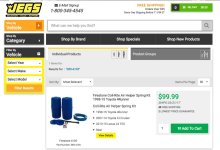
1) Airride rear coil booster


For my leaking Airride rear coil booster springs, I got a free replacement under warranty (all I had to do was email them a photo showing soapy water air bubbles indicating a leak, and the promptly sent me a whole new set)... & the replacement leaked too !!!

coil rite.jpg

Even though I had cut the hose very carefully by "sawing" with a serrated knife as suggested in the instructions, I still had a leak.

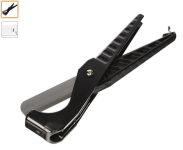
I took it to a shop, and the mechanic there had Razor Blade cutter.
When he cut the hose with the razor blade cutter, and reinserted it into the airbag, all leaks stopped!! It has been fine ever since.

cutter.png

The mechanic told me that having a very precise, ultra clean cut is critical... that even a slightly dull razor blade can cause problems. I guess that's why
he's the professional, and I earn my living a different way. (hehe!)

2) Trans Temp when towing

...had to stop my trip to add a 2nd trans cooler


transcooler.jpg


In August i towed 600 miles each way from Arlington VA to Cape Cod and back.

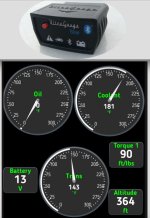
The outside temp was in the 90's F. As I hit the steeper hills / mountains further into Connecticut, my trans temp rose to about 250F and generally stayed in that range...sometimes reaching as high as 275 F !!! Slowing down helped cool the trans some... but not enough to make me comfortable. Additionally, the few times that I hit traffic slow downs, the temp really rose... I learned that even the 90+F air helped to cool the trans, as long as I was going about 40 MPH or faster.

ug6.jpg
(Not my actual reading at the time... but you get the point)


I was mindful of the trans temp throughout the whole trip,
but just couldn't keep the temp down, and it made me uncomfortable.
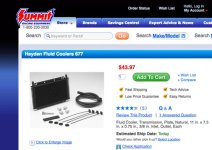
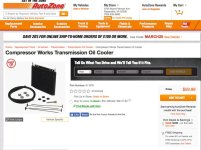
So I decided to stop and install a hayden aux transmission cooler that I had
removed from my previous truck.

Unfortunately, I put too much stress on the aux cooler right where the hose attaches, and caused a crack that started to slowly leak trans fluid. :ybrick:

I used google maps on my phone to find the nearest autozone. I called, and confirmed that they had a Hayden aux trans cooler in stock, removed the broken aux cooler, and drove straight to autozone to buy a replacement and install a replacement on the spot.

cooler2.jpg
(I got the same exact cooler, it was just re-branded)


Although there is already a small factory transmission cooler
in front of the radiator on the driver's side, I decided to add a second
one more near the center of the truck (also in front of the radiator),
and I hooked up the hoses so that it runs in serial with the factory cooler.


I had already brought Toyota WS transfluid & tools with me (including one of the narrow trans fluid funnels), so I was good to go. I was careful not to spill transfluid, and I filled the new trans cooler and new hoses with fluid to see how much fluid they would hold. I poured this into a container with a cap to save, and poured it all back into my system before I did my final connection... that way I knew that my transmission would still filled with fluid, despite the need for additional fluid because of the hoses and the new aux cooler.

About 2 1/2 hrs later, it was in, and I was ready to roll. (It was HOT, so I took several breaks for drinks & even some food... :hungry: I didn't want to over do it, and risk overheating my own body's cooling system!).

Much, much better. :hatsoff:
When I got back on the highway, the trans temp remained closer to 180F to 190F, occasionally reaching 210 F to 215 F for some short bursts, but then always cooling back down fairly quickly.


Remember, I was towing a 4000 lb boat behind me, the 4Runner was fully loaded in the outside temp was in the mid 90 F range.

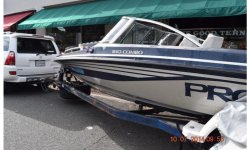
boat.jpg
(Photo of my boat behind my prior 4Runner -- a 2004 SR5 V6 4x4...
my 2008 V8 with the fj cruiser coils, bilstein 5100's and airride bags tows *much* better.)


I used my Ultragauge blue to monitor the trans temp on my phone (it supports apple & android).

ug4.jpg


ug5.jpg

That's all for now... if anyone finds this thread worthwhile, then chime in to comment and/or share info!

I can add photos of my install, plans that I'm considering to add a bypass valve for the 2nd aux trans cooler, and more...

My intent was to start a thread with broadly applicable info on towing and trans cooling, instead of yet another thread that says "I have x, and want to tow y... do I have the two package? Can I pull this? should I change something?"

My goal with this thread is to create a useful and more generally applicable thread on towing and trans temp, but as long as this thread remains a monologue, I'll assume that no one's really interested, and I'm just babbling by myself.

:hello: :hello::hello:
Chime in if you find this worthwhile!
 

Attachments

  • ug4.jpg
    ug4.jpg
    84.7 KB · Views: 435
  • ug5.jpg
    ug5.jpg
    58.3 KB · Views: 432
  • coil rite.jpg
    coil rite.jpg
    81.1 KB · Views: 423
  • transcooler.jpg
    transcooler.jpg
    55 KB · Views: 445
  • cooler2.jpg
    cooler2.jpg
    102.7 KB · Views: 493
  • cutter.png
    cutter.png
    93.6 KB · Views: 437
  • ug6.jpg
    ug6.jpg
    62.8 KB · Views: 452
  • boat.jpg
    boat.jpg
    97.9 KB · Views: 435
Last edited:
This is some good info. if your trans got that hot towing 4k lbs in 90 degree weather i can only imagine how hot mine got last summer towing my first gen home.

i know there's a fan that fits over our OEM cooler almost perfectly. i think its a flexalite fan. its also something to consider to keep temps down.
 
i know there's a fan that fits over our OEM cooler almost perfectly. i think its a flexalite fan. its also something to consider to keep temps down.

Hmm. How valuable is such a thing as preventative maintenance? Especially for those of us who play in the SoCal deserts all summer (summer being March-November here).
 
I have a 2008 SR5 V8 4x4 and we tow a camper that weighs a little over 3k lbs. with everything in it and as we drive through the North Carolina mountains on our way to the beach from TN, I will see temps spike at 230 with my scangauge II. Otherwise, it would normally be under 200. I felt that was pretty normal, but it's nice to know it stayed cooler than 275! I would probably piss my pants if I saw it get that high, but on the plus side, my wife and kids would probably get a good laugh. :D

 
Last edited:
I thought the "A/T TEMP" warning light should trip at 250F?

I've been towing in the Four Corners states for five years, 3100-4000lbs, a Kodiak Hybrid and a Trailmanor with a Tacoma, Tundra and this Runner.

I've depended on the idiot light all that time, so far so good, but obviously a Scanguage and additional trans cooler would be helpful.

In general, if you're in OD and the torque converter unlocks the trans temp will jump up. You can hear the TC unlock, or see the tachometer jump about 400RPM.

As soon as that happens I manually drop it into 4th gear. Towing in hilly terrain I'll leave it in 4th for extended times.

I'm at 110k miles now, about 3000 towing. Not having much maint history on this (Carfax did show a drain and fill at 75k) I'm going to have Toyota do the full trans flush soon.
 
Interested in this thread. I had recently posted up in a couple fb groups asking about max towing capabilities because I'm looking into getting a toy hauler (camper) and I'd like to get the biggest one I can comfortably tow, taking into account planned upgrades to my 2008 Limited V8 4x4.

I have the factory trans cooler. I was looking to add electronic brake control, weight distributing hitch, sway control, upgraded brakes all around, and the Firestone air helper spring kit.

Now I spoke with a guy from Colorado that has the same vehicle I do, with the same mods I listed, and he said he tows his trailer up to 9k#s (fully loaded) up and down all of Colorado's various elevations (up to 11k'!) without issue. He said the key is to take it slow and keep it under 3k rpms.

While I am unlikely to tow 9k#s, I do anticipate towing around 7-8k#s depending on which trailer I end up deciding to go with. The most I've ever towed was around 5500#s through some moderate elevations without anything but the factory cooler and the truck performed flawlessly. But then, I didn't have a trans temp gauge to watch and never had any warning lights come on or have anything else out of the ordinary happen. I do have a wifi obdII reader, which I use with the dash command ios app.

Ultimately, I'd like to be able to tow the trailer across the US and back over the course of a month.
 
Interested in this thread. I had recently posted up in a couple fb groups asking about max towing capabilities because I'm looking into getting a toy hauler (camper) and I'd like to get the biggest one I can comfortably tow, taking into account planned upgrades to my 2008 Limited V8 4x4.

I have the factory trans cooler. I was looking to add electronic brake control, weight distributing hitch, sway control, upgraded brakes all around, and the Firestone air helper spring kit.

Now I spoke with a guy from Colorado that has the same vehicle I do, with the same mods I listed, and he said he tows his trailer up to 9k#s (fully loaded) up and down all of Colorado's various elevations (up to 11k'!) without issue. He said the key is to take it slow and keep it under 3k rpms.

While I am unlikely to tow 9k#s, I do anticipate towing around 7-8k#s depending on which trailer I end up deciding to go with. The most I've ever towed was around 5500#s through some moderate elevations without anything but the factory cooler and the truck performed flawlessly. But then, I didn't have a trans temp gauge to watch and never had any warning lights come on or have anything else out of the ordinary happen. I do have a wifi obdII reader, which I use with the dash command ios app.

Ultimately, I'd like to be able to tow the trailer across the US and back over the course of a month.

The biggest downside to towing with a 4runner is the wheelbase. In my opinion, I would not want to tow something like a toy hauler that is longer than 22-24 ft. I have all of those upgrades you mentioned (Tekonsha P3, airbags, Reese anti sway hitch (bar kind, not the crappy friction sway kind), but there's nothing we can do about wheel base. So, just be careful if you are towing in windy areas. That said, it pulls our 21.5 ft. camper quite well, but I'm sure a Tundra would be better if you plan to tow all the time.
 
Hmm. How valuable is such a thing as preventative maintenance? Especially for those of us who play in the SoCal deserts all summer (summer being March-November here).

OOPS... I meant to reply to the question about installing an aux electric fan... and the answer to that question is:
I don't know... but if anyone installs one and can measure with and without temps, that would be useful to know!
 
Last edited:
Found this info in another thread on this forum.

17644d1222792901-v6-towing-70779-wdh.jpg

This is exactly what I needed to see (since I don't have my owners manual with me right now). Thanks!

I'm planning on doing a long haul trip with my V6 pulling a trailer with my Subaru WRX on the back. It'll probably be over 5k but not by much so I feel a lot better about it as long as I do it all right.

It's got a Class III Reese Hitch so I'll just need the weight distribution setup with a brake controller and an rear air spring kit. I might as well install an additional trans cooler for that warm and fuzzy while monitoring temps with my bluetooth.

Another item I'm considering is some LT tires for the trip.
 
Aside from my tires being bald, when I replaced mine, I went with the KO2's because they were a 10-ply tire. It's probably overkill for the camper I pull, but I'd rather be safe...plus they look cooler and I can do some mild off-roading if I wish.
 
Would an oil cooler be a good idea to install as well, or should that space go to a second trans cooler?


Sent from my iPhone using Tapatalk
 
The short answer is no. If you add anything, add an aux transmission fluid cooler.


The longer answer is:
When I've heard people refer to an "oil cooler", I *think* that it usually means a cooler for the transmission oil, rather than for the engine oil itself.

I *may* be wrong on that... but I can tell you this... you won't need to cool the engine oil. When towing, the extra strain is the hardest on the transmission,
and it's the transmission fluid that gets hotter than normal... sometimes *much* hotter than normal, so it's the transmission fluid that may need additional cooling.

Your truck has an engine temp gauge that you can monitor. Should you notice that the engine temp is running high and heading towards overheating, then you would need to look in to the issue, but even then I wouldn't try to add something to cool the engine oil, but rather I would take the truck to the dealer or to a good specialty shop, and have them determine why the truck is running hot.
 
Last edited:

Thread w/ Q's & INFO on towing... (Different from others!)

Just the 2 cents because this is a great thread. Your tranny fluid rapidly degrades around 225+ degrees, so if you're reaching that, a tranny cooler is definitely needed and change the fluid. Then consider the types of coolers: tube/fin, plate/fin, stacked plate or even stacked plate with built in remote fans, etc. Their cooling efficiency is different and the more efficient, the more money.

Someone asked about installing one of these if they play in the desert; yes, I would. Aux tranny coolers are even good for basic cars that sit in hours of stop/go traffic in high heat. Reducing the temp of transmission fluid by 20 degrees is theorized to almost double the life of the transmission. Is this true? Don't know, but it's inexpensive insurance.

This info for the 4Runner specifically I'm not sure of, but if it's a daily tow vehicle under hard work, you may even consider a power steering cooler. Ours uses ATF so the same degrading of fluid applies and towing increases the temp of power steering fluid if you're more on the steering wheel. Engine oil also heats up more with towing. If you have the ability to monitor these temp and it's not a daily tow vehicle, I personally wouldn't jump to add a cooler. Remember, if you start throwing in multiple large coolers up front, then the radiator isn't getting as much air flow. Consider frame rail coolers or heat sinks at that point.

Lastly, the 4th gen V6 and V8 have the same towing capacity (5K lbs), the V8 just does it with much greater ease. That's why I bought the V8.

Longer, heavier trailers need a weight distribution hitch. Our vehicles are great towers, but as someone already mentioned, that wheel base though! It's smoother and safer with a WD hitch. And don't forget that when you add a WD hitch, the weight is not only the trailer at that point, but all cargo at the point the WD hitch is attached to the vehicle and everything behind it.

Thanks for everyone's contribution to this thread. I'll be following it!


Sent from my iPhone using Tapatalk
 
Last edited:

Hmm. How valuable is such a thing as preventative maintenance? Especially for those of us who play in the SoCal deserts all summer (summer being March-November here).


VERY helpful, I'm sure. An aux trans cooler may help... having a trans temp gauge installed *first* can help you determine if you really need more transmission cooling. There's no point in adding more cooling if your trans isn't getting unusually hot.

Also, having a temp gauge (with or without aux trans cooling) can let you know objectively if you should exchange your trans fluid more often (say every 30K to 40K miles or so). IF you find that you run your trans above 200F for extended periods of time, you may want to change your trans fluid more often.

Update: If you frequently tow and run your trans higher than about 215 F, I would recommend more frequent transmission fluid exchanges. Maybe every 20K miles or so. This goes under the "ounce of prevention..." theory. Fluid exchange == cheap. Trans rebuild == OUCH!!!!
 
Last edited:

VERY helpful, I'm sure. An aux trans cooler may help... having a trans temp gauge installed *first* can help you determine if you really need more transmission cooling. There's no point in adding more cooling if your trans isn't getting unusually hot.


Also, having a temp gauge (with or without aux trans cooling) can let you know objectively if you should exchange your trans fluid more often (say every 30K to 40K miles or so). IF you find that you run your trans above 200F for extended periods of time, you may want to change your trans fluid more often.


Great points! Don't rely on dummy lights. Install temp gauges or go with the wireless OBD II and apps that allow realtime monitoring.


Sent from my iPhone using Tapatalk
 
LT Rated Tires for towing vs Non LT tires

Aside from my tires being bald, when I replaced mine, I went with the KO2's because they were a 10-ply tire. It's probably overkill for the camper I pull, but I'd rather be safe...plus they look cooler and I can do some mild off-roading if I wish.
[MENTION=86000]DrakeMK3[/MENTION] is right that "LT-rated" tires are heavier-duty tires that can better handle towing heavy loads, carrying heavy loads, and commercial abuse...

however, you should note that there are trade-offs, and that SUV tires that aren't LT rated could be a better choice depending on the loads you carry.

Also, it's critical to note that if you use LT-rated tires, you MUST keep your tires inflated at a much higher pressure than tires that are not LT rated. If you fail to do this, you will be running tires that are critically under-inflated, and a critically under-inflated LT-rated tire will carry less weight and handle worse than an a correctly inflated SUV tire that isn't LT-rated.

As I view the world, there are really three types of tires available (just to keep it somewhat simple).

1) P-rated tires are for passenger cars. Don't ever use them on your truck. P-rated aren't designed for the types of use and types of loads that an SUV may encounter. Using P-rated tires on your truck can be dangerous.

2) LT-rated tires are geared more towards heavy duty and commercial use. You run them at higher air pressures. They are tougher, stronger and they stand up better under heavy loads, hauling and general abuse. I'm assuming that they also have a harsher, more "truck like" ride than tires that aren't LT rated.

3) Tires designed for SUVs and light trucks that are neither P-rated nor LT-rated tires.
These are what I run. They are good tires for use on SUVs.
They ride and handle well on-road and they can take heavy loads and tolerate some abuse, although not as much as LT-rated tires.
They also offer a softer, more comfortable ride.

Confusing? Maybe an example and some facts will illuminate the issue:

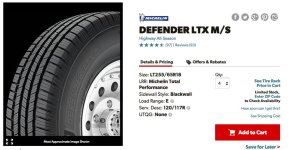
I run these on my 4R:

Tires_michellin_defender_ltx.jpg

Michelin Defender LTX M/S highway all season tires: Size 265/60R18.

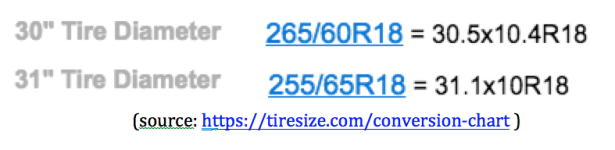
They are 30.5” tires designed for Light Trucks & SUV’s.

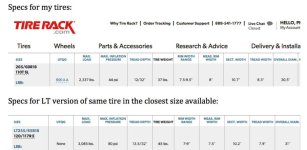
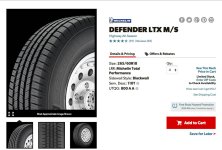
The closest size LT-rated version of the same tire is this:

tire_size_conversion.png


Tires_michellin_defender_LT_Rated_version.jpg


Comparing the specs for each of these tires:

tires_michelin_spec_comarision.jpg


You'll see that:

-- the LT rated tires are each 8 lbs heavier, probably because they are stronger, heavier-duty tires.

-- the LT rated tires can carry more weight per tire (3085 lbs vs 2,337 lbs).

-- the LT rated tires require much higher air pressure in each tire (80 PSI max vs 44 PSI max).

Note that to benefit from the heavier load rating of the LT-rated tire, you MUST run a higher air pressure.
If you normally run your tires at about 40 PSI, if you switch to LT-rated tires, you should run them at at least 60 PSI, and maybe 70 PSI.

Running LT rated tires at lower pressures (such as 40 PSI) is just not good.
Your tires will be drastically under-inflated,
and at these lower pressures they will not be able to carry anywhere near their rated max capacity.

In fact, if you were to compare LT rated tires at 40 PSI to non-LT rated tires also inflated at 40 PSI,
you would find that the non-LT rated tires can handle more weight than their LT-rated brethren.


Also, your tires should match. If you put LT rated tires on the rear, you should put them on the front too.
In fact, in one thread on this forum, a poster with xreas suspension complained of horrible handling with LT tires only on the rear,
and he noted that it improved when he put matching LT tires on the front too. Of course, the xreas system cross-links the suspension for the
front and rear tires, so to that undoubtedly contributed to performance issue.

I thought I'd share this info just to help illuminate the LT-tire issue. It can get a bit confusing, when you realize
that, for example, Michelin "LTX" tires are available in both versions that are LT-rated and versions that are not.

I prefer to run the version that isn't LT-rated.
 

Attachments

  • Tires_michellin_defender_ltx.jpg
    Tires_michellin_defender_ltx.jpg
    96.9 KB · Views: 656
  • Tires_michellin_defender_LT_Rated_version.jpg
    Tires_michellin_defender_LT_Rated_version.jpg
    81 KB · Views: 645
  • tire_size_conversion.png
    tire_size_conversion.png
    59.5 KB · Views: 642
  • tires_michelin_spec_comarision.jpg
    tires_michelin_spec_comarision.jpg
    50.2 KB · Views: 647
Last edited:
Lastly, the 4th gen V6 and V8 have the same towing capacity (5K lbs), the V8 just does it with much greater ease. That's why I bought the V8.

I'm pretty sure my 2008 SR5 V8 is rated at 7000lbs, and the 2WD models were rated at 7300 last time I checked which is not the same as the V6. But regardless, I don't pull anything near that heavy!!

This thread brings up some good points and is useful data for sure. Last summer I pulled my 20' Chris Craft on a custom steel trailer (load around 4200lbs) from Burlington VT to Ithaca NY and back and never had a problem (or so I think). My trailer is a dual axle, with electric over hydraulic disc brakes on both axles, controlled by a tekonsha p3 which definitely helps control the weight.
 

Members online

Forum statistics

Threads
278,312
Messages
3,554,089
Members
248,016
Latest member
Advally Service

Trending content

Back
Top