I agree! What are the best aftermarket coolers out there? Brand wise that isBaba Booey said:Wow! I just got off the phone with my dealer, and they want $347.50 for a "Tacoma" transmission oil cooler. The guy asked me if I needed prices for the lines and other mounting stuff, and I said no, I have heard enough.
I called Partznet, and they want $250.47 for the "V8" 4Runner cooler - again I said don't worry about the lines, etc.
It looks like if I want to add a cooler, I will probably go with a Hayden for about $50 - $60.
Where does Toyota get off charging $350 for a $50 part?

You are using an out of date browser. It may not display this or other websites correctly.
You should upgrade or use an alternative browser.
You should upgrade or use an alternative browser.
Towing with the 2005 V6 4Runner
- Thread starter cmj685
- Start date

charlier180
New member
Baba Booey said:From his signature, it looks like LV4R is running 22" 40s.
Yes, the 265/40/22s sized tires is what I was referring to in my previous post.

LV4R
New member
charlier180 said:Sounds like the manual has indeed been changed since my '04 came out. In your particular case I would be somewhat concerned towing that much weight with the tires you are running according to your sig. Not much tire for the extra stress towing that much weight will place on them. Just curious, does the tire manufacturer have any warnings about using this size/model tire for heavy towing?
A tire failure when towing can/will have disasterous consequences.
Good looking out charlier180! I wont be using those wheels and rims if I do tow that load. I will switch back to my stock rims and wheels which I still have kicking around. I would never trust the nittos with that load.
I picked up my hayden at autozone for $62 and installed it myself. It was rather easy and there is a sticky thread of my install in the accessories forum if you want to check it out. I do not see the need to pay the dealer the outrageous prices to do something this simple. If anything would happen where the transmission would have a problem under warranty they would have to prove that my install of the trans cooler is what caused the problem. A trans cooler can only help unless you live in the arctic
 . When I called them they told me the same thing that it would cost $350 for the part plus other materials!! Pretty simple to install. Took me about 2 hours after messing around with the mounting location for a while.
mtnracer
New member
I am confused. It seems there are all kinds of different hitches, coolers and ratings for the same truck. Looks like Toyota made many changes over the years.
I have a 2003 V8 4x4 4R that was built in late 2002. I do have a small radiator in front of the main radiator so I guess I have the tranny cooler already.
My hitch is essentially just bolted to the frame with two big bolts. Not sure what the weight distributing hitch looks like. The truck also came with a class IV ball mount rated to 10,000lb made by Toyota.
How can I tell what the actual tow rating of my truck is? 5000lbs or 7000lbs. I'm planning on buying a travel trailer in the near future so this will be important. Maybe it's time to call toyota and just give them my VIN.
Any info is appreciated.
I have a 2003 V8 4x4 4R that was built in late 2002. I do have a small radiator in front of the main radiator so I guess I have the tranny cooler already.
My hitch is essentially just bolted to the frame with two big bolts. Not sure what the weight distributing hitch looks like. The truck also came with a class IV ball mount rated to 10,000lb made by Toyota.
How can I tell what the actual tow rating of my truck is? 5000lbs or 7000lbs. I'm planning on buying a travel trailer in the near future so this will be important. Maybe it's time to call toyota and just give them my VIN.
Any info is appreciated.
That small radiator is your for AC.mtnracer said:I am confused. It seems there are all kinds of different hitches, coolers and ratings for the same truck. Looks like Toyota made many changes over the years.
I have a 2003 V8 4x4 4R that was built in late 2002. I do have a small radiator in front of the main radiator so I guess I have the tranny cooler already.
How can I tell what the actual tow rating of my truck is? 5000lbs or 7000lbs. I'm planning on buying a travel trailer in the near future so this will be important. Maybe it's time to call toyota and just give them my VIN.
Any info is appreciated.
If you have a V6 you have 5k limit, but add in a WB Hitch and cooler any you might be ok with 7k.
mtnracer
New member
Thanks for the info about the small A/C radiator. I have the V8 4x4. Should the limit then be 7K lbs?
rweddy1 said:That small radiator is your for AC.
If you have a V6 you have 5k limit, but add in a WB Hitch and cooler any you might be ok with 7k.
mtnracer
New member
I just got off the phone with Toyota USA. I actually gave them my VIN and they could not tell me if the towing capacity should be 5K or 7K lbs. How ridiculous is that! They actually referred me back to my dealer.
I even asked specific questions about mid year changes to the hitch and towing package and they didn't have a clue. When asked if they could research this with Toyota Japan they said that the dealer would be a better source of information.
Has anyone here actually replaced the built in factory hitch with an aftermarket WDH? Is this necessary to get my tow rating to 7K lbs?
I even asked specific questions about mid year changes to the hitch and towing package and they didn't have a clue. When asked if they could research this with Toyota Japan they said that the dealer would be a better source of information.
Has anyone here actually replaced the built in factory hitch with an aftermarket WDH? Is this necessary to get my tow rating to 7K lbs?
mtnracer said:Thanks for the info about the small A/C radiator. I have the V8 4x4. Should the limit then be 7K lbs?
Baba Booey
New member
mtnracer said:I just got off the phone with Toyota USA. I actually gave them my VIN and they could not tell me if the towing capacity should be 5K or 7K lbs. How ridiculous is that! They actually referred me back to my dealer.
I even asked specific questions about mid year changes to the hitch and towing package and they didn't have a clue. When asked if they could research this with Toyota Japan they said that the dealer would be a better source of information.
Has anyone here actually replaced the built in factory hitch with an aftermarket WDH? Is this necessary to get my tow rating to 7K lbs?
A few months ago, there was a member here who wanted to swap an OEM weight distributing hitch for a weight bearing hitch. IIRR, he was installing some sort of rear bumper accessory, and the weight distributing hitch got in the way.
Maybe you can do a search or create a post requesting a swap.

Uneek
Super Moderator
All V8s have an additional transmission oil cooler. I believe it was mid 2003 that V8s got the weight distributing hitch, capacity is up to 7k lbs on the V8 4x4. The WD hitch is a tubular looking hitch which attaches to the frame rails that run length wise with the truck. You will be able to see the tube under the bumper.
The weight carrying hitch on the V6 just has a the small receiver opening and it's attached to last cross member on the truck's frame.
Another way to tell the WD and the WC hitch apart is look at the '06 4Runners on the dealer's lot. All V8's will come standard with the WD hitch. The hitch may or may not be on the V6 as it became an option for '06.
The weight carrying hitch on the V6 just has a the small receiver opening and it's attached to last cross member on the truck's frame.
Another way to tell the WD and the WC hitch apart is look at the '06 4Runners on the dealer's lot. All V8's will come standard with the WD hitch. The hitch may or may not be on the V6 as it became an option for '06.
mtnracer
New member
Okay, I definitely do not have the WD Hitch as mine is a simple bracket bolted to the last frame rail. So to get the 7K rating I'll need to upgrade the hitch and probably add the tranny cooler. Thank you.
Uneek said:All V8s have an additional transmission oil cooler. I believe it was mid 2003 that V8s got the weight distributing hitch, capacity is up to 7k lbs on the V8 4x4. The WD hitch is a tubular looking hitch which attaches to the frame rails that run length wise with the truck. You will be able to see the tube under the bumper.
The weight carrying hitch on the V6 just has a the small receiver opening and it's attached to last cross member on the truck's frame.
Another way to tell the WD and the WC hitch apart is look at the '06 4Runners on the dealer's lot. All V8's will come standard with the WD hitch. The hitch may or may not be on the V6 as it became an option for '06.

Koz
New member
mtnracer said:Okay, I definitely do not have the WD Hitch as mine is a simple bracket bolted to the last frame rail. So to get the 7K rating I'll need to upgrade the hitch and probably add the tranny cooler. Thank you.
You should have the trans cooler and if you are not going to tow more then 4K lbs, that hitch will be fine.
Koz
The TRUTH about Towing (!!!)
I see lots of seriously bad errors and misconceptions here... some from Toyota, others from posters. So, here's some fixes.
(1) The thing on the back of the V8 4Runner, which Toyota calls a "Weight Distribution Hitch", ISN'T. The part on the SUV is the "Hitch Mount", it's not a "Hitch" of any kind. The Hitch connects your trailer to your TV (Tow Vehicle). There is an important difference between the "7K" and "5K" Hitch Mounts... the nice one, standard on the V8s, is attached to the frame in a lot more places. It obviously helps to spread around the loads (PLURAL!) which the Hitch impose on the Hitch Mount, so you could say that's it's a "Weight Distribution" Hitch Mount. But it's not a Hitch!
(2) The actual 'Hitch' is the collection of parts which connect your Trailer frame to the Hitch Mount. The Toyota-provided Weight Bearing ball mount is an ultra-simple example of one of these parts. A Weight Distribution Hitch is a spring-loaded connection device, providing CRITICAL benefits when towing a heavy trailer. If it's not spring-loaded, it ain't a WDH!!!
The pupose of the spring bars and chains in a genuine WDH is to unload the rear axle of the TV, and restore the proper amount of load to the front axle. If you properly put about 15% of your trailer weight on the hitch (e.g., about 600 lbs for a 4000 lb Trailer) it's gonna press the back of your 4Runner down... and push the front of your 4Runner up. This means that the front tires don't have the proper weight on them anymore, your ability to steer and brake is dramatically reduced.
If you used heavier springs or air shocks to make the 'line' from trailer -> hitch -> hitch mount -> rear axle -> front axle *APPEAR* more level, you're only hiding the problem: the rear axle is still overloaded. In fact, by using springs or air to raise the rear axle, you've made the problem slightly worse. (The raised-back-up rear axle will take an even larger portion of the load.)
A WDH is a torque device. Although the hitch needs to have the 600 lbs of 'dead' weight on it, the spring bars create a twisting force to unload the rear axle and put a lot of that load forward to the TV front axle, and backwards to the Trailer axle(s). For proper handling and braking, you need that weight on the front axle. A properly adjusted WDH will divide that 600 lbs more evenly... 200 lbs more on the TV front axle, 200 more on the TV rear axle, and maybe about 200 'pushed' back onto the Trailer axle. If the Trailer has multiple axles, they'd split the loading which is pushed back.
Without the WDH, the loading would typically be about 200 LESS on the front axle (that's the main problem); maybe 100 less on the Trailer axle (due to the whole Trailer tilting down towards the Hitch), and all of this being added to the rear axle: 600 lbs tongue weight plus 300 more unloaded from the TV front axle and the Trailer axle. 900 lbs MORE, while the front axle is 200 lbs LESS... see the problem?
The "Weight Bearing" ball mount which comes with the 4Runner is slightly worse than a dead weight load: Because the ball ends up several inches away from vehicle, it imposes more of a torque load (pushing the back of the 4Runner down more) than it would if it was closer to the rear axle. Of course, you can't really make it shorter, because you need to have some Trailer Clearance room for turns. I'd be comfortable using the el-cheapo Ball Mount up to maybe about 2000 lbs Trailer weight (~300 lbs on the tongue), but it's a really a poor choice above that. And maybe the only reason why I'd be comfortable is because I don't have to :
:
SUMMARY: If you're talking about towing even 3000 lbs with a short-wheelbase SUV (i.e., the 4Runner), it's insanity not to use a WDH! I'm TELLING you all to spend a few hundred bucks and a few extra minutes in set-up. It's money well spent: it could save your vehicle (list price well into the 30s) AND your Trailer, AND your Trailer's contents, and maybe your life.
(3) Sorry to bring the bad news, but I don't think that a 4Runner is suitable for towing a 7K trailer in the ways most of us would want to drive. It's not the Horsepower (although I did get the V8 and Tranny-cooler with towing in mind). It's the
wheelbase.
The 4Runner is a great mid-size SUV... not a monster truck. When you're pulling a really heavy trailer, and it suddenly wants to go a different direction than your 4Runner, it can rapidly lead to a really terrifying question: who's doing the towing, and who's being towed? Our 4 tire patches are just too close together on ground to really control a too-heavy Trailer.
You can go slow. You can stay at sea level. You can do a lot of driving changes to "make up" for a trailer which is too big. But, if someone stops on a downhill switchback corner for no obvious reason, and you just happened to be reaching for the coffee or picking out a CD at that moment, and you just happened to be going a bit faster than you really meant to, you could suddenly spot a big Trailer along side your TV. That's not a pretty sight.
There's no way I'd want to haul a 6K Trailer with my 4Runner on a regular basis. It's not the engine, or the Transmission, or the Transfer case: It's the relatively short wheelbase, leading to increasingly unsatisfactory odds of losing control and getting cut out of your dragged-off-the-road-into-the-ditch-by-your-too-big-Trailer by Ambulance and Highway Patrol personnel. IMHO, even 5K Trailer weight would call for really low speeds, really long following distances, and a strong preference for flat terrain. Yeah, if you want to drive like a OTR Trucker then the V8 with the Tranny Cooler can do it... but you're either gonna be COMITTED to driving that way, or you're gonna be unsafe.
(4) BTW, also get the best brake controller you can find. As with the WDH, it's insane not to spend a few extra $ when you've got so much riding down the road and depending on it.
I see lots of seriously bad errors and misconceptions here... some from Toyota, others from posters. So, here's some fixes.
(1) The thing on the back of the V8 4Runner, which Toyota calls a "Weight Distribution Hitch", ISN'T. The part on the SUV is the "Hitch Mount", it's not a "Hitch" of any kind. The Hitch connects your trailer to your TV (Tow Vehicle). There is an important difference between the "7K" and "5K" Hitch Mounts... the nice one, standard on the V8s, is attached to the frame in a lot more places. It obviously helps to spread around the loads (PLURAL!) which the Hitch impose on the Hitch Mount, so you could say that's it's a "Weight Distribution" Hitch Mount. But it's not a Hitch!
(2) The actual 'Hitch' is the collection of parts which connect your Trailer frame to the Hitch Mount. The Toyota-provided Weight Bearing ball mount is an ultra-simple example of one of these parts. A Weight Distribution Hitch is a spring-loaded connection device, providing CRITICAL benefits when towing a heavy trailer. If it's not spring-loaded, it ain't a WDH!!!
The pupose of the spring bars and chains in a genuine WDH is to unload the rear axle of the TV, and restore the proper amount of load to the front axle. If you properly put about 15% of your trailer weight on the hitch (e.g., about 600 lbs for a 4000 lb Trailer) it's gonna press the back of your 4Runner down... and push the front of your 4Runner up. This means that the front tires don't have the proper weight on them anymore, your ability to steer and brake is dramatically reduced.
If you used heavier springs or air shocks to make the 'line' from trailer -> hitch -> hitch mount -> rear axle -> front axle *APPEAR* more level, you're only hiding the problem: the rear axle is still overloaded. In fact, by using springs or air to raise the rear axle, you've made the problem slightly worse. (The raised-back-up rear axle will take an even larger portion of the load.)
A WDH is a torque device. Although the hitch needs to have the 600 lbs of 'dead' weight on it, the spring bars create a twisting force to unload the rear axle and put a lot of that load forward to the TV front axle, and backwards to the Trailer axle(s). For proper handling and braking, you need that weight on the front axle. A properly adjusted WDH will divide that 600 lbs more evenly... 200 lbs more on the TV front axle, 200 more on the TV rear axle, and maybe about 200 'pushed' back onto the Trailer axle. If the Trailer has multiple axles, they'd split the loading which is pushed back.
Without the WDH, the loading would typically be about 200 LESS on the front axle (that's the main problem); maybe 100 less on the Trailer axle (due to the whole Trailer tilting down towards the Hitch), and all of this being added to the rear axle: 600 lbs tongue weight plus 300 more unloaded from the TV front axle and the Trailer axle. 900 lbs MORE, while the front axle is 200 lbs LESS... see the problem?
The "Weight Bearing" ball mount which comes with the 4Runner is slightly worse than a dead weight load: Because the ball ends up several inches away from vehicle, it imposes more of a torque load (pushing the back of the 4Runner down more) than it would if it was closer to the rear axle. Of course, you can't really make it shorter, because you need to have some Trailer Clearance room for turns. I'd be comfortable using the el-cheapo Ball Mount up to maybe about 2000 lbs Trailer weight (~300 lbs on the tongue), but it's a really a poor choice above that. And maybe the only reason why I'd be comfortable is because I don't have to
: SUMMARY: If you're talking about towing even 3000 lbs with a short-wheelbase SUV (i.e., the 4Runner), it's insanity not to use a WDH! I'm TELLING you all to spend a few hundred bucks and a few extra minutes in set-up. It's money well spent: it could save your vehicle (list price well into the 30s) AND your Trailer, AND your Trailer's contents, and maybe your life.
(3) Sorry to bring the bad news, but I don't think that a 4Runner is suitable for towing a 7K trailer in the ways most of us would want to drive. It's not the Horsepower (although I did get the V8 and Tranny-cooler with towing in mind). It's the
wheelbase.
The 4Runner is a great mid-size SUV... not a monster truck. When you're pulling a really heavy trailer, and it suddenly wants to go a different direction than your 4Runner, it can rapidly lead to a really terrifying question: who's doing the towing, and who's being towed? Our 4 tire patches are just too close together on ground to really control a too-heavy Trailer.
You can go slow. You can stay at sea level. You can do a lot of driving changes to "make up" for a trailer which is too big. But, if someone stops on a downhill switchback corner for no obvious reason, and you just happened to be reaching for the coffee or picking out a CD at that moment, and you just happened to be going a bit faster than you really meant to, you could suddenly spot a big Trailer along side your TV. That's not a pretty sight.
There's no way I'd want to haul a 6K Trailer with my 4Runner on a regular basis. It's not the engine, or the Transmission, or the Transfer case: It's the relatively short wheelbase, leading to increasingly unsatisfactory odds of losing control and getting cut out of your dragged-off-the-road-into-the-ditch-by-your-too-big-Trailer by Ambulance and Highway Patrol personnel. IMHO, even 5K Trailer weight would call for really low speeds, really long following distances, and a strong preference for flat terrain. Yeah, if you want to drive like a OTR Trucker then the V8 with the Tranny Cooler can do it... but you're either gonna be COMITTED to driving that way, or you're gonna be unsafe.
(4) BTW, also get the best brake controller you can find. As with the WDH, it's insane not to spend a few extra $ when you've got so much riding down the road and depending on it.
Koz
New member
Re: The TRUTH about Towing (!!!)
Great info! I would like to just give my 2 cents. Rickst29 is correct about the "Weight Distribution Hitch" (that Toyota calls it), but it does in fact transfer tongue weight to the front axle, that's why Toyota calls it that.
I don't feel you need a WDH to tow 3K lbs. with the V8. I tow more then that with ABSOLUTLY no problems what-so-ever. I was amazed at how controlled and stable it is, even at speed with winds. I think what is the deciding factor for a WDH is when towing above 80% of the tow rating and (very important) the length of the trailer (over 19-20'), because of the wheelbase.
This is based on personal experience.
Koz
rickst29 said:I see lots of seriously bad errors and misconceptions here... some from Toyota, others from posters. So, here's some fixes.
(1) The thing on the back of the V8 4Runner, which Toyota calls a "Weight Distribution Hitch", ISN'T. The part on the SUV is the "Hitch Mount", it's not a "Hitch" of any kind. The Hitch connects your trailer to your TV (Tow Vehicle). There is an important difference between the "7K" and "5K" Hitch Mounts... the nice one, standard on the V8s, is attached to the frame in a lot more places. It obviously helps to spread around the loads (PLURAL!) which the Hitch impose on the Hitch Mount, so you could say that's it's a "Weight Distribution" Hitch Mount. But it's not a Hitch!
(2) The actual 'Hitch' is the collection of parts which connect your Trailer frame to the Hitch Mount. The Toyota-provided Weight Bearing ball mount is an ultra-simple example of one of these parts. A Weight Distribution Hitch is a spring-loaded connection device, providing CRITICAL benefits when towing a heavy trailer. If it's not spring-loaded, it ain't a WDH!!!
The pupose of the spring bars and chains in a genuine WDH is to unload the rear axle of the TV, and restore the proper amount of load to the front axle. If you properly put about 15% of your trailer weight on the hitch (e.g., about 600 lbs for a 4000 lb Trailer) it's gonna press the back of your 4Runner down... and push the front of your 4Runner up. This means that the front tires don't have the proper weight on them anymore, your ability to steer and brake is dramatically reduced.
If you used heavier springs or air shocks to make the 'line' from trailer -> hitch -> hitch mount -> rear axle -> front axle *APPEAR* more level, you're only hiding the problem: the rear axle is still overloaded. In fact, by using springs or air to raise the rear axle, you've made the problem slightly worse. (The raised-back-up rear axle will take an even larger portion of the load.)
A WDH is a torque device. Although the hitch needs to have the 600 lbs of 'dead' weight on it, the spring bars create a twisting force to unload the rear axle and put a lot of that load forward to the TV front axle, and backwards to the Trailer axle(s). For proper handling and braking, you need that weight on the front axle. A properly adjusted WDH will divide that 600 lbs more evenly... 200 lbs more on the TV front axle, 200 more on the TV rear axle, and maybe about 200 'pushed' back onto the Trailer axle. If the Trailer has multiple axles, they'd split the loading which is pushed back.
Without the WDH, the loading would typically be about 200 LESS on the front axle (that's the main problem); maybe 100 less on the Trailer axle (due to the whole Trailer tilting down towards the Hitch), and all of this being added to the rear axle: 600 lbs tongue weight plus 300 more unloaded from the TV front axle and the Trailer axle. 900 lbs MORE, while the front axle is 200 lbs LESS... see the problem?
The "Weight Bearing" ball mount which comes with the 4Runner is slightly worse than a dead weight load: Because the ball ends up several inches away from vehicle, it imposes more of a torque load (pushing the back of the 4Runner down more) than it would if it was closer to the rear axle. Of course, you can't really make it shorter, because you need to have some Trailer Clearance room for turns. I'd be comfortable using the el-cheapo Ball Mount up to maybe about 2000 lbs Trailer weight (~300 lbs on the tongue), but it's a really a poor choice above that. And maybe the only reason why I'd be comfortable is because I don't have to
SUMMARY: If you're talking about towing even 3000 lbs with a short-wheelbase SUV (i.e., the 4Runner), it's insanity not to use a WDH! I'm TELLING you all to spend a few hundred bucks and a few extra minutes in set-up. It's money well spent: it could save your vehicle (list price well into the 30s) AND your Trailer, AND your Trailer's contents, and maybe your life.
(3) Sorry to bring the bad news, but I don't think that a 4Runner is suitable for towing a 7K trailer in the ways most of us would want to drive. It's not the Horsepower (although I did get the V8 and Tranny-cooler with towing in mind). It's the
wheelbase.
The 4Runner is a great mid-size SUV... not a monster truck. When you're pulling a really heavy trailer, and it suddenly wants to go a different direction than your 4Runner, it can rapidly lead to a really terrifying question: who's doing the towing, and who's being towed? Our 4 tire patches are just too close together on ground to really control a too-heavy Trailer.
You can go slow. You can stay at sea level. You can do a lot of driving changes to "make up" for a trailer which is too big. But, if someone stops on a downhill switchback corner for no obvious reason, and you just happened to be reaching for the coffee or picking out a CD at that moment, and you just happened to be going a bit faster than you really meant to, you could suddenly spot a big Trailer along side your TV. That's not a pretty sight.
There's no way I'd want to haul a 6K Trailer with my 4Runner on a regular basis. It's not the engine, or the Transmission, or the Transfer case: It's the relatively short wheelbase, leading to increasingly unsatisfactory odds of losing control and getting cut out of your dragged-off-the-road-into-the-ditch-by-your-too-big-Trailer by Ambulance and Highway Patrol personnel. IMHO, even 5K Trailer weight would call for really low speeds, really long following distances, and a strong preference for flat terrain. Yeah, if you want to drive like a OTR Trucker then the V8 with the Tranny Cooler can do it... but you're either gonna be COMITTED to driving that way, or you're gonna be unsafe.
(4) BTW, also get the best brake controller you can find. As with the WDH, it's insane not to spend a few extra $ when you've got so much riding down the road and depending on it.
Great info! I would like to just give my 2 cents. Rickst29 is correct about the "Weight Distribution Hitch" (that Toyota calls it), but it does in fact transfer tongue weight to the front axle, that's why Toyota calls it that.
I don't feel you need a WDH to tow 3K lbs. with the V8. I tow more then that with ABSOLUTLY no problems what-so-ever. I was amazed at how controlled and stable it is, even at speed with winds. I think what is the deciding factor for a WDH is when towing above 80% of the tow rating and (very important) the length of the trailer (over 19-20'), because of the wheelbase.
This is based on personal experience.
Koz
mtnracer
New member
Re: The TRUTH about Towing (!!!)
Do you know where we can buy a "real" WDH for the 4R? Do you think the Toyota WDH is acceptable?
Do you know where we can buy a "real" WDH for the 4R? Do you think the Toyota WDH is acceptable?
rickst29 said:I see lots of seriously bad errors and misconceptions here... some from Toyota, others from posters. So, here's some fixes.
(1) The thing on the back of the V8 4Runner, which Toyota calls a "Weight Distribution Hitch", ISN'T. The part on the SUV is the "Hitch Mount", it's not a "Hitch" of any kind. The Hitch connects your trailer to your TV (Tow Vehicle). There is an important difference between the "7K" and "5K" Hitch Mounts... the nice one, standard on the V8s, is attached to the frame in a lot more places. It obviously helps to spread around the loads (PLURAL!) which the Hitch impose on the Hitch Mount, so you could say that's it's a "Weight Distribution" Hitch Mount. But it's not a Hitch!
(2) The actual 'Hitch' is the collection of parts which connect your Trailer frame to the Hitch Mount. The Toyota-provided Weight Bearing ball mount is an ultra-simple example of one of these parts. A Weight Distribution Hitch is a spring-loaded connection device, providing CRITICAL benefits when towing a heavy trailer. If it's not spring-loaded, it ain't a WDH!!!
The pupose of the spring bars and chains in a genuine WDH is to unload the rear axle of the TV, and restore the proper amount of load to the front axle. If you properly put about 15% of your trailer weight on the hitch (e.g., about 600 lbs for a 4000 lb Trailer) it's gonna press the back of your 4Runner down... and push the front of your 4Runner up. This means that the front tires don't have the proper weight on them anymore, your ability to steer and brake is dramatically reduced.
If you used heavier springs or air shocks to make the 'line' from trailer -> hitch -> hitch mount -> rear axle -> front axle *APPEAR* more level, you're only hiding the problem: the rear axle is still overloaded. In fact, by using springs or air to raise the rear axle, you've made the problem slightly worse. (The raised-back-up rear axle will take an even larger portion of the load.)
A WDH is a torque device. Although the hitch needs to have the 600 lbs of 'dead' weight on it, the spring bars create a twisting force to unload the rear axle and put a lot of that load forward to the TV front axle, and backwards to the Trailer axle(s). For proper handling and braking, you need that weight on the front axle. A properly adjusted WDH will divide that 600 lbs more evenly... 200 lbs more on the TV front axle, 200 more on the TV rear axle, and maybe about 200 'pushed' back onto the Trailer axle. If the Trailer has multiple axles, they'd split the loading which is pushed back.
Without the WDH, the loading would typically be about 200 LESS on the front axle (that's the main problem); maybe 100 less on the Trailer axle (due to the whole Trailer tilting down towards the Hitch), and all of this being added to the rear axle: 600 lbs tongue weight plus 300 more unloaded from the TV front axle and the Trailer axle. 900 lbs MORE, while the front axle is 200 lbs LESS... see the problem?
The "Weight Bearing" ball mount which comes with the 4Runner is slightly worse than a dead weight load: Because the ball ends up several inches away from vehicle, it imposes more of a torque load (pushing the back of the 4Runner down more) than it would if it was closer to the rear axle. Of course, you can't really make it shorter, because you need to have some Trailer Clearance room for turns. I'd be comfortable using the el-cheapo Ball Mount up to maybe about 2000 lbs Trailer weight (~300 lbs on the tongue), but it's a really a poor choice above that. And maybe the only reason why I'd be comfortable is because I don't have to
SUMMARY: If you're talking about towing even 3000 lbs with a short-wheelbase SUV (i.e., the 4Runner), it's insanity not to use a WDH! I'm TELLING you all to spend a few hundred bucks and a few extra minutes in set-up. It's money well spent: it could save your vehicle (list price well into the 30s) AND your Trailer, AND your Trailer's contents, and maybe your life.
(3) Sorry to bring the bad news, but I don't think that a 4Runner is suitable for towing a 7K trailer in the ways most of us would want to drive. It's not the Horsepower (although I did get the V8 and Tranny-cooler with towing in mind). It's the
wheelbase.
The 4Runner is a great mid-size SUV... not a monster truck. When you're pulling a really heavy trailer, and it suddenly wants to go a different direction than your 4Runner, it can rapidly lead to a really terrifying question: who's doing the towing, and who's being towed? Our 4 tire patches are just too close together on ground to really control a too-heavy Trailer.
You can go slow. You can stay at sea level. You can do a lot of driving changes to "make up" for a trailer which is too big. But, if someone stops on a downhill switchback corner for no obvious reason, and you just happened to be reaching for the coffee or picking out a CD at that moment, and you just happened to be going a bit faster than you really meant to, you could suddenly spot a big Trailer along side your TV. That's not a pretty sight.
There's no way I'd want to haul a 6K Trailer with my 4Runner on a regular basis. It's not the engine, or the Transmission, or the Transfer case: It's the relatively short wheelbase, leading to increasingly unsatisfactory odds of losing control and getting cut out of your dragged-off-the-road-into-the-ditch-by-your-too-big-Trailer by Ambulance and Highway Patrol personnel. IMHO, even 5K Trailer weight would call for really low speeds, really long following distances, and a strong preference for flat terrain. Yeah, if you want to drive like a OTR Trucker then the V8 with the Tranny Cooler can do it... but you're either gonna be COMITTED to driving that way, or you're gonna be unsafe.
(4) BTW, also get the best brake controller you can find. As with the WDH, it's insane not to spend a few extra $ when you've got so much riding down the road and depending on it.
mtnracer
New member
I just checked the front of my truck again. I found a total of 3 radiators. 2 of them are almost the same size and back to back. I know one is for the coolant and the other for AC. That leaves the little baby radiator up front. Is that the factory tranny cooler? It's about 12" x 10" in size.
rweddy1 said:That small radiator is your for AC.
If you have a V6 you have 5k limit, but add in a WB Hitch and cooler any you might be ok with 7k.

sharp4runr
New member
Yes that small radiator to the bottom of the horns is the tranny cooler.
See this thread for a pic: http://www.toyota-4runner.org/showt...ight=transmission cooler picture&pagenumber=1
See this thread for a pic: http://www.toyota-4runner.org/showt...ight=transmission cooler picture&pagenumber=1
LV4R
New member
Just for clarification this is a weight distributing hitch that can be added to any 4runner:
http://www.hidden-hitch.com/prod.asp?pc=70411
Once you have the weight distributing hitch you are set up to use a weight distribution system for towing which is something like Equal-i-zer or Reese systems. Sway control is also very necessary with any heavy trailer. The best system apparently is the Hensley Arrow but it is upwards of $2500.
I was driving to California last week and I saw a jeep grand cherokee with a fairly loaded trailer behind it doing about 65 and the trailer started to sway like crazy and I thought it was going to fish tail right into me! I got past that situation right quick.
Rick you do bring up a good point as to the dangers of towing heavy loads with a small tow vehicle like the 4R. This is why it is ABSOLUTELY necessary to make sure you have all of the proper equipment as well as some common sense when towing heavy loads. I know that here in Vegas people are real a-holes on the road and it is quite scary to be towing.
Just have all of your bases covered and drive safe, the extra few minutes to get to your destination will be well worth it when you get there alive and in one piece.
http://www.hidden-hitch.com/prod.asp?pc=70411
Once you have the weight distributing hitch you are set up to use a weight distribution system for towing which is something like Equal-i-zer or Reese systems. Sway control is also very necessary with any heavy trailer. The best system apparently is the Hensley Arrow but it is upwards of $2500.
I was driving to California last week and I saw a jeep grand cherokee with a fairly loaded trailer behind it doing about 65 and the trailer started to sway like crazy and I thought it was going to fish tail right into me! I got past that situation right quick.
Rick you do bring up a good point as to the dangers of towing heavy loads with a small tow vehicle like the 4R. This is why it is ABSOLUTELY necessary to make sure you have all of the proper equipment as well as some common sense when towing heavy loads. I know that here in Vegas people are real a-holes on the road and it is quite scary to be towing.
Just have all of your bases covered and drive safe, the extra few minutes to get to your destination will be well worth it when you get there alive and in one piece.

LV4R
New member
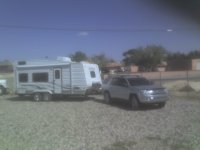
Well I towed over 5000 yesterday with the 4R. Below is a picture of the rig I towed. It towed like a CHAMP and I am extremely pleased with it! I only towed about 70 miles or so on pretty flat land but it definitely held up. Of course I had sway control and weight distribution. I hit some 40+ mph cross winds and it rocked the rig a little but it was not a white knuckle situation. The Prodigy is a sick brake controller and performs better than any I have ever used. The rig I was towing is a Carson FD-202 (20 footer) and I had water and a quad inside.
Attachments
Lone Ranger
New member
There is some good information here that is worth understanding if you will be doing much towing.
I think rickst29 provides a nice explanation but he is a little bit conservative on towing on the ball without a true WDH system. I tow 4-4500 lbs (a boat) and the 4Runner handles it pretty well. You know the load is there but the truck is in control.
However, I have said it before and agree with riskst29 - if you are towing heavier weights regularly, get a bigger vehicle. I also tow my boat with a Suburban (01) and there is no comparison - the Suburban is way better. I have done 1,500 mile each way trips with the Suburban so I have put enough time in while towing to know the difference. The Suburban, with its additional 1,500 lbs and longer wheelbase, controls the towed boat, regardless of crosswinds, regardless of truck traffic, etc. The 4Runner is not close!
The 4Runner is a great mid-size SUV and will handle towing duties well, but it is not a 6K or 7K towing vehicle.
I think rickst29 provides a nice explanation but he is a little bit conservative on towing on the ball without a true WDH system. I tow 4-4500 lbs (a boat) and the 4Runner handles it pretty well. You know the load is there but the truck is in control.
However, I have said it before and agree with riskst29 - if you are towing heavier weights regularly, get a bigger vehicle. I also tow my boat with a Suburban (01) and there is no comparison - the Suburban is way better. I have done 1,500 mile each way trips with the Suburban so I have put enough time in while towing to know the difference. The Suburban, with its additional 1,500 lbs and longer wheelbase, controls the towed boat, regardless of crosswinds, regardless of truck traffic, etc. The 4Runner is not close!
The 4Runner is a great mid-size SUV and will handle towing duties well, but it is not a 6K or 7K towing vehicle.


