Transmission Fluid Change

There is one, and only one scenario in which the in-radiator cooler makes a difference in the regard of heating up the ATF (in a good way). That scenario is this:

If you start you truck from cold when it's say, 15 degrees F outside, and you pull out of your driveway and get on some sort of highway within only a block or so, or only a couple minutes....(basically, the transmission only shifts up/down less than 8-10 times), then after about 10-15 minutes of highway driving, the engine has fully warmed up and the thermostat opens up. The radiator starts actually passing warm coolant through the bottom at this point, and the transmission which is probably only at about 100 degrees F at this point, will warm up from the coolant. It will take a while, but the ATF will get up to about 130-140.....where as a bypassed system, the ATF will stay down around 100-115.

Every other scenario I've witnessed (I'm talking serious miles, 20,000+ miles in both setups observing the ATF with a ScanGaugeII), what heats up the transmission is shifting. I can get the ATF up to 150 before the thermostat has even cracked open if I stop and go hard 10 times in a short period when it's cold outside. The radiator has nothing to do with it getting up to 150....just the fact that it's working and creating friction....which equals heat.

You can do what you want, I'm just trying to be helpful and say what I've observed in real life. People always want to say, "well, the engineers this and the engineer's that"....and that's fine. I'm not going to argue...I'm just stating what I see in real life.

Your last sentence, " If the trans cooler is bathed in the hot coolant, there is going to be some heat transfer via conduction. There's no denying the science behind it" is where almost everyone forgets that by the time the coolant is hot in the bottom of the radiator, the truck has already been driving for enough time to get the ATF warm all by itself. Except for the scenario I laid out above.

Well, all I know is the engine coolant reaches operating temperature and thermostat opens up wayyyy before my trans temps start to come up from driving. How much is the hot coolant helping raise the trans fluid temp, I don't know.

What I do know is people who have bypassed and didn't use an electric fan in addition to the cooler have seen some very high temps when pushing their rigs in different scenarios. Many of those people chose to change to running the external cooler in-series with the OEM radiator cooler because of it.

So, to each his own and run it like you want.
 
Well, all I know is the engine coolant reaches operating temperature and thermostat opens up wayyyy before my trans temps start to come up from driving. How much is the hot coolant helping raise the trans fluid temp, I don't know.

What I do know is people who have bypassed and didn't use an electric fan in addition to the cooler have seen some very high temps when pushing their rigs in different scenarios. Many of those people chose to change to running the external cooler in-series with the OEM radiator cooler because of it.

So, to each his own and run it like you want.

That's interesting. This morning it was 26 degrees outside, and my ATF was 127 degrees before my coolant ever hit 180. What are you using to monitor coolant temp and and ATF temp?

BTW, I consider anything over 120 degree "warmed up" for the ATF. Especially when the outside ambient temp is below freezing.
 
Last edited:
That's interesting. This morning it was 26 degrees outside, and my ATF was 127 degrees before my coolant ever hit 180. What are you using to monitor coolant temp and and ATF temp?

BTW, I consider anything over 120 degree "warmed up" for the ATF. Especially when the outside ambient temp is below freezing.

I use a Bluetooth OBD II reader that sends info to a Torque Pro app on my Android phone. My coolant temps always rise much faster than my trans temps. In the morning when I first get driving, I can be at 188-190 coolant temps fairly quick and my trans ATF temp is still under 100.
 
I guess that makes sense. In my setup, the B&M cooler has an LPD design, so really no ATF is going through the cooler until after the fluid warms up some. In your case, your ATF is sitting in ice cold coolant in the bottom of the radiator, and until the coolant does get warm...the ATF would have a hard time warming up very much.

So yeah....factory cooler makes it harder for the ATF to warm up right away, but then it does get warmer overall after the engine coolant has reached full operating temp.
 
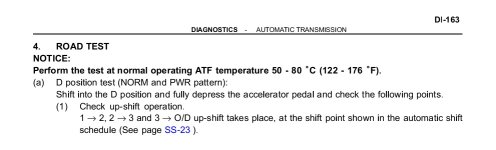
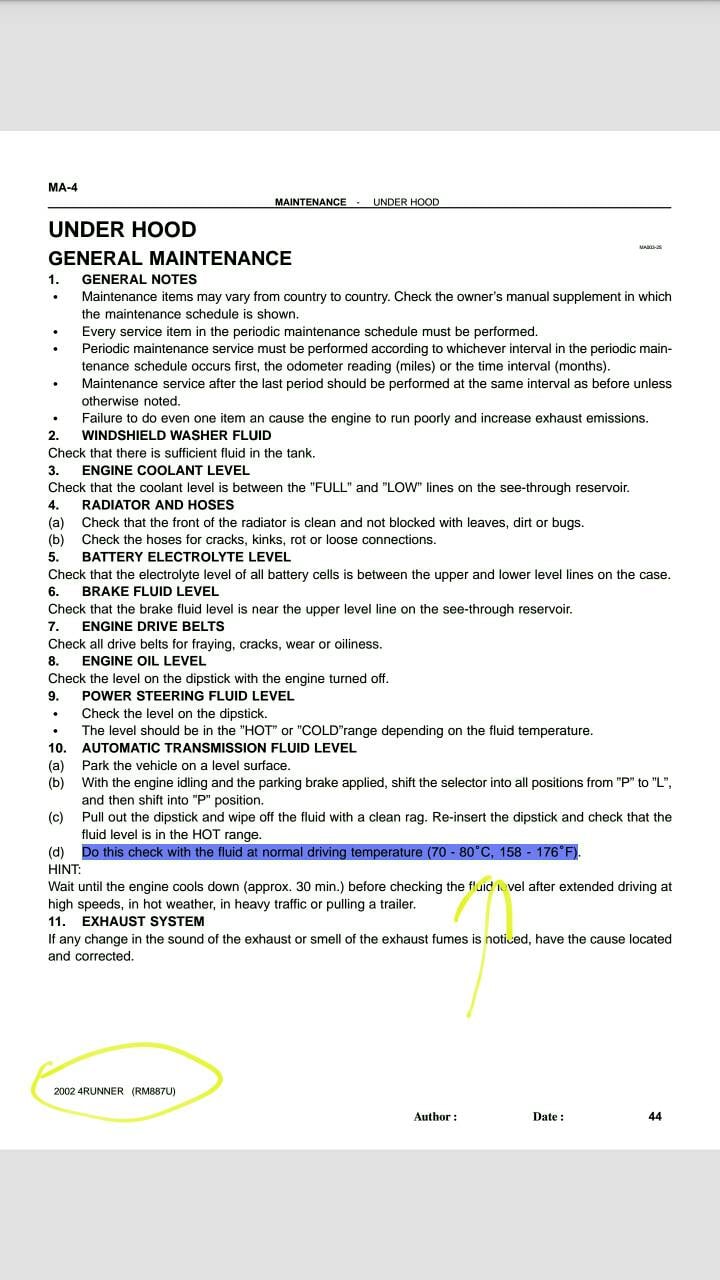
The normal operating temperature of the transmission fluid, according to the FSM is 158-176 degrees Fahrenheit. It takes me about 20 minutes of stop and go driving to get up to 160 (it's about 40 degrees in WI right now).

My coolant temps get up to 190 in about 5 minutes of driving.
 
Last edited:
The normal operating temperature of the transmission fluid, according to the FSM is 158-176 degrees Fahrenheit. It takes me about 20 minutes of stop and go driving to get up to 160 (it's about 40 degrees in WI right now).

My coolant temps get up to 190 in about 5 minutes of driving.


Which FSM year is your info from? The range you have 158-176 is pretty narrow.

Here's the FSM pic I have saved
 

Attachments

  • Transmission normal operating temps.jpg
    Transmission normal operating temps.jpg
    64.3 KB · Views: 690
What type of Amsoil ATF are people using? There is the OE series and the signature series, which both cover DexIII or higher

Thanks!
 
Which FSM year is your info from? The range you have 158-176 is pretty narrow.

Here's the FSM pic I have saved

Sorry for the late response on this, I can't remember which year my FSM is for.

The temp range I quoted is actually the "normal operating temperature" for when you are checking the fluid level on the dipstick. Let me see if I can find it.

I think I've seen the same numbers you listed in my FSM also but in a different section.

I prefer the signature series from Amsoil. It's very good stuff IMO.
 
My pic is from the 2002 FSM as well...? I guess "normal operating" and "normal driving" are two different things...?
 
The trans will warm up much faster driving below 43 -45mph than above 45-48mph where the lockup clutch in the torque converter engages and eliminates the slip of the torque converter and the heat that the slipping produces.


Sent from my iPhone using Tapatalk
 
Hi Guys, this link is broken.just an FYI

Go to Post #42 on this thread and you'll find a video [MENTION=102606]infamousRNR[/MENTION] and I made for doing a DIY transmission fluid flush. If you're interested in dropping the pan and either cleaning or replacing the filter, we will be making a video of this pretty soon, probably within a months time.

Some people have found the trans filter perfect and unclogged while others have found it partially clogged. I want to do it on my rig so I can get a idea of how healthy my transmission is by looking at how much metal debris has accumulated on the magnets on the bottom of the pan. Some people opt to just clean out the old filter with carb or brake cleaner but I'm really wondering how effective this would be because you can only see a fraction of the fine mesh filter material from the two ports on the filter.

As part of the video, I plan on cutting my trans filter open with a dremel tool, to get a good look at all the filter material. It's my belief that this filter may never be necessary to change if the owner takes good care of their transmission and does regular fluid changes. My rig has almost 170k and I know the pan has never been dropped so I'm really curious to inspect the filter to see if my theory is correct.

Here's a link to our channel: https://www.youtube.com/channel/UC9EMiD9KPy61kJ6hdXcbjxA
 
My thought is change the filter by 60k, then omitting the filter change every other fluid exchange is permissible.

I would add this from WIX transmission filters;
WIX Filters - Heavy Duty Transmission Filters - Products Information

Contaminants can enter your transmission fluid system in the manufacturing process. They can also enter the transmission through the vent, or through the dipstick and fill tube during fluid level checking/filling. Most of the time, however, contaminants are the result of normal wear. These contaminants consist of metal chips and flakes from gears and bushings and fine fibrous material from clutch facings.

WIX transmission filters protect transmissions against contaminants in the transmission fluid system. Proper filtration helps improve transmission life by minimizing wear and preventing sticking and scoring of sensitive shift control valves. In the event of a part failure, the filter also guards against secondary damage to other parts and thus helps to minimize repair costs.
 
Go to Post #42 on this thread and you'll find a video [MENTION=102606]infamousRNR[/MENTION] and I made for doing a DIY transmission fluid flush. If you're interested in dropping the pan and either cleaning or replacing the filter, we will be making a video of this pretty soon, probably within a months time.

Some people have found the trans filter perfect and unclogged while others have found it partially clogged. I want to do it on my rig so I can get a idea of how healthy my transmission is by looking at how much metal debris has accumulated on the magnets on the bottom of the pan. Some people opt to just clean out the old filter with carb or brake cleaner but I'm really wondering how effective this would be because you can only see a fraction of the fine mesh filter material from the two ports on the filter.

As part of the video, I plan on cutting my trans filter open with a dremel tool, to get a good look at all the filter material. It's my belief that this filter may never be necessary to change if the owner takes good care of their transmission and does regular fluid changes. My rig has almost 170k and I know the pan has never been dropped so I'm really curious to inspect the filter to see if my theory is correct.

Here's a link to our channel: https://www.youtube.com/channel/UC9EMiD9KPy61kJ6hdXcbjxA

My tranny filter was mega plugged up but I believe it was due to the pink milk shake I suffered about 10k miles prior to me checking the filter. The coolant breaks down the clutch plates and creates a brownish sludge/clay like material that plugs everything up (probably why the tranny shit the bed after 10k miles and possibly burned out the pump).

The filters are relatively cheap but they can certainly be cleaned. Even the one that was plugged up with the brown clay shit was able to be cleaned with brake cleaner. It is a little hard to get in there but with the straw on the can, you can spray it everywhere pretty good. I also put a bunch of brake cleaner in the filter and shook the shit out of it which also helped. I confirmed the filter was clean by using my inspection camera in the areas you cannot see well.

The other downside to just cleaning the filter is the cork gaskets on the top of the filter. They become compressed over the years and may not seal correctly when reinstalled. They are also glued in placed and can come loose (like mine did).

So to make an already long story short, yeah, just probably replace the filter....

PS. This spring I will be installing an inline filter too. My donor tranny has been working great so far and for $20 bucks and a half hour of work, it adds a little peace of mind.
 

Members online

Forum statistics

Threads
278,310
Messages
3,554,079
Members
248,016
Latest member
Advally Service

Trending content

Back
Top