Transmission hose replacement question

4runherpow

New member
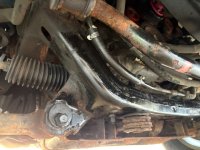
I have to replace one of the hoses that runs along the front since it looks like its about to go. I had one break while driving recently and Toyota replaced one of them at a dumb cost + fill transmission $800.

When I replace this next hose, my plan is to clamp the hose and cap the hard line to prevent as much fluid loss as possible, but when I put the new hose on there will obviously be a big air pocket since the hose has no fluid.

Is it ok to start and run the vehicle like that? I have no experience with this and I don't want to mess with the transmission if this is improper. My hope was to just start and run it, top off a few table spoons of fluid as needed.

Anyone have experience or opinion on this? Thanks
 
Register to hide this ad
Personally I like your plan. The ATF cooler in radiator probably holds a good quantity and lesser amount in hoses.
Are you replacing both? In and out?
You will want to check and add ATF immediately before much driving.
Do you have rubber hoses for flex between steel lines ( mounted) and radiator? Are the steel lines in good shape?
 
Personally I like your plan. The ATF cooler in radiator probably holds a good quantity and lesser amount in hoses.
Are you replacing both? In and out?
You will want to check and add ATF immediately before much driving.
Do you have rubber hoses for flex between steel lines ( mounted) and radiator? Are the steel lines in good shape?

I'm replacing the one that goes from the a hardline straight up in front of the engine then hooks back in to near a frame rail. Its a rubber hose that looks very dry rotted. The metal lines are not in great shape, then have bubbles. I just want to make sure it's ok to replace the line then start the car. Toyota said some stuff that seemed sales-y, but they said they use a pressurized machine to feed fluid through the system before starting the vehicle. I wasn't convinced but wanted to ask if anyone had replaced these rubber transmission hoses before. Thanks,
 
An ATF replacement scheme that makes total sense to me but have never performed, is to let the ATF circulation pump inside the tranny suck in new fluid from a clean container thru in inlet line and push old fluid out into a catch bucket thru the return line.
I know this is not exactly the question you asked, but offers ideas.
Seems perhaps the "Sales ish" answer you were given is trying to avoid a air bubble in your ATF circulation? I would not think that as an issue. But running any pump without fluid to lubricate it should be a very short time.
Getting back to your original idea of changing the line with engine OFF seems safe to me-but messy with spilled fluid.
Do you have a garage to do this in case it takes longer due to unforseen issues? Do you have another vehicle to chase parts?
Hope I am making sense.
Be sure to wear eye protection in case of splashes.
 
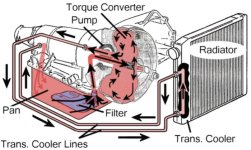
I found this schematic. Seems the fluid intake in bottom of tranny and fluid return dumps into tranny and suggests the air bubble will simply go into air space in tranny?
Does this look sensible?
 

Attachments

  • IMG_2172.jpg
    IMG_2172.jpg
    55.8 KB · Views: 213
An ATF replacement scheme that makes total sense to me but have never performed, is to let the ATF circulation pump inside the tranny suck in new fluid from a clean container thru in inlet line and push old fluid out into a catch bucket thru the return line.
I know this is not exactly the question you asked, but offers ideas.
Seems perhaps the "Sales ish" answer you were given is trying to avoid a air bubble in your ATF circulation? I would not think that as an issue. But running any pump without fluid to lubricate it should be a very short time.
Getting back to your original idea of changing the line with engine OFF seems safe to me-but messy with spilled fluid.
Do you have a garage to do this in case it takes longer due to unforseen issues? Do you have another vehicle to chase parts?
Hope I am making sense.
Be sure to wear eye protection in case of splashes.

Thanks. Yea, I did that technique one time years ago when doing a full fluid exchange. The issue being here, I'm not looking to replace all fluid so the concept of letting air bubble circulate until in reaches the downstream hose probably isn't worth the hassle. I do have a garage and tools, and the hose is new from toyota. I wonder if I could just call and ask them?

I found this schematic. Seems the fluid intake in bottom of tranny and fluid return dumps into tranny and suggests the air bubble will simply go into air space in tranny?
Does this look sensible?

Yea, that's what I was wondering - if it just dumps to the pan. But the airbubble would need to work through the trans cooler (radiator) too, right? How does that air bleed out? just when it hits the pan? Kind of like starting a garden hose in the summer - some water comes out, then it coughs, then steady stream?

I just dont want to mess with the transmission! I'm probable over thinking it but thanks for the help.

Also, any good ideas for how to make a 3/8" hose sized "cap", that I can use to immeadiately cap the hard line when removing the hose?
 
A little bit of air in the line will not harm the transmission at all, it will be gone in a matter of seconds once you start the engine, there's enough fluid coating the parts inside the transmission to keep any harm from happening if any air gets to any components which is unlikely since the air will enter and dump at the pan.

To make a 3/8" "cap" use a piece of 3/8" hose with a bolt plugging the end.
 
Last edited:
I've changed those hoses and the hard lines and you don't lose much fluid at all. Just guesstimate how much and pour some back in, you'll be fine.
 
A little bit of air in the line will not harm the transmission at all, it will be gone in a matter of seconds once you start the engine, there's enough fluid coating the parts inside the transmission to keep any harm from happening if any air gets to any components which is unlikely since the air will enter and dump at the pan.

To make a 3/8" "cap" use a piece of 3/8" hose with a bolt plugging the end.

I've changed those hoses and the hard lines and you don't lose much fluid at all. Just guesstimate how much and pour some back in, you'll be fine.

Thanks guys! Really appreciate the help.
 
Those lines from tranny to radiator and back are low pressure lines. Once the engine shuts off the ATF drains back to the pan passively. It can be full of air and be okay. If you have corrosion on the hard lines, go back to where the coating isnt bubbled and cut the pipe there. Slip the rubber hose on the pipe a good 1” to 2” and hose clamp it in place. (Low pressure line). You dont have to flare the ends, its not going to move. Just replace it now and forget about it. If you worry about the hose you can put some plastic spiral wire loom on it to give it some protection. Just be sure to zip tie the hose so it stay in place and isnt rubbing against anything sharp. I left the steel line brackets bolted to the radiator support so I could attach the hose to it again.

I was lucky. A few months back I used a wire brush on a drill to remove rust on the ps steel line. As soon as I touched it, the steel line broke off. I just removed the bad section and reconnected it with tranny 3/8” hose. Done and done.
 
Drcoffee, rdruss & AuSeeker are right, no need to worry and you won't lose all that much. My lines are now rubber too. These trannies are pretty robust and once the pump runs all the air will be purged. Just make sure the level is correct before you go beating on the truck. :D
 
Those lines from tranny to radiator and back are low pressure lines. Once the engine shuts off the ATF drains back to the pan passively. It can be full of air and be okay. If you have corrosion on the hard lines, go back to where the coating isnt bubbled and cut the pipe there. Slip the rubber hose on the pipe a good 1” to 2” and hose clamp it in place. (Low pressure line). You dont have to flare the ends, its not going to move. Just replace it now and forget about it. If you worry about the hose you can put some plastic spiral wire loom on it to give it some protection. Just be sure to zip tie the hose so it stay in place and isnt rubbing against anything sharp. I left the steel line brackets bolted to the radiator support so I could attach the hose to it again.

I was lucky. A few months back I used a wire brush on a drill to remove rust on the ps steel line. As soon as I touched it, the steel line broke off. I just removed the bad section and reconnected it with tranny 3/8” hose. Done and done.

Drcoffee, rdruss & AuSeeker are right, no need to worry and you won't lose all that much. My lines are now rubber too. These trannies are pretty robust and once the pump runs all the air will be purged. Just make sure the level is correct before you go beating on the truck. :D

Interesting. So you cut the steel lines and ran just normal 3/8id hose? I have the dealer hose the obviously plugs into the steel line, which does have some bubbles. Dumb question but how do I tell the difference between a low and high pressure line? And no down side to running rubber hose all the way back to tranny? And what do I do with this expensive ass dealer hose now? lol
 
Trace the hoses. If it has a hose clamp, low pressure. If it has a crimp connection, high pressure.
 

Attachments

  • IMG_0124.jpeg
    IMG_0124.jpeg
    126.7 KB · Views: 195
Trace the hoses. If it has a hose clamp, low pressure. If it has a crimp connection, high pressure.

Got it. You have a V6? I ask because my PS line down on that dross member looks like a big "S" shape. Yours looks straight across the front.

What's a crimp connection?
 
I don't know if I'd call either side high pressure on the tranny lines. Power steering lines, yeah, there's one with spring clamps that has very little pressure. I used a plumbing pipe cutter to cut back to good steel on the lines, then went to my local hardware store with a piece of line and bought what fit tightly onto it and of course clamped it. I think I used fuel line of some sort.

As for the new line, if you have it why not use it? The fasteners look to corroded?

Crimped lines are the ones you see that have a section of metal crimped around the rubber hose that's over the metal core line. Example in the link.

https://cdn11.bigcommerce.com/s-q45...eering_Hose_Fitting__36806.1617028924.JPG?c=2
 
Got it. You have a V6? I ask because my PS line down on that dross member looks like a big "S" shape. Yours looks straight across the front.

What's a crimp connection?

I do have a v6. The steering lines are adjacent to the cross member. The lower hose is the low pressure return line. The hose above it is the high pressure hose from the pump to the rack. BTW My high pressure hose is pretty rusty too. I bought the replacement hose and its on my bench waiting for me to install. Im not looking forward to doing it.
 

Members online

Forum statistics

Threads
278,308
Messages
3,554,057
Members
248,016
Latest member
Advally Service

Trending content

Back
Top