Ultimate oil undercoating guide (DIY Waxoyl)

Fluid film smells like a wet sheep when its applied. Not kidding, it lanolin based. Some people hate the small. I actually dont mind it. Completely goes away after a few days.

hmmmm...I'm not going to ask how you know what a wet sheep smells like..:boink:

Im glad I live in TN and dont have to deal with all of that was mess. That stuff must attract a lot of road grime and make underbody repairs pretty messy. But I can certainly understand the value of the extra protection.
 
Last edited:
Is this just for people where salt is used in the winter?

I would say yes. The northern states use various salt concoctions on the roads in the winter. That crap eats up the frames of countless vehicle...but Toyota trucks seem to be more prone to frame rot than other brands. My buddy deals in used Tacomas and flies to Arizona, Florida and southern Texas once or twice a year and brings back 20 year old Tacos that look virtually new underneath.
 
I guess if youre around a lot of salt water - drive on the beach a lot, back boats into saltwater etc, but otherwise salt on road is main problem
 
I would say yes. The northern states use various salt concoctions on the roads in the winter. That crap eats up the frames of countless vehicle...but Toyota trucks seem to be more prone to frame rot than other brands. My buddy deals in used Tacomas and flies to Arizona, Florida and southern Texas once or twice a year and brings back 20 year old Tacos that look virtually new underneath.


I spent two periods of my life in western, then central, KY where the roads become mini salt flats sometimes. The Murano has always had a rear subframe rot issue that is terrible.

It’s disappointing from both Toyota and Nissan.

I live in Colorado now and assume my new 4Runner will be fine. I do undercarriage washes and wand washes several times a month when muddy out.
 
Thanks for the awesome post, great info. I coated my truck about 3 years ago with this. I did 1lb of paraffin for 1gal bar and chain oil, and it worked great. Cheap and effective.

However, after 3 years, I noticed that it has attracted a lot of dust particles, especially around the wheel wells. Those areas are not as water repellent as cleaner areas, or as when it was fresh. If I scrape it, it looks like brown packed dirt in places. I am not sure if it is protecting as much as it did, and I am thinking I need to do something for the wheel well areas at least.

What do we do from here, after 3-4 years? Has anyone tried to spray a second coat over an old coat? How does a fresh coat go over a dirty old coat?

There are products that I believe might be better at not attracting dirt and resisting splash, various versions of cosmoline. The YouTube channel "repair geek" has some great testing and comparison on undercoatings, and I really like how cosmoline performed.

To change over to cosmoline though, I have read (and the sales rep told me) that it is necessary to clean the existing DIY waxoyl coating...Anyone knows how to clean the DIY waxoyl without spending 60hours under the truck?

Anyone has tried both DIY waxoyl and cosmoline, and can voice an opinion on a comparison?

Thanks again for all the great input guys and gals.
 
That's pretty heavy on the wax, I've never gone above half that so can't say whether it'd still be working or not. On mine, the wheel wells are caked with dirt, when a friend tapped an area the other week a chunk fell off and it was fresh black paint underneath. But I do want to spray them down with a hose and redo them if I have time. Most everywhere else still looks mint, and it is still working by the wheels but starting to be absorbed by the dirt. Cosmoline is also wax and petroleum based, you should be able to pressure wash the loose areas and go right over it, I would think.
 
I started with 8oz of paraffin per gallon, but in the summer heat (85F) it was running down too much onto the driveway. So I finished with 16oz per gal, which has worked great. Its still tacky in most weather, and will "heal" when parked in the heated garage, but it stick better and doesn't absorb as much dirt over time. Cosmoline is likely high part paraffin per oil and works quite well, so I figure if my mix at ~30% paraffin ~70% oil is well in the OK range.

I can't get the coating to fall when tapping, its really stuck on there good. I also believe pressure washing would get it off, but it would take a while to even clean half the surface, given that its all weird angles under the truck...Re-spraying over it would be waaaay quicker than just the cleaning, just because spraying is much easier to handle for many reasons.

I would think that re-spraying right overtop the old coating would be better than nothing. Maybe re-spray every 4 years, then after 12-16years, pressure wash and start anew?
 
Last edited:
Was meaning more of a hard rinse than actual pressure washing, to knock any loose crud off. If the costing is on there that well then it should be fine to just go over, or rinse and go over. I didn't clean anything when I touched up my diffs and a arms a year or 2 ago, no issues there since. Good luck
 
Thanks for the awesome post, great info. I coated my truck about 3 years ago with this. I did 1lb of paraffin for 1gal bar and chain oil, and it worked great. Cheap and effective.

However, after 3 years, I noticed that it has attracted a lot of dust particles, especially around the wheel wells. Those areas are not as water repellent as cleaner areas, or as when it was fresh. If I scrape it, it looks like brown packed dirt in places. I am not sure if it is protecting as much as it did, and I am thinking I need to do something for the wheel well areas at least.

What do we do from here, after 3-4 years? Has anyone tried to spray a second coat over an old coat? How does a fresh coat go over a dirty old coat?

There are products that I believe might be better at not attracting dirt and resisting splash, various versions of cosmoline. The YouTube channel "repair geek" has some great testing and comparison on undercoatings, and I really like how cosmoline performed.

To change over to cosmoline though, I have read (and the sales rep told me) that it is necessary to clean the existing DIY waxoyl coating...Anyone knows how to clean the DIY waxoyl without spending 60hours under the truck?

Anyone has tried both DIY waxoyl and cosmoline, and can voice an opinion on a comparison?

Thanks again for all the great input guys and gals.

Answer to self for other readers. I bought some cosmoline and tried spraying it directly over my DIY waxoyl. It did not work, meaning that the two did no mix at all. The result is a very thin layer of cosmoline over waxoyl, which streaks easily and makes no difference from having just waxoyl. Better to respray with waxoyl.

As for cosmoline vs waxoyl, I tried both on a clean piece of metal.
Cosmoline has significant advantages over waxoyl:
- cosmoline is MUCH harder to remove, it would not wash out at all from water splash
- cosmoline is much less tacky and would not attract dirt as much, so it would remain effective for much longer.
- cosmoline repells water much better than waxoyl per my testing. Water does NOT want to touch it and beads right off comapred to waxoy. Overall cosmoline probably has quite better performance for rust inhibition
- cosmoline soften less with heat, so it can coat parts that get mildly warm like diff cases and drive shafts. My waxoyl would not stick to those.

DIY Waxoyl has only two upsides compared to cosmoline (that I know of):
- waxoyl is more fluid, and continues to creep better, until it collects dust. Cosmoline creeps mostly until it dries up I believe, then it creeps very slowly or not much at all.
- waxoyl DIY is dirt cheap

My conclusion is that cosmoline is best for all outside areas that see dirt and water splash. Waxoyl is better than cosmoline for all internal cavities where it doesn't collect dust, and can creep over rust for a long time. For those internal cavities, other more creeping fluid products would work equally or better than waxoyl (fluid film, ATF etc). Waxoil can do both external/internal and will work OK for both, but if you want the best use two products, one for external one for internal. Also, because waxoyl collects dust but doesn't wash off like FF does, it makes it weird for re-coating after 4 years, as the best solution I found is just to recoat the dirty layer with fresh.
 
Last edited:
Hi mister JBTVT , I want to try your undercoating receipt , my car have same superficial rust under the body , the chain oil&Wax mix can be applied directly on the rust (I want 1st to apply an rust inhibitor )?How is look your car now after some years ?
Thank you!
 
Rust kills more of our trucks than any other cause. This ~$100 investment (depending what you own already) can save thousands in body and frame rot and struggling with seized bolts, and keep more of the cars and trucks we love on the road. I've used bar and chain oil for years and a knowledgeable friend has used B&C and Fluid Film and has said they're comparable. Both work OK but need annual reapplication and anything that is exposed to constant road spray like the A arms is bare in a matter of weeks. This treatment will not wash off easily, or maybe ever. For most of the vehicle areas it seems like this will be a lifetime coating. It's a PITA, but worth it.

Ingredients -
2 gallons name brand bar and chain oil ( all season, or 1 gal winter, 1 summer)
16 oz paraffin wax
Spray gun with wands ( I like PMT's - https://www.amazon.com/Undercoating-Gun-Spray-Wand-Kit/dp/B018RI373S/ )
Air compressor, 4CFM or higher, 8+ is ideal
Metal paint can
Propane/MAP torch
Scale
Hatchet
Hot plate
Old shirt
Duct tape

Optional:
Infrared thermometer ($17 @ Amazon.com )
Spray suit (the heavy duty plastic lined one from Home Depot paint section works very well)
Spray sock (for hair, paint section)

Truck/car should be clean and dry underneath.

The ratio of wax to oil makes a big difference. You don't want to go above 2 ounces per quart or the oil will harden at very high temperatures, making spraying difficult, as well as possible chipping at cold temperatures. I put various concentrations on wax paper and put it in the freezer, at 0* anything much above 2oz/qt would separate from the paper rather than bending with it. 2oz/qt begins to harden around 150*. Much below 1 oz/qt would make the mixture more fluid than ideal, this mixture hardens around 100*. I used 2 oz/qt on high splash areas like A arms and low crossmembers, as well as anything I could access easily without a wand. With a wand 2oz concentration tends to harden by the time it reaches the end, but can still work with enough heat.

Wrap spray gun base with an old shirt and duct tape to keep the oil warm, like this:
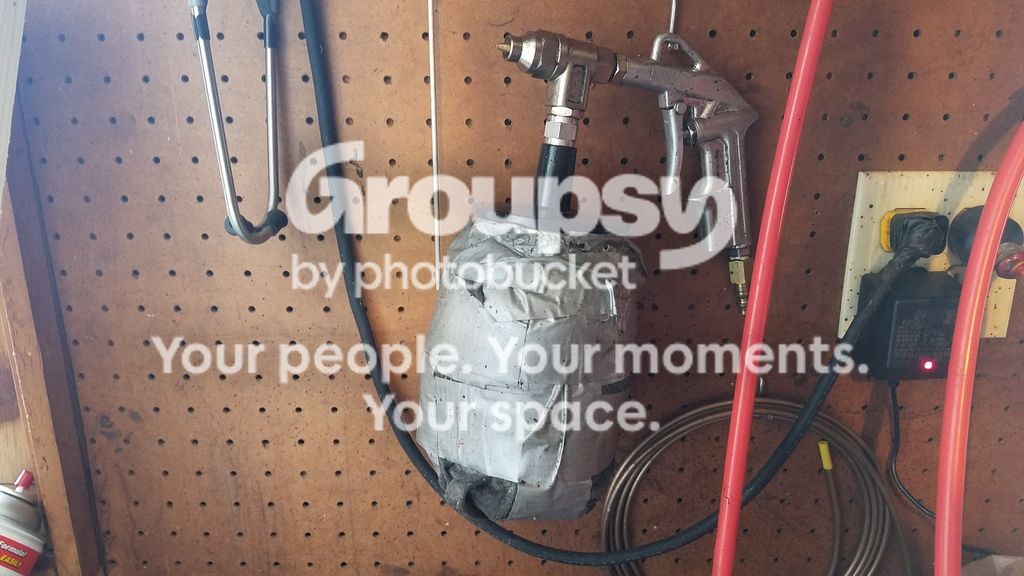

Put paint can on hotplate, add oil, and turn on high. Oil will begin to lightly smoke around 150* and heavy smoke around 200*, this is too hot for the washer in the spray gun so keep it under 200*. Chip up wax into quicker melting flakes, if you don't have a fine scale weigh a large block and divy it up, then chip it. Add to oil at desired ratio, probably start with 2 oz/qt. When mix hits about 175* and wax is all melted add to gun. Beware the vent hole, don't spill this on yourself! You will have to jump start the top of the gun or wax will harden when it hits this, apply heat from torch to top of gun, from base to tip, both sides, then spray away. The threaded nozzles affect flow rate so play around with that till you find one that works for you.

Anytime you stop spraying long enough for the gun to cool down you will have to reapply heat from the torch to it, especially with the higher wax mix. When using nozzles, especially the long one, you will have to heat them with the torch as well, going quickly and careful not to melt them of course. This is an extra PITA but is an important step to get inside of the frame. Take your time and get inside all holes you can find, in A arms, crossmembers, top of the shocks, etc. I dropped all front skid plates, gas tank skid plate, and spare tire to spray everything. Try not to get anything on the exhaust, especially the catalytic converters. It's a good idea to keep a fire extinguisher in your vehicle at all times, but especially for the first few trips after undercoating.

I applied inside of the doors (salt spray will run down the windows and inside in the winter and rust them from inside) by drilling a 1/2" hole at latch side, spraying with the lower wax mixture, and plugging with these - Amazon.com . I also did inside the rockers.

This is what my GX A arms look like two months after spraying and constantly subjected to NH salt and slush.:
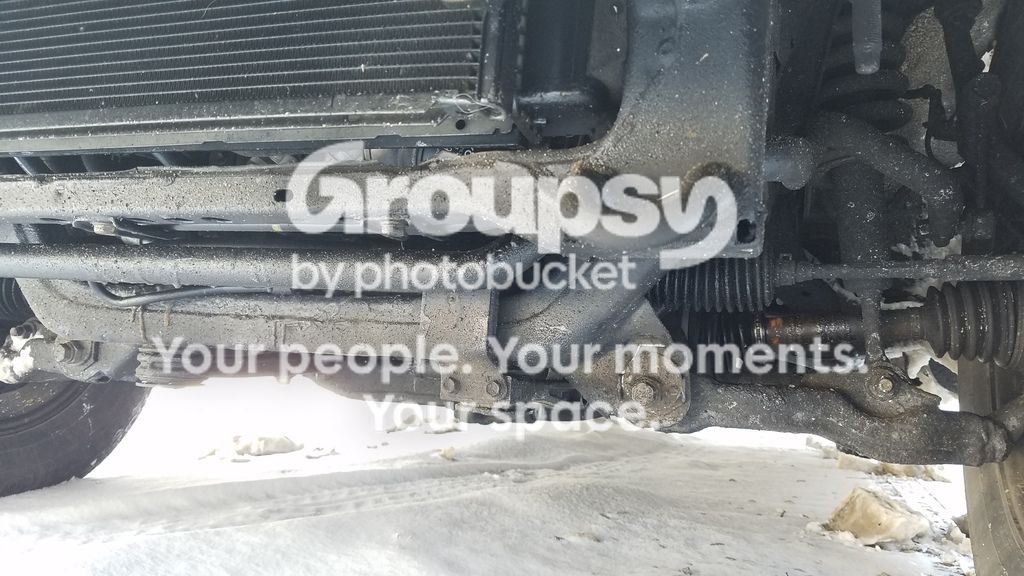

Fully waterproof. You can still see runs on the crossmembers.

Hi mister JBTVT , I want to try your undercoating receipt , my car have same superficial rust under the body , the chain oil&Wax mix can be applied directly on the rust (I want 1st to apply an rust inhibitor )?How is look your car now after some years ?
Thank you!
 
Hi mister JBTVT , I want to try your undercoating receipt , my car have same superficial rust under the body , the chain oil&Wax mix can be applied directly on the rust (I want 1st to apply an rust inhibitor )?How is look your car now after some years ?
Thank you!

I redid the frame by rear wheels and a couple other areas last year, and touched up the differentials every year or two. It still looks mint except the areas like bottom of diff that get warm have some light surface rust now. Brake fittings too, trying cosmoline heavy on them this year. I'd use a scaler to knock off loose rust but just spraying over it is better than nothing. Best to do this when it's going to be cold and get dusty, I did a van in spring a few years ago and that didn't hold up nearly as well. Sucks keeping oil hot when it's cold out though
 

Members online

Forum statistics

Threads
278,316
Messages
3,554,111
Members
248,016
Latest member
Advally Service

Trending content

Back
Top