I've been reading this thread to see its applicability to 5th generation 4runners. I have a 2016 SR5. I pull a 16' Bambi Airstream that has a measured weight of 3700# when fully loaded, and a hitch weight of 495# when lightly loaded. A full water tank will push it over 500#, the specified weight limit.
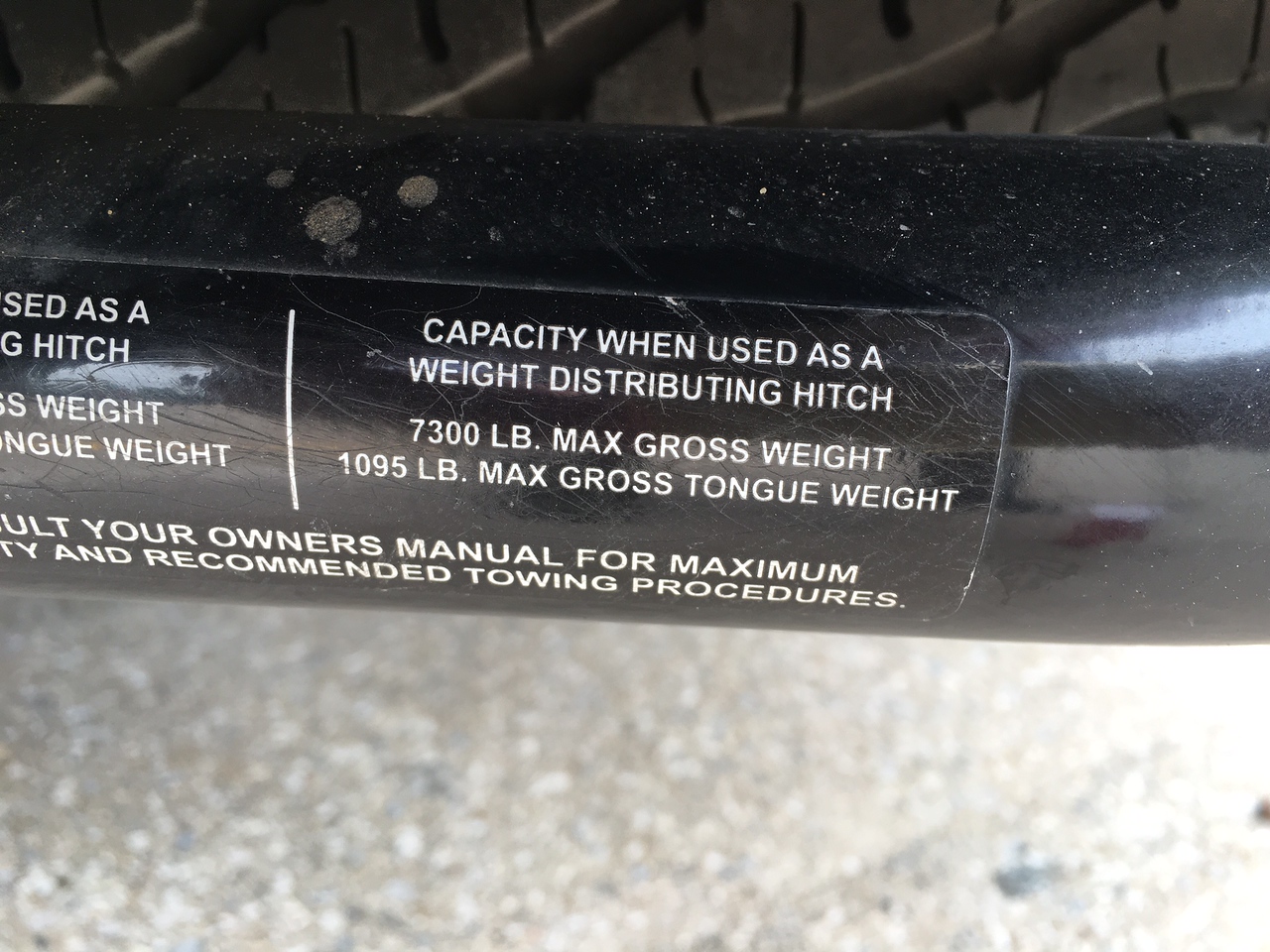
I talked to the Toyota rep and confirmed that WD hitches are OK with my 2016, (and probably all 5th gen 4runners). The tow package came standard, with 500/5000 pound hitch/carrying capacity. I looked underneath at the hitch, and see that there is a significant tubular crossmember that is welded to the outside frame rails. A receiver is bolted onto this member. To my eye, this is as capable as the 4th gen V8 hitches that bolt to the frame, as this extends the frame through a sturdy welded member. Also, note that there are no aftermarket hitches for 5th gen 4runners, so this cannot be removed or replaced. The only thing I can think to do more may be to weld the receiver to the cross member.
However, I'd like to load this up, perhaps with an extra battery, and I'll be in the 550 pound range, 50 pounds over. So why does this hitch have a 500# rating versus the 4th gen V8s with a 700# rating? My hunch is that the short wheelbase and lighter motor cause the 4runner front wheels to ride too high for stability if used without a WD hitch. Unfortunately, other than saying WD are OK, Toyota doesn't spec increased weight limits for using a WD hitch, though it certainly lowers the front wheels (my front wheel wells are only 1/4" higher when using the WD hitch versus being unhitched, they are pretty high if I don't have the WD bars hooked up). It's interesting to see that the 4th gen V8 hitches specified significantly higher tongue capacity with WD, but there is no such rating for 5th gen V6s. I THINK I'm OK to add the extra weight due to this, but I'm still cautious until I study this more.
Thoughts?