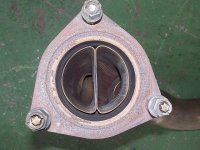
I’ve thought about this a lot as well being that I’m supercharged. Please snag some pictures if possible.I have never seen an aftermarket downpipe replacement. Too bad, since it's a tiny 2.25" where it enters the catalytic converter. When I had my 4Runner in at a muffler shop, they told me increasing the pipe size downstream of the cat was pointless without changing the downpipe, which isn't legal in the good 'ol state of CA.
I'm having my downpipe replaced soon anyway with 2.5" mandrel bent piping. The DT header kit I have on allows it and passes smog so I'm going for it.
I’ve thought about this a lot as well being that I’m supercharged. Please snag some pictures if possible.
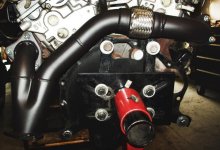
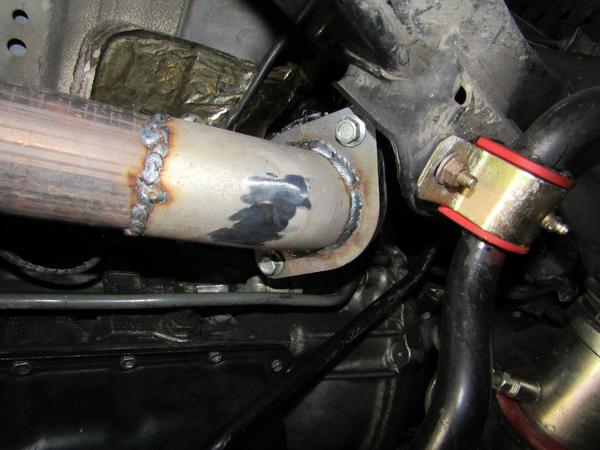
Me too. Offroad Solutions makes a sweet crossover pipe; but with left side collector for 5VZFE conversions into 2nd gens. See below. Wish they made a conventional right collector version...
I've gathered the following exhaust components ready to install along with a 2nd gen TRD supercharger:
3x OEM crossover collector studs 90116-10149
3x OEM nuts for above 90179-10070
Magnaflow 447192 Cali front cat - input pipe to be drilled for AEM wideband sensor bung (for 30-4900). Output flange to be cut off and replaced with 2.5" v-band. Cat has welded steel studs for AFR sensor - may try to replace with ARP SS studs since they come in a 4-pack...
G-Sport GESI 50025 cat - to replace OE rear Cali cat
Berk Technology Stainless Steel O2 Sensor Flange
ARP 400-8001 M8-1.25 X 32 studs for O2 sensor
Vibrant 1141 ultra quiet resonator
Borla catback 14659
3x Racecraft 2.5" V-band clamps
The Borla catback comes with an overly long 304 SS input pipe to work with Fed emission trucks. Plan is to cut that as required, lose the 2-bolt flange and use as donor pipe for segments between components, joined with v-band clamps. Hopefully the replacement of the long OE rear cat will allow fitment of the addl. resonator before the Borla muffler and in between frame cross members. I'll post pics once It's all done in a month or so.
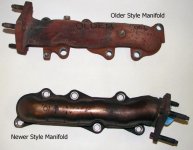
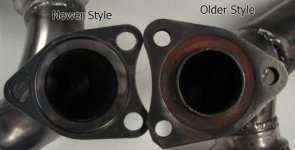
All of the above; however, is after the stock OEM crossover pipe and its 3-bolt collector flange. I do have the later non-cast iron manifolds, which do breathe better at least. See below.
Fabricating a custom crossover pipe is beyond what I'm willing to consider unless I too, one day, go for DT headers.
Also, note the Borla catback is 2.5" into the muffler and 2.25" out, go figure...

That's interesting about the manifolds as I recently discovered that as well. I've got two sets of manifolds, one from a 2000 with 2 cats and one from a 2001 with two cats and the 2001 is bigger with more flow. It's so odd that I couldn't even find the part number for it.
You've piqued my interest. My 4R has a build date of 09/98. It surely has later exhaust manifolds i.e. not cast iron & w/o heat shields or their bolt bosses. That said, are either of the 2 sets of manifolds you possess cast iron?
To add to my confusion, I've now identified 3 sets of p/n's on Toyota's site for later 3rd gens: Left side only for illustration:
17142-62090-4WD AT SR5, 2000, 2001
17142-62100 - discontinued, superseded by -62110
17142-62110-4WD AT SR5, 2000, 2001, 2002
Note the application year overlap. I'd assumed that all non-cast iron ones - 99' Cali and onward, had larger output ports, mating to the single output crossover pipe for dual cats. Today I've seen pics of two types of non-cast manifolds - one with 3 separate flanges to mount to the head and one with a one-piece head mounting flange. If their port sizes are different, you'd think that there would also be two different corresponding crossover pipes to mate with. Can't find any evidence of that.
Either way, I'm sticking with what I have for now.
Re intake: doing ISR delete mod w/Airaid 511-734 & have deck plate mod components. Not porting TB - yet...
Yes, one pair is the older cast iron and the other is not. Cast iron are definitely smaller and more narrow. Can confirm the crossover pipe is also wider on the non-cast iron crossover pipe. It's much thicker and wider than my old 98 one. However, before anyone gets too excited about these, it's the collectors and individual exhaust runners that gain the power on headers for our 4Runners. The exhaust manifolds do a poor job of allowing exhaust gases to pass as the exhaust valves open and close and the stock collectors are pretty restrictive.