What happens, exactly, when you hit the redline?

Sorry, that's just plain silly. So above 5252 rpm the numerical value of power (expressed in some system of units) exceeds the numerical value of torque. How is that important?


Speaking of understanding formulas, you wrote:


Mathematical impossibility. If torque increases with rpm, i.e. both factors on the right hand side increase, then their product (HP) will also increase. If both x & y increase, x*y will also increase, to put it simply. Dont get distracted by (1/5252).

Now, if RPMs increase and torque decreases, then HP may go up or down, depending on how much RPMs increase vs how much torque decreases.

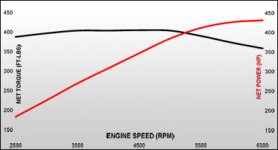
I'm done then. You want to argue with no basis of fact and apparently I cannot put it into terms you understand. I will leave you with this graph of HP and torque though. Notice how they cross at around the 5252 RPM range.
 

Attachments

  • 6a010535a808a3970b0147e05289f6970b-800wi.jpg
    6a010535a808a3970b0147e05289f6970b-800wi.jpg
    17.1 KB · Views: 157
I'm done then. You want to argue with no basis of fact and apparently I cannot put it into terms you understand. I will leave you with this graph of HP and torque though. Notice how they cross at around the 5252 RPM range.

As I stated, If torque increases with rpm, i.e. both factors on the right hand side increase, then their product (HP) will also increase.

Pay attention. In your graph, power, not torque, increases with RPM. If power increases with RPM torque does not necessarily do so. However, if torque increases with RPM then power necessarily increases too.

As to this compleltely un-interesting crossover value, it is 5252 rpm for torque expressed lbxft. It will be at a different rpm for Nxm. So what?
 
As I stated, If torque increases with rpm, i.e. both factors on the right hand side increase, then their product (HP) will also increase.

Pay attention. In your graph, power, not torque, increases with RPM. If power increases with RPM torque does not necessarily do so. However, if torque increases with RPM then power necessarily increases too.

As to this compleltely un-interesting crossover value, it is 5252 rpm for torque expressed lbxft. It will be at a different rpm for Nxm. So what?

Dude. I was just trying to show you why your torque runs out before you reach red line and why going there (past 5252 rpms) does not give you anything. Basically validating what others had already said.

I can explain it to you but I can't understand it for you.
[MENTION=130015]Inferno1[/MENTION] [MENTION=115435]Bevo[/MENTION] [MENTION=104049]marshal[/MENTION] People like this is why I don't help out much anymore. They don't appreciate the help and want to argue about it. Somebody save me.
 
Last edited:
Dude. I was just trying to show you why your torque runs out before you reach red line and why going there (past 5252 rpms) does not give you anything. Basically validating what others had already said.

Again, 5252 rpm is the value you happen get when you use pounds x feet for torque units. It's when torque and power happen to be numerically equal. It's completely accidental and unimportant. In Europe it will be some other number.

I can explain it to you but I can't understand it for you.
[MENTION=130015]Inferno1[/MENTION] [MENTION=115435]Bevo[/MENTION] [MENTION=104049]marshal[/MENTION] People like this is why I don't help out much anymore. They don't appreciate the help and want to argue about it. Somebody save me.

I can see you're frustrated, perhaps because you don't fully understand the subject yourself. Offering help doesnt absolve you from constructive criticism and questioning.
 
Somebody save me.
:clap2::clap2::clap2::clap2::clap2::clap2: :popcorn::popcorn:


In closing.

I like turtles. :typing:

But really I love the analytics that engineers always bring to a discussion. Although I may only understand 60% of it 50% of the time(let the other ones figure out the graph to explain that figure). I do commend you and others always on your thoroughness. It's for these reasons several of my closest friends, family members are engineers and I enjoy the discussions with them as they try to dumb stuff down for my medically inclined brain to understand. Formulas and math were never a strong suit, but I was always intrigued by them.
 
I can explain it to you but I can't understand it for you.
[MENTION=130015]Inferno1[/MENTION] [MENTION=115435]Bevo[/MENTION] [MENTION=104049]marshal[/MENTION] People like this is why I don't help out much anymore. They don't appreciate the help and want to argue about it. Somebody save me.

Sorry bud I can't help you out. I stopped listening to him when he mentioned his Miata.
 
Again, 5252 rpm is the value you happen get when you use pounds x feet for torque units. It's when torque and power happen to be numerically equal. It's completely accidental and unimportant. In Europe it will be some other number.

Uh, no, it is not "completely accidental and unimportant".

Horsepower is a calculation.

To determine the HP at any RPM:
Measure the Torque in lb-ft.
Multiply the Torque by the particular RPM.
Divide that number by 5252.


Torque is what is measured, and the Horsepower is calculated from there.

Rather than typing all afternoon to explain why the specific number 5252 is used, I'll just post a Wiki link: https://en.wikipedia.org/wiki/Horsepower
 
Uh, no, it is not "completely accidental and unimportant".

Horsepower is a calculation.

To determine the HP at any RPM:
Measure the Torque in lb-ft.
Multiply the Torque by the particular RPM.
Divide that number by 5252.


Torque is what is measured, and the Horsepower is calculated from there.

Rather than typing all afternoon to explain why the specific number 5252 is used, I'll just post a Wiki link: https://en.wikipedia.org/wiki/Horsepower

The calculation is elementary but that's not the point. engineeer attaches importance to the fact that at 5252 rpm the torque (lb x foot) is numerically equal to power (in horses). From that observation he concludes that exceeding 5252 rpm is bad for torque. In Europe they use other units for torque, so the magical RPM over there is different.
 
The calculation is elementary but that's not the point. engineeer attaches importance to the fact that at 5252 rpm the torque (lb x foot) is numerically equal to power (in horses). From that observation he concludes that exceeding 5252 rpm is bad for torque. In Europe they use other units for torque, so the magical RPM over there is different.
bwahahaha.

do you actually read what you type?
 
In Europe they measure torque in Newton meters instead of pounds feet. Torque is still torque, it doesn't become something else when it crosses an ocean.

My locomotives torque output is measured in Tractive Effort, it's still torque.

You have an encyclopedia of the entire cumulative knowledge of our species up until this point in time in front of you, and a half a dozen incredibly intelligent individuals, and a mechanical engineer who is much much more qualified than anyone in this forum for this topic, trying to explain it to you in lamens terms; and you still tell them they're wrong and they don't understand...

tumblr_inline_nsssk68TDC1rol1w1_500.gif
 
Last edited:
Dude. I was just trying to show you why your torque runs out before you reach red line and why going there (past 5252 rpms) does not give you anything. Basically validating what others had already said.

I can explain it to you but I can't understand it for you.
[MENTION=130015]Inferno1[/MENTION] [MENTION=115435]Bevo[/MENTION] [MENTION=104049]marshal[/MENTION] People like this is why I don't help out much anymore. They don't appreciate the help and want to argue about it. Somebody save me.

Most of us do appreciate you and other intelligent members helping out, I do at least. This thread made my head hurt starting from the original post. I chose to observe from a distance...
 
Dude. I was just trying to show you why your torque runs out before you reach red line and why going there (past 5252 rpms) does not give you anything. Basically validating what others had already said.

I can explain it to you but I can't understand it for you.
[MENTION=130015]Inferno1[/MENTION] [MENTION=115435]Bevo[/MENTION] [MENTION=104049]marshal[/MENTION] People like this is why I don't help out much anymore. They don't appreciate the help and want to argue about it. Somebody save me.
I've come to appreciate your input. But I'm also a fellow engineer, so I can understand the numbers that come from your words. :D
Take it up with your resident expert. "Running out of torque as you approach 5252 rpm." Incredible.
Running out of torque in this instance doesn't mean you have 0 torque as soon as you hit such and such RPMs. Consider it an exaggeration if that's easier for you, it simply means past x RPM torque is on the decline. The entire point to all this is that holding your miata at the rev limiter isn't helping you pass that civic that's putting along in front of you. And as [MENTION=124801]cashmoney[/MENTION] mentioned, horsepower and torque are only part of the equation.
And the whole discussion around max power and redline in this thread only scratches the surface. The discussion of gearing and shift points and where they drop you back in the power band hasn't even come in to the picture yet. There's a lot more to maximizing acceleration than just shifting at max power so don't get all cocky because you read something some folks in this thread stated.
Now if you're seeking further enlightenment than that, members have already contributed plenty of other articles for the purpose of educating you. If you insist on further making a mockery of yourself by somehow managing to both state the obvious then draw completely erroneous conclusions, by all means.
 
Easiest way to find out what happens when you hit redline is to continually test it until you finally figure it out, then please post back the conclusive results as soon as possible and thanks for doing the research.
 
I've come to appreciate your input. But I'm also a fellow engineer, so I can understand the numbers that come from your words. :D

Running out of torque in this instance doesn't mean you have 0 torque as soon as you hit such and such RPMs. Consider it an exaggeration if that's easier for you, it simply means past x RPM torque is on the decline. The entire point to all this is that holding your miata at the rev limiter isn't helping you pass that civic that's putting along in front of you. And as [MENTION=124801]cashmoney[/MENTION] mentioned, horsepower and torque are only part of the equation.

Now if you're seeking further enlightenment than that, members have already contributed plenty of other articles for the purpose of educating you. If you insist on further making a mockery of yourself by somehow managing to both state the obvious then draw completely erroneous conclusions, by all means.

But I showed him a graph....
 

Members online

Forum statistics

Threads
278,316
Messages
3,554,121
Members
248,016
Latest member
Advally Service

Trending content

Back
Top