Does the behavior of the ATRAC system change when the center diff lock is enabled? I was in Death Valley National Park this past weekend and when confronted with a pretty difficult trail section, enabling the diff lock didn't seem to do much. I was still spinning tires trying to get up and over one particularly tricky loose rocky section (I was also in 4LO). There were many other times both in 4LO and 4HI with the CDL disabled where the traction control came on (light blinking on the dash when climbing up loose rocky stuff).

You are using an out of date browser. It may not display this or other websites correctly.
You should upgrade or use an alternative browser.
You should upgrade or use an alternative browser.
What situations do you lock you center diff?
- Thread starter medicrn
- Start date

JB.
New member
Does the behavior of the ATRAC system change when the center diff lock is enabled? I was in Death Valley National Park this past weekend and when confronted with a pretty difficult trail section, enabling the diff lock didn't seem to do much. I was still spinning tires trying to get up and over one particularly tricky loose rocky section (I was also in 4LO).
As far as low range, I don't think it changes in relation to individual wheel spin, but the integration with the system as a whole can be different. In general, atrac should engage sooner when unlocked than locked.
If you disabled all ABS functions, you'd notice a difference between unlocked and locked in a difficult climbing situation. Because of the multiplying effect of the Torsen, once atrac is involved, unlocked mode gets closer to locked in capability, so depending on the situation you might not notice much difference, but you still want the diff locked on the most difficult sections even if it doesn't seem to be helping.
Last edited:
ToolmanJohn
New member
I almost exclusively use the 4LO when backing up to my travel trailer, because I can crawl it into position very accurately, even on an incline. I also use 4LO to store my trailer in the back yard up a steep hillside, I would rip up the yard in regular 2wd or 4wd.
I also use 4hi when it rains, snows. But the only time I ever use the center lock on road is when there is more than a few inches of snow and I have to climb the giant hill to my street. Locking GREATLY improves traction in that instance. Always bear in mind that locking the center differential will shut of the stability control system, so it will NOT help you stop in a sliding sideways skid, you are on your own at that point.
I haven't ever done anything remotely serious off road. CT doesn't have any legal public land for wheeling.
I also use 4hi when it rains, snows. But the only time I ever use the center lock on road is when there is more than a few inches of snow and I have to climb the giant hill to my street. Locking GREATLY improves traction in that instance. Always bear in mind that locking the center differential will shut of the stability control system, so it will NOT help you stop in a sliding sideways skid, you are on your own at that point.
I haven't ever done anything remotely serious off road. CT doesn't have any legal public land for wheeling.
As far as low range, I don't think it changes in relation to individual wheel spin, but the integration with the system as a whole can be different. In general, atrac should engage sooner when unlocked than locked.
If you disabled all ABS functions, you'd notice a difference between unlocked and locked in a difficult climbing situation. Because of the multiplying effect of the Torsen, once atrac is involved, unlocked mode gets closer to locked in capability, so depending on the situation you might not notice much difference, but you still want the diff locked on the most difficult sections even if it doesn't seem to be helping.
I guess I still don't fully understand the benefits of locking the center diff given that it's a Torsen/LSD unit. According to the brochure, the center diff:
- is 40/60 F/R in normal conditions
- is up to 29/71 F/R if a front wheel slips
- is up to 53/47 if a rear wheel slips
Given these specs, the question is why would we ever want to lock it to a fixed 50/50? Or is it not quite that simple?
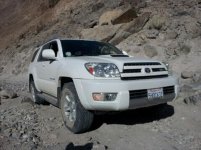
Here's the spot on Lippincott Pass in Death Valley that I was slipping on and didn't seem to notice much difference between locked and unlocked. BTW, I'm totally new to this. I come from a world of BMWs and track days and go-fast stuff, not rock crawling. I'm still learning

Attachments
Last edited:
JB.
New member
I guess I still don't fully understand the benefits of locking the center diff given that it's a Torsen/LSD unit. According to the brochure, the center diff:
- is 40/60 F/R in normal conditions
- is up to 29/71 F/R if a front wheel slips
- is up to 53/47 if a rear wheel slips
Given these specs, the question is why would we ever want to lock it to a fixed 50/50? Or is it not quite that simple?
Your logic is sound given the information at hand, but the thing that trips people up is the confusing term "50/50 torque split" for a locked diff. The 50/50 is relevant to how the front/rear drive shafts rotate when locked together -- their rotating speed relative to each other is 50/50. The possible torque split, however, is nearly 0-100 or 100-0. If you jack up the front end of the truck to get the front wheels in the air and put it in drive with the center diff locked, all the torque -- virtually 100% -- is on the rear wheels. The torque follows the available traction. The Torsen starts to do that, too, but is limited in its ability to continue, plus it needs a little torque (traction) to work with since it doesn't do much good to multiply something near zero. The locked diff has no such limitation.
Conditions can change pretty quickly so my experience (many years ago) on Lippincott may not be relevant, but I'm a little surprised to hear you were spinning there. Did you reduce pressure in your tires?
Last edited:
Your logic is sound given the information at hand, but the thing that trips people up is the confusing term "50/50 torque split" for a locked diff. The 50/50 is relevant to how the drive shafts rotate when locked together -- their rotating speed relative to each other is 50/50. The possible torque split, however, is nearly 0-100 or 100-0. If you jack up the front end of the truck to get the front wheels in the air and put it in drive with the center diff locked, all the torque -- virtually 100% -- is on the rear wheels. The torque follows the available traction. The Torsen starts to do that, too, but is limited in its ability to continue, plus it needs a little torque (traction) to work with since it doesn't do much good to multiply something near zero. The locked diff has no such limitation.
Conditions can change pretty quickly so my experience (many years ago) on Lippincott may not be relevant, but I'm a little surprised to hear you were spinning there. Did you reduce pressure in your tires?
Your explanation makes sense re: 0/100 or 100/0 given a theoretical test case with either axle completely off the ground and the diff locked. My memory is a little foggy but the picture may not show the exact spot I was spinning. Admittedly I didn't lower tire pressure. That may have been my next step. The one spot that challenged me had a large rock in the middle and required careful wheel placement to prevent underside damage. Once I got things lined up properly I gave it a slight running start and had no problem getting up and over.
BTW, I never properly thanked you for your other post in the SoCal forum re: DV suggestions. It was a nice trip and I can't wait to get back up there to explore further.
JB.
New member
Your explanation makes sense re: 0/100 or 100/0 given a theoretical test case with either axle completely off the ground and the diff locked. My memory is a little foggy but the picture may not show the exact spot I was spinning. Admittedly I didn't lower tire pressure. That may have been my next step. The one spot that challenged me had a large rock in the middle and required careful wheel placement to prevent underside damage. Once I got things lined up properly I gave it a slight running start and had no problem getting up and over.
BTW, I never properly thanked you for your other post in the SoCal forum re: DV suggestions. It was a nice trip and I can't wait to get back up there to explore further.
Glad the trip worked out so well.
As for lowering pressure, it's hard to exaggerate how much it helps. It can be tempting to not want to lose any ground clearance, but the traction and control that come with airing down are well worth it.

Robs08Runner
New member
How far can you turn the front tires left to right before there's a bind with the center diff locked?

steveni70
New member
I am looking at it as a whole. If you could turn everything off and lock the center diff, I think it would be a valuable tool, but since it only turns off VSC I think it is a joke. Reason being is that even though it will lock in the power distribution, it doesn't help with abs and traction control kick in and start applying the brakes when you don't need it. I almost hit a curb the other day in the snow because when making a U turn I started to slide. Without the controls I would normally just stepped on the gas to kick it around instead I got a bunch of clicking and beeps while I headed straight for it. Luckily I stopped in time, but back to the point being that the center diff lock was useless in that situation.
If you were taking the U-turn with the center diff locked, you wouldn't hear any beeps from the VSC.
I don't think it's necessary to lock the center diff in snow (unless you want the VSC off) since the torque transfer of the torsen is plenty. I'd leave it unlocked so you don't get the binding and subsequent jumping and loss of traction when turning. And don't use 4low in the snow, you want less torque not more. Some vehicles (like my old FJ62) allow you to start in 2nd gear for this reason.
JB.
New member
How far can you turn the front tires left to right before there's a bind with the center diff locked?
Opinions range between "don't even think about it" to "don't worry about it".
I use 1/2 to 3/4 steering wheel revolution as a rule of thumb and recently devoted a thread to that exact question.
http://www.toyota-4runner.org/4th-g...pavement-center-diff-lock-vsc-off-switch.html

jediwebdude
New member
When off-roading, I've heard other 4R owners say they enable their center diff lock when doing rock crawling. Not sure that's a good idea. My understanding has always been the center diff is for slick surfaces/very loose terrain only (mud, ice, sand).
When I'm going slow through a long stretch of mud, I lock the center diff. If I were to get stuck on ice (haven't yet), I'd lock it. Otherwise, I don't touch that button.
When I'm going slow through a long stretch of mud, I lock the center diff. If I were to get stuck on ice (haven't yet), I'd lock it. Otherwise, I don't touch that button.
Robs08Runner
New member
Great write up.
Thanks guys.
Thanks guys.

emelianenkov
New member
I use my center lock pretty much the second after my tires leave the pavement. When in 4HI unlocked, our trucks are really in AWD. There is a 60/40 split. When you lock the center diff you get a true 50/50 split
emelianenkov
New member
I am looking at it as a whole. If you could turn everything off and lock the center diff, I think it would be a valuable tool, but since it only turns off VSC I think it is a joke. Reason being is that even though it will lock in the power distribution, it doesn't help with abs and traction control kick in and start applying the brakes when you don't need it. I almost hit a curb the other day in the snow because when making a U turn I started to slide. Without the controls I would normally just stepped on the gas to kick it around instead I got a bunch of clicking and beeps while I headed straight for it. Luckily I stopped in time, but back to the point being that the center diff lock was useless in that situation.
Do my ghetto traction mod and it gets rid of auto braking. It's awesome
steveni70
New member
When off-roading, I've heard other 4R owners say they enable their center diff lock when doing rock crawling. Not sure that's a good idea. My understanding has always been the center diff is for slick surfaces/very loose terrain only (mud, ice, sand).
When I'm going slow through a long stretch of mud, I lock the center diff. If I were to get stuck on ice (haven't yet), I'd lock it. Otherwise, I don't touch that button.
You should absolutely lock it when rock crawling. If you have your front wheels with no traction, you want maximum torque to the rear, and you can't achieve that without locking it.
jediwebdude
New member
You should absolutely lock it when rock crawling. If you have your front wheels with no traction, you want maximum torque to the rear, and you can't achieve that without locking it.
Yikes...that's asking for serious breakage. I'll pass and continue to depend on the very dependable ATRAC.
steveni70
New member
Yikes...that's asking for serious breakage. I'll pass and continue to depend on the very dependable ATRAC.
Breakage of what? Locking the center is simply regular 4wd. People have been rock crawling for decades with a locked center.

CAN-03runner
New member
Yikes...that's asking for serious breakage. I'll pass and continue to depend on the very dependable ATRAC.
I see you've got a 2007. On the older trucks like my 2003 atrac does not activate unless the center is locked, but only trac is active.
On the 2007 i think you have an atrac button? If yes, does it activate fully even if you are not center locked or in 4low.
CAN-03runner
New member
If you were taking the U-turn with the center diff locked, you wouldn't hear any beeps from the VSC.
I don't think it's necessary to lock the center diff in snow (unless you want the VSC off) since the torque transfer of the torsen is plenty. I'd leave it unlocked so you don't get the binding and subsequent jumping and loss of traction when turning. And don't use 4low in the snow, you want less torque not more. Some vehicles (like my old FJ62) allow you to start in 2nd gear for this reason.
In snow is a perfect time to use 4x4, plenty of slippage to prevent binding. But yes more often than not, awd mode or even rwd mode is fine provided yiu have good tires for the snow and ice.
4low can actually be beneficial in snow/ice. I've done it often when very slippery. When you need to stop the higher engine compression really helps. And you can increase it even more, by putting the shifter in lower gears like 2 or 3. On take off, i've not felt like there was too much torque that would make me lose control. Actually feels more in control.
The functions are there. If we should avoid their use, we should have got rav4s or highlanders.
jediwebdude
New member
On the 2007 i think you have an atrac button? If yes, does it activate fully even if you are not center locked or in 4low.
I do not have an ATRAC button. ATRAC is automatically enabled when I am in 4-Low.
Similar threads


- Replies
- 0
- Views
- 3K

- Replies
- 1
- Views
- 1K


