What tire pressure do you run?

d33pt

New member
I'm running 255-85/16 BFG Mud Terrain Load Range C. I'm running 30 psi, but I still feel like that's too much. It seems to be wearing more in the middle. What do you guys run?
 
Register to hide this ad
Sheesh, that seems fine, but on the low side in "C." I run lowest on my "E's" 40psi in winter...usually 45 through the warmer months...Isn't the recommended PSI rating like 35psi for these? Do you have photos of the potential wear? Are you sure your gauge is accurate? Silly questions I know but something isn't adding up in my head...
 
If you're wearing out in the middle of the tread you are over inflated. Wearing out on the sides and you are under inflated. I don't go off road but i do tow a 23' Airstream travel trailer. When pulling the trailer I have 35 PSI and when not I have 32 PSI, which is what is listed in the driver's door for proper inflation.
 
If you have ultra large tires (285 and above), wearing the center indeed means overinflation, but you have 255. It's very likely the combination of KM3 tread design and, drive wheels tends to wear in center (steer wheels tends to wear on shoulders). Don't worry about it, just rotate often, or drive in 4hi more.
 
In my extensive search to find what tire pressures to run I ended up just running what feels fine and stop worrying about it. I have Load E 295/75/16 and the local tire shop recommended running them at 35. Many people will say that they need to hold much more and when I ran them at 48 they definitely saved maybe 1mpg and you can feel them having less resistance on the road but I was worried about them not wearing right. They also felt like they grabbed ruts in the road a little more which was not good considering I have to commute downtown. I did a chalk test at 35 psi and found that the outer edges weren't contacting the ground as much but found out that when you make turns you actually wear down the outer edges just a tad so it's normal to see the outer edges just slightly lower. In summary just run whatever your tire shop recommends or whatever the experts say and just leave it. I would be more focused on checking them and making sure that they are always at a specified number.
 
I run 45 PSI on wider TOYO open country A/T tires. Works great for me, handles like a champ.

Sent from my SM-G973U using Tapatalk
 
Tire pressure.....

For my 2008 T4R V8 Sport 2WD.........35# front......32# rear.

Even wear all around........through 3 sets of factory sized Michelin LTX-MS tires.

Hope this helps.

Kevin
 
The best way (especially if running C and D rated tires) is to do a chalk test. Google this...offroadewrs do this a lot since they run larger and often higher-rated tires. Most others run way too high PSI. With Cs on the lighter-than-most Rubicon, the chalk test showed that I should be at 28 PSI. That wore evenly. On the 4Runner and P rated ATs, I run 33 front and 32 rear now. If I ran Cs, I'd prob be around 28 but I have not run Cs so I don't know for sure. Also some tires have stiffer sidewalls like the KO2s while DuraTracs have thinner sidewalls that flex more at the same PSI.
 
I run at 38-40 psi, so you should too. :lmao:

Sounds like its just a trait of running a mud tire of that type on road. Likely rotate often will help. You can certainly lower the PSI but at some point it may be too low for the weight of the vehicle.
 
Last edited:
32 psi as listed on the door. I can run hundreds of miles (short trips) with no tire sensor light coming on. If I do close to 30 miles I get a blinking tire warning light. When scanned, it gives codes communication was lost with either 2 or 3 monitors. Would a change in tire pressure help. Why does it come on at about the 30 mile mark?
 
32 is ideal. You may need to replace your TPMS valves. Mine started to die in 2021. Apparently they will last around 10 years (the Toyota ones anyway) but I got over 15. I got new OEM ones and no issues since. I did have issues with the generic ones.
 
32 is ideal. You may need to replace your TPMS valves. Mine started to die in 2021. Apparently they will last around 10 years (the Toyota ones anyway) but I got over 15. I got new OEM ones and no issues since. I did have issues with the generic ones.

Thanks for the info, I was leaning that way. I am just curious why I can drive months short distances without losing communication and then the longer ride results in the codes. Could heat have something to do with it?

After clearing codes I am good until I drive a distance.
 
if the sensors are very old, they will do weird things and get progressively worse. I think new ones are easy to get from Toyota. I generally will not use aftermarket parts when it comes to sensors, filters, and electronic stuff. This may be my last Toyota so I'm trying to make it last.
 
Tires heat up on longer trips and is probably affecting the sensors, particularly if they are old. Sometimes in the winter I will see a low tire but after I drive a couple miles the light goes off. Air expands when it gets warm. I guess your sensors are close to end of life.

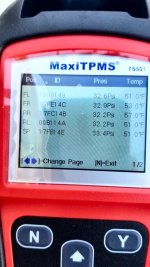
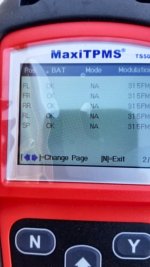
The DENSO sensors that came with my 2004 T4R were still good until last year. One died and another's battery was very weak. The other 3 were OK on the battery. The dealership wanted too much money to put in new Densos so I bought 5 off Amazon and a sensor reader. I paid the local tire guy to install them for me then used the reader to write them into the computer. The reader checks battery voltage, pressure and tire temperature as well as the sensor's manufacturer and sensor ID
 

Attachments

  • 20221017_164346s.jpg
    20221017_164346s.jpg
    131.8 KB · Views: 258
  • 20221017_164353s.jpg
    20221017_164353s.jpg
    124.5 KB · Views: 272
if the sensors are very old, they will do weird things and get progressively worse. I think new ones are easy to get from Toyota. I generally will not use aftermarket parts when it comes to sensors, filters, and electronic stuff. This may be my last Toyota so I'm trying to make it last.

My dealership wanted $400/tire, $2,000 to replace all 5 sensors on my 2004. When I got the sensor reader it said they were Denso sensors and that's what I got from Amazon, about $33 each. When I asked at the Tire stores they wanted to put in their own sensors, said they didn't have the software to write the new IDs into the ECU. The ones that came out of the tires were identical to the ones I got on Amazon, other than the IDs. Now I can just point the reader at each tire and find any that are low on air or battery.
 
Factory Tire Sensors

I just picked up (4) Factory OEM Sensor for my 2006 SR5 4x4 V6 off Ebay for $48.00 plus shipping. I wasn't going to do the generic ones from all the horror stories i heard with them.

just my 2 cents worth
 
I just picked up (4) Factory OEM Sensor for my 2006 SR5 4x4 V6 off Ebay for $48.00 plus shipping. I wasn't going to do the generic ones from all the horror stories i heard with them.

just my 2 cents worth

If you got 4 "OEM" (Denso) sensors for $48, I afraid you bought counterfeit Denso sensors, there's no way you got 4 genuine Denso sensors for $48.

Ebay is full of "OEM" parts that are unfortunately counterfeits, the price is telling sign of that!!

Rockauto sells genuine Denso sensors for $35.79 and you won't find them much if any cheaper anywhere, if you pay somewhere close to that from a reputable supplier then you are going to get the real deal, so if you would of paid another $100+/- plus that $48 from a reputable seller then I would feel good about knowing I more than likely got the real sensors!!

Hopefully the ones you got will work for you, but I would not be surprise if they start giving you trouble at some point.
 
Last edited:

Members online

Forum statistics

Threads
278,312
Messages
3,554,085
Members
248,016
Latest member
Advally Service

Trending content

Back
Top