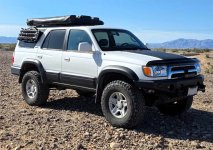
Wheel Advice

Yeah, I see that's a concern, that hub centric really helps you to align things (and some say that's the main reason for them, not that they support the wheel, but rather they're good for aligning it".

Assume I torqued it down correctly (which I believe I did, followed procedures, patters and used my torque wrench) and it's probably correctly "aligned" since it's still very smooth.

Then the issue then is does it inherently pose a greater chance of failure, either through shearing of the studs, stretching the studs, or something else since it's no longer "resting" on the hub.

It just seems that for all wheels that are not hub centric, wouldn't this apply and result in greater % of failures? And I don't think I really see that. Also, it's a 1/4" spacer with extended studs.
 
So it does seem in doing more research, hub centricity is more to ensure proper initial alignment and torqueing. Since of course many wheels are lug centric and don't have any issues. And there are many after market wheels that have larger hubs and have no issues being used on the 4runner.

CHatGPT said that if it's properly aligned on the studs, properly torqued and the spacers are not cheap casted junk (mine are forged then machined) and so have flat mating surfaces, that it would be considered safe, esp. at 1/4" and with extended studs.

The question is, do I trust this? LOL
 
1/4" spacer isn't doing much - is it worth it or needed? Sorry if I missed the reason earlier in the thread. FWIW, Method wheels are hub-centric.
 
1/4" spacer isn't doing much - is it worth it or needed? Sorry if I missed the reason earlier in the thread. FWIW, Method wheels are hub-centric.

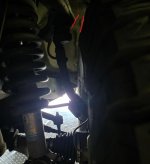
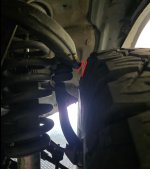
You bring up a valid point. So with a 1/4" Spacer installed, this is the top of the tire to the UCA when the tire is on the ground, then at full droop. As the wheel droops (hanging freely), the gap gets narrower. When it's the ground, the gap gets larger. I wonder as the wheel compresses into the wheel well, would it get closer the UCA or keep it's distance? Effectively being the opposite of when it droops.
 

Attachments

  • 1.jpg
    1.jpg
    51.6 KB · Views: 417
  • 2.jpg
    2.jpg
    64.4 KB · Views: 425
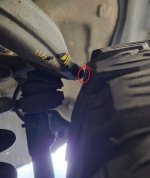
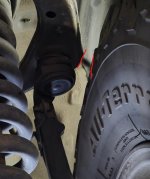
Then without the 1/4" spacer, this is the wheel at full droop (maybe 2mm gap, but some of the nibs can sometimes graze the tip of the UCA. Then when the wheel is on the ground and the truck is resting its full weight on it there is still about a 3/4" gap between the wheel and the UCA.

So I guess maybe the clearance is relatively acceptable w/o the spacer? I would only notice it rubbing when the wheel might drop down really quickly or when entering a driveway at an angle. But it seems like it's maybe not really that bad?

I haven't tested it yet fully compressed into the wheel well, but it seems like it does pull away from the UCA as it goes upwards?
 

Attachments

  • 3.jpg
    3.jpg
    58.3 KB · Views: 418
  • 4.jpg
    4.jpg
    81.1 KB · Views: 417
Then without the 1/4" spacer, this is the wheel at full droop (maybe 2mm gap, but some of the nibs can sometimes graze the tip of the UCA. Then when the wheel is on the ground and the truck is resting its full weight on it there is still about a 3/4" gap between the wheel and the UCA.
You still have clearance at full droop? There is no reason to put spacers on then, other than looks. Aftermarket control arms have more clearance in the area of concern - and even before aftermarket wheels were available, people would cut the arm there and plate it for more clearance. So, along with correcting alignment, that is another reason why people put on aftermarket upper arms. The gap to the upper a-arm only gets wider as the suspension compresses, full droop is worst case.

As for wheels/spacers/studs:
- OEM Toyota truck alloy wheels (at least before the TNGA trucks) use flat seat lug nuts that DO NOT center the wheels. There is a fair amount of play there until the lug nuts are tight. The hub protrusion is required to center the wheels.
- Many/most aftermarket wheels specifically for Toyota applications have the correct bore size already, though they also often change to cone-seat lug nuts. Any that have an oversized hub bore should use hubcentric rings to center the wheels (this is true of any aftermarket wheel in any application)
- The hub protrusion is there for centering during installation only - and yes, the clamping force of the lug nuts and friction takes the load, not the hub protrusion or the wheel studs. The fastest way to break a wheel stud is to have loose lug nuts...

-Charlie
 
You still have clearance at full droop? There is no reason to put spacers on then, other than looks. Aftermarket control arms have more clearance in the area of concern - and even before aftermarket wheels were available, people would cut the arm there and plate it for more clearance. So, along with correcting alignment, that is another reason why people put on aftermarket upper arms. The gap to the upper a-arm only gets wider as the suspension compresses, full droop is worst case.

As for wheels/spacers/studs:
- OEM Toyota truck alloy wheels (at least before the TNGA trucks) use flat seat lug nuts that DO NOT center the wheels. There is a fair amount of play there until the lug nuts are tight. The hub protrusion is required to center the wheels.
- Many/most aftermarket wheels specifically for Toyota applications have the correct bore size already, though they also often change to cone-seat lug nuts. Any that have an oversized hub bore should use hubcentric rings to center the wheels (this is true of any aftermarket wheel in any application)
- The hub protrusion is there for centering during installation only - and yes, the clamping force of the lug nuts and friction takes the load, not the hub protrusion or the wheel studs. The fastest way to break a wheel stud is to have loose lug nuts...

-Charlie

That's very helpful, thanks!

I took off all the spacers this weekend and probably will sleep better at night. Ultra smooth at all speeds. And good know that it's full droop that's the key point. Yes it pretty much clears everything, I might hear some slight rubbing while turning at full lock, but I don't think it's the UCA, probably something else but I'll confirm. Truck alignment is dead on straight.

It really makes it so much more pleasant to drive when everything is smooth and tracks straight and I'm not worrying about the probably irrational fear of using spacers (I had them for 30k miles w/o any issues, just the darn wobble and shake every now and then). I'll think I'll leave well enough alone, esp. with your input about the droop.
 

Members online

No members online now.

Forum statistics

Threads
278,306
Messages
3,554,044
Members
248,016
Latest member
Advally Service

Trending content

Back
Top