
Wheel backspacing and offset defined:

BigRogers

New member
Intent of this thread is to try and help others learn, as well as teach myself (if the math is correct) how to determine backspacing and offset of just about any wheel.

Layout and terms of the wheel:
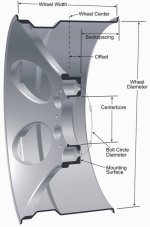
Wheel Breakdown.jpg

So using this link for my reference http://www.toyota-4runner.org/3rd-gen-t4rs/33980-stock-oem-4runner-rim-offset-backspacing.html#post288655
This 16” 3rd gen 5-star measures the wheel width as 7”, this makes a wheel center 3.5”. The backspacing is 4.625".
This is achieved by measuring the distance of the backside of the wheel to the mounting surface as shown above.
If I understand correctly the wheel offset is calc’d by subtracting the wheel center from backspacing (Bs-WC=Offset).
Doing the math that would leave this wheel to have a positive offset of 1.25" or 28.5mm.
Positive offsets are when the backspacing is greater than the wheel center (4.625”>3.5”)

Now throwing wheel spacers in, a 1.25" spacer subtracted from the initial backspacing of 4.625” brings the relative backspacing to roughly 3.375”.
This would create a negative Offset as the Wheel Center is now greater than the Backspacing (3.5”>3.375”)

Let me know if you see any math or methods that are incorrect and I will edit to make right.
 

Attachments

  • Wheel Breakdown.jpg
    Wheel Breakdown.jpg
    32.8 KB · Views: 48,556
Last edited:
Register to hide this ad
[MENTION=74598]hrt4me[/MENTION]

Great link, thanks for posting.
I actually posted in it as well, but i wanted to give an example using numbers to be as straight forward as possible and all on one wheel that we all know.
 
This 16” 3rd gen 5-star measures the wheel width as 7”, this makes a wheel center 3.5”. The backspacing is 4.625".
This is achieved by measuring the distance of the backside of the wheel to the mounting surface as shown above.

rim width= inner tire bead to inner tire bead.
backspace= "mounting surface" (hub face) to outer edge of rim

If I understand correctly the wheel offset is calc’d by subtracting the wheel center from backspacing (Bs-WC=Offset).
Doing the math that would leave this wheel to have a positive offset of 1.25" or 28.5mm.
Positive offsets are when the backspacing is greater than the wheel center (4.625”>3.5”).

The offset (ET) number is better defined as the distance the hub face is offset from the center line of the rim.

When measuring a wheel offset yourself:
measure the "extreme" outer edges for an overall rim width (not the actual "rim width") and the backspacing. Outer edges are usually rimwidth+0.5" but can vary.

Offset= backspacing-(extreme outer edges/2)

Using the example of your 16"x7" BS 4.625"

Offset= 4.625-(7.5/2)
Offset= 0.875"= ET22 (ish)

disclaimer: I cannot see the photos in the "rim link" at work. So I dont know if his numbers are correct. My guess is that something is alittle off, considering that my stock dual trispokes 16x7's were ET15.

Most rims (unless they are custom built) will be stamped with this ET # somewhere.

Postive offsets will sit further in your fender (have more backspace)
Negative offsets will sit further out of your fender (have less backspace)

Now throwing wheel spacers in, a 1.25" spacer subtracted from the initial backspacing of 4.625” brings the relative backspacing to roughly 3.375”.
This would create a negative Offset as the Wheel Center is now greater than the Backspacing (3.5”>3.375”)

Let me know if you see any math or methods that are incorrect and I will edit to make right.

Adding a 1.25" spacer will give you ~32mm more offset and put your at ET-10
 
Rogers, you are really overthinking this. Forget offset, you don't need to calculate offset. Backspace is the distance between the inside surface of the wheel and brake rotor or whatever the wheel bolts to. If you add a spacer or hub adapter, add that number to the backspace. Done.

The only time offset comes into play is if you care how much wheel is on the outside of the wheel mounting surface. You get that number by subtracting the backspace from the wheel width.
 
Rogers, you are really overthinking this. Forget offset, you don't need to calculate offset. Backspace is the distance between the inside surface of the wheel and brake rotor or whatever the wheel bolts to. If you add a spacer or hub adapter, add that number to the backspace. Done.

The only time offset comes into play is if you care how much wheel is on the outside of the wheel mounting surface. You get that number by subtracting the backspace from the wheel width.

Well maybe i am "overthinking" this, but the reason i jumped into this topic is I have been looking at new wheels for my runner and the wheels mostly seem to be labeled with offset (not backspacing): 16X8.5 6-139.7 -6MTB

So trying to work the math to find out what my backspacing is and offset from that point.

How would I take backspacing and understand what the above wheel would look like on my truck with out doing this math?? I think this is about the only way to do it.......Educate me if it is not.

When measuring a wheel offset yourself:
measure the "extreme" outer edges for an overall rim width (not the actual "rim width") and the backspacing. Outer edges are usually rimwidth+0.5" but can vary.

Offset= backspacing-(extreme outer edges/2)

Using the example of your 16"x7" BS 4.625"

Offset= 4.625-(7.5/2)
Offset= 0.875"= ET22 (ish)

disclaimer: I cannot see the photos in the "rim link" at work. So I dont know if his numbers are correct. My guess is that something is alittle off, considering that my stock dual trispokes 16x7's were ET15.

Most rims (unless they are custom built) will be stamped with this ET # somewhere.

Postive offsets will sit further in your fender (have more backspace)
Negative offsets will sit further out of your fender (have less backspace)

Adding a 1.25" spacer will give you ~32mm more offset and put your at ET-10

Thank you for posting some of this information. I had no idea the ET was stamped on the rim. Ill take a look for that.
 
Last edited:
So all this has me stumped on what to by in regards to the offset.
These are the wheels I am looking at: Wheel Details - Discount Tire
they offer 2 offsets in the 16x8.5 size at 25 & -6.
I would prefer not to run the spidertrax wheel spacers unless i must do so to clear my UCA. Somebody shed some light on this for me.
 
(ASSUMING ALL "overall rim widths are equal/negligable" to tire bead (given) rim widths)

If you have OEM stockers now.
I'd be willing to guess they are 16x7 ET15

Doing the math that gives you a ~4.1" BS (back space) 2.9" FS (front space)

Going to a 16x8.5 ET25

~5.25" BS, 3.25"FS: They will go further IN your fender a little over and ince, and come out further ~.25".

Going to a 16x8.5 ET-6
~4"BS, 4.5"FS: The backspacing is roughly the same as stock (gives you a bit more clearance) but your front space increases and inch and a half.

To answer your question getting the ET 25 with 1.25" spacers would be the same as getting the -6 without spacers.
 
Last edited:
(ASSUMING ALL "overall rim widths are equal/negligable" to tire bead (given) rim widths)

If you have OEM stockers now.
I'd be willing to guess they are 16x7 ET15

Doing the math that gives you a ~4.1" BS (back space) 2.9" FS (front space)

Going to a 16x8.5 ET25

~5.25" BS, 3.25"FS: They will go further IN your fender a little over and ince, and come out further ~.25".

Going to a 16x8.5 ET-6
~4"BS, 4.5"FS: The backspacing is roughly the same as stock (gives you a bit more clearance) but your front space increases and inch and a half.

To answer your question getting the ET 25 with 1.25" spacers would be the same as getting the -6 without spacers.

Thanks a TON! I appreciate you laying this all out. It is seems to be preferable to have a positive offset though right?
 
It is more common to have a positive offset. There is some debate on the effects of added stress to wheel bearings/hubs from the lower/negative offset wheels, but I've yet to see anything concrete on it.

For reference I went from ET40 wheels to ET13 on my previous BMW and saw no ill effects.

I also switched to 17"Taco rims with ET30 with spidertrax making them ET-1 and have seen no ill effects as well.
 
So all this has me stumped on what to by in regards to the offset.
These are the wheels I am looking at: Wheel Details - Discount Tire
they offer 2 offsets in the 16x8.5 size at 25 & -6.
I would prefer not to run the spidertrax wheel spacers unless i must do so to clear my UCA. Somebody shed some light on this for me.

Call them. I did, and they gave me the exact backspacing. I am actually ordering wheels today, so I have been speaking with them the past few days.
 
Call them. I did, and they gave me the exact backspacing. I am actually ordering wheels today, so I have been speaking with them the past few days.

So what are you picking up? Very curious what ended up fitting? I called and made an appointment to do a test fit this weekend before I actually order them in.
 
Wheels

(5) 16X8.5 6-139.7 -6MTB Level 8 STRIKE 6
They will be here on Thursday :party:

They are supposed to have a 4.5" backspacing.

levst6.mtb.ang.jpg


Check out Blcktpstr's build thread, I believe he has these same wheels.
 
from a physics perspective, i think then having a backspacing of half the width of the rim is ideal, and if the stock backspacing is a little past center, adding the 1.25" wheel spacers makes it a little inwards of center, therefore its still the same amount of leverage.
 
Intent of this thread is to try and help others learn, as well as teach myself (if the math is correct) how to determine backspacing and offset of just about any wheel.

Layout and terms of the wheel:
View attachment 83475

So using this link for my reference http://www.toyota-4runner.org/3rd-gen-t4rs/33980-stock-oem-4runner-rim-offset-backspacing.html#post288655
This 16” 3rd gen 5-star measures the wheel width as 7”, this makes a wheel center 3.5”. The backspacing is 4.625".
This is achieved by measuring the distance of the backside of the wheel to the mounting surface as shown above.
If I understand correctly the wheel offset is calc’d by subtracting the wheel center from backspacing (Bs-WC=Offset).
Doing the math that would leave this wheel to have a positive offset of 1.25" or 28.5mm.
Positive offsets are when the backspacing is greater than the wheel center (4.625”>3.5”)

Now throwing wheel spacers in, a 1.25" spacer subtracted from the initial backspacing of 4.625” brings the relative backspacing to roughly 3.375”.
This would create a negative Offset as the Wheel Center is now greater than the Backspacing (3.5”>3.375”)

Let me know if you see any math or methods that are incorrect and I will edit to make right.

In doing some research for the trailer I am building, I found this thread...but correct me if I am looking at this wrong...

But in the diagram, the wheel center is 3.5", how can the back space be 4.625", greater than the center difference, even in the diagram, the back space reference line is shorter than the wheel center dimension.

77
 
In doing some research for the trailer I am building, I found this thread...but correct me if I am looking at this wrong...

But in the diagram, the wheel center is 3.5", how can the back space be 4.625", greater than the center difference, even in the diagram, the back space reference line is shorter than the wheel center dimension.

77

So if i understand it correctly this is possible. the back spacing has nothing to do with the wheel center. The back spacing measures from the back of the wheel to the mounting surface, the offset is what measures from the mounting surface to the center of the wheel.

Basically what you have described is a negative wheel offset of 1.125", if it was going the other direction it would be a positive offset (I THINK?).

Does that make it a bit clearer?
 
So if i understand it correctly this is possible. the back spacing has nothing to do with the wheel center. The back spacing measures from the back of the wheel to the mounting surface, the offset is what measures from the mounting surface to the center of the wheel.

Basically what you have described is a negative wheel offset of 1.125", if it was going the other direction it would be a positive offset (I THINK?).

Does that make it a bit clearer?

That is the way I understand it. The way I see it, using round numbers, if you have an 8 rim, so this is a 4" center, you measure from the back side to the mounting flange and it is 4", then the backspace would be 0...

Thanks,

77
 
Originally posted by 77bronc
In doing some research for the trailer I am building, I found this thread...but correct me if I am looking at this wrong...

But in the diagram, the wheel center is 3.5", how can the back space be 4.625", greater than the center difference, even in the diagram, the back space reference line is shorter than the wheel center dimension.

77

You are correct. The pictured wheel is not the one being discussed. That wheel in the diagram has a negative offset, so the backspacing would be less the the distance from the centerline to inner lip. The wheel being discussed - with a 7" total width and 4.625" backspace - would have the mounting surface on the opposite side of the centerline, thus having a positive offset.
 
That is the way I understand it. The way I see it, using round numbers, if you have an 8 rim, so this is a 4" center, you measure from the back side to the mounting flange and it is 4", then the backspace would be 0...

Thanks,

77


The backspace would be 4".....The offset would be 0.
 
The backspace would be 4".....The offset would be 0.

close. wouldn't the offset be the difference between the actual center of the wheel(as shown in the diagram in the OP), and the mounting surface? it would take into account the thickness of the metal.
perhaps for a steel wheel, its so small, they would still consider it zero?
 

Members online

No members online now.

Forum statistics

Threads
278,309
Messages
3,554,068
Members
248,016
Latest member
Advally Service

Trending content

Back
Top