Wheel offsets for 285's on stock 5th gen Trail

pelemay

New member
Good afternoon everyone, and thank you all for the very useful info I found on this forum since I got my 4Runner a couple weeks ago.

I am just about to purchase 285/70/17 DuraTracs (studded for winter) mounted on Ultra Gauntlet wheels on my stock (no lift) 2013 Trail edition. The wheels are apparently available in -12mm or +12mm offsets.

Now, as I understand it, the Trail original wheels have a +15mm offset. So I guess that the +12mm Gauntlets would fit better. In fact, the centerline of my new tires would then be pushed 3mm inside, so a little less risk for the bigger tire to rub against the fender liner.

However, I saw on this forum that most people seem to favor the -12mm ones, thus pushing the tires out more. Don't those have more chances to cause rubbing against the fender liner when turning ? Is the -12mm done mostly for the more aggressive looks, at the price of possibly more rubbing ? Or is it necessary to avoid suspension/UCA rubbing ?

Of course, in either case I am ready to have to move the fender liner as per this forum's instructions, but I want to optimize the fine balance between... rubbing against suspension and rubbing against fender liner when turning :-)

Long story short: Anyone has experience with this tire mounted on -12 or +12 mm offset wheels ? Which one would fit best on a zero-lift Trail ?

Thanks !
 
Register to hide this ad
I think that in the absence of a lift or aftermarket UCA's to dial your caster in properly, you're likely going to experience some rubbing regardless. On the fender lining in the front and body mount in the rear of the wheel well . If you go from a -12mm to a +12 mm offset you're going to be moving the wheel inwards, and combined with the wider tire you're now risking rubbing on the UCA.
Not sure what the width on the new wheels is going to be, but more width on the wheel is a factor there as well.
I'd have to say the best bet considering the info you have given is to stick as close to stock offset as you can and hope there's sufficient gap between the tire and UCA.
Seems to me anyway.
 
I get rubbing with 285s on a lifted TE with aftermarket UCAs. Whichever offset you get I think you'll get rubbing with the question being how much and where. Add the studded tires to that and you're risking some damage. Unless you want to take an angle grinder and BAH to your body mount and pinch weld I'd go with 265s and call it a day.
 
:iagree:
Stick close to stock with out a lift=no rubbing. When/if you decide to lift in the future,285 and up will be good to go with your wheels.
 
Offset is irrelevant without knowing the wheel width. With 285's on your stock height you will have considerable rubbing issues regardless so be prepared for liner and bumper cover modifications along with mudflap/bodymount mods. If you are going to stay at stock height you would be better off staying with 265's. My .02
 
Thanks for your reply.

Wow. I admit that pops my dreamy bubble :-(

...based on many replies on this forum, I had assumed the 285's would (closely) fit on a TE: NHinAK, GrantK, RNA352, Rlin0997, ScottsdaleT4R, Tengu and others seemed to somehow have succeded.

Am I missing something ?

P.S. What is a "BAH" ?

Thanks :-)

It can be done, but not without compromise as far as fender liner work and possible body mount modifications. I think if you look at some of those other builds they might have stock wheels/offsets as well. When you throw studs and wheels with different offset into the mix you're adding another variable. If you plan to take your truck off road with 285s and no lift you're going to have even more rubbing as soon as you start compressing regardless of wheel offset and width. It's totally up to you whether or not you want to try it, just be aware that there might be a lot more involved than just pulling the fender liner forward.
 
Just got stock size BFG AT's. The only rubbing I got is from ice packed in the wheel wells :D (later in the day from the posted pic) These things rally in the snow. I have taken it light offroad without issues, I have only have it a little over a month so time will tell.

RmMyS0dl.jpg
 
Last edited:
Like mentioned above, a studded 285 w/o lift could or better yet will cause some damage. Combine that with a -12mm offset and your tires are going to stick out even further. Looks killer, but keep in mind a set-up like that could throw more road debris up around your truck. I'm not sure what part of QC you're in, but I know some parts are much like NL winters, which are dirty! If it were me I'd stick with the 265s and go with the -12mm offset. Skinnier tires work better for winter, and the new offset will push the Duratracs out a little which looks much better.

Why not go with a 275 Duratrac in the summer? No studs thrown into the equation then.
 
Can't thank you enough for taking the time to answer my newbie questions :thumb3:

Still, there is something I cannot really seem to figure out:
Offset is irrelevant without knowing the wheel width.
Please stop me before I say something stupid: unless the alloy wheel were actually wider than the tire, then my only real rub concern is with the rubber tire, right ? So, the result of half the tire width minus the offset would be the parameter we should actually compare, isn't it ? (The width of the wheel has no actual effect, I would think, for a constant offset.)

Let us assume that the original Trail wheel has a +15mm offset (can someone please confirm this, btw ?) and the original tire is 265mm wide. I calculate that the inside face of the tire is (265mm/2) - (+15mm) = 117.5mm "inside" from the mounting pad plane.

The "new" 285mm tire mounted on a +12mm offset wheel would sit at (285mm/2) - (+12mm) = 130.5mm "inside".

The difference between those results tells me where the new tire will end up, on the UCA side: (130.5 - 117.5) = 13mm closer to the UCA. (A shortcut to this result is that the tire is 10mm wider on either side of its middle plane and the new wheel protrudes 3mm less outside.)

I think I can easily get 13mm closer to the stock UCA without hitting/rubbing anything on that side, yes ? (...then the only remaining issue would be with the outer edge of the tire, when turning/reversing/wheeling...)

Comments / wisdom / experience welcome...

:thanks:

P.S. FYI, the wheel I am looking at is 9'' wide.
 
I just threw 275/55/20's on a stock '12 Limited, 20x9 wheels, +18 offset, ZERO RUBBING. 285's will be close...

285/70/17 - 32.7" diameter and 11.22" width
275/55/20 - 31.9" diameter and 10.83" width

And that doesn't take tread depth and shoulder into consideration with different tires. 285/70/17 MT/Rs are bigger than the same size Duratracs, which in turn are bigger than Nokian Rotiivas.
 
Can't thank you enough for taking the time to answer my newbie questions :thumb3:

Still, there is something I cannot really seem to figure out:

Please stop me before I say something stupid: unless the alloy wheel were actually wider than the tire, then my only real rub concern is with the rubber tire, right ? So, the result of half the tire width minus the offset would be the parameter we should actually compare, isn't it ? (The width of the wheel has no actual effect, I would think, for a constant offset.)

Let us assume that the original Trail wheel has a +15mm offset (can someone please confirm this, btw ?) and the original tire is 265mm wide. I calculate that the inside face of the tire is (265mm/2) - (+15mm) = 117.5mm "inside" from the mounting pad plane.

The "new" 285mm tire mounted on a +12mm offset wheel would sit at (285mm/2) - (+12mm) = 130.5mm "inside".

The difference between those results tells me where the new tire will end up, on the UCA side: (130.5 - 117.5) = 13mm closer to the UCA. (A shortcut to this result is that the tire is 10mm wider on either side of its middle plane and the new wheel protrudes 3mm less outside.)

I think I can easily get 13mm closer to the stock UCA without hitting/rubbing anything on that side, yes ? (...then the only remaining issue would be with the outer edge of the tire, when turning/reversing/wheeling...)

Comments / wisdom / experience welcome...

:thanks:

P.S. FYI, the wheel I am looking at is 9'' wide.
Your making this way harder then it is.
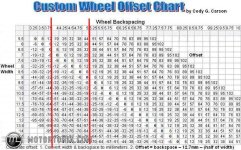
As stated several times ,comparing wheel offset is useless info unless you are comparing wheels of the same width. Backspace is how you compare and if you have the offset you can find the backspace with a chart. Not sure where you came up with stock TE at +15.

Somebody please measure bs on a TE wheel and post up so we can get facts instead of assumptions . Not that hard to measure and it's definitely a 7.5" width so it's either a 4.5"or 4.75 bs making it a +6 or a +12 offset.The how to is in the wheel tech info on the link down below.
4 years now and nobody with a TE wheel has reported the actual measured back space = lame.:Cry:

Back to the 9 inch wide wheel with a +12 offset....that will give you a 5.5" bs which will move the inward edge of the wheel about 1 full inch inward and that doesn't include the cross section of the tire width.That just happens to be the stock backspace of a GM 6 bolt truck wheel that has the same bolt pattern as us.Who would you bet that wheel in this size was designed for them .

Here is good reading on how wheels are measured....https://www.rsracing.com/tech-wheel.html

Here is a little better chart and stay in the red between a 4 and 5 inch back space and a 7-9 inch width for a 5th Gen 4Runner for best results.Been discussed at least 20 times already.
 

Attachments

  • Max_Wheel_Offset_Chart_by_Cody_G_CarsonJPG_Thumbnail1 (1).jpg
    Max_Wheel_Offset_Chart_by_Cody_G_CarsonJPG_Thumbnail1 (1).jpg
    116.3 KB · Views: 26,486
Please stop me before I say something stupid: unless the alloy wheel were actually wider than the tire, then my only real rub concern is with the rubber tire, right ? So, the result of half the tire width minus the offset would be the parameter we should actually compare, isn't it ? (The width of the wheel has no actual effect, I would think, for a constant offset.)

Let us assume that the original Trail wheel has a +15mm offset (can someone please confirm this, btw ?) and the original tire is 265mm wide. I calculate that the inside face of the tire is (265mm/2) - (+15mm) = 117.5mm "inside" from the mounting pad plane.

The "new" 285mm tire mounted on a +12mm offset wheel would sit at (285mm/2) - (+12mm) = 130.5mm "inside".

The difference between those results tells me where the new tire will end up, on the UCA side: (130.5 - 117.5) = 13mm closer to the UCA. (A shortcut to this result is that the tire is 10mm wider on either side of its middle plane and the new wheel protrudes 3mm less outside.)

I think I can easily get 13mm closer to the stock UCA without hitting/rubbing anything on that side, yes ? (...then the only remaining issue would be with the outer edge of the tire, when turning/reversing/wheeling...)
Actually, I think all of this is logical and theoretically correct. However, the reality is that it's difficult to compare tires based on the nominal dimensions. As was mentioned, all 285s (or any other nominal width) are not equal. They are roughly equal, but can still vary quite a bit. Some may be taller, some may have a larger tread width, some may have a larger section width, etc.

The other problem is that the shape/size of the tread blocks at or near the shoulder may be the deciding factor for some of the possible rubbing. Generally you won't have any rubbing in the center of the tread pattern, but when turning, it's going to be the shoulder areas that have more potential to hit something when angled one way or the other.

When it comes down to it, you're trying to match a 3D wheel inside of a 3D wheel well, so it's not quite as straight forward. From what I can tell, even sticking with the exact wheel/tire/size/offset combinations, you STILL might not have the exact same experience as another member due to some small variations in suspension (could be driver/cargo weight, sagging due to age or use, etc.). When you go to a different wheel/offset AND a different tire brand/size, that just adds another variable to the matter.

It's really a situation where the most probable fitting is from following others' suggestions. But if you want something different, it MIGHT end up costing a bit more to make it work - or you might come to the conclusion that it just doesn't work and then you have to get new tires.
 
[...]comparing wheel offset is useless info unless you are comparing wheels of the same width. Backspace is how you compare and if you have the offset you can find the backspace with a chart. Not sure where you came up with stock TE at +15.

Somebody please measure bs on a TE wheel and post up so we can get facts instead of assumptions . Not that hard to measure and it's definitely a 7.5" width so it's either a 4.5"or 4.75 bs making it a +6 or a +12 offset.The how to is in the wheel tech info on the link down below.
4 years now and nobody with a TE wheel has reported the actual measured back space = lame.:Cry:

Thanks Harper7. I actually took a look and now realize why the backspace is so important in our case. The UCA and some tie-rod end up pretty close to the stock tire and wheel as it is, when turning. (I come from an Xterra and I do not recall having such proximity issues.)

That said, this morning I took off one wheel of my 4runner TE. There are two distinct markings on the inside of the wheel spokes: "17X7 1/2J" and "J DOT 15". I assume that means 17" dia wheel x 7.5" width, having a +15mm offset.

I then actually measured the distances from the innermost edge (UCA side) to mounting pad, and got 124 mm. I repeated the same operation for the outermost edge (curb side) to the same mouting plane, and got 92 mm.

Hence, the total actual width of the wheel is 124 + 92 = 216 mm. (That is 8.5", so that means the flanges are each about 0.5" wide.)

Assuming symmetrical flange widths, I obtain a mid-plane lying at 216 / 2 = 108 mm from either flange. My measured/calculated offset is thus (124 - 108) or (108 - 92) which is +16mm.

Conclusion, I feel pretty confident to claim that the TE wheels have a +15/+16mm offset. :nerd:
 
They fit !

Well, after lots of reading on this forum, and thanks to the frank advice in this thread, I opted for keeping the stock wheel, but I took a chance and ordered the 285/70/17 Duratracs (studded for winter).

After harper7's front fender mod (real easy) and after removing the (useless ?) mudflaps, I get no rubbing at all in normal/city driving !

Yay !

Thanks to all :hug:

P.S. Not removing the mudflaps would have resulted in them being eaten away quite fast by the studded tires (!)
 
I think that in the absence of a lift or aftermarket UCA's to dial your caster in properly, you're likely going to experience some rubbing regardless. On the fender lining in the front and body mount in the rear of the wheel well . If you go from a -12mm to a +12 mm offset you're going to be moving the wheel inwards, and combined with the wider tire you're now risking rubbing on the UCA.
Not sure what the width on the new wheels is going to be, but more width on the wheel is a factor there as well.
I'd have to say the best bet considering the info you have given is to stick as close to stock offset as you can and hope there's sufficient gap between the tire and UCA.
Seems to me anyway.

Any idea on how the 285 70 r17's would do with a -12mm offset. Thinking of getting the Fuel SHOK D666's -12mm offset.

I have the 2006 oem toyota wheels on now with the 285's along with 1.5" wheel spacers.. If I remove the spacers and throw on the -12mm rims would the space outwards be about the same?

2006 4runner, 3" lift. (For what its worth, im i nstalling a Coastal offroad high clearance bumper this weekend)
 

Members online

Forum statistics

Threads
278,316
Messages
3,554,120
Members
248,016
Latest member
Advally Service

Trending content

Back
Top