Which static alignment specs are directly adjustable on a stock 2wd 3rd-gen 4runner?

Status
Not open for further replies.

foo

Banned
Which static alignment specs are directly adjustable on a stock 2wd 3rd-gen 4runner?

While I know that every adjustment to one component of the suspension affects some of the others, what I mean by directly adjustable is that it has its own factory-supplied adjustment bolt, cam, or arm (i.e., it was meant to be adjusted).

  • Front toe has to be adjustable (by virtue of having tie rods) but is rear toe adjustable?
  • Is the front and rear camber factory adjustable?
  • Does the front caster have a direct adjustment point?
  • Anything else in a typical static alignment adjustable?

Once I know what "can" be adjusted, the next question would be:
  • What accuracy is needed?
  • Are the specs easy to come by?

Note a search finds "specs" but most of you have the 4WD version.
- Lifted 3rd Gen Recommended Alignment Specs?
 
Register to hide this ad
Which static alignment specs are directly adjustable on a stock 2wd 3rd-gen 4runner?

While I know that every adjustment to one component of the suspension affects some of the others, what I mean by directly adjustable is that it has its own factory-supplied adjustment bolt, cam, or arm (i.e., it was meant to be adjusted).

  • Front toe has to be adjustable (by virtue of having tie rods) but is rear toe adjustable?
  • Is the front and rear camber factory adjustable?
  • Does the front caster have a direct adjustment point?
  • Anything else in a typical static alignment adjustable?

Once I know what "can" be adjusted, the next question would be:
  • What accuracy is needed?
  • Are the specs easy to come by?

Note a search finds "specs" but most of you have the 4WD version.
- Lifted 3rd Gen Recommended Alignment Specs?


All vehicles that I know of can adjust camber, caster, and toe in the front. The rear on our truck is a solid axle so it is non adjustable.
The LCA cams (2 on each side) adjust camber/caster and toe. To correctly do the front alignment, you would adjust the cams to get the proper camber/caster then do a caster sweep, re check the caster camber then set the toe - one side at a time, using the tie rods, keeping the other side where it is at, meaning don't go from one side to the other than back to the other side back and forth. that's how you get a crooked steering wheel.


Specs are out there and should be the same for a 2WD as a 4WD.
caster 1.7 to 3.4 degrees with cross caster no more than .5 degrees maybe a little more caster on passenger side for road crown
camber spec is something like -.9 to + .9 degrees with the same cross camber as caster
toe spec is -.1 to 0 but basically 0 degrees on either side
 
Last edited:
What he said above.

Make it simple you have only two adjustments for front. None fo rback.

OTRE's nut for toe
Lower cam bolts for camber/caster.
 
Specs are like one persons opinions. Some matter some don't!

Just happen to have my truck on a system yesterday. I sell alignment equipment so I get to see my readings 2 or 3 times a month. Now if you check the specs on the machine from those guys in St. Louis(Hint it starts with an H), they could be different. But here goes for 99 4wd

Caster 1.7 to 3.2
Camber -.6 to .9
Total toe 0 to .4

Many new vehicles have toe specs that are almost unattainable like Jerzee posted, which would require .05 individual toe. Of course specs are subjective in the eyes of many alignment techs. I also have a 2000 2wd which used to get the 3 times a month check, and I do believe the specs are VERY similar.
 
I sell alignment equipment so I get to see my readings 2 or 3 times a month. Now if you check the specs on the machine from those guys in St. Louis(Hint it starts with an H), they could be different.

Which company?

But here goes for 99 4wd

Caster 1.7 to 3.2
Camber -.6 to .9
Total toe 0 to .4

You don't happen to have toe specs in inches, do you?

Many new vehicles have toe specs that are almost unattainable

Why is that?
 
Which company?

I work for Snapon Equipment, we sell alignment and tire equipment under the John Bean brand.

You don't happen to have toe specs in inches, do you?

No, specs in inches are tire height dependent. There are formulas you can use to figure it out, but generally decimal degrees are what is used these days. But if you are doing it with a toe in bar or string, you can use this to help you.
https://robrobinette.com/ConvertToeDegreesToInches.htm


Why is that?

Because the tolerance is so tight that the slightest turn of the tie rod changes it from high to low. And example would be if the Camber was a minimum of -.1 and a maximum of -.05. 5/100ths of a degree is hard to stop on when moving camber eccentrics.
 
sorry, toe in fractional inches is what I meant. I do camber and caster in degrees as usual.

fractional inches are a lot easier to dial in on my machine (toe again).

curious though - what cars have such precise tolerances? we do Porsche and that's no problem (in fact, we're more tightly toleranced than Porsche spec as a general rule..)
 
wait - toe/inches are tire height dependent?? - glad modern stuff converts for you then! :dance:
 
sorry, toe in fractional inches is what I meant. I do camber and caster in degrees as usual.

fractional inches are a lot easier to dial in on my machine (toe again).

curious though - what cars have such precise tolerances? we do Porsche and that's no problem (in fact, we're more tightly toleranced than Porsche spec as a general rule..)

Fractional inches are easier to visualize, but the actual adjustment isn't any different. What machine are you using? There is just a general trend for the narrow tolerances. I've seen it on different brands, haven't really paid attention except for one Jeep. Because of course I had to make fun of the Jeep.
 
I'm on Hunter optical stuff - DSPsomething (I'll have to look, I quit thinking about it once we paid it off). ;)


Sent from my iPhone using Tapatalk
 
When I had my truck aligned, toe was way way off, the tech asked how many inches was I lifted and was I using springs or spacers.
 
All vehicles that I know of can adjust camber, caster, and toe in the front.

Not all passenger vehicles can adjust all three X:Y:Z dimensions of caster:camber:toe, but maybe you mean all Toyota 4Runner vehicles?

NOTE: My sedan is a very common make and model and it definitely only has three alignment adjustments that are intended by the factory to be adjusted, which are rear camber, rear toe, and front toe (after setting ride height with 500 pounds of weight). Nothing else is adjustable on my sedan without adding non-OEM hacks like camber plates.

The rear on our truck is a solid axle so it is non adjustable.

Thank you for clarifying that the camber and toe are non adjustable in the rear.
Certainly that makes things simpler when I replace all four tires (which I'm doing this weekend).

The LCA cams...

I had to look up what "LCA" means; apparently it means "Lower Control Arm".
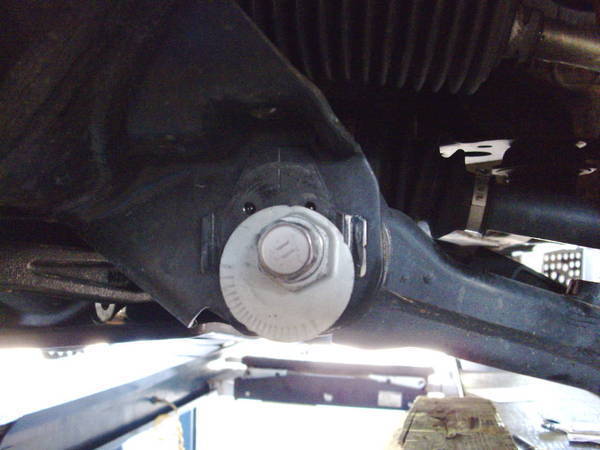
lca-front-alignment-bolts-jpg.158574

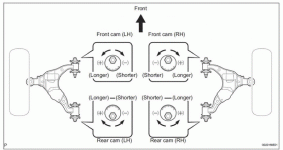
The LCA cams (2 on each side) adjust camber/caster and toe.

Thank you for summarizing that there are 4 lower-control-arm cams to adjust, and that they adjust the front caster, camber, and toe (to be adjusted in that order).
PICT1751.JPG


To correctly do the front alignment, you would adjust the cams to get the proper camber/caster then do a caster sweep, re check the caster camber then set the toe - one side at a time, using the tie rods, keeping the other side where it is at, meaning don't go from one side to the other than back to the other side back and forth. that's how you get a crooked steering wheel.
I'll need to look up some terms you used above (such as a caster sweep) but I do understand that the order is caster first, then camber, and then toe.

The problem I always have with toe is that it's easiest to measure linear distance (which depends on the size of the tires & wheels but luckily the one I'm working on has the stock 15 inch wheels with the stock P225/75R15 102T tires) while most toe tables seem to be in degrees (which is independent on the tire and wheel size).

So, for me, toe is harder because we measure in inches but the spec is in degrees.
Camber is easier because we measure in degrees and the spec is in degrees.

Specs are out there and should be the same for a 2WD as a 4WD.
Thank you for stating that the alignment specs are the same for the 2WD as for the 4WD as that's not intuitive to me that it would be the case (and the 4WD is vastly more prevalent).

caster 1.7 to 3.4 degrees with cross caster no more than .5 degrees maybe a little more caster on passenger side for road crown

Road crown is sort of a "camber" in and of itself.
Proper%20Crown.png

So, I can imagine camber being different to account for road crown, but, caster?

Interesting. I had to look that up because I thought caster was to adjust wander tendencies on uneven (aka bumpy) road surfaces - but not to handle crowns.

But apparently caster handles crowns, just like you said!
slide_16.jpg


camber spec is something like -.9 to + .9 degrees with the same cross camber as caster
This is good to know that there isn't much camber on these SUVs.
A tenth of a degree is pretty close to zero degrees for me.

The nice thing about zero degrees is that it's easier to measure than any other angle.
toe spec is -.1 to 0 but basically 0 degrees on either side

I hate toe specs in degrees!
I really do.
toe-degrees.jpg

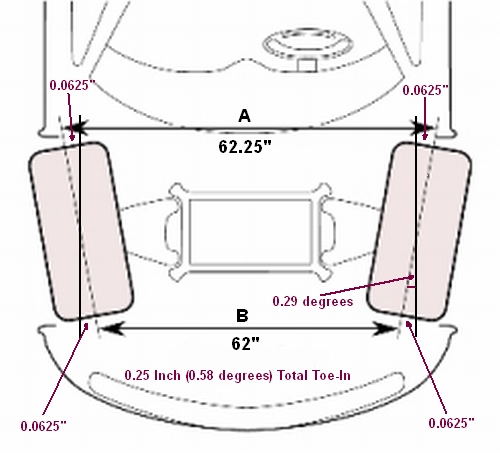
I understand why toe is specified in degrees to the centerline; but I don't measure degrees of toe at home.
I have to measure inches from a point on the wheel or tire to the centerline of the vehicle.

I haven't done this, but a quick search just now shows that I might be able to measure in inches and then convert to degrees:
toe-in.jpg


BTW, what do we use as our centerline reference point in the 2WD 4Runner?

 

Attachments

  • four_lca_cams.gif
    four_lca_cams.gif
    66.6 KB · Views: 10,953
Last edited:
Specs are like one persons opinions. Some matter some don't!
Well, there are a lot of specs that I can't adjust directly, so, for my purpose here, those don't matter.

But here goes for 99 4wd

Caster 1.7 to 3.2
Camber -.6 to .9
Total toe 0 to .4
Those are different numbers than were quoted by someone else so I understand this is like having two clocks, where you never know which one is actually correct. :)
Many new vehicles have toe specs that are almost unattainable like Jerzee posted, which would require .05 individual toe.

If that were the spec, I'd set it to zero (which should be easy to measure) and then just drop in a "smidge" like it says here.

Of course specs are subjective in the eyes of many alignment techs. I also have a 2000 2wd which used to get the 3 times a month check, and I do believe the specs are VERY similar.

Depending on what I use to adjust the toe and camber, I think I may just aim for zero degrees for both since that's simple.

But first I have to figure out how to measure the front caster, camber, and toe, as shown in this Tundra article on doing alignment at home that I just found:
CDC47EED-7734-4F46-AB87-6C41E9D505A5-15832-00000DF412507910.jpg~original
 
You don't happen to have toe specs in inches, do you?

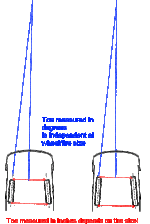
I realize you were asking someone else, but toe in inches will change depending on the diameter of the wheel/tire assembly, whereas toe in degrees stays the same even if the wheels are of different diameter than stock.

I made this graphic just now to illustrate this concept that toe specified in degrees is independent of wheel/tire size while toe specified in inches depends on the wheel/tire size being stock.

Having said that, this 4Runner has the stock 2WD wheels and tires which are P225/75R15 so any spec for the OEM toe in inches for the OEM vehicle should work for me if it exists.
 

Attachments

  • toyota_toe-tire_size.gif
    toyota_toe-tire_size.gif
    22.5 KB · Views: 4,347
Holy crap Foo, your really getting analytical. I can appreciate that and I must say your nicely laid out posts are, well, nicely laid out. With that being said, let me try to clear a few things up ( or further complicate them

First the degrees to Inches. Here's a website with a calculator

https://robrobinette.com/ConvertToeInchesToDegrees.htm

As you said, inches is dependents on tire size.

I've done toe in my driveway, and I use a tape measure from as close to 180 degrees from the front of the tire and the back of the tire, using the tread ( the same on both tires). I can remember measuring say 59" on both the back and the front so this is 0 total toe. This is only a get by until I can get to a shop, but when I ask the guys how close the toe was they say it wasn't that far out.

Looking at one of your pictures of the lower cams, It looks like one of the side tabs is flattened out. Those tabs are critical to proper cam adjustment and ultimately LCA movement. Also, the actual position of yours is basically not doing anything. It's not touching the one tab and the other is flattening out. Something is wrong there. Check to make sure your cams turn freely and move the LCA inward and outward. Also, the markings should be facing up. You really only need to turn the cam 90 degrees from center, inward or outward, to get full LCA movement. That picture you posted with the cams and how the make the LCA "longer or shorter" was in the FSM. There's also a somewhat complicated (which you may like) graph which shows the positioning of the gradients on the cam bolts and their respective angles for camber/caster.

A caster sweep is when a vehicle is on an alignment rack. The front tires are on turntables which allow free movement of the steering and load of the front end. Most modern alignment machines start out at what the "machine" thinks is center or equally balanced toe left to right. Then your turn the wheel 10 to 20 degrees left until the machine tells you to stop and back the other way until the machine tells you to stop. This "sweep" from left to right maximizes you caster angle and flexes out the front end to its natural position. I used to tell guys to do this after all the final adjustments just to make sure that the front end flexes out because sometimes when you are making your adjustments the suspension can bind and give false readings.

Road crown is pretty simple when you know what caster and camber do.
You can probably visualize, and maybe experienced that when you are on a road with road crown, that your vehicle want to pull off the side of the road. To compensate for this, the best way is to use caster. Reason being is that it is the angle that is "least" tire wearing. Toe is the most tire wearing, then camber is next. So we utilize caster. Caster pulls to the side which is more negative so to set for road crown we might set the caster on the left for 2.9 and the caster on the right for 3.4. This will NOT cause a pull on flat roads because the general rule of thumb is that more than .5 degrees difference left to right in caster or camber (cross caster/ cross camber) you wont get a pull on a flat road but is just enough of a difference in cross caster to help the car go straight when dealing with road crown. To summarize, caster pulls to the side more negative, camber pulls to the side more positive.

Here's a decent site that explains a lot of things

AGCO Automotive Repair Service - Baton Rouge, LA - Detailed Auto Topics - Wheel Alignment, Camber and Caster
 

Thanks for that conversion site as I was also using this pure trig site for the calculations.

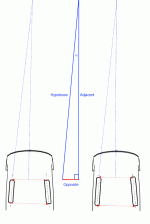
I think my main measurement confusion, with respect to toe being specified in degrees but measured in inches, is WHERE the heck is the TRIANGLE?

So, here is my first attempt at defining where that elusive triangle is.

Is this the triangle everyone is talking about when needing to convert degrees to inches (and vice versa)?
 

Attachments

  • toyota_toe_trig_angle.gif
    toyota_toe_trig_angle.gif
    22.5 KB · Views: 1,820
Thanks for that conversion site as I was also using this pure trig site for the calculations.

I think my main measurement confusion, with respect to toe being specified in degrees but measured in inches, is WHERE the heck is the TRIANGLE?

So, here is my first attempt at defining where that elusive triangle is.

Is this the triangle everyone is talking about when needing to convert degrees to inches (and vice versa)?

Triangle? I think it's easier to picture one rectangle for total toe or two individual rectangles (or squares) for individual toe. For total toe, the two vertical sides are your wheels. A perfect rectangle is 0 toe. If the top line (which one alignment machines, is the reported number and the "front" of the tires) is longer than the bottom line (the "back" of the tires), you have a positive number, greater than 0. If the bottom line is less than the top line, then you'll have a negative total toe number.
Individual toe is kinda the same but the "inside" vertical lines is the centerline of the vehicle and stays straight and the opposite line is the wheel.
As with total toe, if the top line is longer than the bottom line than you have a positive number and a toe-out situation. If it is the opposite than you have a negative number and a toe-in situation.
If you look at that site I posted, the "triangle" is shown from the hub of the wheel. One side is straight up and down (0 toe) and the other line is the wheel itself. The third line is actual toe, which on alignment machines, will be a negative number (toe in) or positive number (toe out)
 
Last edited:
Triangle? I think it's easier to picture one rectangle for total toe or two individual rectangles (or squares) for individual toe. For total toe, the two vertical sides are your wheels. A perfect rectangle is 0 toe. If the top line (which one alignment machines, is the reported number and the "front" of the tires) is longer than the bottom line (the "back" of the tires), you have a positive number, greater than 0. If the bottom line is less than the top line, then you'll have a negative total toe number.
Individual toe is kinda the same but the "inside" vertical lines is the centerline of the vehicle and stays straight and the opposite line is the wheel.
As with total toe, if the top line is longer than the bottom line than you have a positive number and a toe-out situation. If it is the opposite than you have a negative number and a toe-in situation.
If you look at that site I posted, the "triangle" is shown from the hub of the wheel. One side is straight up and down (0 toe) and the other line is the wheel itself. The third line is actual toe, which on alignment machines, will be a negative number (toe in) or positive number (toe out)

OK, you need to forget the Triangle @foo, you aren't Phil Jackson and Shaq and Kobe have both retired. I'll tell you why.

On cars today we don't do a geometric centerline alignment. We do what is called a Thrust Angle alignment. The front wheel toe center is based on where the rear wheels are pointing. Otherwise if you have a Thrust Angle on the rear axle that is NOT 0, you will end up with a crooked steering wheel. The rear axle will drive the the car in the opposite direction it is pointing, like rear steer on a forklift.

What Jerzee is telling you is a good way for you to visualize it. EXCEPT HE HAS POSITIVE NEGATIVE BACKWARDS. Positive to is toe IN, negative is OUT.

Heavy trucks do align to the geometric centerline of the chassis because they can shim or use eccentrics to align each axle. They need this because 25K on the drive axles that aren't both going in line will scrub tires quickly. Cars and light trucks don't have that problem.

You are overthinking the degrees to fractional inches concept. Build a tire scribe and set the toe 1/16" shorter in the front than the back.

Or just buy one.

https://www.summitracing.com/search/part-type/wheel-alignment-tools/wheel-alignment-tool-type/scribe-assembly

Or, find a good alignment shop that spent the 20 grand for a good imaging aligner and drive it home!
 
OK, you need to forget the Triangle @foo, you aren't Phil Jackson and Shaq and Kobe have both retired. I'll tell you why.

On cars today we don't do a geometric centerline alignment. We do what is called a Thrust Angle alignment. The front wheel toe center is based on where the rear wheels are pointing. Otherwise if you have a Thrust Angle on the rear axle that is NOT 0, you will end up with a crooked steering wheel. The rear axle will drive the the car in the opposite direction it is pointing, like rear steer on a forklift.

What Jerzee is telling you is a good way for you to visualize it. EXCEPT HE HAS POSITIVE NEGATIVE BACKWARDS. Positive to is toe IN, negative is OUT.

Heavy trucks do align to the geometric centerline of the chassis because they can shim or use eccentrics to align each axle. They need this because 25K on the drive axles that aren't both going in line will scrub tires quickly. Cars and light trucks don't have that problem.

You are overthinking the degrees to fractional inches concept. Build a tire scribe and set the toe 1/16" shorter in the front than the back.

Or just buy one.

https://www.summitracing.com/search/part-type/wheel-alignment-tools/wheel-alignment-tool-type/scribe-assembly

Or, find a good alignment shop that spent the 20 grand for a good imaging aligner and drive it home!

This is not my subject matter, but I am not too bad at geometry, and I am pretty proud of my first driveway alignment I did recently (good enough to get me to the shop, which was my goal, and spot on for caster and camber).

While clearly inches are tire height dependent, or more precisely, tire radius dependent, and angle is not, the change in fractional inches spec between a stock tire and whatever else any of us uses (outside Hawaii and funny car shows) has to be extremely small, probably less than the deflection caused by one single spin of the tierod end. So you probably won't get much closer by adjusting your inches for tire radius. Also, obviously, angle 0° works for all tire radii out to infinity.

So it would seem to me one spin to the inside of 0° would work for any tire and is pretty much what you want to shoot for outside of a shop. This what I tried to do on my attempt with a tape measure and two sticks. I screwed it pretty badly, though. One side was 2.08°. At least I got them both positive.

Iball, am I close? ( [MENTION=102597]IBallEngineer[/MENTION] )
 
Last edited:
This is not my subject matter, but I am not too bad at geometry, and I am pretty proud of my first driveway alignment I did recently (good enough to get me to the shop, which was my goal, and spot on for caster and camber).

While clearly inches are tire height dependent, or more precisely, tire radius dependent, and angle is not, the change in fractional inches spec between a stock tire and whatever else any of us uses (outside Hawaii and funny car shows) has to be extremely small, probably less than the deflection caused by one single spin of the tierod end. So you probably won't get much closer by adjusting your inches for tire radius. Also, obviously, angle 0° works for all tire radii out to infinity.

So it would seem to me one spin to the inside of 0° would work for any tire and is pretty much what you want to shoot for outside of a shop. This what I tried to do on my attempt with a tape measure and two sticks. I screwed it pretty badly, though. One side was 2.08°. At least I got them both positive.

Iball, am I close? ( [MENTION=102597]IBallEngineer[/MENTION] )

One spin would probably too much, if you knew for certain you were at 0, 1/2 spin per side would be more than enough. NOW the real question is how you get the Degrees™ symbol on your numbers!

:wtf:
 
Status
Not open for further replies.

Members online

Forum statistics

Threads
278,314
Messages
3,554,095
Members
248,016
Latest member
Advally Service

Trending content

Back
Top