
You are using an out of date browser. It may not display this or other websites correctly.
You should upgrade or use an alternative browser.
You should upgrade or use an alternative browser.
who has 2 meter or 440/dual band in your 4Runner?
- Thread starter hrt4me
- Start date
Register to hide this ad

98OzarksRunner
New member
I have a Yaesu FT-2900 2M radio. I mounted it under the radio using the radio mount and some spacers to center the 2M. It has a small gap on either side, but it's not noticeable and probably helps with cooling.
My antenna is a 5/8 wave mounted on my tire carrier. It's not the ideal location, but a 1/4 wave antenna mounted on my roof wouldn't last long in the woods (already destroyed a FireStik mounted on my bumper).
You will need an external speaker since the 2M will sound very muddy mounted like this.
Here's a picture when it was in the 98.

Here it is in the 02 (not the greatest shot but a different angle).

I had an 8800 in my 95 4Runner mounted the same way. I'm sure one would fit in the 02 in the same spot.
My antenna is a 5/8 wave mounted on my tire carrier. It's not the ideal location, but a 1/4 wave antenna mounted on my roof wouldn't last long in the woods (already destroyed a FireStik mounted on my bumper).
You will need an external speaker since the 2M will sound very muddy mounted like this.
Here's a picture when it was in the 98.
Here it is in the 02 (not the greatest shot but a different angle).
I had an 8800 in my 95 4Runner mounted the same way. I'm sure one would fit in the 02 in the same spot.
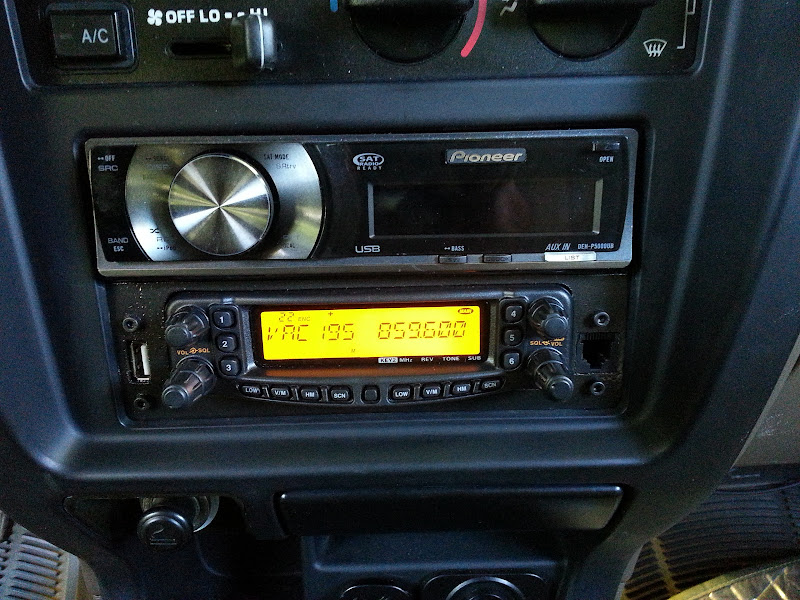
I've had a 2800, model earlier than the 2900 above, mono band and currently have a dual band 8800 in the dash. Neither are DIN sized radios so you need to fab a bracket. It's not hard to do and in my opinion the radio looks much better in the dash than stuffed or mounted somewhere else in such a small cab.
2m is very active locally and within the state for that matter. 70cm around where I live is locked down but active not far out of town. Being able to connect to the WINsys, more available frequencies for group work and crossband repeat (on the 8800) is why I have the dual band.
I run an NMO antenna mount on the roof. It requires a 3/4" hole to be drilled which is no biggie compared to all the other mods we do. The mounting location and antenna selection is far better in my opinion.
Here was the 2800. I liked this radio. Big screen and large controls. I filled the gap with a USB port for charging goodies.

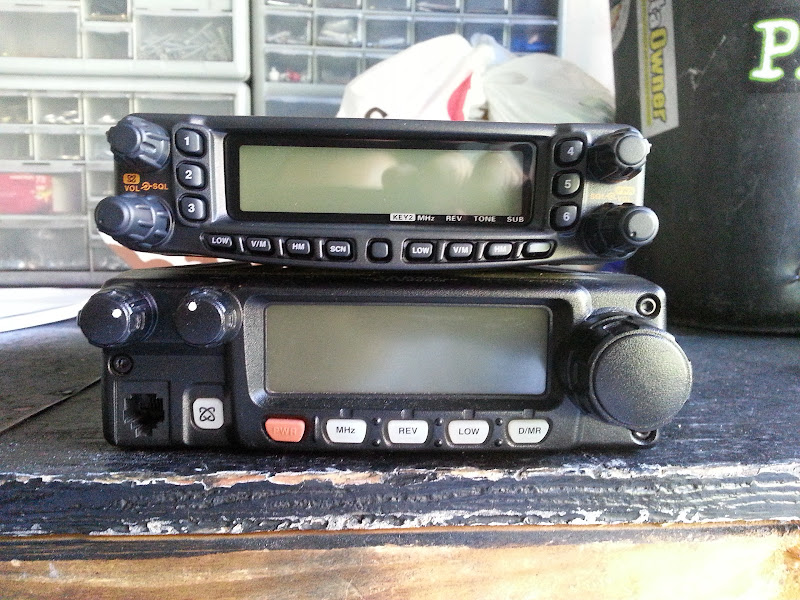
This is the 2800 and the 8800 side by side. The 8800 is smaller so another bracket had to be made.

One downside to the 8800 is the smaller keys and knobs. I wished the radio was 2800/2900 sized or even DIN sized.
Made me a filler plate, made a mic input extension and moved the USB to the other side.
This picture is dark but shows the location and types of antennas. There are two mounts, the front is for uhf/vhf and the rear is for my cb (it just has a cover on the mount). The short antenna with the curly is a dual band antenna and is installed on the mount. The other antenna is just placed next to it for size reference. It's a 1/4 vhf antenna.

Here are the 1/4 wave and CB antenna installed.

Figure out what what you need from a radio and do some shopping. For the most part you'll be able to get it in the dash. Another good option for a vhf only radio is the Icom V8000. It's got great audio and has a front firing speaker.
2m is very active locally and within the state for that matter. 70cm around where I live is locked down but active not far out of town. Being able to connect to the WINsys, more available frequencies for group work and crossband repeat (on the 8800) is why I have the dual band.
I run an NMO antenna mount on the roof. It requires a 3/4" hole to be drilled which is no biggie compared to all the other mods we do. The mounting location and antenna selection is far better in my opinion.
Here was the 2800. I liked this radio. Big screen and large controls. I filled the gap with a USB port for charging goodies.
This is the 2800 and the 8800 side by side. The 8800 is smaller so another bracket had to be made.
One downside to the 8800 is the smaller keys and knobs. I wished the radio was 2800/2900 sized or even DIN sized.
Made me a filler plate, made a mic input extension and moved the USB to the other side.
This picture is dark but shows the location and types of antennas. There are two mounts, the front is for uhf/vhf and the rear is for my cb (it just has a cover on the mount). The short antenna with the curly is a dual band antenna and is installed on the mount. The other antenna is just placed next to it for size reference. It's a 1/4 vhf antenna.
Here are the 1/4 wave and CB antenna installed.
Figure out what what you need from a radio and do some shopping. For the most part you'll be able to get it in the dash. Another good option for a vhf only radio is the Icom V8000. It's got great audio and has a front firing speaker.
Last edited:

giguchan
Senior Member
Nice work Boys!
I wish I could get my Motorola's in my runner! I almost sold it twice- JUST so I could fit em in a Tahoe. or perhaps If there was a way to split one Head unit into two bricks... but Motorola does not support this.... you guys have fun hammin!
73'
N2gig
I wish I could get my Motorola's in my runner! I almost sold it twice- JUST so I could fit em in a Tahoe. or perhaps If there was a way to split one Head unit into two bricks... but Motorola does not support this.... you guys have fun hammin!
73'
N2gig
Last edited:

RussToy
New member
Hey guys...not trying to hi-jack this thread, but I'd like to ask a question. I know nothing of these radios yall are talking about...I'm assuming these are what people call "ham radios"??. I have a CB in my rig...why would I need one of these radios? Are they different channels, use different wave lengths, do they reach further out...are they better than a CB?? Sorry for all the questions...just always been interested about these but never really knew who to ask.
Thanks for your time and knowledge!
Thanks for your time and knowledge!
Here is a good collection of information: HAM radio/amateur radio FAQ - Expedition Portal
People use the radios for different reasons. In some instances CB and FRS radios work fine. That's all I used for close to 10 years. They still have their place as they don't require licenses, easy for all ages to use/understand and are usually less expensive.
These "HAM" radios allow the same usability as say a CB but most of the time you're going to have much greater distance, clarity and flexibility. Depending on your radio and settings you can talk to a few people as you want or as many people as you'd want. Locally, unless you're way up in the hills CB is garbbled by illegal transmissions. Also in the woods usable distance is usually line of sight.
People use the radios for different reasons. In some instances CB and FRS radios work fine. That's all I used for close to 10 years. They still have their place as they don't require licenses, easy for all ages to use/understand and are usually less expensive.
These "HAM" radios allow the same usability as say a CB but most of the time you're going to have much greater distance, clarity and flexibility. Depending on your radio and settings you can talk to a few people as you want or as many people as you'd want. Locally, unless you're way up in the hills CB is garbbled by illegal transmissions. Also in the woods usable distance is usually line of sight.
RussToy
New member
[MENTION=22406]4x4mike[/MENTION] Thank you sir for the explanation and for the link. It looks like it will be some good reading...with lots of good info that I've been looking for!
Although...after reading this, it might end up costing my more money...lol!! What's a good middle of the road radio cost?
Thanks again...
Although...after reading this, it might end up costing my more money...lol!! What's a good middle of the road radio cost?
Thanks again...
Offer this guy $125 and I'll buy the power supply from you for $25 and ship you the radio.
HAM Radio and Power Supply
It's the radio I started with in the 4Runner. Plenty of power, quality and functions. If you wanted I can check the thing out, test it with a handheld and ship to you.
HAM Radio and Power Supply
It's the radio I started with in the 4Runner. Plenty of power, quality and functions. If you wanted I can check the thing out, test it with a handheld and ship to you.
98OzarksRunner
New member
If you just want to listen and see what's out there, you can buy one of these for $40 (or less, depending on version):
Amazon.com: New Etekcity® UV 5RA Ham Two Way Radio 136-174/400-480 MHz Dual-Band DTMF CTCSS DCS FM 5W Amateur Radio UV-5R Transceiver - 2013 Latest Version with Enhanced Features: Car Electronics
or even cheaper here:
http://www.amazon.com/gp/product/B00C8780DW/ref=ox_sc_act_title_1?ie=UTF8&psc=1&smid=AD8KB6G20MIR8
I bought one and use if for a backup-backup radio (I have my 2M in the truck, a FT-270 HT in my GHB, and the little 'toy' radio I throw in where-ever. Most of the time it sits on my desk at home and I listen to the local po-po while I'm working (lots of accidents today with the snow - it's also amazing how many people with warrants do stupid things in traffic to get stopped and hauled off to jail). Guys on expo started buying them and everyone is surprised at how good this throwaway Chinese radio is. ($40 BaoFeng UV-5R Dual-Band Handhelds - Expedition Portal)
Be sure and get the programming cord ($7) and download CHIRP (free) since these radios are a pain to program from the buttons.
Amazon.com: New Etekcity® UV 5RA Ham Two Way Radio 136-174/400-480 MHz Dual-Band DTMF CTCSS DCS FM 5W Amateur Radio UV-5R Transceiver - 2013 Latest Version with Enhanced Features: Car Electronics
or even cheaper here:
http://www.amazon.com/gp/product/B00C8780DW/ref=ox_sc_act_title_1?ie=UTF8&psc=1&smid=AD8KB6G20MIR8
I bought one and use if for a backup-backup radio (I have my 2M in the truck, a FT-270 HT in my GHB, and the little 'toy' radio I throw in where-ever. Most of the time it sits on my desk at home and I listen to the local po-po while I'm working (lots of accidents today with the snow - it's also amazing how many people with warrants do stupid things in traffic to get stopped and hauled off to jail). Guys on expo started buying them and everyone is surprised at how good this throwaway Chinese radio is. ($40 BaoFeng UV-5R Dual-Band Handhelds - Expedition Portal)
Be sure and get the programming cord ($7) and download CHIRP (free) since these radios are a pain to program from the buttons.
Last edited:
Offer this guy $125 and I'll buy the power supply from you for $25 and ship you the radio.
HAM Radio and Power Supply
It's the radio I started with in the 4Runner. Plenty of power, quality and functions. If you wanted I can check the thing out, test it with a handheld and ship to you.
I would be interested in that offer...
RussToy
New member
Hey Mike...I truly appreciate the offer; however, I must decline. After reading the link you provided to me...I believe I would really like to have a radio that supports the 70cm frequency also . While everything I have read today says the FT-2800 M is a great radio...I'd just assume to not buy a radio...just to want to upgrade later.Offer this guy $125 and I'll buy the power supply from you for $25 and ship you the radio.
HAM Radio and Power Supply
It's the radio I started with in the 4Runner. Plenty of power, quality and functions. If you wanted I can check the thing out, test it with a handheld and ship to you.
Once again thank you for the offer and all the info!
I would be interested in that offer...
Hrt4me...by all means...I hope you and Mike can work out a deal that make you both happy! I only wish this radio was an 7800M or better yet an 8800M...if it was either one I would jump on this in a heart beat!
Hopefully things work out for you guys...good luck!
I emailed the guy yesterday with some questions and he said he had just sold it. Just the power supply, new, is $89.
Keep an eye out for sales and swaps for mobile radios. HRO has sales and rebates which help. The handi talkies can be had for cheap, new as shown above.
I'd buy the ARRL study book, learn about the hobby, schedule a test and buy a Boefeng. From there you'll get more experience and know what you want from a radio besides the obvious power upgrade. It helps if you know others with a license and a radio otherwise you'll just be sitting there listening.
Keep an eye out for sales and swaps for mobile radios. HRO has sales and rebates which help. The handi talkies can be had for cheap, new as shown above.
I'd buy the ARRL study book, learn about the hobby, schedule a test and buy a Boefeng. From there you'll get more experience and know what you want from a radio besides the obvious power upgrade. It helps if you know others with a license and a radio otherwise you'll just be sitting there listening.

Jon T4R
New member
2 meter/440 in 4runners
is this guy a member here?
Toyota 4Runner Mobile Setup
Nice setup -including the Icom 746
is this guy a member here?
Toyota 4Runner Mobile Setup
Nice setup -including the Icom 746
RussToy
New member
I emailed the guy yesterday with some questions and he said he had just sold it. Just the power supply, new, is $89.
Keep an eye out for sales and swaps for mobile radios. HRO has sales and rebates which help. The handi talkies can be had for cheap, new as shown above.
I'd buy the ARRL study book, learn about the hobby, schedule a test and buy a Boefeng. From there you'll get more experience and know what you want from a radio besides the obvious power upgrade. It helps if you know others with a license and a radio otherwise you'll just be sitting there listening.
Wow...I wish I would have known how much these radio's where new before I passed on that 7200! I would have re-thought my decision!
But Mike thanks for letting me know about HRO. Nice site and lots of information. I'm going to order my ARRL study book this weekend. I've already check and the next test is late January in the next town over. I'm excited about this...being a police officer, I've seen how fast after a disaster that cell phones get over loaded and no one is able to get info in or out. We have CB's in our cruisers and have a state channel that all law enforcement monitors...but CB's are not very reliable. So I'm looking for something that I can depend on in my personnel vehicles!
I do have a question, sorry for my ignorance, but what's a Boefeng and why should I get one? Is that a name brand of a radio, or??
Thanks again for sharing your knowledge with me...it's much appreciated!!
Wow...I wish I would have known how much these radio's where new before I passed on that 7200! I would have re-thought my decision!
But Mike thanks for letting me know about HRO. Nice site and lots of information. I'm going to order my ARRL study book this weekend. I've already check and the next test is late January in the next town over. I'm excited about this...being a police officer, I've seen how fast after a disaster that cell phones get over loaded and no one is able to get info in or out. We have CBs in our cruisers and have a state channel that all law enforcement monitors...but CBs are not very reliable. So I'm looking for something that I can depend on in my personnel vehicles!
I do have a question, sorry for my ignorance, but what's a Boefeng and why should I get one? Is that a name brand of a radio, or??
BaeFeng is a PRC manufacturer/brand name
as a police officer, do your cellular/mobile phones not have WPS? my own Blackberry has that feature just for overloaded networks during emergency events...
98OzarksRunner
New member
I do have a question, sorry for my ignorance, but what's a Boefeng and why should I get one? Is that a name brand of a radio, or??
It's a brand of a cheap Chinese radio that works incredibly well for the price. If you just want something cheap to listen on (before spending the big bucks for a nice radio like a Yaesu, Icom, or Kenwood) or a backup radio, it's well worth the money. It's a 2M (144 MHz VHF) and 70cm (440 MHz UHF) radio.
Boefeng are the little handhelds that are linked above. They have a huge following because they are feature rich HT's (Motorola coined the name Handi-Talkie for their walkie talkies) and are priced really low for what they are.
You being around wireless communication everyday you might have certain preferences in a radio. The HAM HT's are pretty small and light, probably a lot different than what you carry especially when it comes to reception and durability. They are limited to 5 watts and have small batteries so their range and long distance talk time is limited. At a lower power and HT to HT or through a near by repeater the battery will last much longer.
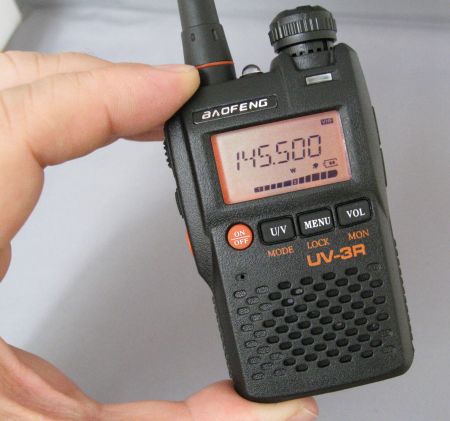
I have a Boefeng but it's the UV 3R, super small and limited to 2 or 3 watts. I use it for monitoring or simplex. It's got even fewer buttons than a 5R version but wasn't bad to program. One of the Boefeng gripes is programming. In my opinion they aren't bad at all as long as you understand a menu and what you're programming and why.
Here are the three handhelds I own.

Left is the uv 3r Boefeng. Middle is a Yaesu FT-60 and right is a retired Motorola MT2000. The Boefeng purchase was because it's small and like a toy yet still totally usable. It's small but doesn't have a long battery life or range, both because of the battery size. I use it on walks with the kids, simplex and with the crossband repeat on my 8800R in the 4Runner. This is a file internet photo. I have the updated one with 2 line screen and one dual band antenna.
The FT 60 is pretty much like a Boefeng 5R. It's a 5 watt max, dual band with keypad, memories, scan, etc. It retails for much more but is completely serviceable, weather resistant, heavy high quality case, higher end battery and is capable of using a high gain after market antenna. These are a couple of my antennas. As you can imagine the highest performing one is the long one. It's length can be a problem inside a vehicle or chest harness.

I bought the Motorola off eBay for my longer outdoor volunteer work. It's sealed, super tough, massive battery and has excellent receive and transmit. The overall duty of the radio is greater than that of the FT60 which is really nice. The MT2000 I bought is only a VHF. They have UHF and 800 and 900 mhz radios but my need was for VHF. As far as I could tell there aren't dual band which is ok.
Mine is older, like 10 years and still looks like new. It was probably in a holster all it's life but it's held up great. Newer radios have tons of features that aren't used in the amateur radio world. Plus they are super expensive so there isn't much benefit to buying one. New the MT2000 probably cost a department $1000 per radio, I got my set up for $110, programmed and delivered.
The radios need expensive licensed software that isn't available to the public or worth purchasing. It's not programmable in the field which can be a draw back. If I'm reliant on a radio I have more than one, my back up is the FT60 and can be pulled into service if need be. I've had my programs for years so I was set when it came to having a shop do the work for me. My model is a top screen with 3 banks of 16 channels, 48 total frequencies which is more than enough.


I use a chest harness when I'm using the radio somewhere else than on the trail. Most of that work is on a bicycle or mountain bike so i need the remote mic as the harness isn't really for a quick draw to talk. The longer antennas can make this setup cumbersome but I've found that the MT2000, which doesn't have aftermarket antennas (at least anything longer) has much better reception than the others with the stock antenna.
You being around wireless communication everyday you might have certain preferences in a radio. The HAM HT's are pretty small and light, probably a lot different than what you carry especially when it comes to reception and durability. They are limited to 5 watts and have small batteries so their range and long distance talk time is limited. At a lower power and HT to HT or through a near by repeater the battery will last much longer.
I have a Boefeng but it's the UV 3R, super small and limited to 2 or 3 watts. I use it for monitoring or simplex. It's got even fewer buttons than a 5R version but wasn't bad to program. One of the Boefeng gripes is programming. In my opinion they aren't bad at all as long as you understand a menu and what you're programming and why.
Here are the three handhelds I own.
Left is the uv 3r Boefeng. Middle is a Yaesu FT-60 and right is a retired Motorola MT2000. The Boefeng purchase was because it's small and like a toy yet still totally usable. It's small but doesn't have a long battery life or range, both because of the battery size. I use it on walks with the kids, simplex and with the crossband repeat on my 8800R in the 4Runner. This is a file internet photo. I have the updated one with 2 line screen and one dual band antenna.
The FT 60 is pretty much like a Boefeng 5R. It's a 5 watt max, dual band with keypad, memories, scan, etc. It retails for much more but is completely serviceable, weather resistant, heavy high quality case, higher end battery and is capable of using a high gain after market antenna. These are a couple of my antennas. As you can imagine the highest performing one is the long one. It's length can be a problem inside a vehicle or chest harness.
I bought the Motorola off eBay for my longer outdoor volunteer work. It's sealed, super tough, massive battery and has excellent receive and transmit. The overall duty of the radio is greater than that of the FT60 which is really nice. The MT2000 I bought is only a VHF. They have UHF and 800 and 900 mhz radios but my need was for VHF. As far as I could tell there aren't dual band which is ok.
Mine is older, like 10 years and still looks like new. It was probably in a holster all it's life but it's held up great. Newer radios have tons of features that aren't used in the amateur radio world. Plus they are super expensive so there isn't much benefit to buying one. New the MT2000 probably cost a department $1000 per radio, I got my set up for $110, programmed and delivered.
The radios need expensive licensed software that isn't available to the public or worth purchasing. It's not programmable in the field which can be a draw back. If I'm reliant on a radio I have more than one, my back up is the FT60 and can be pulled into service if need be. I've had my programs for years so I was set when it came to having a shop do the work for me. My model is a top screen with 3 banks of 16 channels, 48 total frequencies which is more than enough.
I use a chest harness when I'm using the radio somewhere else than on the trail. Most of that work is on a bicycle or mountain bike so i need the remote mic as the harness isn't really for a quick draw to talk. The longer antennas can make this setup cumbersome but I've found that the MT2000, which doesn't have aftermarket antennas (at least anything longer) has much better reception than the others with the stock antenna.
Last edited:

Similar threads


- Replies
- 0
- Views
- 2K

- Replies
- 0
- Views
- 1K
- Replies
- 0
- Views
- 900
- Replies
- 0
- Views
- 4K


