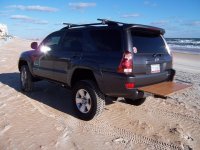
Why the rake??

Forenaftrunner

New member
I've read tons of great threads here about people leveling and/or raising their T4Rs. When I bought mine I really didn't notice the forward rake and I'm sure that 99% of the population doesn't notice it either. But after looking at pics of T4Rs that have been leveled, I have to say they do look a lot better after being leveled.

Does anyone know why Toyota builds them lower in the front to begin with?
 
Register to hide this ad
KD7SMX said:
Heaven forbid I be incompatible with an impending collision.

Well, i am sure that the driver in the Miata that you are about to collide with will be happy that your 4runner's front end is low enough to prevent you from squashing him/her like a bug! :D

BTW, this front rake design is required by law i believe or that it is the standard among SUV makers. Either way, it is here to stay and all modern SUVs (trucks too i think) will be this way. Some SUVs get around this by having an air/electronic suspension that lowers itself at speed. Other SUVs do this by having a steel bar under the front bumper. I know that the current Jeep Wrangler has a steel bar + "air dam" to lower the front end in a crash. The good thing is that this bar and air dam are removable by the owner. :)

In the grand scheme of things, this design/requirement is a good thing for everyone. If you're into off-roading, then this will just be an extra step to overcome...and it is a relatively easy step to overcome.

BTW #2, if you think that the rake is bad, then wait for the next generation of vehicles...the nose will be flat, plasticky, and with a high hoodline for pedestrian crash compatibility. Hmm, in a way, my G-wagen has already met this criteria! :D (But unfortunately, my whole front nose is steel....)
 
Probably how Toyota chooses to meet bumper height requirements, which are in place to ensure that speed bumps er... smaller cars aren't squashed like bugs.

And.. pedestrian crash compatibility? So, now we're going to have to drive ugly cars so that we can coddle idiots? Ungh.
 
Annoyed said:
And.. pedestrian crash compatibility? So, now we're going to have to drive ugly cars so that we can coddle idiots? Ungh.

I used to have a brush guard on an old S-10 Blazer and one of my girlfriend's friends made a snide comment that it was a "child killer". I was taken back by this because exactly what part of the several thousands pound truck ISN'T going to be lethal at speed?

Oprah cult run rampant.

(btw "Oprah" passed FireFox's spell check *facepalm*)
 
i agree with the OP that i didn't really care too much about the rake until i saw level T4Rs on this forum. they look SO MUCH better flat.

i have the V8 in my '05 Limited which makes the front end sit even lower. (at least that's what my local shop said) it's a full 3.25" lower than the back. new tires are priority #1 now...a 2.5" lift will be the next thing on the list.
 
Forenaftrunner said:
Does anyone know why Toyota builds them lower in the front to begin with?

I though it was so when you load the back with a couple hundred pounds of stuff or tow a heavy trailer you're not nose happy.
 
Re: Re: Why the rake??

Chalk Outline said:
I though it was so when you load the back with a couple hundred pounds of stuff or tow a heavy trailer you're not nose happy.

The nose dive design is only over the last few years. My G500 can tow 7000 lbs, but is level. My brother's 2001 LX470 does not. Previous Land Cruiser did not. My brother's old Disco does not.
 
I dig my runners ass hight south of the border old school look.
 

Attachments

  • side.jpg
    side.jpg
    102.9 KB · Views: 2,136
I'm not buying into the crash compatibility theory. Sure, there are other similar SUVs out now that have some rake, but not really as much as a 4th gen 4Runner. The Grand Cherokee and Commander both come to mind as they have some rake, but when side by side with a 4Runner, you can easily see the difference.

Besides, look at some other SUVs that do not really have any rake. The Pathfinder immediately comes to mind, as well as Land Rovers (LR3, Range Rover, and RR Sport). None of those SUVs has a lower nose than a 4Runner, yet they seem to sit level.

I think it might have more to do with avoiding the sagging rear end that seems to plague so many SUVs once they start to age a bit. The older Explorers and 4Runners seem to develop quite a bit of rear sag as they get older. I bet it won't be common to see a 4th gen with a sagging rear end look as they age. If anything, the rear end sagging will tend to level out the look.
 
EH007 said:
Besides, look at some other SUVs that do not really have any rake. The Pathfinder immediately comes to mind, as well as Land Rovers (LR3, Range Rover, and RR Sport). None of those SUVs has a lower nose than a 4Runner, yet they seem to sit level.

Not sure about the pathfinder, but the other SUVs you mentioned have air-suspension, which allows them to lower electronically at speed.

Remember, a SUV may not have a front rake, but it may have a crossmember below the bumper that makes it compatible with car bumpers. Jeeps are a good example of such.
 
EH007 said:
I think it might have more to do with avoiding the sagging rear end that seems to plague so many SUVs once they start to age a bit. The older Explorers and 4Runners seem to develop quite a bit of rear sag as they get older. I bet it won't be common to see a 4th gen with a sagging rear end look as they age. If anything, the rear end sagging will tend to level out the look.

Also remember that the classic "rear end sag" on 3rd gen 4runners was due to a bad springs...see: http://www.toyota-4runner.org/showthread.php?threadid=48552
 
Thai said:
Also remember that the classic "rear end sag" on 3rd gen 4runners was due to a bad springs...see: http://www.toyota-4runner.org/showthread.php?threadid=48552

Maybe, but all springs sag over time. And SUVs typically lead a "harder" life than most vehicles due to cargo carrying, towing, etc... so an SUV that starts life basically level will seem to be sagging as the rear springs really start to wear. The Ford Explorer has also had this problem for many years now. I see sagging Explorers all the time...
 
EH007 said:
Maybe, but all springs sag over time. And SUVs typically lead a "harder" life than most vehicles due to cargo carrying, towing, etc... so an SUV that starts life basically level will seem to be sagging as the rear springs really start to wear. The Ford Explorer has also had this problem for many years now. I see sagging Explorers all the time...

Well, that would apply to all SUVs...and all the older ones do not have the rake, but most (if not all) the newer ones do. So, i don't think that engineers just found out about the sag in recent years....
 
Thai said:
Well, that would apply to all SUVs...and all the older ones do not have the rake, but most (if not all) the newer ones do. So, i don't think that engineers just found out about the sag in recent years....

Some SUVs are more prone to sagging than others. This has more to do with the selection of spring rates than anything else. Like anything else, it's a compromise that is made by suspension engineers, trying to balance ride comfort, handling, towing abilty, etc... Maybe Ford and Toyota blew with with certain generations of their popular SUVs. But then again, we have no way of knowing how many (or which) owners replaced their sagging rear springs with a fresh set or possibly a set with higher spring rates.

My idea here is more of a way for engineers to avoid the sagging look by designing in a bit of rake on their newer SUVs without owners having to swap out the sagging springs that are basically inevitable as their vehicles age. Just a thought.
 
Thai said:
Not sure about the pathfinder, but the other SUVs you mentioned have air-suspension, which allows them to lower electronically at speed.

Remember, a SUV may not have a front rake, but it may have a crossmember below the bumper that makes it compatible with car bumpers. Jeeps are a good example of such.

I live in a townhouse and my neighbor has a brand new Range Rover. When I don't park in my garage, I park right next to his Range Rover in the driveway. I have a 1" spacer lift on my 4Runner and his Range Rover's front end is still higher than my 4Runner (even with the 1" lift). If I'm not mistaken, the Range Rover's air suspension is at its lowest when the vehicle is parked. So if that's correct, then I still think the crash compatibilty theory is wrong. It just doesn't make much sense to me.
 
EH007 said:
I live in a townhouse and my neighbor has a brand new Range Rover. When I don't park in my garage, I park right next to his Range Rover in the driveway. I have a 1" spacer lift on my 4Runner and his Range Rover's front end is still higher than my 4Runner (even with the 1" lift). If I'm not mistaken, the Range Rover's air suspension is at its lowest when the vehicle is parked. So if that's correct, then I still think the crash compatibilty theory is wrong. It just doesn't make much sense to me.

Don't quote me, but i think that the RR lowers itself even lower at speed. The park lowering feature has to be activated manually...i think.
 

Members online

Forum statistics

Threads
278,305
Messages
3,554,041
Members
248,016
Latest member
Advally Service

Trending content

Back
Top