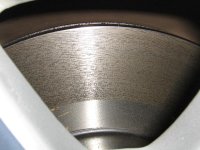
03 Front Brake Problems

pjohns

New member
I recently had new pads installed and the rotors turned. When applying the brakes hard at highway speed (65-75 MPH) the steering wheel shakes violently. At slower speeds you can feel some pulsating.

Had the tires re-balance with no improvement.

I have read about "hot spots" in rotors that can't be detected until hot, or warped rotors that won't show up until hot also. My issue seems to be present even before the rotors have a chance to get hot.

I have also read about stuck calipers. I would have thought the technician that replaced the pads, and turned the rotors would have detected this if indeed the case.

Where do I start, Any Ideas??
 
Register to hide this ad
Have the thickness of your rotors checked. If they are out of specs, that is, less than the minimum thickness, you will definitely feel vibration when braking.
 
replace the rotors. They're warped. Chances are the tech didn't really turn the rotors cause they wouldn't be doing this if they weren't warped still.
 
I've got the same problem. My rotors look like sandpaper with all the crud on them. If you have the same problem I do the best bet is probably to get new rotors, new pads wouldn't be a terrible idea either.
 
It is worth checking the front wheels bearings. I recently had braking problems that were related to bad bearings.
 
I recently had new pads installed and the rotors turned. When applying the brakes hard at highway speed (65-75 MPH) the steering wheel shakes violently. At slower speeds you can feel some pulsating.

Had the tires re-balance with no improvement.

I have read about "hot spots" in rotors that can't be detected until hot, or warped rotors that won't show up until hot also. My issue seems to be present even before the rotors have a chance to get hot.

I have also read about stuck calipers. I would have thought the technician that replaced the pads, and turned the rotors would have detected this if indeed the case.

Where do I start, Any Ideas??

Sounds to me like the technician who cut your rotors did a poor job. Believe it or not, rotors CAN be cut incorrectly. If the action is as violent as you're describing, then it definitely sounds like the tech messed up your rotors.

I'd go back and tell them to test drive the vehicle. Then I'd tell them that I want NEW rotors. You just can't keep cutting material off rotors to get rid of thickness variation. And actually, all rotors have a minimum thickness spec stamped into them, so they shouldn't cut under that spec in the first place.
 
What kind of pads did you put on? The best bet is OEM. Don't waste your money cutting rotors. They will not last long after reducing their mass. Rotors are cheap, just replace them. One of the main reasons rotors warp is because the pads are not changed soon enough. The pad thickness is a big factor in dissipating heat and insolating the calipers from heat. You need to find out how long the pads will last and then change them much sooner then recommended. On my T4R, I would only get 20K miles out of a front set of pads. Pads can be changed without even having to take the calipers off. It takes more time to remove the wheels then to replace the pads. I would change them every 15 to 17K miles. I never warped a rotor. It is a lot cheaper the replace the pads sooner then having to replace pads and rotors and possibly having the calipers rebuilt.

Koz
 
What kind of pads did you put on? The best bet is OEM.

Best bet for what? OEM pads are a good compromise if you don't want to research upgraded pads. I recently replaced my OEM pads with Raybestos Advanced Technology (their premium line) ceramics. They were actually less expensive than the OEM pads. Are they better? Well, that would be impossible to prove. But I'll say this-- my 4Runner stops great. Pedal application feel great. No brake noise. Hardly any brake dust (definitely less than the OEM pads) and no issues whatsoever....just smooth, quiet, and strong stops time after time.

BTW, the OEM pads are made by Akebono, so you can still get the same pads without paying inflated dealership prices. That's true for virtually all OEM pads because they are always manufactured by one of the big brake manufacturers. So why bother getting pads at the dealership?

Don't waste your money cutting rotors. They will not last long after reducing their mass. Rotors are cheap, just replace them.

I agree with this....they are cheap, so it's better to just replace them. A lot of newer vehicles come with lightweight "throwaway" rotors that are already too thin to cut. Then again, our 4Runners come with thick rotors that have plenty of room for cutting before they are near the minimum thickness spec. So if someone wants to cut them, then they should be fine. But I'd just toss them and install new ones instead.

One of the main reasons rotors warp is because the pads are not changed soon enough. The pad thickness is a big factor in dissipating heat and insolating the calipers from heat. You need to find out how long the pads will last and then change them much sooner then recommended.

Pad thickness makes very little difference when it comes to transferring heat. It's not a big factor at all. We're talking a matter of millimeters here, on a relatively small surface area. The difference is insignificant.

On my T4R, I would only get 20K miles out of a front set of pads. Pads can be changed without even having to take the calipers off. It takes more time to remove the wheels then to replace the pads. I would change them every 15 to 17K miles. I never warped a rotor. It is a lot cheaper the replace the pads sooner then having to replace pads and rotors and possibly having the calipers rebuilt.

Koz

I never warped a rotor either and I run my pads down all the way before I change them. I'd never swap them out in 15K-17K miles. I get more than twice that amount out of a set of pads!
 
One thing no one has mentioned yet, is how the rotors were reinstalled after they were resurfaced. Assuming the resurfacing was done correctly, if the surface of the hub that the rotor mates to and the inner surface of the rotor that mates to the hub were not cleaned of any possible built up rust deposits or debris, then the rotor might not sit flush on the hub. This could cause it to not turn true, which will cause 'brake shake' and pedal vibration. Also, if the wheels were not torqued correctly, that can cause brake vibrations.
 
Best bet for what? OEM pads are a good compromise if you don't want to research upgraded pads. I recently replaced my OEM pads with Raybestos Advanced Technology (their premium line) ceramics. They were actually less expensive than the OEM pads. Are they better? Well, that would be impossible to prove. But I'll say this-- my 4Runner stops great. Pedal application feel great. No brake noise. Hardly any brake dust (definitely less than the OEM pads) and no issues whatsoever....just smooth, quiet, and strong stops time after time.

Yes, you can do your research and take your chances with aftermarket pads. You may even save a couple bucks. Through the years I've tried just about every pad out there and I have come to the conclusion "Your best bet is the OEM pads".

Then again, our 4Runners come with thick rotors that have plenty of room for cutting before they are near the minimum thickness spec. So if someone wants to cut them, then they should be fine. But I'd just toss them and install new ones instead.

Again, don't waste your time and money on cutting rotors. Chances are you will be changing them very shortly after cutting them!

Pad thickness makes very little difference when it comes to transferring heat. It's not a big factor at all. We're talking a matter of millimeters here, on a relatively small surface area. The difference is insignificant.

Here is where you are wrong. The pad material acts as an insulator for the calipers. The less material on the pads the more heat the calipers will be exposed to. Also the pads will absorb and retain more heat and this will in turn increase the heat being transferred to the rotors. On most vehicles this is not an issue but on some vehicle where the rotors are prone to warping, it WILL make a difference. A big help to vehicles that are prone to warping rotors is too not apply pressure to the brake when you come to a stop or too never fully stop (put in neutral and take your foot off the brake or crawl). The reason why; the pads are so hot that if they sit on one spot of the rotors, they can warp.

I never warped a rotor either and I run my pads down all the way before I change them. I'd never swap them out in 15K-17K miles. I get more than twice that amount out of a set of pads!

I am very hard on both pedals, gas and brake.

http://www.toyota-4runner.org/4th-gen-t4rs/16379-top-speed-data.html

Koz

 
Here is where you are wrong. The pad material acts as an insulator for the calipers. The less material on the pads the more heat the calipers will be exposed to. Also the pads will absorb and retain more heat and this will in turn increase the heat being transferred to the rotors. On most vehicles this is not an issue but on some vehicle where the rotors are prone to warping, it WILL make a difference. A big help to vehicles that are prone to warping rotors is too not apply pressure to the brake when you come to a stop or too never fully stop (put in neutral and take your foot off the brake or crawl). The reason why; the pads are so hot that if they sit on one spot of the rotors, they can warp.

Koz, I think you have a few misconceptions here. There's no doubt about heat transfer from the rotors to the calipers through the pads. That's common sense, especially when you consider that the pads are the only thing that touches both the rotors and the calipers. My point is that the thickness of the pads is an insignificant factor for this heat transfer. We're talking about millimeters here, not any big difference. Unless we've actually prove this one way or another, we're both just guessing at the true difference in temperature. My guess is that it would hardly be measurable, especially on a street driven vehicle like a 4Runner. Either way, there's no way it would cause any issues, especially on a vehicle like a 4Runner with its robust rotors.

Also, there's a recent thread in the 3rd gen forum that goes into detail about the myth of rotors warping. I'm not saying that it can't happen, but 99% of the time the issue with rotors is pad material depositing on the rotor unevenly. If you sit in one spot with the brakes on when the rotors are hot, it's not that the rotors will warp, it's really an issue of excess pad material being deposited on the rotor on that particular spot. Read up on the subject and I think you'll be surprised.
 
It's human nature for people to believe what they want to believe. With that said, you believe what you want and I will believe what I want. But common sense will tell you that less insolating material will provide less heat resistance. Less material on the pad will cause the pads, calipers and rotors to get hotter and this in turn will cause the whole system to be less efficient. HEAT is the killer!

Let’s not forget about the proper way to bed-in new pads.

Koz
 
It's human nature for people to believe what they want to believe. With that said, you believe what you want and I will believe what I want. But common sense will tell you that less insolating material will provide less heat resistance. Less material on the pad will cause the pads, calipers and rotors to get hotter and this in turn will cause the whole system to be less efficient. HEAT is the killer!

Let’s not forget about the proper way to bed-in new pads.

Koz


Yes, I agree with the common sense part and I even said that in my last post. But you should also realize that it just take a little common sense to understand heat transfer through brake pads. If you think the thickness of the pad will make a significant difference, then I guess there's nothing else to say. Some day you should take the time to measure the actual temperatures and then you'll probably change your mind when you see it for yourself.

In the meantime, I'm not gonna swap out the 8-inch handle on my frying pan for a 9-inch handle because it will help me avoid burning my hands! LOL
 
Also, there's a recent thread in the 3rd gen forum that goes into detail about the myth of rotors warping. I'm not saying that it can't happen, but 99% of the time the issue with rotors is pad material depositing on the rotor unevenly.

+1.

I deleted that thread you were referring to because it was getting acrimonious (it's cached in google if you really want to read it - but be prepared for emotional responses more so than factual).

To begin with a fresh start, I listed a few of the references that were suggested in that thread (and put it all into this thread).

The first step to solving a problem is to understand the problem; and it's important to understand that, fundamentally, rotors don't warp (99.9% of the time).

So, if you have a problem; it isn't warp. It's something else. Most likely what's in the picture below ...

33097d1284799804-solved-my-3rd-generation-4runner-severe-brake-pedal-pulsation-highway-speeds-brake_friction_material_deposited_on_rotor.jpg
 
Last edited:
The picture you posted doesn't show any problems....it only shows pad material on a rotor. Every rotor that has been in use has pad material deposited on it. I don't know if you've ever seen a rotor with a perfect imprint of a brake pad on it, but if you have, then you've seen the problem first hand. The next time I see a rotor like that, I'll take a picture and post it. Unfortunately, I'd discarded several rotors like that just recently.

Anyway, the point here is that all used rotors have pad material deposited on them. That's how they work....problems only occur when it builds up excessively in some spots more than others.

I'll take a picture of my front rotors (which are only about a month old) and you'll see what perfect deposition looks like. You can actually see it very clearly.
 
all used rotors have pad material deposited on them. That's how they work....problems only occur when it builds up excessively in some spots more than others.

Exactly!

Braking is caused partly by breaking covalent bonds between the pads themselves and their thin layer of uniform deposition on the rotors.

If you bed your brakes right, you'll get that nice layer of deposition.

If you leave a pad imprint at some point, it just gets worse and worse over time until you can feel the shudder when you brake.

The main solution is to prevent that pad deposition (by changing your braking habits) and to remove it if it is there (rebedding or turning).

I too wish I had a better picture of uneven pad depostion ... so if you find one, let us know.
 
The main solution is to prevent that pad deposition (by changing your braking habits) .....[/COLOR][/B]

No, you can't prevent pad deposition nor do you want to! You need a nice even layer of pad material for the braking system to have maximum effectiveness!
 
Okay, I took a picture of the front rotors on my 4Runner. It was really hard to get a good shot, so I had to take several pics under different lighting & flash conditions. Anyway, these rotors are about a month old and I was sure to bed the pads/rotors properly after installing them. This is about as good as it gets when it comes to a nice, even break-in of pad material on the rotors.
 

Attachments

  • Picture 096.jpg
    Picture 096.jpg
    83.1 KB · Views: 504
BTW, I forgot to mention this earlier--- an old racer's trick for cleaning up uneven deposits on rotors is to switch to race pads and use them to "clean up" uneven deposits from street pads. The idea here is that the much harder race pad material will effectively scrape off the softer material deposited from the street pads. Of course this isn't really applicable to the 4Runner because we obviously don't have race pads to swap in, but the concept is still the same.
 
No, you can't prevent pad deposition nor do you want to! You need a nice even layer of pad material for the braking system to have maximum effectiveness!

+1

What I clearly meant (but didn't insert in my haste) was to prevent UNEVEN pad deposition.

Of course you want pad deposition! Why else would initial prophylactic bedding and retroactive rebedding be so important.

What you want to do, basically, is:
- Initially create that nice mono-molecular layer of even deposition
- Forever be cognizant of your braking habits to reduce uneven deposition

This whole "warp" thing is amazingly fascinating because the uninitiated blame the rotors (of all things!) ... when the blame is on them!

That's why it's so very important to not say the rotors are 'warped' when they are, in fact, merely spluttered with brake pad deposits due to mechanic inattention when installing and/or driver inattention when braking.
 

Members online

Forum statistics

Threads
278,307
Messages
3,554,048
Members
248,016
Latest member
Advally Service

Trending content

Back
Top