1998 3.4 Fail Smog high NOX....ways of fixing it

Reina

New member
Just took my 1998 Toyota 4Runner 3.4 for a smog check and it fail very bad on NOX. It register 1056ppm NoX with a max allowable limit to pass at like 500 something NoX.

Here is what I did to fix it.
Step 1 Took MAF out and clean it.
Step 2 Replace Air filter
Step 3 Drive the the car around for a while to work the sea foam through the system. Use all the fuel with the sea foam in it. Then get a fresh tank of gas from a good gas station like Chevron
Step 4 Sea foam the oil, fuel, and vacuum
Step 5 Replace fuel filter
Step 6 Replace Bank 1 O2 sensor, with a good brand O2 sensor, like NTK
Step 7 Replace engine Oil and filter
Step 8 Make appointment at your favorite Smog tester
Step 9 Drive around to get the engine and cat nice and warm
Step 10 cross your fingers that your hard work pay off

For my 98 4Runner 3.4 I drop my NoX from 1056 ppm to 152 ppm. Not to mention that the other measured numbers (HC, CO, O2, CO2) also improved.

It is also a good idea to change the Spark plug wires and plugs if it has not been replaced for a while.
 
Register to hide this ad
Just curious: Did you have the MIL light on or was the fail a surprise? Here in NJ they only go by the on-board pass/fail, no tailpipe sniffers.
 
Just curious: Did you have the MIL light on or was the fail a surprise? Here in NJ they only go by the on-board pass/fail, no tailpipe sniffers.

No MIL light was on came to me as a total surprise. Since my 4Runner was running great getting 19.8MPG AVG.
In CA a 2 speed dyno smog check is done
Do you have a MIL light problem on your 4Runner?
 
No MIL light was on came to me as a total surprise. Since my 4Runner was running great getting 19.8MPG AVG.
In CA a 2 speed dyno smog check is done
Do you have a MIL light problem on your 4Runner?

No. I do all those things you listed (except Seafoam--I just do Techron in the fuel) as a matter of routine. I was just wondering if the Cali. sniffer was really more stringent than the Federal advanced emissions spec that goes by the OBD. I guess it is, if your NOx can be so high with no MIL.
 
I just had my 96 smogged and it passed but the NO was high also.
They test it at
15mph Max is 508 mine measured 493
25mph Max is 761 mine measured 336

I just changed both O2 sensors since I had no idea how old they were. Hopefully 2 years from now when I have to get it smogged again the readings will be a little lower.
 
No. I do all those things you listed (except Seafoam--I just do Techron in the fuel) as a matter of routine. I was just wondering if the Cali. sniffer was really more stringent than the Federal advanced emissions spec that goes by the OBD. I guess it is, if your NOx can be so high with no MIL.

Yes CA has the strictest Smog law in all of America if not the world.
NOx high is created due to high combustion temperature from running the engine Lean. Which is not a problem that would cause a MIL light.
From my knowledge of automotive computer, the 4runner PCM was getting fails signal from the sensors that determent the fuel ratio. Those on a 3.4 4Runner sensor are : MAF and O2 sensor. Therefore the PCM ran the engine too lean causing High NOx and higher O2 due to unburn air.
 
I just had my 96 smogged and it passed but the NO was high also.
They test it at
15mph Max is 508 mine measured 493
25mph Max is 761 mine measured 336

I just changed both O2 sensors since I had no idea how old they were. Hopefully 2 years from now when I have to get it smogged again the readings will be a little lower.

Just to let you know, you could of save yourself some money by just changing the front O2 sensor, since the rear one really don't do anything related to engine operation. All the after Cat O2 sensor do is to turn on a MIL light for a P0420, letting you know the Cat is no longer doing its job.
 
Before throwing any parts at it, check to see if your engine actually is running lean. EGR plays a huge role in nox reduction. Clogged egr ports are common.
 
Before throwing any parts at it, check to see if your engine actually is running lean. EGR plays a huge role in nox reduction. Clogged egr ports are common.

Yes that is true for engine equipped with EGR. But a 3.4 5VZ-FE equipped in the 4Runner does not have an EGR.
But if it is any other engine with an EGR, That would be the first system I would check.
But since the 5VZ-FE dont have EGR I needed to make sure the sensors are giving the engine the correct info. That is why I change the O2 sensor since it looks old and rusted and the MAF was cleaned.
 
When the readings are that high, its usually the catalytic converter.

Catalytic converter does play a big role in cleaning up the exhaust. Before you blame it on the Catalytic converter, you should look at other numbers on the smog check sheet. If the Catalytic converter is bad the other readings should be higher too. also it should throw on a check engine light P0420.

One more way you can tell if the Catalytic converter, and this is the way I check if the Catalytic converter is bad is to hook up a computer to the OBD2 connector (no not the one you can get from autozone that only read codes) and pull up live data from Bank 2 O2 sensor which is the after Cat O2 sensor. If the Catalytic converter is working the Voltage reading will stay constant. If it varies then your Catalytic converter is bad
 
Yep you definitely do not want to throw money on the cat if not necessary.

However, the alloy that converts the NOx to O and N often is the most expensive and will wear out the fastest. I have had 1 vehicle, and know of a few others that have had high NOx and nothing else, and it turns out to be the cat!

Toyota cat's though, will last a very long time, as long as its not getting gummed up by something upstream ;)
 
Thats crazy! I never even noticed that! I replaced the egr a few months ago in our shop truck (tacoma) but never noticed the 4runners didnt have them. So did you figure out what the actual problem was? Thankfully the part of wa state that I live in doesnt have any emissions testing but i think its coming soon. Thanks for the clarification.
 
Yep you definitely do not want to throw money on the cat if not necessary.

However, the alloy that converts the NOx to O and N often is the most expensive and will wear out the fastest. I have had 1 vehicle, and know of a few others that have had high NOx and nothing else, and it turns out to be the cat!

Toyota cat's though, will last a very long time, as long as its not getting gummed up by something upstream ;)

Yea usually cat is the last thing to blame on my list of stuff that could go wrong with smog problem. Unless it is obvious that the cat has problems through the testing methods I listed above. Usually I will make sure the car have all the tune ups and maintenance up to date, so I can take out the possibly of the engine not running efficiently. Also having the engine run efficiently I got a 0.5 mpg avg increase compare to before I did all the maintenance.
But I will keep that in mind when the next time I'm looking at a NOx problem Thx =).
 
Thats crazy! I never even noticed that! I replaced the egr a few months ago in our shop truck (tacoma) but never noticed the 4runners didnt have them. So did you figure out what the actual problem was? Thankfully the part of wa state that I live in doesnt have any emissions testing but i think its coming soon. Thanks for the clarification.

Lucky you that you dont need to go through emission testing lolz.
The problem causing the high NOx was a dirty MAF and a old O2 sensor giving the PCM false data causing the PCM to run at a leaner then normal mixture causing higher then normal combustion temperature, which causes high NOx ^_~.
 
hey just wondering, in your steps you said to take out the MAF and clean it. not what is that exactly?

also i have a 96 4runner with a 3.4L V6 but it is not 4x4 would these steps help me out ?
 
hey just wondering, in your steps you said to take out the MAF and clean it. not what is that exactly?

also i have a 96 4runner with a 3.4L V6 but it is not 4x4 would these steps help me out ?

4wd or 2wd shouldn't matter.

As for the MAF, here is a link to a write up as well as throttle body cleaning. Note that you have a have a 97 4Runner so pay attention to the directions for the 96-98 year 4runnrs that have a different MAF than later years.

4Runners.org - Cleaning Your Throttle Body and MAF
 
This thread helped improve my smog results but it still hasn't passed. I did pretty much all the above and got better smog numbers but still failing the 15mph test in the NOx and HC. I'm thinking now it's the cat but thought I'd ask before replacing.
It's a 96 3.4 and I'm pretty sure when I looked underneath it only had a single cat. Is it supposed to have 2? It has California legal stickers under the hood so I'm not sure what it's supposed to have. If it is a single cat does anyone have experience with the new lcengineering 50 state legal cats? Any help would be greatly appreciated!


1986 Toyota Supra
1987 Toyota 4Runner
1996 Toyota 4Runner
 
Catalytic converter does play a big role in cleaning up the exhaust. Before you blame it on the Catalytic converter, you should look at other numbers on the smog check sheet. If the Catalytic converter is bad the other readings should be higher too. also it should throw on a check engine light P0420.

One more way you can tell if the Catalytic converter, and this is the way I check if the Catalytic converter is bad is to hook up a computer to the OBD2 connector (no not the one you can get from autozone that only read codes) and pull up live data from Bank 2 O2 sensor which is the after Cat O2 sensor. If the Catalytic converter is working the Voltage reading will stay constant. If it varies then your Catalytic converter is bad

So I got the p0420 code a while back but hasn’t showed up in a long time. But now I’m going in to get my emissions done and I failed due to high NOx. Ran my live data odbII scanner and saw that O2 B1S2 voltage did kinda go up and down when accelerating. Still stayed under 1V but went from 0.015 to 0.855. Would this be a sign that my cat should be replaced. Here in Colorado they do it a little differently. My NOx GPM is 2.1272 with the limit set at 2. So I’m really close. Was thinkin throwing some additive in there to get it past inspection and do the cat when I can. Don’t wanna go throwing money into the cat if I don’t have too. All other emission levels are way way way low.

I’ve done the e-85 trick before and brought my NOx down but increased CO
 
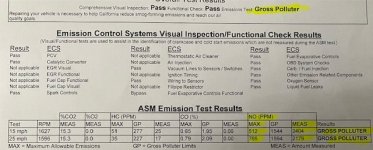
I know I am reviving an old thread here but my '98 just failed smog with VERY high NO numbers. I am curious if the steps Reina initially took will be enough or if I have a bigger problem somewhere.


Just took my 1998 Toyota 4Runner 3.4 for a smog check and it fail very bad on NOX. It register 1056ppm NoX with a max allowable limit to pass at like 500 something NoX.


Here is what I did to fix it.

Step 1 Took MAF out and clean it.

Step 2 Replace Air filter

Step 3 Drive the the car around for a while to work the sea foam through the system. Use all the fuel with the sea foam in it. Then get a fresh tank of gas from a good gas station like Chevron

Step 4 Sea foam the oil, fuel, and vacuum

Step 5 Replace fuel filter

Step 6 Replace Bank 1 O2 sensor, with a good brand O2 sensor, like NTK

Step 7 Replace engine Oil and filter

Step 8 Make appointment at your favorite Smog tester

Step 9 Drive around to get the engine and cat nice and warm

Step 10 cross your fingers that your hard work pay off


For my 98 4Runner 3.4 I drop my NoX from 1056 ppm to 152 ppm. Not to mention that the other measured numbers (HC, CO, O2, CO2) also improved.


It is also a good idea to change the Spark plug wires and plugs if it has not been replaced for a while.


I could not seem to find anyone else that discussed having such high numbers with no other real issues so I am hoping y'all can provide a little more insight.


For some background on the car, its a '98 SR5 3.4L 2wd with 240K miles on it. The oil was changed recently and the plugs were changed at 233K and look pretty good based on my knowledge. (I did switch to single ground NGK G-Power Platinum after reading that it may only matter for longevity, correct me if I am wrong here) The Cat was replaced at 220K miles almost 4 years ago to the day. Other than that the car runs great, a few issues here and there but not anything I think would be relevant to smog issues. It has not thrown any codes and does not appear to be smoking at all besides right when starting up in the mornings.


Thanks for the help in advance.
 

Attachments

  • IMG_6964.jpg
    IMG_6964.jpg
    80.7 KB · Views: 283
Last edited:

Members online

No members online now.

Forum statistics

Threads
278,316
Messages
3,554,124
Members
248,016
Latest member
Advally Service

Trending content

Back
Top