2010 4Runner Brake Pad Replacement

artstar1983

Junior Member
Getting ready to replace front pads on my 2010 SR5. With other cars I have typically bled the brake lines while compressing the piston in the caliper. However, I don't have the equipment presently to do this on the SR5.

I have not been able to find any specific feedback online regarding whether or not bleeding the lines is necessary. I would appreciate any feedback from any of you on the forum that have replaced pads yourself. Thank you
 
Register to hide this ad
I did not bleed mine when I did them. I loosened the cap of the master cylinder a little. The fluid simply pushes back and refills the master reservoir.

One of the easiest brake jobs I ever did. I replaced my rotors at the same time so I had to remove the caliper brackets, but if only changing pads it is super easy.

I do remember having to improvise a tool to push all the pistons in at the same time, its been a while so don't remember exactly how I did it, but probably a couple C clamps and a piece of metal big enough to catch both pistons.
 
When I changed mine the second time I just loosened the bleeder valve nuts on the calipers to allow the fluid to escape instead of getting pushed into the reservoir. You can loosen the fitting with just a box wrench. It's better to bleed the calipers when you push the Pistons back in. The fluid is dirty and the master cylinder has internal components that could catch the dirt and cause problems.
 
I did not bleed mine when I did them. I loosened the cap of the master cylinder a little. The fluid simply pushes back and refills the master reservoir.

Yup, I just got done with mine last week. Super simple, less than 2 hours total.
 
A piece of wood or C-clamp does the job just as well as anything else. If the pads need changing the rotors may also need an updating. In either case, be sure to seat/bed the pads properly.
 
My wife's 2014 SR5 is not likely due for pads anytime soon, but it will be 2 years old come March of '16, so I started doing some recon on brake fluid change out. I referenced the 2010 4Runner FSM that member nashman69 provided in another thread.

The first thing I discovered was once the brake fluid reservoir cap was off, you are no longer able to insert a turkey baster or MityVac vacuum line down into the reservoir in order to first extract old fluid; then refill with fresh fluid before beginning the flush/bleed. The upper part of the reservoir is sealed with the exception of a vent hole - a VERY small vent hole.

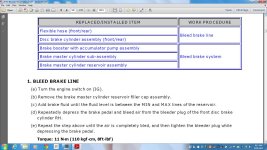
The procedure to change fluid and bleed fluid were the same. At the top of the bleeding section you'll see what components encompass a "Bleed Brake Line" operation and what components encompass a "Bleed Brake System".

There is a highlighted caveat for the "Bleed Brake System" which states the following:

If air is bled without using TECHSTREAM, damage or accicents may result.

It would seem that regardless of what type of work you are doing that involves bleeding/changing fluid, you might set off DTCs. Not saying you will - just pointing out the possibility This is not necessarily the result of an error on your part - just something that goes with the territory. Digging around the web I learned that an excessively long pedal stroke can set a DTC.

I've yet to find a diyer-affordable scanner that will reset brake system DTCs for this late a model.

UPDATE - I scrounged around some more for diyer-type diagnostic hardware/software. There are some out there, but at the moment and for the $$$ - this might be one of the better choices. According to the support person I dealt with you get:

OBDII/ABS/SRS/TRANSMISSION:

AUTEL.COM

ST06 ProLine Hardware - $249
EI03 Toyota Expansion - $199
Shipping - $14

Total - $462.00

Available now for '14 Toyota(and back-need to check with them)

Available for '15 Toyota late Nov. '15 - Early Dec. '15

INNOVA.COM has 4 models - 3150D/3160D/3150E/3160E that handle OBDII/ABS/SRS. Lots of providers and prices start around $200 and go up.


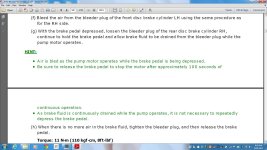
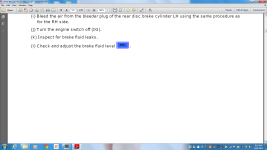
Here are some screen shots for the "Bleed Brake Line" procedure:
 

Attachments

  • 2010_4Runner_BleedBrakes1.jpg
    2010_4Runner_BleedBrakes1.jpg
    137.1 KB · Views: 696
  • 2010_4Runner_BleedBrake2.jpg
    2010_4Runner_BleedBrake2.jpg
    129 KB · Views: 693
  • 2010_4Runner_BleedBrakes3.png
    2010_4Runner_BleedBrakes3.png
    126 KB · Views: 687
Last edited:
Good point. This is basically the same way brakes have been bled forever. The noted difference with the 4R, and most modern vehicles, is that one must have the IG key to the Run position. You will hear all sorts of noises when bleeding the 4R brakes, that is all normal and is the electronics doing their thing.
Use this opportunity to run a mess of fluid through the system at each corner and get that fluid changed.
 
for vehicles with this time of MC, or even those with standard ABS, I like to crack the bleeder whenever I compress the pistons.

i took an old gallon jug and drilled a small hole in the lid. then i stuff in a small section of rubber tubing. i break the bleeder free, then put on the tubing. i open the bleeder, then compress the piston. i try to close the bleeder before the piston is fully compressed, or any time i release the clamp. to avoid any chance of introducing air into the system, as the piston does retract slightly upon releasing the clamp, and it may pull air back in through the bleeder.

when doing this, be sure to top off the MC prior to pumping the pedal, after installing the new parts. as you don't want to suck the fluid down to low and get air inside.
 

Members online

Forum statistics

Threads
278,307
Messages
3,554,054
Members
248,016
Latest member
Advally Service

Trending content

Back
Top