2014 Engine Toast - Rebuild vs Replace

axel1

Member
So, I have been very pleased with my 2014 SR5 and it's served me great for the 7 years I've owned it. 160k total miles, 100k of those mine, and I've had to do basically nothing except basic maintenance - oil changes, filters, etc.

Recently, on a trip up to Wisconsin I was driving to dinner at around 20 mph when it started shaking badly, and the flashing CEL came on. Pulled over, read the codes - P0300, P0301, P0303. Two cylinders misfiring, not great, but I figured it would be something simple like coils or plugs. I tried swapping the coil packs around, checking all the harness connections, etc, and no luck - still the same misfires and the engine was sputtering out after around 10 seconds of running. I admitted defeat and had my insurance tow it to the local dealer in Oshkosh.

After fighting with the dealer for a few days about my aftermarket electronics preventing them from diagnosing things (laziness most likely) they finally came back with bad news: no compression in cylinders 1 & 3, with lots of carbon buildup and fluid in cylinder 1 (though they wouldn't tell me what the fluid was nor did they take any borescope photos). Their recommendation was a new engine at a pricetag of $13,800.

It being a dealer, I was skeptical, since I had had zero mechanical issues up to this point and it hadn't been overheating or smoking or anything. I had it towed again to another local shop who managed to squeeze me in on short notice (shoutout to Jacobsen Auto Service in Oshkosh!). They confirmed the same findings - essentially 0 compression on cylinder 1 indicating a major engine failure. Their recommendation was the same, a new engine, though they advised towing it back home would be best since they couldn't get to it for at least a month.

So far, I've called a few local shops near home and have gotten estimates between $6000-$9000 for a remanned or used 1GR installed. That's not great, but swallowable if it means I can run the truck for another 10-15 years. It's otherwise in great shape with minimal rust, especially for the midwest, so I think I'm willing to pay that much.

So that's where we're at - my 4runner is sitting in the lot in WI, 150 miles from me, while I call around local shops and prepare to trailer it back home for repairs.

Now onto my question - my understanding is that even if the engine is rebuildable (which I assume it is considering it still runs and is likely just a head gasket or stuck valve or something) - once you factor in all the labor to tear it down, you're basically paying as much or more than it would be to just rip the old one out and throw a new one in. A few local shops have agreed with this conclusion, but a few more have been skeptical that it could still be something relatively easy to repair. I'm waiting to decide on where to take it until I get all the estimates in and can compare, but I'd love to hear what the hivemind thinks about the whole situation. I don't have a garage or a friend with one, so DIY is unfortunately out of the question.
 
Register to hide this ad
So, I have been very pleased with my 2014 SR5 and it's served me great for the 7 years I've owned it. 160k total miles, 100k of those mine, and I've had to do basically nothing except basic maintenance - oil changes, filters, etc.

Recently, on a trip up to Wisconsin I was driving to dinner at around 20 mph when it started shaking badly, and the flashing CEL came on. Pulled over, read the codes - P0300, P0301, P0303. Two cylinders misfiring, not great, but I figured it would be something simple like coils or plugs. I tried swapping the coil packs around, checking all the harness connections, etc, and no luck - still the same misfires and the engine was sputtering out after around 10 seconds of running. I admitted defeat and had my insurance tow it to the local dealer in Oshkosh.

After fighting with the dealer for a few days about my aftermarket electronics preventing them from diagnosing things (laziness most likely) they finally came back with bad news: no compression in cylinders 1 & 3, with lots of carbon buildup and fluid in cylinder 1 (though they wouldn't tell me what the fluid was nor did they take any borescope photos). Their recommendation was a new engine at a pricetag of $13,800.

It being a dealer, I was skeptical, since I had had zero mechanical issues up to this point and it hadn't been overheating or smoking or anything. I had it towed again to another local shop who managed to squeeze me in on short notice (shoutout to Jacobsen Auto Service in Oshkosh!). They confirmed the same findings - essentially 0 compression on cylinder 1 indicating a major engine failure. Their recommendation was the same, a new engine, though they advised towing it back home would be best since they couldn't get to it for at least a month.

So far, I've called a few local shops near home and have gotten estimates between $6000-$9000 for a remanned or used 1GR installed. That's not great, but swallowable if it means I can run the truck for another 10-15 years. It's otherwise in great shape with minimal rust, especially for the midwest, so I think I'm willing to pay that much.

So that's where we're at - my 4runner is sitting in the lot in WI, 150 miles from me, while I call around local shops and prepare to trailer it back home for repairs.

Now onto my question - my understanding is that even if the engine is rebuildable (which I assume it is considering it still runs and is likely just a head gasket or stuck valve or something) - once you factor in all the labor to tear it down, you're basically paying as much or more than it would be to just rip the old one out and throw a new one in. A few local shops have agreed with this conclusion, but a few more have been skeptical that it could still be something relatively easy to repair. I'm waiting to decide on where to take it until I get all the estimates in and can compare, but I'd love to hear what the hivemind thinks about the whole situation. I don't have a garage or a friend with one, so DIY is unfortunately out of the question.

sorry to read about this but that sucks! Time for a V8!!!

2016 Toyota 4Runner with a 500+ hp Supercharged 3UR V8 – Engine Swap Depot

May try sourcing an engine from ebay , co part etc
 
Seems like pretty low mileage for engine failure. I wonder what caused it. If it is toast, personally i would get a new long block, but thats just me. Keep us updated on the diagnosis.
 
Not having a garage definitely puts you at a disadvantage, but somehow I would want to know the real extent of my failure, in other words have the head(s) removed at the least before I made a decision, staring with the head with the cylinder with no compression.
 
I had a revelation last night at about 3 AM, literally shot out of bed as I thought of it. I think I know how the engine died

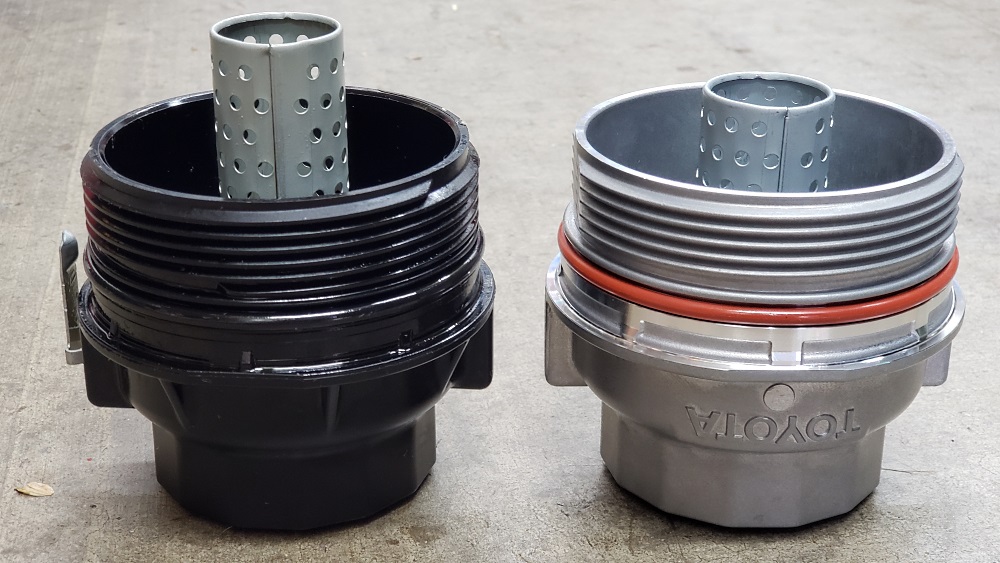
About 2000 miles ago I changed my oil, and as part of it I finally did the plastic -> metal filter housing upgrade. I'd bought the metal filter housing like 3 years ago and kept forgetting to put it on. That big delay also meant that I'd forgotten the very important and critical step that you have to do when you make the swap - ensuring that the longer center tube gets transferred over from the old housing:

20190417_112947.jpg


If the top end of the filter collapsed or shredded itself, well, that could absolutely block up some oil ports somewhere in the engine and cause things to overheat locally without showing any signs of a problem before a catastrophic failure. Obviously, I won't know for sure until I can get to the truck and look at the filter, but this is the closest thing I have to a smoking gun right now.
 
Not having a garage definitely puts you at a disadvantage, but somehow I would want to know the real extent of my failure, in other words have the head(s) removed at the least before I made a decision, staring with the head with the cylinder with no compression.

Yeah, the big problem is most of these shops are telling me by the time you teardown the heads and inspect everything, you're already halfway to the cost of a new engine in labor.

In other news, I got my first official estimate from a shop: complete 1GR-FE with 120k miles is $5020, labor is $3500, and there's a freon charge + EPA, taxes, etc with the grant total coming out to $10,105.

I'm still waiting on a few other shops to come back to me with estimates, but it seems like the main cost driver is the fact that a used 1GR-FE is expensive. $5k seems to be about average. Obviously, I could go for a junkyard motor or a sketchy eBay pull, but if I'm going to be spending thousands already I'd rather get something with a decent chance of lasting me another 100k miles.
 
I reached out to TCCN as well as probably 5-6 other shops in the area. Waiting on the rest of the estimates to flow in, and I'll probably be picking one this weekend.

I have a rental truck right now and I'll be trailering the 4runner back down from Wisconsin once I decide where it's going.
 
I had a revelation last night at about 3 AM, literally shot out of bed as I thought of it. I think I know how the engine died

About 2000 miles ago I changed my oil, and as part of it I finally did the plastic -> metal filter housing upgrade. I'd bought the metal filter housing like 3 years ago and kept forgetting to put it on. That big delay also meant that I'd forgotten the very important and critical step that you have to do when you make the swap - ensuring that the longer center tube gets transferred over from the old housing:

20190417_112947.jpg


If the top end of the filter collapsed or shredded itself, well, that could absolutely block up some oil ports somewhere in the engine and cause things to overheat locally without showing any signs of a problem before a catastrophic failure. Obviously, I won't know for sure until I can get to the truck and look at the filter, but this is the closest thing I have to a smoking gun right now.

I could understand that causing a bottom end knock or frying the cams but I don't see how it would cause fluid in a cylinder/cylinders and low compression.

There's videos of engines being run deliberately with no oil at all and they don't lose compression due to it, they normal fail when the block gets a ventilation hole!

I think you might have got lucky with the oil filter and it could just be a headgasket, or an overfuelling injector maybe? (Would also explain carbon build up) Finding the fluid type would be handy, that garage had what we call a "More than my job's worth" attitude IMO.
 
For that kind of money I would get entire wrecked 4R from Copart and swap engines and part out the rest.

I wouldn't buy anything till I took a look at the existing engine. Likely fixable.
 
Unfortunately, every shop I've called has basically said that the labor costs to tear it down, resurface the heads, clean up the cylinders, and replace the head gasket is going to be more expensive than just throwing a new engine in, including the price of the engine. And that's assuming the problem isn't something deeper like a cracked block.

No response from TCCN yet but I'm sure they're plenty busy. I think I've decided on a good local shop that seems very honest and has given me the best estimate so far ($9k). I'll be making the round trip Monday to trailer it back home.
 
Request Rejected

Link is a search on LKQ's website with available engines for your rig and their source location. LKQ is a nationwide company and parts are warrantied. You can buy direct or through your local parts store, though with a markup if bought from a 3rd party.
 
why not get used engine with low miles? but do try find one locally, shipping in from overseas might be cheaper, but most of them are scammers. Stay away from hmotorsonline.
 
why not get used engine with low miles? but do try find one locally, shipping in from overseas might be cheaper, but most of them are scammers. Stay away from hmotorsonline.

That’s what the shops I’ve talked to so far have quoted me for. Most of them have relationships with local junkyards and decent warranties.

Low mileage 1GRs are like $5-6k so I’ll probably go for one around 100k to save some money.
 
I had a revelation last night at about 3 AM, literally shot out of bed as I thought of it. I think I know how the engine died

About 2000 miles ago I changed my oil, and as part of it I finally did the plastic -> metal filter housing upgrade. I'd bought the metal filter housing like 3 years ago and kept forgetting to put it on. That big delay also meant that I'd forgotten the very important and critical step that you have to do when you make the swap - ensuring that the longer center tube gets transferred over from the old housing:

20190417_112947.jpg


If the top end of the filter collapsed or shredded itself, well, that could absolutely block up some oil ports somewhere in the engine and cause things to overheat locally without showing any signs of a problem before a catastrophic failure. Obviously, I won't know for sure until I can get to the truck and look at the filter, but this is the closest thing I have to a smoking gun right now.

What were you thinking when you went with metal filter housing? Like metal is better than the original OEM plastic design?

I have the original OEM plastic housing on our 2014 and it’s rolling past 430K miles this weekend.
 
What were you thinking when you went with metal filter housing? Like metal is better than the original OEM plastic design?

I have the original OEM plastic housing on our 2014 and it’s rolling past 430K miles this weekend.

It can be easy to get sucked into the "it's an upgrade" game. Especially if one hasn't experienced the reality of past said "upgrades."
 
What were you thinking when you went with metal filter housing? Like metal is better than the original OEM plastic design?

I have the original OEM plastic housing on our 2014 and it’s rolling past 430K miles this weekend.

It is an upgrade if done correctly. With the metal one you just tighten until it is snug and go. There are many reports of the plastic housing cracking and leaking, especially when letting a shop do your oil changes.

I have been a mechanic for over 45 years and the T4R oil filter location (under skid plate on later models) and plastic housing is one of the worst I have seen. Several reports of Toyota shops not changing the filter on the "free" oil changes due to the skid plate drop, as well as all of the stripped out skid plate bolts.

Your 4Runner is a great example of what these vehicles are capable of when maintained. Congrats to you for that mileage accomplishment. I hope to get the same from mine.

The metal filter will not degrade and become brittle like plastic, nor will it crack from being overtightened (although I am sure some mechanics could even screw that up).

I respect all opinions, and this is just my opinion from having many Lexus/Toyota products in the family. I have upgraded all of the ones with a plastic housing to a metal one. You just have to get the right one and swap the tube if necessary.

On another note, I would be surprised if that is what caused this issue due to the strength of the inner wall of the filter itself, assuming that it was a Toyota filter.

OP I feel for you brother. Please keep us updated.
 
It is an upgrade if done correctly. With the metal one you just tighten until it is snug and go. There are many reports of the plastic housing cracking and leaking, especially when letting a shop do your oil changes.

I have been a mechanic for over 45 years and the T4R oil filter location (under skid plate on later models) and plastic housing is one of the worst I have seen. Several reports of Toyota shops not changing the filter on the "free" oil changes due to the skid plate drop, as well as all of the stripped out skid plate bolts.

Your 4Runner is a great example of what these vehicles are capable of when maintained. Congrats to you for that mileage accomplishment. I hope to get the same from mine.

The metal filter will not degrade and become brittle like plastic, nor will it crack from being overtightened (although I am sure some mechanics could even screw that up).

I respect all opinions, and this is just my opinion from having many Lexus/Toyota products in the family. I have upgraded all of the ones with a plastic housing to a metal one. You just have to get the right one and swap the tube if necessary.

On another note, I would be surprised if that is what caused this issue due to the strength of the inner wall of the filter itself, assuming that it was a Toyota filter.

OP I feel for you brother. Please keep us updated.

Snug is all you need to do w/ the plastic version as well. Don't over torque it, use an appropriate cap wrench, and it's a forever part. Plus the thread dimensions/surface finish differences compared to the plastic version are a non issue if one doesn't swap. Not to mention the inner filter support tube swap which some have fumbled. It's an answer to a question which hasn't been asked.
 

Members online

Forum statistics

Threads
278,307
Messages
3,554,056
Members
248,016
Latest member
Advally Service

Trending content

Back
Top