2014 Towing Capacity

The limit is a limit for a reason, and now with this new SAE standard, it should be especially so.
The J2087 consists of many tests*. Flat accel (0-60, 0-30, 40-60, etc), incline starts, parking brake, long climb (Davis Dam Grade), braking, stability, hitch, etc. The final TWR is the lowest result of any test.

*website doesn't mention all tests

As a made up example, say the Davis Dam climb resulted in a 4700 lb TWR, but every other test came up with 5500 TWR. Personally, I'd be fine running 5500 lbs. The Davis Dam climb is a 7% grade that goes up 3000 ft while starting at a minimum of 100 degrees ambient temperature. Also, the A/C is on high and the trailer being towed is enclosed with a minimum frontal area dependent on the weight class the TWR falls into. These are extreme conditions that I can avoid by route/trailer selection.

One factoid regarding J2087 is the trailer frontal area goes up significantly if you go over 5000 lbs TWR. I'm sure it's no accident it lines up with the limits of Class III hitches, also 5k lbs. A 5000 lb rating requires a Class III hitch and ~50 ft^2 trailer. 5001-7000 lb rating requires a Class IV hitch and ~70 ft^@ trailer. I'll have to look up the actual figures Monday when I can look at the paper again.
 
I have a 2014 4runner from Hatch and asks the sales representative about the 4700 versus the 5000 stated in the manual. He said the manual is correct as the brochure specs are subject to revisions. You will also note there is no warning against using a weight distributing hitch, as in previous manuals. I would not hesitate to pull that much, as the SAE standards are real world numbers tested under extreme conditions.
 
You will also note there is no warning against using a weight distributing hitch, as in previous manuals. I would not hesitate to pull that much, as the SAE standards are real world numbers tested under extreme conditions.
No 5th gen manual has had a warning against using WDHs.

The 2012/2013 manual mentions WDH setup.
2010,2011,2014 doesn't mention anything about WDHs.
 
No 5th gen manual has had a warning against using WDHs.

The 2012/2013 manual mentions WDH setup.
2010,2011,2014 doesn't mention anything about WDHs.

I think the 4th Gen V6 manual warned against using a WDH, which is why some folks on these boards advise against using one on 5th Gens, since they contend the receiver design is the same. But, like you said, the 2012/13 manual seems to give it's blessing on use of a WDH, which seems to me to be a more applicable point of comparison.
 
The Tacoma max is still 6500, correct? Other than wheelbase, what's the mechanical differences? Brakes better in Taco, drivetrain?

Stopping a heavy trailer has quite a bit to do with the trailer brakes. I think the T4rs softer rear springs and wheelbase are the biggest limitation to heavy trailers.

Indeed!
I regularly tow a boat and trailer combo at approximately 5750 lbs and the truck handles the load fine. I brought the boat back to VA from IN and it did fine through the mountains. I now trailer a mix of highway and back country roads - from 70 to 45 MPH. After the long trip from IN, I did add air bags in the rear springs, so the truck runs stock rear height with the bags at 30 lbs. I should note that the trailer has surge disk brakes on both axels. Dangerous? Whatever...
Be safe out there...
Chris
 
I towed for the first time with my 2014 LE this past weekend. I have a 21' Mastercraft Prostar 205. My guess is it is somewhere in the 4000-4500# range loaded up with gear etc. Trailer is dual axel with surge breaks. I have to say I was disappointed with the towing capability of the 14'. It downshifted a lot and averaged between 11-11.6 MPG. I have no factual data, but it sure seemed my 04' Sport Edition pulled better than my 14' LE. We traded in a 10' Armada Platinum for the 14' LE and damn I missed the Armada pullling the boat! However there are many things I don't miss about the Armada as well! ;)
 
I towed for the first time with my 2014 LE this past weekend. I have a 21' Mastercraft Prostar 205. My guess is it is somewhere in the 4000-4500# range loaded up with gear etc. Trailer is dual axel with surge breaks. I have to say I was disappointed with the towing capability of the 14'. It downshifted a lot and averaged between 11-11.6 MPG. I have no factual data, but it sure seemed my 04' Sport Edition pulled better than my 14' LE.
My waifu and I are looking at buying a boat and drove one of her co-worker's 2003 19' Mastercraft 190 yesterday to get an idea of how our 4Runner handled it. Dry weight is 2620, he's weighed it at 4400 loaded out. It has the optional 8.1L instead of the stock 350 though. Dual axle surge brakes.


I thought the 4Runner handled it fine. Trailer didn't push around the tow vehicle, felt stable. 5th gear became a pipe dream, which was expected. Took it up the only nearby hill, 4% grade over 3 miles (640 ft elevation gain). Needed all of 3rd gear to get up doing 50-55 mph. Trans pan temp went from 180 at the bottom to 205 and rapidly rising at the top of the hill. Coolant temp didn't budge at all. The drive sold me on being able to tow the boat we're looking at (~4800 lbs towed), although the 4Runner will need a tranny cooler.
 

Attachments

I towed for the first time with my 2014 LE this past weekend. I have a 21' Mastercraft Prostar 205. My guess is it is somewhere in the 4000-4500# range loaded up with gear etc. Trailer is dual axel with surge breaks. I have to say I was disappointed with the towing capability of the 14'. It downshifted a lot and averaged between 11-11.6 MPG. ! ;)

I will speak on the RV towing mpg:

It is all about weight, speed/wind direction, terrain and traffic.

5 - 6 mpg would be considered low mileage.

8 - 10 mpg is normal gasoline mileage for an RV tow vehicle of normal size.

12 - 14 mpg is about as good as it gets for RV gas engine towing.

Has something to do with engine efficiency versus the most power that gasoline can possibly provide (to move a set amount of weight) lol.
 
I will speak on the RV towing mpg:

It is all about weight, speed/wind direction, terrain and traffic.

5 - 6 mpg would be considered low mileage.

8 - 10 mpg is normal gasoline mileage for an RV tow vehicle of normal size.

12 - 14 mpg is about as good as it gets for RV gas engine towing.

Has something to do with engine efficiency versus the most power that gasoline can possibly provide (to move a set amount of weight) lol.

The MPG I experienced towing was to be expected. I should have written my post better. The MPG was not something I took issue with I was just putting my numbers out there. What I was a little bit disappointed with was the lack of power/torque and the excessive need for downshifting vs. towing the same boat with my 04' Sport Edition V6. It may have something to do with the fact that the 04' was a 4 speed trans so I was towing in S3 vs the 14' having a 5 speed so I am towing in S4. I do feel the towing MPG's are similar between the two even with the 5 speed vs. 4 speed??? Pretty sure my 04' got better daily driving/non-towing mpg. May be due to the 14' LE being all wheel drive.
 
Last edited:
The MPG I experienced towing was to be expected. I should have written my post better. The MPG was not something I took issue with I was just putting my numbers out there. What I was a little bit disappointed with was the lack of power/torque and the excessive need for downshifting vs. towing the same boat with my 04' Sport Edition V6. It may have something to do with the fact that the 04' was a 4 speed trans so I was towing in S3 vs the 14' having a 5 speed so I am towing in S4. I do feel the MPG's are similar between the two even with the 5 speed vs. 4 speed???

Were you towing in 4th?

I haven't towed in my 2014 yet (just hit 1000 miles and crap boating weather), but I will admit even with my 2005 Sport V8 I rarely was able to tow in 5th and it would drop on slight hills, even in flat Florida. Hell I towed in 4th all the way to North Carolina and back a few times when towing my car.

I know I'm going to be a little disappointed in the V6 towing, BUT I only tow my boat less than 30 miles each way and Florida is very flat. I won't be disappointed that I didn't spend another 12-13k on the GX460, which I would assume is only marginally better as the engine seemed only slightly more powerful on my test drive.
 
Not trying to thread-jack, but I have a few questions on this topic...

There is a good chance I will be doing a NC to CA move around June of 2015. I have a 2014 TE and we will most likely be towing my wife's VW Golf R. The curb weight is 3450lbs. I'm reading a lot of things I didn't know were important factors when it comes to towing a vehicle. I've never towed a vehicle with an SUV before. We will also be bringing our 3 dogs, some luggage, and a roof topper.

1. Are there things I need to know and consider prior to towing the vehicle?
2. I've read about transmission coolers. Is this something inexpensive to consider?
3. The trailer will most likely be a rental. It'll need to be a dolly style or flat bed since the car is all-wheel drive.

It seems there is a wealth of knowledge from everyone who has contributed to this thread. I'd like your input and education on this topic to help me and teach me.

I plan on getting a scangaugeII to monitor vehicle diagnostics. My concern though, from what I've read, is how tires effect the towing capability, trailer type and weight, brakes, WDH's, and some other things I know nothing about when talking about trailers.
 
Not trying to thread-jack, but I have a few questions on this topic...

There is a good chance I will be doing a NC to CA move around June of 2015. I have a 2014 TE and we will most likely be towing my wife's VW Golf R. The curb weight is 3450lbs. I'm reading a lot of things I didn't know were important factors when it comes to towing a vehicle. I've never towed a vehicle with an SUV before. We will also be bringing our 3 dogs, some luggage, and a roof topper.

1. Are there things I need to know and consider prior to towing the vehicle?
2. I've read about transmission coolers. Is this something inexpensive to consider?
3. The trailer will most likely be a rental. It'll need to be a dolly style or flat bed since the car is all-wheel drive.

It seems there is a wealth of knowledge from everyone who has contributed to this thread. I'd like your input and education on this topic to help me and teach me.

I plan on getting a scangaugeII to monitor vehicle diagnostics. My concern though, from what I've read, is how tires effect the towing capability, trailer type and weight, brakes, WDH's, and some other things I know nothing about when talking about trailers.

I can't speak to the 5th gen but it's much easier on the truck to tow a car on a full trailer then say a boat or a box trailer. It's much more aerodynamic.

When I had my 4th gen v8 I towed my Honda S2000 on a flat bed type trailer and it performed very well even in the mountains. I towed in 4th. Mileage was about 10. I will tell you I had zero problems towing through the NC mountains to the Dragon. I had to tow on the Dragon many times unfortunately as our events hotel was on it. The only piece I needed on my 4runner was a Tekonesha Prodigy brake controller.

Considering the smaller engine and lack of a dedicated transmission cooler on the new v6 I'd probably get a transmission cooler for that distance. With a rental trailer you will have surge brakes so you won't need a controller. I would also only use a flat bed trailer.
 
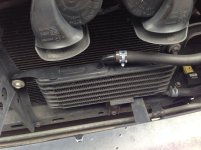
Related to the transmission cooler issue. Has anyone looked into putting a Toyota OEM transmission cooler into the 5th gen that has the mounting brackets on it? I obviously do not have an extra unit but it looks like the current structure has at least one hold to mount it and you could add a bolt for another. The pic below is from my 4th gens.
 

Attachments

  • image.jpg
    image.jpg
    134.6 KB · Views: 1,315
Last edited:
Have not checked, but other than the VVti in the 4R, how is the engine/gearing different? I'm surprised there is a tranny/axle gearing difference? Makes sense if so, but you are saying the T4R is geared higher/numerically lower than the Taco?

Just checked the Taco double cab gear ratio is 3.73, the tow capacity is 6400 in 2014. HP TQ is 236/266 vs 270/278 for the 2014 4R. Thought the 4Runner has 3.73s too, but not sure.

I have 3.73 in my 2014 4runner which I had to check the sticker/stamp on the rear diff to verify but they are 3.73.
 
5th Generation Tow Rating

I spoke with a representitive from Toyota in Europe and they said that the reason the towing capacity is different from each vehicle has more to do with what tires are put on it from stock. The stock Bridgestone tires that come on the 4runner are poor tires to begin with and have weak sidewalls so it makes sense that the tires would be a major contributor to that rating. The tacoma comes with a higher load range tire and it is an all terain tire not a highway tire. My 2 cents is get better tires with a higher load rating.
 
I spoke with a representitive from Toyota in Europe and they said that the reason the towing capacity is different from each vehicle has more to do with what tires are put on it from stock. The stock Bridgestone tires that come on the 4runner are poor tires to begin with and have weak sidewalls so it makes sense that the tires would be a major contributor to that rating. The tacoma comes with a higher load range tire and it is an all terain tire not a highway tire. My 2 cents is get better tires with a higher load rating.

I read through this whole thread, ....again...

Tires is what I was going to say. But not simply load capacity.

My version of things is it is more dependent on tire size. You'll notice on 4th gens they are sporting 31" tires. V6 tows what is it 6000 or 6400# and V8 7000ish. 4.0 V6 Taco also tows 6400#. What do they have in common? 31" tires. If you build a taco and add the towing package it drops you down from the 32" tire to 31" tires.

FJ cruiser, rated at 5000#, same 4.0L V6 32" tires
5th gen, rated 5000# (maybe 4700#) 32" tires ( same line, even bigger, little heavier, different gen, but didn't keep the 6400 rating??) Other than tires??
Highlander, 5000#, 30" tires

Look at the old-ish Jeep commanders, V8s rated for 7000# but with the Heep axles they had like 28" tires to do it.

Also I noticed a trend with pickups too. They were getting more and more power, and taller tires. Gas consumption was a none issue. Towing capacity always was/is. Now fuel efficiency is more of a concern. So how did they make trucks, with more efficient engines and with less than ideal differential ratios for towing still tow enormous weights but still get better fuel efficiency when jetting around empty. Tire size. I'm looking at the newer pickups and they look weird. Big, huge full size trucks and tiny little tires. It looks like something is missing in the wheel well.

As for getting stopped for being over weight. The officer will look at the sticker on your door and not t4r.org or a dealership pamphlet.

For my 4th gen, total weight is 12,000# as per the door/user manual. So for me if I'm 5000ish for the truck and 6000ish for the trailer I'm good with that. 6000# is still 6000#, even in a Tundra or F150 or other big pickup. I think even 2000# can mess you up real bad if something goes wrong and you lose control. Heck even no trailer, slamming the brakes on black ice or rain can be disastrous never mind a 5000# or 500# trailer
 
Last edited:

Members online

Forum statistics

Threads
278,309
Messages
3,554,071
Members
248,016
Latest member
Advally Service

Trending content

Back
Top