4WD mode has lots of drag... issues?

Ok, here's the video of me putting around with my attempt at narration...


https://www.youtube.com/watch?v=ZEs_djfNvPU


The brakes were applied twice and you can hear em squeal when I do.. other than that, all drag. Around 2:50 I get up to 25mph and you can hear the noise the drivetrain makes in 4x. Where there is no noise in 2x. And, of course I come to a pretty quick stop, like the brakes are applied moderately.


..

..
 
Last edited:
Oh yeah, all pavement tests so far...

That is your issue right there. That is why it feels "wrong" while driving on pavement with 4WD on.

STOP driving in 4WD on pavement. STOP entirely. 2WD only on pavement - no exceptions. No exceptions!

The 4Runner manual clearly says drive on dirt roads or mud or snow only. It also clearly states DO NOT drive on pavement with 4WD on.

This is not unique to 4Runners. This is a 4WD truck, not AWD. You cannot drive on pavement with the 4WD in fully engaged mode.


Read this: http://www.4x4abc.com/4WD101/axle-wind-up.html

And this: http://www.4x4abc.com/4WD101/def_turnpart.html


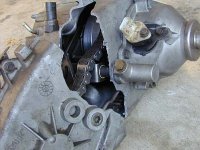
Driving on pavement causes BINDING STRESS on the drivetrain and will eventually break the transfer case ($1,5000+ repair) , and it will possibly look like this:

:flame: :flame: :flame:
 

Attachments

  • split-transfer-case.jpg
    split-transfer-case.jpg
    68.2 KB · Views: 426
Last edited:
I wouldn't be turning on dry pavement in 4w hi or low. You don't have a center diff in your 4runner and are locked while in 4w. This can put extreme pressure on the t case.

edit: what he ^ said.
 
Even on pavement in 4wd hi and not turning my truck does not drag. If im turning or backing up while turning the steering will be tough and it can bind a little but never noticed much drag when going straight on pavement. Every 4wd vehicle I have bought I have tested 4wd on pavement. Hard to find dirt and snow when testing 4wd trying to buy vehicle.
 
It could be that it didn't drag when first engaged but he quickly made a turn and the binding started.

I really just don't know.

I think we all would suggest that OP go find a big dirt lot or road and drive it there.
 
Even on pavement in 4wd hi and not turning my truck does not drag. If im turning or backing up while turning the steering will be tough and it can bind a little but never noticed much drag when going straight on pavement. Every 4wd vehicle I have bought I have tested 4wd on pavement. Hard to find dirt and snow when testing 4wd trying to buy vehicle.

At what speed though?
 
I'll cross my fingers.. Just took a little video, I'll post when its uploaded.

It already seems to be getting a tad better now this is the 3rd time around the neighborhood testing it out. It always comes out of 4wd delayed so it gets me worried it will get stuck in 4wd with these issues. It's my DD so I'll need her working in 2wd no matter what. I can live without much 4x till I get under there, grease everything up and check the levels.

Meanwhile thanks for all the responses so far!

I'll let you in on a secret that most people on this board don't know since they use 4 wheel drive often.

If someone goes a long time without using 4 wheel drive, the gears and other components become dry and sticky. When you use it for the first time in a long time, you will have a lot of resistance as it has not been lubricated. Kind of like if you haven't started an engine up for a while, the engine smokes and shakes because the oil has completely drained out of key areas of the engine, among other things.

Check your fluid levels and make sure there's adequate fluid in the transfer case (might as well check the differential fluid as well). Like you are already figuring out though, the more you use it the better it gets. Use it enough and it'll be as smooth as butter.
 
Quickly scanning through this, I'm surprised no one has mentioned an alignment.

I could be wrong here, but that seems like it's the issue.

If your toe is off, this can cause the experiences you're having.

The reason you don't really feel it when in 2wd is that the tires are being pushed. In 4wd they're being driven.

If you're looking at the front of your truck, and you can see your wheels pointed out, like this \ /, then you need an alignment.


Driving it in 4wd with your toe off, the stress is much more because the tires are being turned, and are trying to go in different directions, relative to where they are pointing.

In 2wd you really wouldn't notice it as much, because they're being pushed. There is really no drive force behind them.


Just a suggestion...
 
Ok no 4wd on DRY pavement... :nono:

So my diffs do lock in 4wd? I was thinking that was an upgrade/mod.

I'm pretty car savy so I understand all this, don't bust out your :flamethrwoer2: yet.

I'll be checking levels, and greasing up... hopefully it just needs to be used more. Seems like there are no "known" issues like this, so thats good.

Should fluids be replaced? I want to cover most/all the maintenance that should be done from 70k+ as I know zero about the history.. I am hoping to get another 100k out of this drivetrain.
 
Ok no 4wd on DRY pavement... :nono:

So my diffs do lock in 4wd? I was thinking that was an upgrade/mod.

I'm pretty car savy so I understand all this, don't bust out your :flamethrwoer2: yet.

I'll be checking levels, and greasing up... hopefully it just needs to be used more. Seems like there are no "known" issues like this, so thats good.

Should fluids be replaced? I want to cover most/all the maintenance that should be done from 70k+ as I know zero about the history.. I am hoping to get another 100k out of this drivetrain.
Your truck will not blow up if you use 4wd on dry pavement. Just don't make a habit of it.

Unless you have an elocker, your diffs don't lock. The reason 4wd on pavement can be bad is because your front diff and rear diff will travel different distances as you turn, and that'll cause binding (similar to what your front or rear axle would do if it didn't have a differential, or if it was locked). First you'll bog down and feel like you're trying to drive through a rubber band. Then your tires will scrub and squeal, unless you have a lot of traction in which case something in your drivetrain will let go. So avoid 4wd on pavement especially if you're taking lots of sharp corners, but if you need to put it in 4wd to diagnose a trouble, it's not the end of the world.

Some trucks, including some 4Runners, have a differential on the tcase that relieves that driveline binding. You'll see those guys talk about staying in 4wd all the time, I guess because they like getting half a gallon worse mpgs. ;)
 
Last edited:
At what speed though?

My wife's 4WD light doesn't work. Twice now I've borrowed my wife's 4Runner to go to work and only discovered she'd left it in 4WD when I tried to turn a sharp corner in the parking garage. So that's 20-30 mph on the surface streets, corners at 15 or so, and 70 mph on the freeway with two sweeping 50 mph corners.

Your truck will not blow up if you use 4WD on dry pavement.
 
My wife's 4WD light doesn't work. Twice now I've borrowed my wife's 4Runner to go to work and only discovered she'd left it in 4WD when I tried to turn a sharp corner in the parking garage. So that's 20-30 mph on the surface streets, corners at 15 or so, and 70 mph on the freeway with two sweeping 50 mph corners.

Your truck will not blow up if you use 4WD on dry pavement.

Lol, that sucks man. I would be lost without the light. I think you can tell though if the button is depressed.
 
That is your issue right there. That is why it feels "wrong" while driving on pavement with 4WD on.

STOP driving in 4WD on pavement. STOP entirely. 2WD only on pavement - no exceptions. No exceptions!

The 4Runner manual clearly says drive on dirt roads or mud or snow only. It also clearly states DO NOT drive on pavement with 4WD on.

This is not unique to 4Runners. This is a 4WD truck, not AWD. You cannot drive on pavement with the 4WD in fully engaged mode.


Read this: http://www.4x4abc.com/4WD101/axle-wind-up.html

And this: http://www.4x4abc.com/4WD101/def_turnpart.html


Driving on pavement causes BINDING STRESS on the drivetrain and will eventually break the transfer case ($1,5000+ repair) , and it will possibly look like this:

:flame: :flame: :flame:

The problem is caused by uneven tires. You're ok on dry pavement as long as the tires are properly rotated and not worn unevenly. If the tires are the same effective diameter on all corners 4wd on dry pavement isn't a huge issue.
 
The problem is caused by uneven tires. You're ok on dry pavement as long as the tires are properly rotated and not worn unevenly. If the tires are the same effective diameter on all corners 4wd on dry pavement isn't a huge issue.


Nah dude. It's 4WD not AWD. If you are right and it is somehow OK then why does Toyota, specifically the user manual say not to do it?

Uneven tires? Like oval shaped? That just doesn't sound right at all.

But that aside, as linked above, it is easy to see why you don't want to have transfer case binding.

Personally I think the negatives of driving with it engaged while on pavement FAR OUTWEIGH any negatives from going several months without engaging the 4WD at all. The system will be fine.

My truck has gone months and years without engaging the 4WD, in fact I don't think it was ever engaged once until I bought it from the first owner back at 65k miles in 2003.
 
Last edited:
If...it is somehow OK then why does Toyota, specifically the user manual say not to do it?

To avoid noise, reduced fuel economy, and accelerated wear.

From the manual:

Toyota recommends not using four-wheel
drive on dry hard-surfaced roads, because
four-wheel driving will cause
unnecessary noise and wear, and poor
fuel economy.
 
Should fluids be replaced? I want to cover most/all the maintenance that should be done from 70k+ as I know zero about the history.. I am hoping to get another 100k out of this drivetrain.
Replace all the fluids.
Replace the belts, unless they are new.
Replace the radiator hoses.
Replace the radiator; These are cheap, aluminium and plastic radiators---$200 from a discount dealer, less for OEM brands. The trans fluid cooler in the bottom of the rad can internally disintegrate and mix coolant with ATF. You don't want that.
As for the transfer not binding in straight line, paved road driving: here's a little experiment you can do.
1. On a dirt road, travel along at , oh, 10MPH or so and as you travel, gently shift from Hi2 to HI4 and back. Do it a bunch of times, like ten.
2. Now try the same thing on a dry paved road: Chances are, it's gonna be difficult or impossible to freely shift between HI2 and HI4 on the dry paved road. This is binding. It is to be avoided if possible.
Good luck with the new ride!
 
To avoid noise, reduced fuel economy, and accelerated wear.

From the manual:

Toyota recommends not using four-wheel
drive on dry hard-surfaced roads, because
four-wheel driving will cause
unnecessary noise and wear, and poor
fuel economy.


[MENTION=2798]JB.[/MENTION]

I read your thread, very detailed and much appreciated!

What I don't get is what is your position (relatively for or against) on whether or not you recommend people avoid driving on pavement with 4WD engaged.

And if you think it is irrelevant (eg doesn't cause harm) then I would ask: Do you think Transfer Case Binding is a serious risk?

Personally I don't think that driving around for a few minutes on pavement with 4WD on will break anything but doing it for hours, days, weeks? Well I just think that may damage things, or at a minimum the risk is legit. I know this has been debated a lot of ways so I'm not trying to start a huge flame discussion .... I'm just a bit :suspicious:
 
Last edited:

Members online

No members online now.

Forum statistics

Threads
278,316
Messages
3,554,120
Members
248,016
Latest member
Advally Service

Trending content

Back
Top