5th Gen 4runner: will my tires (285’s) rub? Here are some things to consider...

The reality is each truck is different. I have 2-2015s. Same lift, same tires, same wheels, same alignment Tech. The red truck did not rub, the blue one rubbed.

Maybe it has something to do with color?
 
Always good to have more info and coverage... but this has been pretty well covered. Most of it here... http://www.toyota-4runner.org/5th-g...-tire-size-wheels-read-first.html#post2161256

That top post touches on all the issues that keep coming up. The easiest wheels to clear large tires are 17x8 4.5BS. They don't give quite the look/stance of a little less Back spacing, but they are pretty much ideal for clearance. And always go for the narrower rim if off-road is your goal... They hold the bead better, but you may get grief from the tire shop if you go out of recommended spec (but never heard of a problem when done within reason)

Lift does not really help clear bigger tires. It does help on the road, but that is a really bad way to think about it.

You covered most of it... but missed a few of the big ones. Alignment is key (mostly caster). Followed by wheel size and back spacing + trimming off what is easily removed..

There is a lot going on in determining clearance. It's a very complex equation with many factors at play... Each factor (besides body location) impacts all the others and changes all the movement ratios.

I've never heard the tire pressure point be made about clearing the body. Maybe, but I sort of doubt it makes any real difference compared to tire design...

Thanks [MENTION=106176]wfo9[/MENTION] for the reference to your writeup! That is an awesome thread that I somehow missed. Didn't mean to duplicate efforts, but organized my thoughts similar to how I laid out things out in this writeup and wanted to share. Plus I am a visual learner so wanted to include some charts that I used when selecting things for my rig. Caster, wheel size, backspacing, and trimming were all mentioned in my writeup, not missed. Didn't realize that thinking that a lift could clear bigger tires was a bad way to think, I guess I just mean "In general, more ride height/lift is going to increase clearance for larger tires," a statement that you would probably agree with ;) I understand that compression and extension could result in untoward rubbing and may need to be rectified with the measures you mentioned.

I have seen mention of rubbing when airing down on a few threads so I thought I would include. It is anecdotal and I agree tire design likely plays more of major role.

Thanks again.
 
Last edited:
I'm just glad we have someone else who wants to post solutions instead of problems or questions.

Now, for all of those people who post "my tires only rub on full lock" or "only rub in reverse" or "only rub under full stuff" are silly. They still rub and that is unacceptable.
As an engineer how would you, consumer or operator, like it if I told you "the gas pedal works but you have to take your foot and move it over to the left a bit if you want full throttle." Yeah, I'm sure all you guys would be fine with that. [MENTION=100152]Misterquad[/MENTION] reiterated a point I have mentioned many times in the past: Every 4Runner is a bit different dimensionally! How hard is that to comprehend? We can put together a guide like the fitment guide but it, by design, has to be a bit vague because all 4Runners are not the same!
 
Last edited:
Thanks [MENTION=106176]wfo9[/MENTION] for the reference to your writeup! That is an awesome thread that I somehow missed. Didn't mean to duplicate efforts, but organized my thoughts similar to how I laid out things out in this writeup and wanted to share. Plus I am a visual learner so wanted to include some charts that I used when selecting things for my rig. Caster, wheel size, backspacing, and trimming were all mentioned in my writeup, not missed. Didn't realize that thinking that a lift could clear bigger tires was a bad way to think, I guess I just mean "In general, more ride height/lift is going to increase clearance for larger tires," a statement that you would probably agree with ;) I understand that compression and extension could result in untoward rubbing and may need to be rectified with the measures you mentioned.

I have seen mention of rubbing when airing down on a few threads so I thought I would include. It is anecdotal and I agree tire design likely plays more of major role.

Thanks again.

When you have your lift installed, often the manufacturer will have a preset caster angle (google, read, pics, it will click). However, if you have the option, have the tech (or you) put the lift at full caster and this will avoid body mount rubbing in many cases.

Sorry, you did mention caster under lift.. but it was a bit confusing to me. Lifts don''t have caster. They impact caster (I know it is just a detail, but...). Caster is constantly changing as the suspension moves.... Lifts raise the ride height, so they impact caster. UCAs do have a built in caster bias... Stock UCAS are set for factory specs, but a lift will naturally decrease caster as ride height goes up.. That is why aftermarket UCAs usually bias about 2* of positive caster in by moving the ball aft... More caster provides more clearance for the body mount... but there is always a catch. As you increase caster it tends to create positive camber (since the lower ball arcs in as it moves forward) That is why the aftermarket UCAs will also pull the upper ball in a bit. But it can only go so far before having spring contact issues at the upper and lower limits...
 
Last edited:
I actually met Michael Swear, Toyota's Chief Engineer for Tundra and Tacoma, and asked him why not redesign that body mount so we could fit more tires. He said they would have to redo all their crash testing. It would cost them a fortune. But they are aware that the struggles are real.

And so far, I spent more time on this thread than I did trimming both 4Runners. Seriously, if anyone wants to come over, I will trim theirs for free. It will take 20 minutes. And unless you know where to look and what to look for, you cannot tell.
 
Last edited:
Now, for all of those people who post "my tires only rub on full lock" or "only rub in reverse" or "only rub under full stuff" are silly...

I disagree with you on this one but not entirely. Yes, rub is not wanted that is why 265/70/17 is he factory size with plenty of clearance. If you install 285/70/17 that clearance is diminished greatly. After you discover that there is light rub on plastic inner fender liner you can: a) Trim the plastic while opening that area to the elements, b) Install Lift $$$ or c) Live it alone if it is minor contact and happens once in blue moon. Maybe it is silly but I left my alone and for 3 years now and that plastic is still intact and I'm fine with little chirp while backing out parking spot at full lock.
 
:sawzall:

Do we have the sawzall emoticon? That is the standard answer on Tacomaworld when someone says my tires rub.

Tires rubbing are like nails on a chalk board in my world.
 
I actually met Michael Swear, Toyota's Chief Engineer for Tundra and Tacoma, and asked him why not redesign that body mount so we could fit more tires. He said they would have to redo all their crash testing. It would cost them a fortune. But they are aware that the struggles are real.

And so far, I spent more time on this thread than I did trimming both 4Runners. Seriously, if anyone wants to come over, I will trim theirs for free. It will take 20 minutes. And unless you know where to look and what to look for, you cannot tell.
Please tell me at the mention of crash testing you whipped out the sawzall and told Mr. Swear to quit being a wuss.
 
Last edited:
Sorry, you did mention caster under lift.. but it was a bit confusing to me. Lifts don''t have caster. They impact caster (I know it is just a detail, but...). Caster is constantly changing as the suspension moves.... Lifts raise the ride height, so they impact caster. UCAs do have a built in caster bias... Stock UCAS are set for factory specs, but a lift will naturally decrease caster as ride height goes up.. That is why aftermarket UCAs usually bias about 2* of positive caster in by moving the ball aft... More caster provides more clearance for the body mount... but there is always a catch. As you increase caster it tends to create positive camber (since the lower ball arcs in as it moves forward) That is why the aftermarket UCAs will also pull the upper ball in a bit. But it can only go so far before having spring contact issues at the upper and lower limits...
So, there is something to be said about target audience here. I just wrote a thread where I pointed at the body mount with my index finger :) I am going to link up your thread to my write up to make sure that if someone comes across mine they will also get the benefit of your know-how. That said, you don't think there is any credence in the recommendation to set the caster (angle) higher to clear the body mount? Curious your thoughts... Thanks.
 
Please tell me at the mention of crash testing you whipped out the sawzaw and told Mr. Swear to quit being a wuss.

We talked to him at length about mods we do, mechanical and electrical. He travels around watching the mods. They watch the Toyota enthusiasts and show us a lot of interest. He just mentioned it was too late for them to change it.

He pointed out the ridiculous stuff they go through for testing. Once Toyota changed a headliner in a Camry and the NTSB required new crash test data.

So, they hear what we want but there are constraints.
 
One of things that I would consider adding even if it doesn't directly pertain to rubbing issues, is a section on wheel and tire weights. Running 285 GY Duratrac LTs means going up to 58lbs per tire vs 39lbs of rotating mass found on the stock Bridgestone Dueller.

Sounds like a job for 1engineer to me. I know he's posted on this previously because he replied to several of my questions. On the other hand, I agree w/ Ryan, that would this (i.e. Rolling weight) would be a worthy and important addition to this thread. 1engneer has so much relevant info & his posts are both very informative and practical.
Thanks everyone for posting!
JD
 
Last edited:
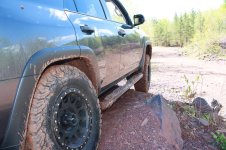
Update: still no rub

Few months out. Things are still good. Took a spin crawling at the iron range (MN) and added 100lbs to the front end with the wench. Still no rub. Again 285/70/r17's on 17x8.5 rims, no front mud flaps,+ fender mods, 3.5 inch lift (icon stage 2).
 

Attachments

  • image.jpg
    image.jpg
    141.2 KB · Views: 1,421
Hate to bump an old thread, but I had a question about throwing 285/70/17's on my 2011 SR5. Currently, the suspension is stock, except for 5100's in the front set at 0.85. Besides the front fender mod, is there anything else that I should know about throwing 285's on? Will I have any issues in the rear? Am I ok running 285's with the 5100's set to 0.85? I'm asking, because I found a killer deal on some 285's locally, and have wanted to beef up my tires. Any help would be appreciated. Thanks in advance.
 
Hate to bump an old thread, but I had a question about throwing 285/70/17's on my 2011 SR5. Currently, the suspension is stock, except for 5100's in the front set at 0.85. Besides the front fender mod, is there anything else that I should know about throwing 285's on? Will I have any issues in the rear? Am I ok running 285's with the 5100's set to 0.85? I'm asking, because I found a killer deal on some 285's locally, and have wanted to beef up my tires. Any help would be appreciated. Thanks in advance.

You have to get your tires to fit at stock height first without rubbing. Why?

Lifting a vehicle will only help with tire clearance in a static condition. What that means is, if you lift a vehicle 1" to get your tires to clear, when your suspension travel compresses 1" while off road you are back to stock height for that instant.

You have to make sure your tires clear through the whole range of suspension travel or else you will rub while off road.
 
You have to get your tires to fit at stock height first without rubbing. Why?

Lifting a vehicle will only help with tire clearance in a static condition. What that means is, if you lift a vehicle 1" to get your tires to clear, when your suspension travel compresses 1" while off road you are back to stock height for that instant.

You have to make sure your tires clear through the whole range of suspension travel or else you will rub while off road.

So, according to the chart you made, I should be good to go with just the fender modifications and mud flap removal?

I never said anything about lifting the vehicle, just stated what I am currently running. Also, thank you for the clarification on the stock height setup and rubbing while offroad.
 
So, according to the chart you made, I should be good to go with just the fender modifications and mud flap removal?

I never said anything about lifting the vehicle, just stated what I am currently running. Also, thank you for the clarification on the stock height setup and rubbing while offroad.

No, you are not "good to go." I mentioned lifting because you implied that was important by mentioning you are set at .85.

Depending on factory caster setting (still within proper range but on the low side for example) you could rub on the body mount.

If you want to put 285's on, you have to be committed to modding to get rid of rubbing. Those mods could include:

Trimming bumper cover
Trimming mudflap
Moving inner fender liner
Removing mudflap
Body Mount Chop
Getting an alignment and pushing caster up

...or, you might not rub at all. Every vehicle is slightly different.
 

Members online

Forum statistics

Threads
278,316
Messages
3,554,124
Members
248,016
Latest member
Advally Service

Trending content

Back
Top