

mtbtim
Elite Member
Hey Dudes and Dudettes,
As I've used my FSM over the last couple years, I've noticed discrepancies, mainly with torque specs. One page describing how to take something apart or put back together will show a bolt or nut with one torque spec and then you go to the master schematic page of the area of the truck you're working on and you'll see a totally different torque spec for the same bolt or nut.
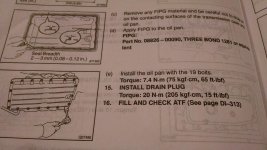
This morning I was doing some research regarding dropping the transmission oil pan and I saw a torque spec for the transmission pan bolts that didn't make any sense. Since I know the bolts for the pan are fairly small, the 65 ft-lbf spec for these bolts seemed seriously excessive. I looked up conversions for the Newton-Meter and Kilogram Force-Centimeter values and they both converted to 65 in-lbf. 65 in-lbf is equal to 5.4 ft-lbf. The difference between 65 ft-lbf and 5.4 ft-lbf is pretty huge.
The point of this is you have to use your head and not blindly follow the FSM. If someone followed that spec, and they gradually tightened the bolts in a crossing pattern, they would have eventually snapped one off in the transmission and found themselves removing the pan, dealing with getting the broken bolt out and probably buying all new bolts because they were all over-torqued.
The FSM is still an invaluable resource for us DIY mechanics but you just have to be a little careful and question things when they don't seem to jive.
As I've used my FSM over the last couple years, I've noticed discrepancies, mainly with torque specs. One page describing how to take something apart or put back together will show a bolt or nut with one torque spec and then you go to the master schematic page of the area of the truck you're working on and you'll see a totally different torque spec for the same bolt or nut.
This morning I was doing some research regarding dropping the transmission oil pan and I saw a torque spec for the transmission pan bolts that didn't make any sense. Since I know the bolts for the pan are fairly small, the 65 ft-lbf spec for these bolts seemed seriously excessive. I looked up conversions for the Newton-Meter and Kilogram Force-Centimeter values and they both converted to 65 in-lbf. 65 in-lbf is equal to 5.4 ft-lbf. The difference between 65 ft-lbf and 5.4 ft-lbf is pretty huge.
The point of this is you have to use your head and not blindly follow the FSM. If someone followed that spec, and they gradually tightened the bolts in a crossing pattern, they would have eventually snapped one off in the transmission and found themselves removing the pan, dealing with getting the broken bolt out and probably buying all new bolts because they were all over-torqued.
The FSM is still an invaluable resource for us DIY mechanics but you just have to be a little careful and question things when they don't seem to jive.



