
You are using an out of date browser. It may not display this or other websites correctly.
You should upgrade or use an alternative browser.
You should upgrade or use an alternative browser.
A possible solution to leaking axle seals
- Thread starter Drcoffee
- Start date

genmarks
New member
Been working on my axle seals today and took my axle shaft down to a friend's shop to get new bearings, retainers, and abs ring pressed on. He described these axles being so notorious for seal leaks because often the inner axle seal doesn't even meet the retainer on the shaft... so there tends to be a gap right there or at least they are not snug together.
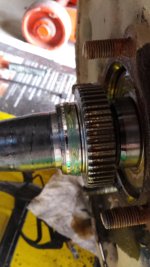
So when I got the shaft back today my friend at the shop showed me why he didn't press the retainer all the way down to the ABS ring
You can see how the retainer is not pressed all the way down against the ABS Ring
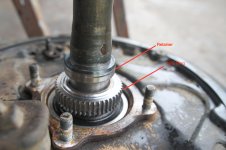
Here is what it would look like inside the axle housing and how the inner axle seal would fit flush on top of the retainer
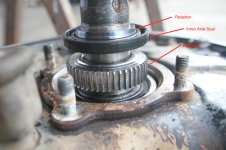
I measured the inside of the axle housing from the end to the inner axle seal, and it measures perfectly for the retainer to fit snuggly against the inner seal. Unfortunately I did not keep the exact measurements anymore, but you guys get the idea. By eliminating the gap between the retainer on the axle shaft and the inner axle seal hopefully there will be a less chance of leaking. So far I have only driven a couple miles and everything is still dry, I will try to update after substantial driving
So when I got the shaft back today my friend at the shop showed me why he didn't press the retainer all the way down to the ABS ring
You can see how the retainer is not pressed all the way down against the ABS Ring
Here is what it would look like inside the axle housing and how the inner axle seal would fit flush on top of the retainer
I measured the inside of the axle housing from the end to the inner axle seal, and it measures perfectly for the retainer to fit snuggly against the inner seal. Unfortunately I did not keep the exact measurements anymore, but you guys get the idea. By eliminating the gap between the retainer on the axle shaft and the inner axle seal hopefully there will be a less chance of leaking. So far I have only driven a couple miles and everything is still dry, I will try to update after substantial driving
Attachments



Drcoffee
Senior Member
I hope it works for you. But it looks like you have 70% chance it will leak and a better chance the ABS sensor wont work since the tone ring is pushed down too far.
Edit: I don't get the impression you ready the whole thread, but just jumped in with your buddies advice. Not to be a jerk, but before you hijack a thread, why don't you verify your axle is not leaking. Pull out the ABS sensor and look inside.
Edit: I don't get the impression you ready the whole thread, but just jumped in with your buddies advice. Not to be a jerk, but before you hijack a thread, why don't you verify your axle is not leaking. Pull out the ABS sensor and look inside.
Last edited:
genmarks
New member
I hope it works for you. But it looks like you have 70% chance it will leak and a better chance the ABS sensor wont work since the tone ring is pushed down too far.
Edit: I don't get the impression you ready the whole thread, but just jumped in with your buddies advice. Not to be a jerk, but before you hijack a thread, why don't you verify your axle is not leaking. Pull out the ABS sensor and look inside.
I am sorry I did not intend to hijack the thread, I have been following it off and on and I figured this was at least a little bit relevant.
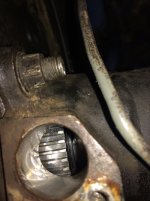
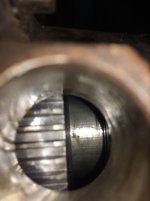
As I said I havent done any substantial driving yet, only about 20 miles. But I just checked the inside the abs sensor and it is completely dry
Attachments


Last edited:

Drcoffee
Senior Member
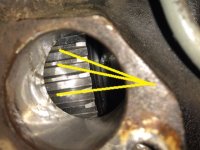
I hate to break it to you but I see gear oil on the ABS ring. Keep an eye on it.
For what its worth, you used the wrong seal. The aftermarket seals are too rigid to handle the amount of movement the axle will experience. The OEM seal is far more flexible. Again, check page 1. there is a video you should have watched.
For what its worth, you used the wrong seal. The aftermarket seals are too rigid to handle the amount of movement the axle will experience. The OEM seal is far more flexible. Again, check page 1. there is a video you should have watched.
Attachments
Last edited:
Drcoffee
Senior Member
I guess I'm confused as to why even push the ABS ring so far down in the first place? Why not have it in its proper location? You could still have the retainer where you want it but put the abs ring in the correct spot.
Is the ABS sensor working with it that far down?
I'm not sure 20 miles is far enough to trigger a code on the ABS brakes. But I am curious as well.
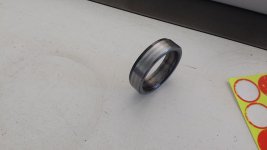
Here's a pic of where my old seal was riding on the retainer. If you look at my pic and post from above, you will see where it was riding with the new seal. Dr coffee's solution has merit. I reversed the retainer picking up about 1/8" because of the bevel and moved the retainer about 1/16" closer to the differential. No leak yet. Thanks Dr Coffee.
Attachments
blarchitect
Member
Youtube video of rear axle (w/abs) repair
About to tear down rear end to fix leaking axles. Was going to buy a complete rear end but the deal fell through. Will definitely be reversing the inner board beveled retainer as per Dr. Coffee's success. Anyway found this excellent video which shows the complete repair on a T4R with ABS.
https://www.youtube.com/watch?v=42yR9En9JHo
About to tear down rear end to fix leaking axles. Was going to buy a complete rear end but the deal fell through. Will definitely be reversing the inner board beveled retainer as per Dr. Coffee's success. Anyway found this excellent video which shows the complete repair on a T4R with ABS.
https://www.youtube.com/watch?v=42yR9En9JHo

blarchitect
Member
Don't want to open up that old chestnut! Besides, my mind is made up. Point of thread response was to add the tear down video link.
tommybui.2010
New member
First post.
Just wanted to say thanks to everyone for the help! I have 1999 V6 4WD 4Runner with 205k miles, both rear seals were leaking.
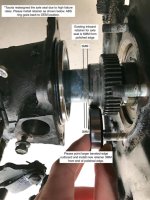
Dealership wanted $1,200 just for labor to replace the seals and press new bearings. I was able to find a local machine shop that pressed the new bearings onto my axles for $67/side. Went with the method recommended here; retainers were reversed and moved 2MM inboard. The original factory seal sat dead center on the retainer, grease test of the new seal design had it on the edge as shown on the photo.
I rented a seal driver set from Autozone (item 27119) and a rubber mallet to set the new seals.
Purchased Toyota OEM for the seals, aftermarket for the ABS ring, NSK bearings (still Japanese) and aftermarket retainers.
Only thing I noticed were on two of the four aftermarket retainers, the machined surface was so rough it would have chewed up the new seals, ended up using them to retain the bearings. Other two were fine, same finish and diameter as OEM. Got the whole set off eBay $105.
Total DIY cost was just shy of $300.
Attached a photo that I gave to the machine shop in case anyone else wants to use it.
Only 1,000 miles so far but no leak.
Thanks again.
Just wanted to say thanks to everyone for the help! I have 1999 V6 4WD 4Runner with 205k miles, both rear seals were leaking.
Dealership wanted $1,200 just for labor to replace the seals and press new bearings. I was able to find a local machine shop that pressed the new bearings onto my axles for $67/side. Went with the method recommended here; retainers were reversed and moved 2MM inboard. The original factory seal sat dead center on the retainer, grease test of the new seal design had it on the edge as shown on the photo.
I rented a seal driver set from Autozone (item 27119) and a rubber mallet to set the new seals.
Purchased Toyota OEM for the seals, aftermarket for the ABS ring, NSK bearings (still Japanese) and aftermarket retainers.
Only thing I noticed were on two of the four aftermarket retainers, the machined surface was so rough it would have chewed up the new seals, ended up using them to retain the bearings. Other two were fine, same finish and diameter as OEM. Got the whole set off eBay $105.
Total DIY cost was just shy of $300.
Attached a photo that I gave to the machine shop in case anyone else wants to use it.
Only 1,000 miles so far but no leak.
Thanks again.
Attachments
Hello All. I've been a 3rd Gen 4Runner owner now for about 4 years. I have a 1999 3.4L and I love it. Certainly not the most glamorous vehicle I have ever owned but at this point in my life, raising a family and saving for college funds, it's all about reliable transportation from point A to B.
I've done all the necessary repairs to keep this thing running for years to come with the exception of the dreaded axle seal leak. It's not that i haven't tried, I have certainly tried and tried and tried (3 times). The person I bought it from made a point to tell me that he did it DIY. After having it that first year I noticed it was leaking so I took it to a very reputable shop and decided to have the professionals do it. $1200 later I figured I was good to go. I didn't even bother checking to see if I was leaking because I was confident it was fixed but while doing my oil change about a year later.....I noticed the signs of leakage. Called the shop and they stood behind the work (even after 12 months) and gave it another shot.
Fast forward another 6 months and I am back leaking again. I found this thread and thought it was very interesting. I have a consultation back at the shop that has tried to fix it twice to see what my next move should be. I have a hunch they are going to suggest the axles are bent and I should replace them and try to seal them up again. I am not confident that is the end all be all fix.
Should I suggest they try the configuration mentioned in this thread? My other thought is, should I just bite the bullet and take it to a dealership. I'll spend the money. I'd rather throw another $1200 at a guaranteed fix to this problem than buy another vehicle. Spending the money to get it fixed sure beats spending the money it takes to buy a good used vehicle.
I guess my questions boil down to this. Should I give up on the independent shop? Is it a GUARANTEE that if I take it to a Toyota dealer they will get it right?
Any words of wisdom would be greatly appreciated.
Thanks!
I've done all the necessary repairs to keep this thing running for years to come with the exception of the dreaded axle seal leak. It's not that i haven't tried, I have certainly tried and tried and tried (3 times). The person I bought it from made a point to tell me that he did it DIY. After having it that first year I noticed it was leaking so I took it to a very reputable shop and decided to have the professionals do it. $1200 later I figured I was good to go. I didn't even bother checking to see if I was leaking because I was confident it was fixed but while doing my oil change about a year later.....I noticed the signs of leakage. Called the shop and they stood behind the work (even after 12 months) and gave it another shot.
Fast forward another 6 months and I am back leaking again. I found this thread and thought it was very interesting. I have a consultation back at the shop that has tried to fix it twice to see what my next move should be. I have a hunch they are going to suggest the axles are bent and I should replace them and try to seal them up again. I am not confident that is the end all be all fix.
Should I suggest they try the configuration mentioned in this thread? My other thought is, should I just bite the bullet and take it to a dealership. I'll spend the money. I'd rather throw another $1200 at a guaranteed fix to this problem than buy another vehicle. Spending the money to get it fixed sure beats spending the money it takes to buy a good used vehicle.
I guess my questions boil down to this. Should I give up on the independent shop? Is it a GUARANTEE that if I take it to a Toyota dealer they will get it right?
Any words of wisdom would be greatly appreciated.
Thanks!
Last edited:


mtbtim
Elite Member
Hello All. I've been a 3rd Gen 4Runner owner now for about 4 years. I have a 1999 3.4L and I love it. Certainly not the most glamorous vehicle I have ever owned but at this point in my life, raising a family and saving for college funds, it's all about reliable transportation from point A to B.
I've done all the necessary repairs to keep this thing running for years to come with the exception of the dreaded axle seal leak. It's not that i haven't tried, I have certainly tried and tried and tried (3 times). The person I bought it from made a point to tell me that he did it DIY. After having it that first year I noticed it was leaking so I took it to a very reputable shop and decided to have the professionals do it. $1200 later I figured I was good to go. I didn't even bother checking to see if I was leaking because I was confident it was fixed but while doing my oil change about a year later.....I noticed the signs of leakage. Called the shop and they stood behind the work (even after 12 months) and gave it another shot.
Fast forward another 6 months and I am back leaking again. I found this thread and thought it was very interesting. I have a consultation back at the shop that has tried to fix it twice to see what my next move should be. I have a hunch they are going to suggest the axles are bent and I should replace them and try to seal them up again. I am not confident that is the end all be all fix.
Should I suggest they try the configuration mentioned in this thread? My other thought is, should I just bite the bullet and take it to a dealership. I'll spend the money. I'd rather throw another $1200 at a guaranteed fix to this problem than buy another vehicle. Spending the money to get it fixed sure beats spending the money it takes to buy a good used vehicle.
I guess my questions boil down to this. Should I give up on the independent shop? Is it a GUARANTEE that if I take it to a Toyota dealer they will get it right?
Any words of wisdom would be greatly appreciated.
Thanks!
Dude, what you need to do is take your truck back to them and insist they do the grease test right in front of you. This is what I did when my local Toyota dealership screwed up the job and I was leaking on my driver side in less than 5000 miles. The tech who did the job on my truck did not even know what a f#cking grease test was. So, another tech watching the whole show told him what he had to do. When he pulled the axle back out the grease test showed the lip of the seal was barely riding on the polished surface on the retainer, right on the edge of the bevel. At one point, one of the many techs watching what was going on told the tech that did the job on my truck that I just schooled him. This goes to show that a DIY mechanic can often know more than a paid mechanic because of forums like this that share information.
[MENTION=102606]infamousRNR[/MENTION], [MENTION=148218]JZiggy[/MENTION] and I recently did an axle seal job on [MENTION=148218]JZiggy[/MENTION] non-abs rearend. We confirmed without a doubt that following [MENTION=78997]Drcoffee[/MENTION] suggestion of flipping the retainer around was absolutely necessary to get the lip of the seal riding in the center of the polished part of the seal retainer.
What many techs still don't understand is they can't follow the FSM specs for the placement of the retainer anymore. Toyota redesigned the axle seal at some point in the past and now the lip of the seal sits 2mm more inboard than before. If you follow the FSM spec, the lip of the seal will be barely riding on the polished part of the retainer.
With the Non-ABS rearend, you have to press the retainer all the way against the bearing to get the retaining clip in place so you can't adjust the retainer position to get a better mating with the seal. The only choice we saw was to flip the retainer.
With the ABS rearends, you have a second inner retainer and an ABS gear. The inner retainer is what connects with the axle seal. This retainer in it's original orientation can be moved a little more inboard to mate up with the seal better but then it comes very close to rubbing the inside of the axle housing. Flipping the retainer again seems like the best choice to get a better mating of the seal and retainer and keep the retainer from rubbing the axle housing.
We filmed the Non-ABS job and we're going to hopefully film an ABS one soon. We missed filming an important part of the pressing procedure so we're going to wait until we film the next one so we can add that missing footage so the video will be complete and not leave people guessing how we did it.
TAKE YOUR TRUCK BACK AND TEACH THEM SOMETHING ABOUT OUR RIGS. Your efforts will hopefully avoid the next 3rd Gen owner that visits their shop for an axle seal failure from going through the same bullshit. Good luck and please report back what the result end up being.
mtbtim
Elite Member
I'd like to know as well. Where can you find someone that's fixed this issue many times? I'd like a one and done solution. My back passenger is leaking at 165K but not bad enough for the job, yet.
When [MENTION=102606]infamousRNR[/MENTION] get both axle seal (ABS and Non-ABS) videos done, I will post them here so people can use it as a tutorial to do the job themselves, to show the pertinent pressing footage to the machine shop you bring your axles to or maybe show it to your mechanic so he knows all the nuances of doing this job so they don't f#ck it up.
This has got to be the most common repair mechanics f#ck up and it's mostly because they're not familiar with the fact Toyota redesigned the seals. It's also due to their lack of knowledge or laziness not to check to see if the seal is mating with the retainer properly. There a lots of good mechanics out there but there's also lots of bad ones. At least when you do your own wrenching, the only person you can blame is yourself.
Last edited:
Similar threads
- Replies
- 3
- Views
- 5K


