

You are using an out of date browser. It may not display this or other websites correctly.
You should upgrade or use an alternative browser.
You should upgrade or use an alternative browser.
A serious question… how to get rid of KDSS dummy light?
- Thread starter SOcalTRAIL
- Start date


SOcalTRAIL
New member
Maybe if there is an electrical connector could you replace with a resistor so that it thinks it is still connected? Same goes with the hydraulic side, maybe you need something to keep pressure on the system?
I had to make a couple of the metric flare fittings to plug the hydraulic lines in the front which was kind of a pain, and the rear banjo fittings I sealed with a 1/2" bolt and a couple precision flat washers so the system could hold pressure. I am almost positive that the dummy light is on because of the lack of pressure in the system. If I could find out how much pressure it is supposed to have I might be able to pressurize it from the central proportioning unit and trick the system.
Worth a shot!
characterzero
New member
Same here. Actually my only regret with this truck... I wanted the Trail Edition and the only ones popping up at any of the dealerships around here all had KDSS... had I known I probably would have gone with a SR5. Live and learn.
I did love KDSS in my 2010 TE that was relatively unmodded but if you are going on full lift kits, etc, just get an SR5 and a locker.

1engineer
Moderator
I had to make a couple of the metric flare fittings to plug the hydraulic lines in the front which was kind of a pain, and the rear banjo fittings I sealed with a 1/2" bolt and a couple precision flat washers so the system could hold pressure. I am almost positive that the dummy light is on because of the lack of pressure in the system. If I could find out how much pressure it is supposed to have I might be able to pressurize it from the central proportioning unit and trick the system.
Worth a shot!
I hate electrical crap. With that said, this is what you need to do:
You have a pressure transducer in your KDSS circuit. It sends a signal (probably 4-20ma or so) that determines the "health" of the KDSS system. Find that transducer, induce a current through it until the light goes off. Wire it up and you are golden. What you would be doing by finding the right pressure for the accumulator circuit on the KDSS system is giving that transducer a correct signal to send to the ECU, which will light up the KDSS light.
Last edited:

WarnerD9
New member
I hate electrical crap. With that said, this is what you need to do:
You have a pressure transducer in your KDSS circuit. It sends a signal (probably 4-20ma or so) that determines the "health" of the KDSS system. Find that transducer, induce a current through it until the light goes off. Wire it up and you are golden. What you would be doing by finding the right pressure for the accumulator circuit on the KDSS system is giving that transducer a correct signal to send to the ECU, which will light up the KDSS light.
Aside from your username, have you had experience doing this? I am not doubting you, I'm just curious to see how you would know how to handle that. If that works it would be awesome. If you have done it could you point out (with pictures) how one might go about making this happen? Thanks!

eddiebx
New member
I thought about this one for a while Shawn, aside from taking apart the gauge cluster and covering it with electrical tape from behind, or desoldering the LED altogether; there's really not much else you can do to directly turn that LED off. These darn gauge clusters nowadays are just way too high tech, it's fed with only a serial data signal and then the on/off signals of the indicators are generated inside the gauge cluster for the most part. It's not like the old days where we can just ground out a particular wire at the connector to trick it 
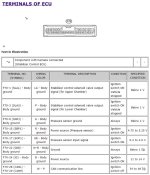
The only way I can think of is basically along the lines of what Greg is talking about, but a bit more refine, lol. Check out this chart from the FSM, it gives you the proper voltages (and grounds) each terminal should be seeing if KDSS is working properly. My theory is...if you generate a voltage signal (or ground signal) to mimic the respective singals on each terminal, the KDSS might just be tricked into thinking it's work
But of course this is all just theoretical, so proceed with caution because once you let the smoke out of the ecu, you can't put it back in :cheers:
The only way I can think of is basically along the lines of what Greg is talking about, but a bit more refine, lol. Check out this chart from the FSM, it gives you the proper voltages (and grounds) each terminal should be seeing if KDSS is working properly. My theory is...if you generate a voltage signal (or ground signal) to mimic the respective singals on each terminal, the KDSS might just be tricked into thinking it's work
But of course this is all just theoretical, so proceed with caution because once you let the smoke out of the ecu, you can't put it back in :cheers:
Attachments
1engineer
Moderator
Aside from your username, have you had experience doing this? I am not doubting you, I'm just curious to see how you would know how to handle that. If that works it would be awesome. If you have done it could you point out (with pictures) how one might go about making this happen? Thanks!
No, I have not done this with a Toyota KDSS system. With that said, the KDSS system is a typical hydraulic system. When I say typical I mean that there are no new groundbreaking concepts or ideas and the principles of the KDSS are employed in thousands of hydraulic applications every day. The KDSS is simply two cylinders and accumulators. The accumulator is precharged to a certain pressure (nitrogen) on one side and acts as a "cushion" as the other side of the cylinder pushes downward. The system is sealed, meaning the hydraulic fluid is also under pressure too. There is no magic there, no pumps or anything else, just cylinders and accumulators.
In order to light a light or anything else electrical there has to be some electro-hydraulic interface. That usually comes in the form of a pressure transducer, the most common form. That transducer gets a pressure signal from one side, transfers that pressure signal into a corresponding electrical signal, and sends that signal outward. Find the transducer, duplicate the signal and your light will go away. Here is a nice video Toyota Land Cruiser 150 - KDSS (Kinetic Dynamic Suspension System) - YouTube explaining how it works.
SOcalTRAIL
New member
I hate electrical crap. With that said, this is what you need to do:
You have a pressure transducer in your KDSS circuit. It sends a signal (probably 4-20ma or so) that determines the "health" of the KDSS system. Find that transducer, induce a current through it until the light goes off. Wire it up and you are golden. What you would be doing by finding the right pressure for the accumulator circuit on the KDSS system is giving that transducer a correct signal to send to the ECU, which will light up the KDSS light.
Just the man I was hoping would respond…. We should change your name to "1electricalengineer" haha
I hate electrical stuff too, prefer turning nuts and bolts myself.
I thought about this one for a while Shawn, aside from taking apart the gauge cluster and covering it with electrical tape from behind, or desoldering the LED altogether; there's really not much else you can do to directly turn that LED off. These darn gauge clusters nowadays are just way too high tech, it's fed with only a serial data signal and then the on/off signals of the indicators are generated inside the gauge cluster for the most part. It's not like the old days where we can just ground out a particular wire at the connector to trick it
The only way I can think of is basically along the lines of what Greg is talking about, but a bit more refine, lol. Check out this chart from the FSM, it gives you the proper voltages (and grounds) each terminal should be seeing if KDSS is working properly. My theory is...if you generate a voltage signal (or ground signal) to mimic the respective singals on each terminal, the KDSS might just be tricked into thinking it's work
But of course this is all just theoretical, so proceed with caution because once you let the smoke out of the ecu, you can't put it back in :cheers:
Eddie, thank you very much. I was exhausted last night, eyes burning, trying to look through the Toyota FSM and find the diagram. I probably looked right at that multiple times and it didn't register. I think IU am going to try and locate the pressure sensor input wire, probe it (i'm guessing it would be on the low end of the voltage scale depending on how the pressure sending unit is wired as Greg said.
Next question….
This is getting into a realm of 12V that I am unfamiliar with…. Aside from a handheld voltage regulator, how do i reduce the voltage off my battery? A potentiometer? I've only messed with that stuff making little 555 timer kits and what not…
SOcalTRAIL
New member
Question - How does the system know how to react? I'm assuming it's linked to a speedometer signal, maybe 4wd and TRAC systems also? If it is, wouldn't you need a variable signal to keep the system happy?
David
KDSS is a "dumb" system - meaning, no intelligence to it. From what I understand, it is linked to the terrain select feature that is accessible in 4x4 driving. Basically is a closed hydraulic system with two rams attached to the front and rear sway bar and a proportioning valve and accumulator in the middle of the system. The mode of terrain select you are in determined the position of the valve and allows more free movement an articulation of the sway bar.
Thats kind of the short and simple explanation obviously, but you get the gist of it.
Last edited:
eddiebx
New member
Just the man I was hoping would respond…. We should change your name to "1electricalengineer" haha
I hate electrical stuff too, prefer turning nuts and bolts myself.
Eddie, thank you very much. I was exhausted last night, eyes burning, trying to look through the Toyota FSM and find the diagram. I probably looked right at that multiple times and it didn't register. I think IU am going to try and locate the pressure sensor input wire, probe it (i'm guessing it would be on the low end of the voltage scale depending on how the pressure sending unit is wired as Greg said.
Next question….
This is getting into a realm of 12V that I am unfamiliar with…. Aside from a handheld voltage regulator, how do i reduce the voltage off my battery? A potentiometer? I've only messed with that stuff making little 555 timer kits and what not…
One sure fire way to reduce voltage is with a simple resistor network. The only issue with this is your output voltage fluctuates along with the input voltage, but it seems like the pressure sensor input has a pretty wide range for you to mess around with, so the minor fluctuations might not be a huge deal...
Check out this wikipedia link, it explains the concept and then some: Voltage divider - Wikipedia, the free encyclopedia
^^Too long didn't read? I've got a solution for that too: Voltage Divider Calculator
After calculating the desired resistances to achieve your voltage, I'd put in one potentiometer in the network so you can tweak the output voltage a bit on the fly
One concern after reading that FSM chart is, those first few grounds (SLAL, SLAU), it seems like it might only need to be grounded when the vehicle is stopped, so I am not sure if a constant ground would throw a code? This is where you need to start probing around and see what's on each terminal and go from there (this might just be a long drawn out way of the FSM saying its a constant ground, lol). Hopefully the only thing you really need to do is mimic that pressure sensor input signal (SOP1), and you will be on your merry way.

Canazes9
New member
KDSS is a "dumb" system - meaning, no intelligence to it. From what I understand, it is linked to the terrain select feature that is accessible in 4x4 driving. Basically is a closed hydraulic system with two rams attached to the front and rear sway bar and a proportioning valve and accumulator in the middle of the system. The mode of terrain select you are in determined the potation of the valve and allows more free movement an articulation of the sway bar.
Ok - So you give the pressure sensor the voltage indicated for normal highway driving, the light goes out. Does the terrain select feature have any value other than KDSS? If you use one of the terrain select features will it give an error because the system is still reading the pressure for normal highway driving?
David
eddiebx
New member
You know...here's another thought, you might just need to unplug the pressure sensor and do output signal modification right from there at the three pin plug to drop the voltage a bit (from ~4.75-5.25V down to under 4.6v).
I think (SBP1) and (SGP1) are the ground and power wires going to the sensor, and (SOP1) is the output voltage after the transducer (that Greg is talking about) has done it's thing. So you have more than enough create a modified output signal, and you don't need to mess with the 12v power network, since the sensor's power source is already at 5v.
If you test this and it works, there's more sophisticated ways to make drop the voltage to whatever you want, like voltage regulators, but that's more trouble than it's worth if you're just testing.
Another idea comes to mind is using diodes to drop the voltage too, but testing purposes you're not going to be the simplicity of doing a resistor network. It's what we nerds used all the time in the lab at college, lol.
I think (SBP1) and (SGP1) are the ground and power wires going to the sensor, and (SOP1) is the output voltage after the transducer (that Greg is talking about) has done it's thing. So you have more than enough create a modified output signal, and you don't need to mess with the 12v power network, since the sensor's power source is already at 5v.
If you test this and it works, there's more sophisticated ways to make drop the voltage to whatever you want, like voltage regulators, but that's more trouble than it's worth if you're just testing.
Another idea comes to mind is using diodes to drop the voltage too, but testing purposes you're not going to be the simplicity of doing a resistor network. It's what we nerds used all the time in the lab at college, lol.
1engineer
Moderator
Holy Hell [MENTION=85512]eddiebx[/MENTION] did I not say that?You know...here's another thought, you might just need to unplug the pressure sensor and do output signal modification right from there at the three pin plug to drop the voltage a bit (from ~4.75-5.25V down to under 4.6v).
[MENTION=96409]Canazes9[/MENTION] I'm pretty sure [MENTION=74569]SOcalTRAIL[/MENTION] explanation is accurate. The terrain response does other things to the truck besides opening or closing the proportional valve for the KDSS but that signal won't light the light. It's the pressure transducer signal that signifies all is well in the circuit.
Canazes9
New member
Holy Hell @eddiebx did I not say that?
@Canazes9 I'm pretty sure @SOcalTRAIL explanation is accurate. The terrain response does other things to the truck besides opening or closing the proportional valve for the KDSS but that signal won't light the light. It's the pressure transducer signal that signifies all is well in the circuit.
Read my post again slowly...
I'm talking about the pressure transducer signal. Won't the pressure be one value for high speed highway running and a significantly lower pressure for low speed off-road articulation?
I'm asking if giving the system a signal for one value that makes the system believe it has the proper pressure for "normal conditions", will then trigger the KDSS error light when using one of the terrain select features. If the system pressure is supposed to be lower, it may read the false higher pressure signal as the system not functioning and trigger the KDSS light.
In order for the KDSS to operate properly it must have a normal system pressure and a lower pressure setting that allows for greater suspension articulation. Assuming the system is expecting a variable signal output based on terrain select, it may trigger the KDSS light whenever the output signal doesn't match expected values.
Short version - they system may not just be looking for a pressure signal, no pressure signal trips the light. It may be looking for a high pressure signal in normal mode and a low pressure signal in the terrain select modes. If this is the case, then satisfying the pressure signal requirement in normal driving may give an error when a terrain select feature is used. That's why I was asking if the terrain select activated things other than KDSS - if it does and you still have reason to use it, then you may get an error light when you do.
David
eddiebx
New member
Holy Hell [MENTION=85512]eddiebx[/MENTION] did I not say that?
[MENTION=96409]Canazes9[/MENTION] I'm pretty sure [MENTION=74569]SOcalTRAIL[/MENTION] explanation is accurate. The terrain response does other things to the truck besides opening or closing the proportional valve for the KDSS but that signal won't light the light. It's the pressure transducer signal that signifies all is well in the circuit.
I mean yeah I guess you did implicitly say that, but geeez how many people here could decipher the code w/o diagrams and long winded explanations. Silly engineers :caked:
Attachments

1engineer
Moderator
Read my post again slowly...
I'm talking about the pressure transducer signal. Won't the pressure be one value for high speed highway running and a significantly lower pressure for low speed off-road articulation?
I'm asking if giving the system a signal for one value that makes the system believe it has the proper pressure for "normal conditions", will then trigger the KDSS error light when using one of the terrain select features. If the system pressure is supposed to be lower, it may read the false higher pressure signal as the system not functioning and trigger the KDSS light.
In order for the KDSS to operate properly it must have a normal system pressure and a lower pressure setting that allows for greater suspension articulation. Assuming the system is expecting a variable signal output based on terrain select, it may trigger the KDSS light whenever the output signal doesn't match expected values.
Short version - they system may not just be looking for a pressure signal, no pressure signal trips the light. It may be looking for a high pressure signal in normal mode and a low pressure signal in the terrain select modes. If this is the case, then satisfying the pressure signal requirement in normal driving may give an error when a terrain select feature is used. That's why I was asking if the terrain select activated things other than KDSS - if it does and you still have reason to use it, then you may get an error light when you do.
David
I re-read it slowly lol. The KDSS system has no mechanism to change pressures arbitrarily. With that said there will be differing pressures within the circuit depending on terrain which is where the accumulators come in. Example:
Let's say you are sitting still in your driveway in 2WD. Nothing is moving and the system is static and has an equal pressure to whatever the accumulator precharge is. When you drive it on the road, the KDSS cylinders will move a bit depending on the swaybar movement and the pressure could have a differential depending on the terrain, but you have not controlled it, the terrain has. When off-roading and proper switches have been moved the KDSS cylinder has greater movement due to the orificing as a function of the proportional valve, which acts like the sway bar has been effectively taken out of the circuit as a input signal. This has nothing to do with the simple pressure transducer that tells the truck there is pressure in the circuit and the KDSS is operational but everything to do with the proportional valve, which is controlled by the terrain selector.
Canazes9
New member
I re-read it slowly lol. The KDSS system has no mechanism to change pressures arbitrarily. With that said there will be differing pressures within the circuit depending on terrain which is where the accumulators come in. Example:
Let's say you are sitting still in your driveway in 2WD. Nothing is moving and the system is static and has an equal pressure to whatever the accumulator precharge is. When you drive it on the road, the KDSS cylinders will move a bit depending on the swaybar movement and the pressure could have a differential depending on the terrain, but you have not controlled it, the terrain has. When off-roading and proper switches have been moved the KDSS cylinder has greater movement due to the orificing as a function of the proportional valve, which acts like the sway bar has been effectively taken out of the circuit as a input signal. This has nothing to do with the simple pressure transducer that tells the truck there is pressure in the circuit and the KDSS is operational but everything to do with the proportional valve, which is controlled by the terrain selector.
Let me try to ask this a different way.
Let's say you switch the system into one of the terrain modes and the signal is sent to proportional valve to open, but the proportional valves are screwed up with corrosion or something and they don't operate properly. The valves stay stuck in the restricted position and KDSS does not allow the greater articulation that you are supposed to receive.
Will you get a KDSS error light? If yes, why?
David
1engineer
Moderator
Let me try to ask this a different way.
Let's say you switch the system into one of the terrain modes and the signal is sent to proportional valve to open, but the proportional valves are screwed up with corrosion or something and they don't operate properly. The valves stay stuck in the restricted position and KDSS does not allow the greater articulation that you are supposed to receive.
Will you get a KDSS error light? If yes, why?
David
That is a good question my friend. I have no clue. The KDSS system is intact yet you have a mechanical malfunction. The actual suspension is working correctly, just not changing to match terrain. I honestly do not know if that would light that light.
Similar threads


Forum statistics
Trending content
-

-

-
-
-
Thread 'Fixed: Dead Instrument Cluster in 2003 Toyota 4Runner (Corrosion Issue)'
- TheSpeakGeek
Replies: 9