AC Manifold Gauge Comment/Question

mtbtim

Elite Member
So, I just bought an AC Manifold Gauge set and I decided to try it out today. I used my 99 Subaru Outback as the test vehicle. I hooked up the low and high pressure lines, started the AC, and got my readings. Based off the ambient temps, my pressure readings looked a little low.

I disconnected the lines and realized there's still a pressure reading on both gauges. I don't think too much of it and figure I can just purge out what's left. I start with the low side and it hisses out a little refrigerant, just like I thought. When I get to the high side, I was shocked how much is left in the line. And, it's not only refrigerant but quiet a bit of compressor oil as well. I don't know how much compressor oil I lost doing this, but it was a decent amount.

I researched AC up, down and sideways. I read a ton, watched videos and nowhere did I read or view in a video that talked about what to do with what's left in the manifold gauge when you're either done diagnosing your system, adding refrigerant or doing a full recharge. So, I did a little more research and read on a forum where a mechanic said when he's done servicing an AC system, he disconnects the high pressure side from the vehicle but keeps the low pressure hooked up. With the AC still running, he opens the low side manifold valve and then cracks the high side valve allowing the left over refrigerant/compressor oil flow through the manifold to the low side hose and into the vehicle. I tried it and it works. There will still be a little pressure left on the high side, but not like it was without performing that procedure. When I purged the line, only a little refrigerant and oil came out.

If it was just a small amount of refrigerant/compressor oil left in the lines, I wouldn't be bringing this up but that high side line has enough left inside to make a difference with the system's performance. If you had evacuated and vacuumed down your system for whatever reason and recharged with the exact amount of refrigerant, you'd end up being low on refrigerant and you'd lose compressor oil on top of it if you didn't do a procedure like I mentioned above to get most of what's left in the high side back into the vehicle.

How do some of you guys with AC service experience deal with the left over pressure in the manifold and lines when you're done?

Another question I have is in regards to topping off a system. Say you're a little low on refrigerant, possibly a tiny leak somewhere. Can you accurately top off the system using an ambient temp pressure chart with the corresponding low and high side values? I've looked at different charts and you get different values for the same temps. Some take into consideration for humidity while others don't.

I thought servicing an AC system was going to be fairly straight forward but there's definitely a learning curve here and I want to do it right and not half-ass it.
 
Register to hide this ad
Not accurate to recharge to pressure with R134A - was more accurate with R12. The correct (and legal) way to do it is to recover what is in the system using an AC machine. Then evacuate the system and refill the full charge specified for the system adding back the oil that was removed. Then you recover the refrigerant left in the hoses using the machine as well.

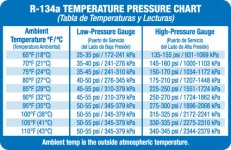
That said, the machines are very expensive and I have topped off slowly using the attached pressure chart and trying to be very careful that I don't overfill which can cause the system to not cool properly and possibly damage the compressor.

Buckaroo
 

Attachments

So, I just bought an AC Manifold Gauge set and I decided to try it out today. I used my 99 Subaru Outback as the test vehicle. I hooked up the low and high pressure lines, started the AC, and got my readings. Based off the ambient temps, my pressure readings looked a little low.

I disconnected the lines and realized there's still a pressure reading on both gauges. I don't think too much of it and figure I can just purge out what's left. I start with the low side and it hisses out a little refrigerant, just like I thought. When I get to the high side, I was shocked how much is left in the line. And, it's not only refrigerant but quiet a bit of compressor oil as well. I don't know how much compressor oil I lost doing this, but it was a decent amount.

I researched AC up, down and sideways. I read a ton, watched videos and nowhere did I read or view in a video that talked about what to do with what's left in the manifold gauge when you're either done diagnosing your system, adding refrigerant or doing a full recharge. So, I did a little more research and read on a forum where a mechanic said when he's done servicing an AC system, he disconnects the high pressure side from the vehicle but keeps the low pressure hooked up. With the AC still running, he opens the low side manifold valve and then cracks the high side valve allowing the left over refrigerant/compressor oil flow through the manifold to the low side hose and into the vehicle. I tried it and it works. There will still be a little pressure left on the high side, but not like it was without performing that procedure. When I purged the line, only a little refrigerant and oil came out.

If it was just a small amount of refrigerant/compressor oil left in the lines, I wouldn't be bringing this up but that high side line has enough left inside to make a difference with the system's performance. If you had evacuated and vacuumed down your system for whatever reason and recharged with the exact amount of refrigerant, you'd end up being low on refrigerant and you'd lose compressor oil on top of it if you didn't do a procedure like I mentioned above to get most of what's left in the high side back into the vehicle.

How do some of you guys with AC service experience deal with the left over pressure in the manifold and lines when you're done?

Another question I have is in regards to topping off a system. Say you're a little low on refrigerant, possibly a tiny leak somewhere. Can you accurately top off the system using an ambient temp pressure chart with the corresponding low and high side values? I've looked at different charts and you get different values for the same temps. Some take into consideration for humidity while others don't.

I thought servicing an AC system was going to be fairly straight forward but there's definitely a learning curve here and I want to do it right and not half-ass it.

Most mechanics have a recovery machine. When your done using the machine you use it to recover what's in the hoses. Since most shade tree mechanics don't have a recovery machine there are ways around it.
First of all, what you lost wasn't as much as you think. that procedure you described would only help if it was liquid in the lines, and since your concerned about the high side , that's only vapor, which is not even a fraction of what it would be weight wise if it were in liquid form. A set of gauges and hoses can hold up to 6 oz of liquid refrigerant, especially the kind of manifold sets with the block style manifold with a sight glass. Most of the time, the last thing you do is charge the system. The hose will be filled with the liquid as that is the only way to fill a system WITHOUT IT RUNNING AND IN A VACUUM. The best way is to draw a deep vacuum, and feed the liquid refrigerant through the high side. This is beneficial for 2 reasons as the liquid freon has to go through the expansion valve / orifice before it goes to the low side of the system and wont slug the suction side of the compressor. Also, you can watch the low side gauge SLOWLY build pressure which would give you a good indication of the condition of the expansion valve/orifice.

Using pressures to charge is ok. not the best way but if your system is in good condition it will work
 
Last edited:
Most mechanics have a recovery machine. When your done using the machine you use it to recover what's in the hoses. Since most shade tree mechanics don't have a recovery machine there are ways around it.
First of all, what you lost wasn't as much as you think. that procedure you described would only help if it was liquid in the lines, and since your concerned about the high side , that's only vapor, which is not even a fraction of what it would be weight wise if it were in liquid form. A set of gauges and hoses can hold up to 6 oz of liquid refrigerant, especially the kind of manifold sets with the block style manifold with a sight glass. Most of the time, the last thing you do is charge the system. The hose will be filled with the liquid as that is the only way to fill a system WITHOUT IT RUNNING AND IN A VACUUM. The best way is to draw a deep vacuum, and feed the liquid refrigerant through the high side. This is beneficial for 2 reasons as the liquid freon has to go through the expansion valve / orifice before it goes to the low side of the system and wont slug the suction side of the compressor. Also, you can watch the low side gauge SLOWLY build pressure which would give you a good indication of the condition of the expansion valve/orifice.

Using pressures to charge is ok. not the best way but if your system is in good condition it will work

It wasn't so much the refrigerant gas that was still stored in the high side line but the compressor oil. I don't know how much was in there but it was a decent amount. I was expecting to just hear some gas escaping and not see a bunch of compressor oil come out. The low side line definitely just holds a very insignificant amount of refrigerant after you disconnect the lines.

Maybe the amount of compressor oil lost isn't a huge deal. Since I connected and disconnected a few times screwing around with it, I probably lost more than just a little so I added some compressor oil via the low side with an oil/dye injector. Just guessed I lost around an ounce.

It's interesting you mention filling via the high side in liquid form. I've read that procedure in the FSM and on one website. All the videos I've seen and discussions on this forum talk about only filling via the low side in gas form.

After all the research I've done on this subject, I've come to the conclusion that a Do-it-Yourselfer can accurately recharge a system that has been evacuated and vacuumed down by adding the correct amount of refrigerant by the weight specified on the label under the hood or in the FSM. Topping off a system that has lost a little refrigerant over time is sort of guesswork. Having the FSM is a huge help, but even with this reference, there's really no exact science to it because of the variables. The ambient temperature and humidity of the day you're doing the service will affect the pressure readings you'll see. I think the best I can do is wait for a day that has the test temps shown in the FSM (86-95 degrees F). The FSM says a normally functioning AC system will have a low side pressure of 21.7 - 36.2 psi and a high side pressure of 198.7 - 227.7. I had to convert the numbers to psi because the numbers in the FSM are given in Megapascals and Kilogram Force/Square Centimeter. I've looked at various temp/humidity charts for R134A systems and they are all over the place. Like I said, I think the best I can do is wait for a hot day in the upper 80's - low 90's and follow the FSM to diagnose the system and possibly add refrigerant if there is an indication it's low.

Why do I think my AC is a little undercharged? I'm basing it off what others on the forum and on videos I've watched have reported their center vent temperature gets down to and the fact that I see bubbles in the site glass when the compressor is engaged. I've read on this forum and on other websites that using the site glass on the top of receiver/dryer for a R134A system as a diagnostic tool isn't the most accurate way to determine if you're undercharged or overcharged. Regardless, the FSM mentions it as a tool to use and when the right conditions present themselves, I'm going to use the site glass along with the manifold gauge pressures to get as close as possible to having the correct amount of refrigerant in the system.
 
It wasn't so much the refrigerant gas that was still stored in the high side line but the compressor oil. I don't know how much was in there but it was a decent amount. I was expecting to just hear some gas escaping and not see a bunch of compressor oil come out. The low side line definitely just holds a very insignificant amount of refrigerant after you disconnect the lines.

Maybe the amount of compressor oil lost isn't a huge deal. Since I connected and disconnected a few times screwing around with it, I probably lost more than just a little so I added some compressor oil via the low side with an oil/dye injector. Just guessed I lost around an ounce.

It's interesting you mention filling via the high side in liquid form. I've read that procedure in the FSM and on one website. All the videos I've seen and discussions on this forum talk about only filling via the low side in gas form.

After all the research I've done on this subject, I've come to the conclusion that a Do-it-Yourselfer can accurately recharge a system that has been evacuated and vacuumed down by adding the correct amount of refrigerant by the weight specified on the label under the hood or in the FSM. Topping off a system that has lost a little refrigerant over time is sort of guesswork. Having the FSM is a huge help, but even with this reference, there's really no exact science to it because of the variables. The ambient temperature and humidity of the day you're doing the service will affect the pressure readings you'll see. I think the best I can do is wait for a day that has the test temps shown in the FSM (86-95 degrees F). The FSM says a normally functioning AC system will have a low side pressure of 21.7 - 36.2 psi and a high side pressure of 198.7 - 227.7. I had to convert the numbers to psi because the numbers in the FSM are given in Megapascals and Kilogram Force/Square Centimeter. I've looked at various temp/humidity charts for R134A systems and they are all over the place. Like I said, I think the best I can do is wait for a hot day in the upper 80's - low 90's and follow the FSM to diagnose the system and possibly add refrigerant if there is an indication it's low.

Why do I think my AC is a little undercharged? I'm basing it off what others on the forum and on videos I've watched have reported their center vent temperature gets down to and the fact that I see bubbles in the site glass when the compressor is engaged. I've read on this forum and on other websites that using the site glass on the top of receiver/dryer for a R134A system as a diagnostic tool isn't the most accurate way to determine if you're undercharged or overcharged. Regardless, the FSM mentions it as a tool to use and when the right conditions present themselves, I'm going to use the site glass along with the manifold gauge pressures to get as close as possible to having the correct amount of refrigerant in the system.


The system holds about 4oz or so. I doubt you got a whole oz in the high side line, which would be a tablespoon of oil. How did you get an oz of oil back in the system? With a pressurized can of oil? One of those oil injectors?

People who are ADDING refrigerant or topping off are using the low side with vapor. What I described was filling an empty system in a vacuum. The FSM uses the same method. It's the only true way to get the RIGHT amount of refrigerant in the system.

Using pressures will work as long as the system is sound. Look up a 134A temp/ pressure chart and it will show that the low side pressure is pretty consistent, in summer temps, all the way up to 110 degrees ambient which is a by product of a sound AC system. The high side pressures are where you see the difference. So if you added refrigerant to a well functioning 134A system until your low side pressure was between 50-55 with the compressor engaged and the hi side near the corresponding pressure to the ambient temp, you probably be fine.

By the way, you said their is no exact science. Actually that's exactly what's going on in there, which is why it works. Research how the system works. It's really super simple. Once you know how it works, you'll know what to expect when diagnosing it.
 
Last edited:
By the way, you said their is no exact science. Actually that's exactly what's going on in there, which is why it works. Research how the system works. It's really super simple. Once you know how it works, you'll know what to expect when diagnosing it.

I think you might have misunderstood my comment about the exact science. After reading a ton on AC systems, I fully understand how it works and the science behind it. My comment was referring to the guesswork when topping off a partially filled system based off the low and high side pressures. Depending on which R134A Temperature/Humidity/Pressure chart you choose to use ( they vary a lot from what I've seen) and the temperature and humidity at the time you're filling there really doesn't seem to be a very exact way to accurately top it off. So maybe my use of "science" was the wrong choice of words.

It seems to me the only way you can be certain your AC system has the right amount of refrigerant in it is to have it evacuated at a shop, vacuum it down and fill it with the prescribed weight. But, that doesn't mean I'm not going to try to top off my 4runner one of these days. I'm definitely going to give a try and see how it goes.
 
I think you might have misunderstood my comment about the exact science. After reading a ton on AC systems, I fully understand how it works and the science behind it. My comment was referring to the guesswork when topping off a partially filled system based off the low and high side pressures. Depending on which R134A Temperature/Humidity/Pressure chart you choose to use ( they vary a lot from what I've seen) and the temperature and humidity at the time you're filling there really doesn't seem to be a very exact way to accurately top it off. So maybe my use of "science" was the wrong choice of words.

It seems to me the only way you can be certain your AC system has the right amount of refrigerant in it is to have it evacuated at a shop, vacuum it down and fill it with the prescribed weight. But, that doesn't mean I'm not going to try to top off my 4runner one of these days. I'm definitely going to give a try and see how it goes.

I can tell you know what your doing Tim. Please don't think I was picking on your wording. You provide some great info on here and are an asset to the forum.
Those pressure/temp charts should be fairly standard. Maybe you could provide some links to these charts you're looking at. Many of the machines I worked on had the chart right on the keypad. You are right though, the only way to do it right is to recover, vacuum and recharge.
You should definitely hook those new gauges up. That's what you bought them for right? Are you having problems with your AC system? I missed where you said your issue was.
 
I can tell you know what your doing Tim. Please don't think I was picking on your wording. You provide some great info on here and are an asset to the forum.
Those pressure/temp charts should be fairly standard. Maybe you could provide some links to these charts you're looking at. Many of the machines I worked on had the chart right on the keypad. You are right though, the only way to do it right is to recover, vacuum and recharge.
You should definitely hook those new gauges up. That's what you bought them for right? Are you having problems with your AC system? I missed where you said your issue was.

I'm just a DIY guy and no expert. I was surprised what he said about the charts. I use the exact same chart you posted, as it is the only one I found that does BOTH temp and humidity in narrow intervals. It was my understanding that those pressures are sort of universal constants due to the physics of the refrigerant, and not subject to variation. I'm glad you posted it, as my link to it has died, and I only have my aging hard copy in my gauge case.

I have been successful using that chart to top up my 4Runner every two years or so. I have a very slow leak and I just can't find it. (I have tried both dye and a leak detector.) It takes about a half to a full can every two years and it works great. I'm not going to spend the bucks to do the exact charge as long as my halfass approach works for $6-$12 every two years.
 
Last edited:
If I were in your shoes, I would just do some experimenting. See what readings you get on the gauges on different days. Remember, at the absolute worst you can buy a vacuum pump after capturing the old r134 and start with a clean slate.
 
I can tell you know what your doing Tim. Please don't think I was picking on your wording. You provide some great info on here and are an asset to the forum.
Those pressure/temp charts should be fairly standard. Maybe you could provide some links to these charts you're looking at. Many of the machines I worked on had the chart right on the keypad. You are right though, the only way to do it right is to recover, vacuum and recharge.
You should definitely hook those new gauges up. That's what you bought them for right? Are you having problems with your AC system? I missed where you said your issue was.

Getting back to a previous question you asked about how I added compressor oil, I added it with an injector I bought. I bled the high side line into a rag and it soaked it pretty damn good. It was quite a bit, so that's why I decided to add compressor oil. I wish I would have bled it into some type of container so I could have measured it.

I was just trying to see if my Subaru was indeed low on refrigerant because it hasn't been cooling as effective. My 3rd Gen seems pretty good but I think it could be better. It's probably just slightly low.

Here's one example of a chart:

Temp-pressure-chart-33776F1.jpg

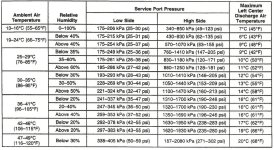
Here's one [MENTION=10169]TheDurk[/MENTION] hooked me up with on one of the links he gave me to learn about AC systems.

ac-performance-chart.jpg

If you compare the charts above to the numbers stated in our FSM for a normally functioning refrigeration system at 86-95 degrees F, there's a huge discrepancy. The FSM says you should have a low side pressure of 21.7-36.2 and a high side of 198.7-227.7. If I went by the first chart I gave a link to, I'd be charging until I see 45-55 on the low side and 250-270 on the high side. If I went by the second chart, I'd be charging 30-45 on the low side and 150-210 on the high side.

Now let's compare the chart that [MENTION=71326]Buckaroo[/MENTION] supplied a link to up above to the one [MENTION=10169]TheDurk[/MENTION] gave me since they both take into account relative humidity. We'll say it's 90 degrees out with a 30% relative humidity. [MENTION=71326]Buckaroo[/MENTION] chart says the low side should be 42 (no range given) and the high side should be 166 (again, no range). [MENTION=10169]TheDurk[/MENTION] chart says the low side should be between 30-44 and the high side 153-209.

See what I'm getting at here? Big discrepancies. Which one do I follow? The FSM gives numbers but there's only a temperature reference and not any mention to the affects that relative humidity can have on the numbers.
 

Attachments

  • ac-performance-chart.jpg
    ac-performance-chart.jpg
    139.4 KB · Views: 23,770
  • Temp-pressure-chart-33776F1.jpg
    Temp-pressure-chart-33776F1.jpg
    66.1 KB · Views: 4,281
Last edited:
I'm just a DIY guy and no expert. I was surprised what he said about the charts. I use the exact same chart you posted, as it is the only one I found that does BOTH temp and humidity in narrow intervals. It was my understanding that those pressures are sort of universal constants due to the physics of the refrigerant, and not subject to variation. I'm glad you posted it, as my link to it has died, and I only have my aging hard copy in my gauge case.

I have been successful using that chart to top up my 4Runner every two years or so. I have a very slow leak and I just can't find it. (I have tried both dye and a leak detector.) It takes about a half to a full can every two years and it works great. I'm not going to spend the bucks to do the exact charge as long as my halfass approach works for $6-$12 every two years.

On the times you've used your manifold gauges to top off your 4runner, what did you do with with what was left over in the lines, primarily the high side? Maybe it's just my Subaru, but that high side line definitely has a significant amount of compressor oil in it after I disconnect. Like I said before, I thought I'd just be bleeding off a little pressure in the lines after disconnecting them from the vehicle. I wasn't expecting a flood of compressor oil (enough to soak a regular shop rag pretty good), to come with the residual pressure.
 
On the times you've used your manifold gauges to top off your 4runner, what did you do with with what was left over in the lines, primarily the high side? Maybe it's just my Subaru, but that high side line definitely has a significant amount of compressor oil in it after I disconnect. Like I said before, I thought I'd just be bleeding off a little pressure in the lines after disconnecting them from the vehicle. I wasn't expecting a flood of compressor oil (enough to soak a regular shop rag pretty good), to come with the residual pressure.

I don't remember a lot of oil. Last time I messed with it was last summer as the truck has been down of late. Were you charging with pure R-134a? Or one of those fancy oil/dye/sealant cocktails? I just use the pure stuff.
 
Last edited:
I don't remember a lot of oil. Last time I messed with it was last summer as the truck has been down of late. Were you charging with pure R-134a? Or one of those fancy oil/dye/sealant cocktails? I just use the pure stuff.

The first time I hooked up the gauges to my Subaru, I just wanted to know what the pressures were. After disconnecting the lines, I realized that there was stored pressure in the lines and manifold. The oil and refrigerant that came out was from what was already in the system, not anything I added. So, I figured by hooking up the gauges, I just reduced my refrigerant by a little and my compressor oil by a decent amount. Like I said, I wish I measured it, but it was enough to soak a small red shop rag pretty good.

The next time I hooked the gauges, I added pure R134A to the system. Again, the high side line had a ton of compressor oil in it. I don't know how much I lost because I kept screwing with it and lost some compressor oil each time.

I'm sort of wondering if I'm doing something wrong. I did read on a forum where another guy like me doing AC work for the first time was shocked how much was left in the high side line and was wondering about it too. An experienced AC tech responded to the guy's question and that's where I learned the technique of disconnecting the high side from the vehicle, keeping the low side connected, opening up the low side manifold valve and then cracking the high side manifold valve so the left over refrigerant and compressor oil can be sucked out of the high side line, into the manifold, out the low side line and back into the system. I tried it and it works. I'm just wondering why nobody else has mentioned this in any video or write-up or whatever. It will definitely be the way I finish any charging or inspection of an AC system because the amount of compressor oil loss is not insignificant.

I just find it weird that none of the videos or instructional write-ups on this subject addresses the topic of what to do with the stored pressure in the lines when you're done. If I make a video on it, I'll definitely be addressing this.
 

Members online

Forum statistics

Threads
278,309
Messages
3,554,071
Members
248,016
Latest member
Advally Service

Trending content

Back
Top