mtbtim
Elite Member
So, I just bought an AC Manifold Gauge set and I decided to try it out today. I used my 99 Subaru Outback as the test vehicle. I hooked up the low and high pressure lines, started the AC, and got my readings. Based off the ambient temps, my pressure readings looked a little low.
I disconnected the lines and realized there's still a pressure reading on both gauges. I don't think too much of it and figure I can just purge out what's left. I start with the low side and it hisses out a little refrigerant, just like I thought. When I get to the high side, I was shocked how much is left in the line. And, it's not only refrigerant but quiet a bit of compressor oil as well. I don't know how much compressor oil I lost doing this, but it was a decent amount.
I researched AC up, down and sideways. I read a ton, watched videos and nowhere did I read or view in a video that talked about what to do with what's left in the manifold gauge when you're either done diagnosing your system, adding refrigerant or doing a full recharge. So, I did a little more research and read on a forum where a mechanic said when he's done servicing an AC system, he disconnects the high pressure side from the vehicle but keeps the low pressure hooked up. With the AC still running, he opens the low side manifold valve and then cracks the high side valve allowing the left over refrigerant/compressor oil flow through the manifold to the low side hose and into the vehicle. I tried it and it works. There will still be a little pressure left on the high side, but not like it was without performing that procedure. When I purged the line, only a little refrigerant and oil came out.
If it was just a small amount of refrigerant/compressor oil left in the lines, I wouldn't be bringing this up but that high side line has enough left inside to make a difference with the system's performance. If you had evacuated and vacuumed down your system for whatever reason and recharged with the exact amount of refrigerant, you'd end up being low on refrigerant and you'd lose compressor oil on top of it if you didn't do a procedure like I mentioned above to get most of what's left in the high side back into the vehicle.
How do some of you guys with AC service experience deal with the left over pressure in the manifold and lines when you're done?
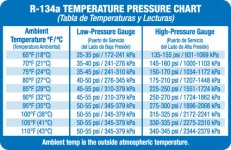
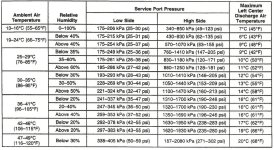
Another question I have is in regards to topping off a system. Say you're a little low on refrigerant, possibly a tiny leak somewhere. Can you accurately top off the system using an ambient temp pressure chart with the corresponding low and high side values? I've looked at different charts and you get different values for the same temps. Some take into consideration for humidity while others don't.
I thought servicing an AC system was going to be fairly straight forward but there's definitely a learning curve here and I want to do it right and not half-ass it.
I disconnected the lines and realized there's still a pressure reading on both gauges. I don't think too much of it and figure I can just purge out what's left. I start with the low side and it hisses out a little refrigerant, just like I thought. When I get to the high side, I was shocked how much is left in the line. And, it's not only refrigerant but quiet a bit of compressor oil as well. I don't know how much compressor oil I lost doing this, but it was a decent amount.
I researched AC up, down and sideways. I read a ton, watched videos and nowhere did I read or view in a video that talked about what to do with what's left in the manifold gauge when you're either done diagnosing your system, adding refrigerant or doing a full recharge. So, I did a little more research and read on a forum where a mechanic said when he's done servicing an AC system, he disconnects the high pressure side from the vehicle but keeps the low pressure hooked up. With the AC still running, he opens the low side manifold valve and then cracks the high side valve allowing the left over refrigerant/compressor oil flow through the manifold to the low side hose and into the vehicle. I tried it and it works. There will still be a little pressure left on the high side, but not like it was without performing that procedure. When I purged the line, only a little refrigerant and oil came out.
If it was just a small amount of refrigerant/compressor oil left in the lines, I wouldn't be bringing this up but that high side line has enough left inside to make a difference with the system's performance. If you had evacuated and vacuumed down your system for whatever reason and recharged with the exact amount of refrigerant, you'd end up being low on refrigerant and you'd lose compressor oil on top of it if you didn't do a procedure like I mentioned above to get most of what's left in the high side back into the vehicle.
How do some of you guys with AC service experience deal with the left over pressure in the manifold and lines when you're done?
Another question I have is in regards to topping off a system. Say you're a little low on refrigerant, possibly a tiny leak somewhere. Can you accurately top off the system using an ambient temp pressure chart with the corresponding low and high side values? I've looked at different charts and you get different values for the same temps. Some take into consideration for humidity while others don't.
I thought servicing an AC system was going to be fairly straight forward but there's definitely a learning curve here and I want to do it right and not half-ass it.