
palerider01
Junior Member
Fancy artwork. Who published those? Dates and times? Where'd the data come from?
Sent from my iPhone using Tapatalk
Sent from my iPhone using Tapatalk


"More Guns = More Gun Homicides, Statistically Speaking
In 2008, we explored the issue of whether more gun ownership meant more or less gun violence. What we found, and it still holds true, was that some studies had shown a statistical relationship between those factors — areas with a higher prevalence of guns had higher prevalence of gun homicides and homicides in general. But studies haven’t been able to show a causal relationship — that the mere presence of guns, as opposed to other factors, caused the higher rates of gun violence. It’s doubtful, however, that a study could ever beyond-a-doubt prove a causal relationship.
As Sorenson explained, scientists can’t conduct a random experiment. So, instead, researchers are left with statistical models, which are “very fragile,” says Charles F. Wellford, who was chair of the committees that authored a lengthy 2004 report on this topic by the National Research Council of the National Academies. These models are subject to what control variables researchers use. “Everyone knows there’s other things than guns that cause crime,” says Wellford, a professor in the Department of Criminology and Criminal Justice at the University of Maryland. So these models become very complex and slight changes can cause very different results, he says.
The National Research Council review of the available research on guns and crime found that studies comparing similar geographic areas, such as urban areas to urban areas, known as “case-control studies,” showed that “violence is positively associated with firearms ownership.” But when looking at larger areas, such as countries, the National Research Council report found “contradictory evidence.” Both types of studies, said the report, failed to address factors involved in buying a gun — it’s not a random decision. And gun ownership data itself is lacking — it comes only from public opinion surveys.
Eighteen experts participated in the NRC report, including those in criminology, sociology, psychology, economics, public health and statistics. The NRC’s conclusion: “In summary, the committee concludes that existing research studies and data include a wealth of descriptive information on homicide, suicide, and firearms, but, because of the limitations of existing data and methods, do not credibly demonstrate a causal relationship between the ownership of firearms and the causes or prevention of criminal violence or suicide.”
Wellford says the new literature that has emerged since that 2004 review “doesn’t change in any way the conclusions from our report.”
Why can’t a statistical relationship prove a causal one? There are many other factors besides the presence of guns. Adam Lanza, the shooter in the elementary school killings in Newtown, “had lots of things going on in his life and one of them was access to multiple weapons,” says Wellford, himself a gun owner. “It’s hard to parse out what the effect is of having the gun, but there’s no question there’s some effect.” But is it 2 percent, 10 percent, 100 percent of the causal model? “We don’t know.”
Hemenway, director of the Harvard Injury Control Research Center, says he would “bet a lot of money” that the prevalence of guns increases homicide, all other things being equal. “I think the evidence is very consistent with the notion that more guns have made us less safe.” But it’s “almost impossible” to prove a causal relationship. “All the data are consistent with a causal relationship, but it’s very hard to say anything is causal,” he says.
Hemenway and coauthor Lisa M. Hepburn reviewed research from peer-reviewed journals and found that the evidence from studies of U.S. cities, states and regions “is quite consistent … where there are higher levels of gun prevalence, homicide rates are substantially higher, primarily due to higher firearm homicide rates.” But, again, the 2004 report said: “None of the studies can prove causation. They merely examine the statistical association between gun availability and homicide.”
There’s also a chicken-and-egg question when it comes to gun violence. Did the violence come first, and then the guns followed, or the other way around?
“I don’t think any of us believe the arrow points in one direction,” says Garen Wintemute, director of the Violence Prevention Research Program at the University of California-Davis and an emergency room doctor. It’s “probably true that rising crime leads to a perception of increased threat and, therefore, an increase in the prevalence of gun ownership.” And it’s “also the case that making firearms more available is followed by an increase in firearm crime.”
An International Comparison
The United States has the highest rate of gun ownership in the world — by far. And it has the highest rate of homicides with guns among advanced countries. But, again, those are statistics and not demonstrative of a causal relationship.
The National Research Council of the National Academies concluded in its report that studies comparing large geographic areas, what it called “ecological studies,” didn’t show a distinct trend, and instead “provide[d] contradictory evidence on violence and firearms.”
One problem in comparing various countries is the wealth of other factors, besides the mere presence of guns, that can affect whether a homicide occurs, such as the economy, general crime rates, and laws governing guns. Another issue is that the data isn’t all that great. Gun ownership numbers are largely based on public opinion surveys, and the reliability of numbers can vary widely from country to country. “We don’t have good data on the prevalence of ownership on all the countries we’d want to have it on,” says Wintemute.
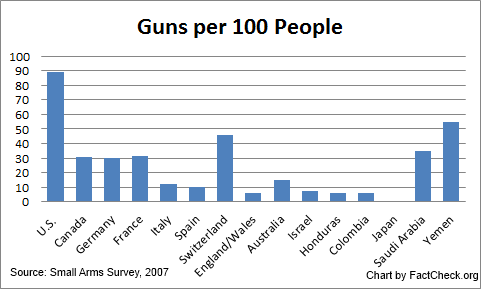
The numbers in the chart above are from the Small Arms Survey. The project gives high and low estimates, along with an average. We used the average numbers. They show the U.S. with 88.8 guns for every 100 people. That’s No. 1 in the gun ownership rate in the world. Switzerland, with 45.7 guns per 100 people, is No. 3 in the world, with nearly half the rate of the U.S. Switzerland also requires military service. (Yemen is No. 2, with 54.8 guns per 100 people.)
Janet Rosenbaum, an assistant professor of epidemiology at the School of Public Health at the State University of New York Downstate Medical Center School, told the Washington Post that “Switzerland has also been moving away from having widespread guns,” and moving away from having those in the army keep guns at home.
The Small Arms Survey acknowledges that its numbers are approximations and making these estimates is far from an exact science. In addition to surveys, it relies on gun registration, experts, other indicators such as firearm suicides, and comparisons to similar countries. It says: “All gun numbers—even those that seem most accurate—approximate reality or reveal only part of it. They should be used with caution.”
The firearms homicide rate, and homicide rate overall, is also higher in the U.S. than other advanced countries, such as Canada, Australia and those in Europe, according to data from the United Nations Office on Drugs and Crime. The U.S. gun homicide rate was 3.2 per every 100,000 people in 2010, according to UNODC figures. The UNODC measures “intentional homicide,” which is “an unlawful death purposefully inflicted on a person by another person.”
The international data show that country-to-country comparisons are inherently difficult to make — and, as the NRC said, provide “contradictory evidence.” For instance, Latin American countries with high levels of firearm homicide show low levels of gun ownership. Honduras has a gun ownership rate of 6.2 per 100 people and a gun homicide rate of 68.43 per 100,000 people, and Colombia has a gun rate of 5.9 and firearm homicide rate of 27.09, as shown in this chart produced by the Washington Post using the same data we have cited here.
But among advanced countries, the U.S. homicide rate stands out. “We seem to be an average country in terms of violence and aggression,” says Harvard’s Hemenway. “What we have is huge homicide rates compared to anybody else.”
Says Wintemute: “The difference is that in this country violence involves firearms and firearms change the outcome.”


Gun Rhetoric vs. Gun Facts
Gun Laws Matter 2012: Understanding the Link Between Weak Laws and Gun Violence | Law Center to Prevent Gun Violence

So look at the data without it being sifted to get the end result wanted. Look at all factors. Not just one.
This measurement problem has proved to be quite complex, with some estimates suggesting just over 100,000 defensive gun uses per year and others suggesting 2.5 million or more defensive gun uses per year.
A primary cause of this uncertainty is the disagreement over the definition of defensive gun use—in particular, whether it should be defined as a response to victimization or as a means to prevent victimization from occurring in the first place. There is also uncertainty regarding the accuracy of survey responses to sensitive questions and the related problems of how to effectively measure defensive gun use, the types of questions that should be asked, and the methods of data collection. These disagreements over definition and measurement have resulted in prevalence rates that differ by a factor of 22 or more. While even the smallest of the estimates indicates that there are hundreds of defensive uses every day, there is much contention over the magnitude and the details.
...
A number of researchers have attempted to infer the defensive utility of firearms by examining the firearms deaths that occur in or near the victim’s
home. Both Kellermann and Reay (1986) and Rushforth et al. (1974) compare fatalities caused by self-defense and other motivations. Both studies find that people using guns in self-defense account for a small fraction of fatalities in the home. Kellermann and Reay find that there were nearly 5 times as many homicides and 37 times as many suicides as perpetrators killed in self-defense.
https://www.nap.edu/read/10881/chapter/1#v
Thats exactly what the dataset I posted did.
I certainly trust it to be less biased than a site dedicated to promoting gun rights, or a guy who's screen name is based around guns.
If you read the conclusions they say what I've been saying for awhile. There is an intentional lack of data on this issue, making it hard to prove causation conclusively either way. But as they say there is certainly a statistical correlation between more guns and more gun homicides.
Trying to accurately assess defensive gun uses is an even harder thing to try to quantify.

I get it, you're anti-gun so you're going to trust an anti-gun website more than a pro gun person or web site, Earth is also an oblate spheroid- not a big surprise.
etc, etc.

why bother engaging with the op? clearly, you won't sway his opinion in any way, nor will you get any satisfaction in having enlightened him about your opinions and positions on various topics. all you'll get is the condescending smugness of a know-it-all who discounts any differing opinion and will not see the world through anything but polarized lenses.

Rules of the 18th century? Explain
Sent from my iPhone using Tapatalk
It just makes me laugh at how strongly people hold onto things from over 200 years ago. That people can argue the unchanging ideas and principles behind something who's very definition opposes that. Or who are so sure what people meant when writing those words as if they were standing in the room with them.
There isn't one Amendment that doesn't have it's restrictions or regulations as time has advanced. Walk into a Police Station and yell "Bomb!" See where that gets you.
And yes, I write this knowing I'll get butchered and labeled a libtard or whatever other word(s) people want to use. Or that I'm saying I want to restrict all guns or take them all away, even though I've never said anything to the sorts.
I'm just someone who prefers to find ways to try and walk ashore as the tide comes in as opposed to standing with my feet in the sand.
OK, so if you apply the laws of Chicago everywhere and that would potentially criminalize formally law abiding citizens, then could you cite examples of legal gun owners being criminalized in Chicago?

So, essentially people want the rules of the 18th century, but with the technology and societal advancements of the 21st century. That makes perfect sense to me.
There are many amendments that haven't been modified. I will not call you names but merely start out in the first 15 amendments
3rd, 4th, 5th, 6th, 7th, 8th, 9th, 10th, 14th, & 15th amendments remain fully in place to my knowledge. They may not be followed but if you peaceful and have your day in court you usually prevail if one of your rights has been violated.
But to throw the argument out there that technology and silence today don't apply to the 200+ year old amendments is a dangerous slope. By that means the government (state, city, county, federal) can force you to turn over any documents you have written that would no longer be protected under the freedom of speech. That includes your computer, cell phone, pencils, pens, typewriter, did you use modern paper?, the list is almost endless. So unless you said it with your voice used a wooden typeset printing press, or ink and quill you have no freedom of speech. Now let's transfer that over to the media as well. See where this argument goes? Firearms are about the least untouched item out there and Hell I can have cannons sitting in my front yard with explosive cannon balls. Think modern day mortars without the accuracy. Is that really safer than modern firearms? That also gives them the ability to go and modify the slavery, voting, and birth citizenship amendments.
So let's apply Chicago gun laws to Missouri. Missouri currently does not require a permit to conceal carry a firearm. So since Chicago does and if this Chicago law was enforced in Missouri every citizen that used the Missouri law of not needing a permit would now be in direct violation of the Chicago law. There are no examples to cite as Chicago laws apply to Chicago and Missouri laws apply to Missouri.
Did I give clear enough example of how forcing another states laws on a state could and would create contradictions in laws and therefore force citizens of the state that just had new laws forced upon then to conform of become felons? After all we were set up as 50 separate states bound together for commerce and national security. Free to make our own laws regarding governing of our states as long as they were in compliance with the Constitution of the United States of America.
But to throw the argument out there that technology and silence today don't apply to the 200+ year old amendments is a dangerous slope.
You're right...the US constitution should be redefined every week.
Treat it like a letterman top ten list. The top ten with the most "likes" stay and the rest are thrown out.
That would be amazing!
Again, you're reading what you want into what I'm saying. I'm not saying that they don't apply today. What I'm saying is that there is a very good reason we were founded on the idea of a Living Constitution with the ability to amend it as times change.
There are only 2 ways to an end the constitution. Can you please explain what way the current gun control laws being proposed by the democratic presidential candidate Hilary would use by making people go through a psyc eval. Even after she stated she would use executive action if needed. Same as Obama did to change the gun trust laws. Here is a link to the only 2 legal ways the constitution may be amended
https://www.archives.gov/federal-register/constitution/


