Best speculation of a 2023 6th generation I have seen

I guess I'm not impressed. It's nearly exactly what j expected minus the front locker. No new surprise engines or features other than the TRD pro seats that are unusual and the sway disconnect. Top spec engine is only 278 hp steady state. Just matching base ranger engine with low output tune. No front locker. Small windows and high hood. And only the 8AT? why no 10 speed? Will likely not tow or haul well.

No PHEV or EV version.

Interior is okay. Very busy.

High points are bigger tires and looks like better clearance. Maybe fit 35s? I think the non TRD model looks really good. TRD pro and especially trail hunter look very overland expo at the mall to me. But the suspension is great IMO.

Odd that they kept leaf springs in some trims.

Pricing and mpg will be interesting. My bet is $35-80k and 20mpg.
The 4WD non-hybrid Tundra, with much more weight and much more power, does 17/22/19mpg. I think you can expect the new 4WD Tacoma to do at least 2-3mpg better all around than that. I think they'll finally crack 20mpg city without the hybrid, and definitely with the hybrid.

The 8-speed was a surprise to me. I like it, because 10-speeds seem a little much, a little complicated, for rugged offroad trucks. I remain very surprised they kept a 6MT around. That makes them and the Gladiator the only manual trucks left, and it's hard to actually count the Gladiator for me.

The engine was never going to be some all-new unique thing--they have to share components across lineups or they're going to die. I don't care for PHEV anything, but I wouldn't be suprised if an EV Tacoma releases by model year 2026.

As far as front locker, Toyota has always been remarkably committed about refusing to put a locker in IFS.

When you say "steady state", is the hybrid powertrain incapable of constantly providing maximum power output? The 465 lb ft of torque at 1700rpm is the king of midsize trucks now.
 
If this is the same engine that's going in the next 4Runner, I'll probably still wait a couple of years to buy one, just to wait out all the teething issues.
Benefit of the 4Runner coming later. Gives time for this new powertrain to get tested by hundreds of thousands of consumers before it even enters the new 4Runner.

I would be entirely confident to buy the new 4Runner with this engine if all has shown well by the new 4Runner's second or third model year. Assuming new 4Runner makes MY2025.
 
The interior looks cheap. US full size trucks have much nicer interiors. I dont get why the manufacturers dont give nicer interiors to the mid size.

I wonder how much nicer this will ride around town and in the mtns (i-70) than the current 4Runner
 
As far as front locker, Toyota has always been remarkably committed about refusing to put a locker in IFS.

I know you meant in the US but Toyota did re-introduce the front locker to the IFS Land Cruiser with the J300. Unfortunate we dont get it here.

In other news, Car and Driver just released an article comparing the specs of the Tacoma vs the midsize competition (2024 Toyota Tacoma vs. Ford Ranger vs. Chevy Colorado: How They Compare)

Some key things that stood out to me is both Chevy has no option to get coil springs and Ford requires you to pay Raptor money for them. At first it looked odd that Toyota was keeping leafs on the SR5 and below but now its a huge selling point as you can get a TRD Sport or Off-Road with coils for FAR less money than the competition.

Toyota, along with Nissan, are now the only two makes to offer a 6ft bed or an access cab (albeit with no seats).

Toyota is now the sole manufacturer offering a manual transmission.

When you say "steady state", is the hybrid powertrain incapable of constantly providing maximum power output? The 465 lb ft of torque at 1700rpm is the king of midsize trucks now.

Agreed. You need to pay ZR2 or Raptor (~$50-60k) money to get anywhere close to the Hybrid Max's torque of 465 ft lbs. Just for fun, I even checked Chevy's full size offerings and the 5.3 V8 only has 383 ft lbs and even their top of the line 6.2 V8 and 3.0 Duramax only produce 460 ft lbs.

They will not be cheap (I mean what is these days), but the TRD Off-Road with Hybrid Max is going to be some serious truck.
 
Last edited:
Toyota's press release for the 2024 Tacoma: 2024 Toyota Tacoma

It looks like they knocked it out of the park. I would expect these powertrains (or at least one of them) to end up in the next-gen 4Runner.

I particularly find the following cool about the new Tacoma:
2.4L turbo, with OPTIONAL hybridization. I appreciate giving people the choice, not forcing it.
8-speed automatic (and 6-speed manual!). I appreciate not going to a 10-speed in a rugged offroad truck.
Leaf spring OR coil-spring rear suspension. Bizarre that they're offering it both ways!!
They did not abandon 2-door variants like Ford and Chevy just did. They replaced the "access cab" (which had rear seats) with an XtraCab, which is a 2-seater, offered in two bed lengths. Probably a great workhorse vehicle!
Now at 11" ground clearance in the TRD PRO--capable!

If the next gen 4Runner has a 2.4L turbo-four with an 8-speed automatic, preferably also making the hybridization optional, I could live with that one day. Expect the new Tacoma MPG ratings to absolutely dwarf the current 4Runner MPG ratings--the new larger Tundra/Sequoia already do.

Agree that there is a lot to like here and it makes me even more curious about what directions the next 3 trucks coming out go in (GX, LC and 4Runner).

On the coil spring versus leaf, there is a really good write up on Motortrend about the general issues with towing feel that have been experience with coil springs on the Tundra (and also the Jeep Gladiator) versus leaf springs. Their theory was that they kept the leafs on the vehicles most likely to be used to towing and hauling (where the leafs may actually be advantageous).

The 2024 Toyota Tacoma's New Coil Spring Rear Suspension Explained
 
The 2.4 turbo in the Highlander gets 1 mpg better than the 3.5 V6 Highlander. So I would say the Tacoma will see a 1 mpg improvement with this engine.
The Tundra hybrid gets 1 mpg better than the 3.44 tt so if you assume Toyota adds another 1 mpg improvement with the hybrid 2.4 t you get 2 mpg better overall than the 2023 Tacoma.

So 2024 Tacoma Hybrid 21 city/26 highway mpg
2025 4Runner Hybrid 18 and 21 mpg
 
The Bilstein suspension on the TRD Offroad trim will be the same that is offered on certain Bronco trims. Different look, same thing.

And that's a great choice, highly effective, yet lowish cost solution that I am sure can go fast enough especially with the better front travel compared to a 4R.

So whether this is of any interest to me will come down to pricing.

It is a tall order for me to decide to either give the 4R to my son or to trade it in on some sort of new Tacoma+used Rav 4 package deal, but if the price is acceptable, getting a Tacoma in a couple years would be worth a serious consideration.

I am not too afraid of a turbo 4 offroad because any really slow, rocky stuff I do is at elevation. In the desert, I prefer to go fast while the Wranglers get baked on some boulders in the AZ sun :)
 
On the topic of competition, I will say the Colorado ZR2 is going to be tough competition for Toyota. I think there's enough benefits from the SR5, TRD Off-Road, to the Limited for the Tacoma to be very competitive if not class leading against the competition but specifically the TRD Pro has never presented much value and I don't think that will change, the ZR2 is (on paper) just too good.

I do think Toyota's focus on the "overlanding" crowd is key. No other truck will allow you to spec a full size cab with a 6 foot bed (plenty of space to haul gear or a bed tent) and with the Hybrid Max, the 2400W inverter opens up a lot of possibilities for powering appliances and other electronics on the road.
 
Last edited:
"No new surprise engines"?

Does Toyota/Lexus have a turbocharged 2.4L Hybrid anywhere else in their lineup? Oh, wait, the Lexus RX500h. But is this the same engine?

As someone who shops Toyota specifically because of reliability, I like that their engines are tried and true. If this is the same engine that's going in the next 4Runner, I'll probably still wait a couple of years to buy one, just to wait out all the teething issues.

Apparently toyota hired some fluffers to pump the Taco? Sad day for Toyota.

And yes, lexus has the same engine with a more powerful hybrid. This isn't new. It's the same engine and powertrain everyone expected. You can read the last year of this thread to see that everyone knew exactly what was coming and generally understood it would be a replacement for the v6, not a competitor in the class with the Ranger or Colorado that both have significantly more powerful engine options.

Toyota needs a mid-range engine between the T24A and the V35A. The T24A isn't enough power for comfortable highway towing or hauling. Not with a hybrid. Not without a hybrid. It simply cannot produce enough power at low-mid range rpms for steady state highway loads when towing.

And that's fine for people who don't need to do truck things. I'm sure it's nice for city driving. It would be a lot better with an optional 350hp turbo v6 non-hybrid for folks that want a small truck that does truck things.

It is very true to the core ethos of Tacoma being 2cyl short. I expect the 4runner to be the same.


The 4WD non-hybrid Tundra, with much more weight and much more power, does 17/22/19mpg. I think you can expect the new 4WD Tacoma to do at least 2-3mpg better all around than that. I think they'll finally crack 20mpg city without the hybrid, and definitely with the hybrid.

The 8-speed was a surprise to me. I like it, because 10-speeds seem a little much, a little complicated, for rugged offroad trucks. I remain very surprised they kept a 6MT around. That makes them and the Gladiator the only manual trucks left, and it's hard to actually count the Gladiator for me.

The engine was never going to be some all-new unique thing--they have to share components across lineups or they're going to die. I don't care for PHEV anything, but I wouldn't be suprised if an EV Tacoma releases by model year 2026.

As far as front locker, Toyota has always been remarkably committed about refusing to put a locker in IFS.

When you say "steady state", is the hybrid powertrain incapable of constantly providing maximum power output? The 465 lb ft of torque at 1700rpm is the king of midsize trucks now.

What is it about a 10 speed you think is different from an 8 speed that makes it less reliable? Both the 8 and 10 at have 10 internal gear and clutch elements. They're probably the same transmission gear train and the Tacoma doesn't shift into 2 of the gears. Probably 3rd gear and 10th gear, but I haven't gone through the breakdown to see. The direct shift 10AT has about 15% wider gear ratio range, so it would offer better 1st gear crawl gearing.

BUT - I think either is probably okay. Both have a pretty wide ratio range and should be significant upgrades over the 6AT.

When I say stead state - I mean literally that. How much power can it produce continuously. Like going up a mountain pass. The hybrid battery is very small. It can produce around 40hp for about 40 seconds. After that it's dead weight. It will not help towing a trailer up a pass. It will help on the on-ramp and have good 0-60 times. It's not for sustained power delivery. It could be if it had a properly sized battery for the task - whatever the expected power and duration is. In my view that would be something like 30-40hp for 5 miles. A typical mountain pass climb. But it doesn't have anywhere close to enough juice for that. So it's mostly for getting a high power number on paper and quick 0-60. Closer to a shot if nitrous than it is to a bigger engine. And TBH that's probably all tacoma buyers generally want. So Toyota did okay in getting its target buyer satisfied. But it's not going to be comparable to a Ranger or a Colorado that can actually maintain 300hp output all the way up a mountain pass.

And what that means in the real world is that it'll be 4-5k rpms up every mountain pass where the more powerful competitor trucks will offer less fatiguing experience by having enough reserve power to climb without running up to the high rpms to get enough power. It's probably an upgrade from the v6, but not a huge one.

And that's why then need a PHEV - because they need a 10kwh battery to make the hybrid system useful for doing truck stuff. As it is - it's not really useful for anything other than quicker 0-60 times, adding 600lbs, and deleting all the rear seat storage space.

As far as MPG - I don't expect much improvement. It might do better in EPA cycle, but probably wont in the real world. In most real world tests small displacement turbos perform worse than NA engines. The C&D long term test hybrid tundra is only averaging 16mpg in non-towing use. Way lower than the EPA numbers. That generally seems consistent with most feedback. I think 20 combined mpg is about where it'll be at for the offroad trims. Same as the Ranger and Colorado. Not as good as the high efficiency full size powertrain options. And - how much do they weigh? How often do the shocks need to be rebuilt? And how much does a rebuild of the seat shock cost? what happens if they fail - what does the seat do when one side goes out?


EDIT: The suspension seats are very odd. I'm really curious about whether it's a gimmick or it's really useful. I'd hate to sit behind one. Rear taco seats are small as it is. Also - no adjustable headrest. I can't remember seeing a production car without an adjustable headrest that wasn't a 5 point harness seat like a COPO model. So that's maybe a first for a modern production car that I'm aware of. Also - how much doe the shocks cost to rebuild or replace and how often is that? What happens if one side blows out - what does that do to the seat position? Also how much does it weigh? So many questions.

Edit 2 - looks like they will offer a 2.4kw inverter. That's great. Should also be std on the Tundra hybrids. Thumbs up on that choice.

 
Last edited:
On the topic of competition, I will say the Colorado ZR2 is going to be tough competition for Toyota. I think there's enough benefits from the SR5, TRD Off-Road, to the Limited for the Tacoma to be very competitive if not class leading against the competition but specifically the TRD Pro has never presented much value and I don't think that will change, the ZR2 is (on paper) just too good.

I do think Toyota's focus on the "overlanding" crowd is key. No other truck will allow you to spec a full size cab with a 6 foot bed (plenty of space to haul gear or a bed tent) and with the Hybrid Max, the 2400W inverter opens up a lot of possibilities for powering appliances and other electronics on the road.

I guess the quintessential buyer is somebody who wants to look cool :)

For function, I am the quintessential buyer. And I am not considering ZR2 because I do not trust it. Maybe that is just prejudice but to me dependability is #1. On paper ZR2 is superb, but...

On to 2024 Tacoma, I just watched the promo video. So the TRD Offroad trim requires aftermarket suspension to match the lift and angles of the Pro and TH. A TRD Offroad with a top-of-the-line suspension will come much cheaper than a Pro while also being better so the Pro is a no go for function-only folks like me.

BUT, it sucks that while those Bilstein shocks are nice, one needs an immediate suspension upgrade on the TRDOR to get the clearance and the angles and that the front air dam better be easy to remove. AND, presumably the TRD Offroad will come with smaller tires?

So if we assume that the TRDOR comes with inferior clearance, tires, air dam, less power etc than the Trailhunter...

...well then the Trailhunter does start looking interesting indeed.

As usual, it will end up being "buy and mod" or "pay through the nose and shut up" proposition....
 
So if we assume that the TRDOR comes with inferior clearance, tires, air dam, less power etc than the Trailhunter...

...well then the Trailhunter does start looking interesting indeed.

As usual, it will end up being "buy and mod" or "pay through the nose and shut up" proposition....

It says the off-road and Sport offer the hybrid as an option. The front air dam has 9 bolts to take off according to TFL.

Good points JetBoy on the small battery and consistent power delivery towing or going up a hill. The pain in the arse with the 4r has always been the 4500 rpm hill climbs on the highway.
 
It says the off-road and Sport offer the hybrid as an option. The front air dam has 9 bolts to take off according to TFL.

Good points JetBoy on the small battery and consistent power delivery towing or going up a hill. The pain in the arse with the 4r has always been the 4500 rpm hill climbs on the highway.

I think I should probably hold judgment until I drive it. I've just been less than impressed with the turbo4 Lexus models i've driven. But maybe this one will be fantastic and I'll eat my words. I really do think the turbo 4 is better than the v6 in terms of mid range rpm power. I'd just rather have a small turbo 6 than the hybrid.

I think the engine can probably handle 325hp with a tune. So you could probably get the same performance as the hybrid for a few hundred dollars aftermarket tune once it's out. And then you also get the 8 speed and save a bunch of weight and cargo room.

There's a lot of details I haven't seen if anyone knows:

What rear axle is it? Does it fit 17" wheels over the brakes or are they too big?

Other observations - they did a good job keeping the bolt together lower ball joint so you can change front axles in the field easily. That's a significant upgrade for actual offroad users that is only a small part of the market but really helpful. It has aluminum spindle/uprights.

A new aluminum rear driveline - not sure I like that because they don't hold up to trail use very well. But it dies look like it's high and tight. So hopefully it'll be safe. And it can be replaced with steel if needed. That would be a top priority for me if I were going to play in the rocks anywhere on a regular basis.

Factory snow plow!

The base 2 door model is going to be really popular for fleets if its priced right. Looks like a really good little work truck. Especially if it's high $20k range. Current base model starts at 28k and it sounds like they may be similar or cheaper for that one because it drops a bunch of cost for the rear suicide door. If it's in that range, I can see it being a big seller. And a good platform for a more hardcore offroad build due to shorter wheel base and lighter weight.

And cab is now about 3 inches taller, so much better seating position and headroom! Huge upgrade I think.

Factor brake controller is nice upgrade. I hope it's better than the tundra. Tundra OEM brake controller is complete garbage. It's nearly unusable. Toyota should have fixed the gain issue by now.

And the awd transfer case with center diff is a nice option. I find it very odd that they don't have that in the sequoia. Good job on that.
 
Toyota needs a mid-range engine between the T24A and the V35A. The T24A isn't enough power for comfortable highway towing or hauling. Not with a hybrid. Not without a hybrid. It simply cannot produce enough power at low-mid range rpms for steady state highway loads when towing.

I agree with what you're saying and it's probably the case. But, keep in mind anyone serious about doing truck things isn't buying a mid sized truck. This is a 6500lb towing capacity vehicle and I don't think it's pretending to be anything more. Tow your small camper, your adventure trailer, and your boat around. That's it. Toyota will sell you a tundra for bigger stuff. Those numbers are low for the segment as is, but that doesn't mean a gladiator or ZR2 is going to be a good tow vehicle too because it's rated a bit higher.

Also, we are all driving a vehicle now that is rated at 5k with a non hybrid 270hp NA V6 and it is horrible for towing. Hoping the 8 speed in the Tacoma give it a much better edge, but seeing as it's only rated 1500lbs more than this with those extra gears I'd say you're right that it's not going to make a great tow rig. Again, something that it's truly not designed to do anyway even in previous generations. Car manufacturers leave their full sizers for that.

To me, tow capacity isn't anything I'd worry about in this segment of vehicles, especially if getting a TRD Pro, Rubicon, Raptor, or ZR2.
 
I guess the quintessential buyer is somebody who wants to look cool :)

For function, I am the quintessential buyer. And I am not considering ZR2 because I do not trust it. Maybe that is just prejudice but to me dependability is #1. On paper ZR2 is superb, but...

On to 2024 Tacoma, I just watched the promo video. So the TRD Offroad trim requires aftermarket suspension to match the lift and angles of the Pro and TH. A TRD Offroad with a top-of-the-line suspension will come much cheaper than a Pro while also being better so the Pro is a no go for function-only folks like me.

BUT, it sucks that while those Bilstein shocks are nice, one needs an immediate suspension upgrade on the TRDOR to get the clearance and the angles and that the front air dam better be easy to remove. AND, presumably the TRD Offroad will come with smaller tires?

So if we assume that the TRDOR comes with inferior clearance, tires, air dam, less power etc than the Trailhunter...

...well then the Trailhunter does start looking interesting indeed.

As usual, it will end up being "buy and mod" or "pay through the nose and shut up" proposition....

As others have said air dam is removable with 9 bolts.

As to your question of tire size, it's 33" same as the TRD Pro, Ranger Raptor, ZR2. I was very surprised Toyota opted for such a big tire on a mid-level trim.

It says the off-road and Sport offer the hybrid as an option. The front air dam has 9 bolts to take off according to TFL.

Good points JetBoy on the small battery and consistent power delivery towing or going up a hill. The pain in the arse with the 4r has always been the 4500 rpm hill climbs on the highway.

Not sure where people are getting small battery. The Tacoma's battery is 26% larger than the full size F-150 PowerBoost Hybrid. If you've spent some time on the Ford forums, the Powerboost is universally praised for how well it tows especially with the electric assist up hills. I'm in Colorado and especially look forward to the extra torque up mountain passes.

Outside of the outrageously expensive Ranger Raptor with 400hp and 430 ft lbs of torque, the Tacoma's Hybrid Max is the most powerful offering more torque than even 1/2 ton Duramax diesels. This all happens at 1700rpm
 
Last edited:
I think the engine can probably handle 325hp with a tune. So you could probably get the same performance as the hybrid for a few hundred dollars aftermarket tune once it's out. And then you also get the 8 speed and save a bunch of weight and cargo room.

Other observations - they did a good job keeping the bolt together lower ball joint so you can change front axles in the field easily. That's a significant upgrade for actual offroad users that is only a small part of the market but really helpful. It has aluminum spindle/uprights.

A new aluminum rear driveline - not sure I like that because they don't hold up to trail use very well. But it dies look like it's high and tight. So hopefully it'll be safe. And it can be replaced with steel if needed. That would be a top priority for me if I were going to play in the rocks anywhere on a regular basis.

Factory snow plow!

The base 2 door model is going to be really popular for fleets if its priced right. Looks like a really good little work truck. Especially if it's high $20k range. Current base model starts at 28k and it sounds like they may be similar or cheaper for that one because it drops a bunch of cost for the rear suicide door. If it's in that range, I can see it being a big seller. And a good platform for a more hardcore offroad build due to shorter wheel base and lighter weight.

And cab is now about 3 inches taller, so much better seating position and headroom! Huge upgrade I think.

Factor brake controller is nice upgrade. I hope it's better than the tundra. Tundra OEM brake controller is complete garbage. It's nearly unusable. Toyota should have fixed the gain isot sure I like that because they don't hold up to trail use very well. But it dies look like it's high and tight. So hopefully it'll be safe. And it can be replaced with steel if needed. That would be a top priority for me if I were going to play in the rocks anywhere on a regular basis.
.

Ugh...so they went that route as well? I saw the ZR2 has a steel rear driveshaft "available." Looks like ZR2 requires skids for the front LCAs which are aluminum.

That's the kind of crap I would rather not have to deal with on an off-road trim....

So the upgrades an OR would need for me start piling up in a hurry.

But your point about tuning the turbo is surely valid.

And if the TH is treated like the Pro (huge demand/low production) then there will never be a purely math-based way of justifying a TH over a TRDOR.
 
I agree with what you're saying and it's probably the case. But, keep in mind anyone serious about doing truck things isn't buying a mid sized truck. This is a 6500lb towing capacity vehicle and I don't think it's pretending to be anything more. Tow your small camper, your adventure trailer, and your boat around. That's it. Toyota will sell you a tundra for bigger stuff. Those numbers are low for the segment as is, but that doesn't mean a gladiator or ZR2 is going to be a good tow vehicle too because it's rated a bit higher.

Also, we are all driving a vehicle now that is rated at 5k with a non hybrid 270hp NA V6 and it is horrible for towing. Hoping the 8 speed in the Tacoma give it a much better edge, but seeing as it's only rated 1500lbs more than this with those extra gears I'd say you're right that it's not going to make a great tow rig. Again, something that it's truly not designed to do anyway even in previous generations. Car manufacturers leave their full sizers for that.

To me, tow capacity isn't anything I'd worry about in this segment of vehicles, especially if getting a TRD Pro, Rubicon, Raptor, or ZR2.

For my current life with 2 little kids, a sequoia without the hybrid system would be ideal. Short of that I really hoped we'd see a new engine in the 3 liter range that would let me downsize from the Tundra to something smaller but still tow my camp trailer well. Oh well. I'll stick with the Tundra for now I guess and use the UTV and LC40 for offroad fix. I was really hoping for a more powerful 4Runner to replace the Tundra. I don't need Tundra towing capacity, but just comfortable highway towing of 5klb full size trailer.

I think the Taco will hit its target audience well. It's a lifestyle truck. It'll tow a drift boat and haul a bottle of small batch whisky perfectly well. Maybe the new Land Cruiser will have a bit more of a midsize HD utility SUV push.
 
Last edited:
The 2.4 turbo in the Highlander gets 1 mpg better than the 3.5 V6 Highlander. So I would say the Tacoma will see a 1 mpg improvement with this engine.
The Tundra hybrid gets 1 mpg better than the 3.44 tt so if you assume Toyota adds another 1 mpg improvement with the hybrid 2.4 t you get 2 mpg better overall than the 2023 Tacoma.

So 2024 Tacoma Hybrid 21 city/26 highway mpg
2025 4Runner Hybrid 18 and 21 mpg
I don't think you're making an apples to apples comparison there. You added 1 and 2mpg to 2023 Tacoma and 4Runner ratings. The 2023 Tacoma and 4Runner have completely different powertrains. Generally, the Tacoma V6 4WD auto is currently rated 2mpg city 3mpg highway more than the 4Runner 4WD.

I would expect the next-gen 4Runner, even nonhybrid if offered, to crack 20mpg city, maybe barely. It shouldn't be all that hard for them to do, with 3 more gears, an engine that will use a lot less fuel than the 4.0L when idling, and gobs of torque.
 
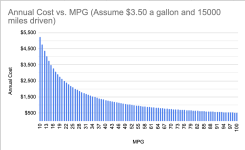
On the topic of MPGs, I made this chart awhile back because mpg is a flawed when trying to determine efficiency.

As you can see, 1 mpg can mean a whole lot or a lot less depending on how many MPGs you're currently getting. As you approach 40+ mpgs, the cost savings are negligible.

However, for people like us who are into trucks that are stuck in sub-20 MPG territory. every single mpg matters. Even if the new engines are only a few MPGs better, that will be an noticeable difference and with the huge bump in torque, a big leap from the previous V6. These effects will compound for those who plan on towing, adding lifts and bigger tires, etc.
 

Attachments

  • Screenshot 2023-05-19 at 2.11.34 PM.png
    Screenshot 2023-05-19 at 2.11.34 PM.png
    80.4 KB · Views: 559
Last edited:
For my current life with 2 little kids, a sequoia without the hybrid system would be ideal. Short of that I really hoped we'd see a new engine in the 3 liter range that would let me downsize from the Tundra to something smaller but still tow my camp trailer well. Oh well. I'll stick with the Tundra for now I guess and use the UTV and LC40 for offroad fix. I was really hoping for a more powerful 4Runner to replace the Tundra. I don't need Tundra towing capacity, but just comfortable highway towing of 5klb full size trailer.

I think the Taco will hit its target audience well. It's a lifestyle truck. It'll tow a drift boat and haul a bottle of small batch whisky perfectly well. Maybe the new Land Cruiser will have a bit more of a midsize HD utility SUV push.
I still think that might happen, probably just best for us all to reserve judgement until these new powertrains are actually test-driven.

The current 3.5L and 4.0L V6's in the Tacoma and 4Runner offer up 265lb-ft of torque at 4600rpm, and 278 lb-ft at 4400rpm, respectively. Those are relatively low torque ratings, and only come online pretty high up in the rev range. The new non-hybrid Tacoma 2.4L is said to make 317 lb-ft of torque, 20% and 14% more than the prior V6's, and it surely makes it at least 1000rpm earlier, probably closer to 2000rpm earlier. Paired with an 8-speed vs a 5 or 6, I would expect it to behave a good bit better on towing than the prior engines, and be revving lower than prior in all situations. I would not be expecting it to ask for 4500rpm unladen to go up 10% 70mph mountain passes like the 4.0L does.
 
Last edited:
Not a perfect example - but this is the problem: Ford F-150 V8 vs 2.7L Turbo V6 Towing MPG Test: If You Want The Best F-150 Fuel Economy, Buy THIS Truck! (Video) - The Fast Lane Truck Tow test between 2.7 turbo and 5.0 v8 F150 on same course with same trailer. The naturally aspirated V8 truck returned a result of 9.8 MPG. They ran the 2.7-liter turbo V6 right after and got a result of 8.7 MPG.

Turbo engines can be efficient and do very well in the EPA test cycle. They tend to do poorly under high load vs normally aspirated engines with similar peak power numbers. So an oversized turbo gas engine can offer very high thermal efficiency. A marginal size one that is in the boost range a lot is likely to have worse fuel economy. And that's not unexpected - the huge cooling systems should tell us that there's a lot more thermal loss when they're worked hard. If they were more thermally efficient than NA engines, you'd need a smaller cooling system not a larger one. It'll be really interesting to see how this engine does with efficiency.

One shining bright spot for the 1GR is low output efficiency. It's exceptionally fuel efficient on the trail. I often see 10+mpg on long low speed offroad trails. On trails where the LC80's are needing to carry fuel and I'm using less than half a tank. I know it's apples and oranges between a 20-30 year old engine and a newer one, but the 1GR really is a great engine for non-highway use. It would top my list of gas engines for crossing Africa or the Aussie outback where I was going slower and needed to maximize fuel efficiency and reliability.

The 1GR torque curve is odd. It has a double peak. It hits about 250 ft lbs at around 2200 rpm, but then drops again and peaks at 4400. The T24A is artificially cut off with the tune at 317 at 1700 and it'll be flat until it runs out of breath at around 5k rpms and drop off if it's anything like the other tunes. So at 2k rpms the 1GR is making 95hp and the T24A is 120hp. It a significant increase. The 1GR would need to be around 2,600 rpms to equal the power of the T24A at 2,000 rpms. Up a mountain pass where you're at 4500 rpms in the 4Runner, the T24A would need 3800 rpms to equal the power output.

Just for fun - the V35A in the Tundra makes 120hp at around 1300 rpms and 180hp at 2k rpms.
 
Last edited:

Members online

Forum statistics

Threads
278,315
Messages
3,554,125
Members
248,016
Latest member
Advally Service

Trending content

Back
Top