
You are using an out of date browser. It may not display this or other websites correctly.
You should upgrade or use an alternative browser.
You should upgrade or use an alternative browser.
Best way to carry spare fuel?
- Thread starter jdm-v35
- Start date
I did not look through this entire thread to see what folks are using. I tried various cans but have stuck with Scepter Military Cans from Canada. They never leak. They are pricey but you get what you pay for. I usually strap two to the roof rack when needed
Cans
New Scepter Olive Drab Military Fuel Can (MFC) 2.5 Gallon / 10 L | eBay
Spout
Scepter MFC Pour Spout 19mm - 3/4" diameter - DS Tactical
These folks are in the USA and also sell some nice stuff
JAGMTE - Just a Guy Making Things Easier – jagmte
Cans
New Scepter Olive Drab Military Fuel Can (MFC) 2.5 Gallon / 10 L | eBay
Spout
Scepter MFC Pour Spout 19mm - 3/4" diameter - DS Tactical
These folks are in the USA and also sell some nice stuff
JAGMTE - Just a Guy Making Things Easier – jagmte
I did not look through this entire thread to see what folks are using. I tried various cans but have stuck with Scepter Military Cans from Canada. They never leak. They are pricey but you get what you pay for. I usually strap two to the roof rack when needed
Cans
New Scepter Olive Drab Military Fuel Can (MFC) 2.5 Gallon / 10 L | eBay
Spout
Scepter MFC Pour Spout 19mm - 3/4" diameter - DS Tactical
These folks are in the USA and also sell some nice stuff
JAGMTE - Just a Guy Making Things Easier – jagmte
Those look nice! I just wish there was a spout that fit inside the can!
johnnygraphic
Member
Are the wavian fuel cans any good?
Yes. They are among the best gas cans you can get. Those and the Scepter cans are the cans for street cred out on the trails. Get the Harbor Freight Midwest metal cans if you don’t care about those things. Very good quality but plastic cap and filler nozzles. Buy a few spare caps for a just in case.
Sent from my iPhone using Tapatalk

srsrogerissrs
Member
I have a couple of wavians and wouldn't hesitate to carry them inside. No fumes and no leaks from the spout.

Captain Spalding
Member
This is a brief history of jerrycans with the addition of a few design details. It’s really dry reading, and it’s long, so fair warning. In fact, just skip it.
The NATO fuel can has a long history. It was invented in Germany in the late 1930’s and was used extensively in WWII. It was referred to by the allies as a “Gerry can”, Gerry being a mildly pejorative term for Germans at the time. Somehow it has morphed into Jerrycan, but I don't know when or why. After the war the German Jerrycan was adopted as the NATO standard (along with the 9mm Luger round.)
My first 4WD vehicle was a 1985 Toyota Extra-cab pickup. At first I had a few plastic cans, but they didn’t last very long. I was considering getting a couple of Blitz cans. That’s what all the Jeep guys were carrying at the time. But I had heard some bad things about them.
All three styles of containers, the Wavian, Blitz, and Sceptre, share the characteristic triple carry handle, which allows the can to be carried by two men, or 4 empty cans to be carried by one man, or for cans to be passed man-to-man down a line. All three also are designed with an air space at the top to allow for thermal expansion. They are all roughly the same size and capacity. That’s where the similarity ends.
The Blitz cans routinely leaked. It was hard to achieve a reliable seal on the cap, even using a tool to tighten it. The construction of the can used a rolled seam around the bottom which was prone to rust and would split as a result of rough handling. By comparison the NATO can had a longitudinal seam that was welded rather than rolled. The seam was recessed as well. The recess protected the seam from impacts and moisture. The cam-lock lid has the advantage of merely compressing the gasket, rather than compressing and distorting the gasket with a twisting motion as with the Blitz and Sceptre containers.
So then one day at the surplus store I saw the NATO jerrycan. I bought a pair for $15 each, replaced the gaskets with new ones, and never looked back. I was lucky to find them because not very long afterwards the supply dwindled and pristine copies became rare and expensive. After almost 40 years those two surplus cans are perfectly serviceable. They don’t leak. No liquid. No vapor. Nothing. I took them on many adventures and slept with them in the covered bed of my pickup and never smelled a whiff of fuel. They can be laid on their backs or on their sides. No leaks.
Several years later, after a sizable earthquake and a days-long power outage, I decided I needed more fuel storage capacity, so I bit the bullet and sprung for another pair of jerrycans. By this time only re-enactors we’re shelling out the huge prices for original Wehrmacht cans. So I bought “re-pops” from Wedco. Wedco was only an importer, and the cans were made in Latvia by a manufacturer called Valpro which took over manufacture of the cans after the war. The Valpro cans are a faithful, if not exact reproduction. The Wavian cans available today are made in the same facility as the Wedco cans were, and are identical in every respect except for a brand stamping on the side. The Wavian/Wedco/Valpro cans use a lighter gauge sheet metal than the original German version. In spite of that difference they still meet the NATO specification. I have 10 cans now (some are 10 liter and some are 5 liter). They have been continuously stored full for years.
The NATO fuel can has a long history. It was invented in Germany in the late 1930’s and was used extensively in WWII. It was referred to by the allies as a “Gerry can”, Gerry being a mildly pejorative term for Germans at the time. Somehow it has morphed into Jerrycan, but I don't know when or why. After the war the German Jerrycan was adopted as the NATO standard (along with the 9mm Luger round.)
My first 4WD vehicle was a 1985 Toyota Extra-cab pickup. At first I had a few plastic cans, but they didn’t last very long. I was considering getting a couple of Blitz cans. That’s what all the Jeep guys were carrying at the time. But I had heard some bad things about them.
All three styles of containers, the Wavian, Blitz, and Sceptre, share the characteristic triple carry handle, which allows the can to be carried by two men, or 4 empty cans to be carried by one man, or for cans to be passed man-to-man down a line. All three also are designed with an air space at the top to allow for thermal expansion. They are all roughly the same size and capacity. That’s where the similarity ends.
The Blitz cans routinely leaked. It was hard to achieve a reliable seal on the cap, even using a tool to tighten it. The construction of the can used a rolled seam around the bottom which was prone to rust and would split as a result of rough handling. By comparison the NATO can had a longitudinal seam that was welded rather than rolled. The seam was recessed as well. The recess protected the seam from impacts and moisture. The cam-lock lid has the advantage of merely compressing the gasket, rather than compressing and distorting the gasket with a twisting motion as with the Blitz and Sceptre containers.
So then one day at the surplus store I saw the NATO jerrycan. I bought a pair for $15 each, replaced the gaskets with new ones, and never looked back. I was lucky to find them because not very long afterwards the supply dwindled and pristine copies became rare and expensive. After almost 40 years those two surplus cans are perfectly serviceable. They don’t leak. No liquid. No vapor. Nothing. I took them on many adventures and slept with them in the covered bed of my pickup and never smelled a whiff of fuel. They can be laid on their backs or on their sides. No leaks.
Several years later, after a sizable earthquake and a days-long power outage, I decided I needed more fuel storage capacity, so I bit the bullet and sprung for another pair of jerrycans. By this time only re-enactors we’re shelling out the huge prices for original Wehrmacht cans. So I bought “re-pops” from Wedco. Wedco was only an importer, and the cans were made in Latvia by a manufacturer called Valpro which took over manufacture of the cans after the war. The Valpro cans are a faithful, if not exact reproduction. The Wavian cans available today are made in the same facility as the Wedco cans were, and are identical in every respect except for a brand stamping on the side. The Wavian/Wedco/Valpro cans use a lighter gauge sheet metal than the original German version. In spite of that difference they still meet the NATO specification. I have 10 cans now (some are 10 liter and some are 5 liter). They have been continuously stored full for years.
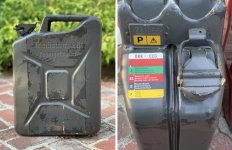
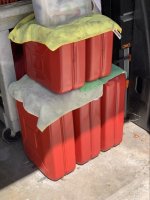
Top Photo: my first Jerrycan purchased surplus on 1985. Detail: the label can be changed depending on what fuel,is stored in the can.
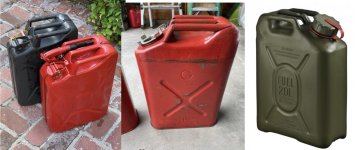
Next:OG and Valpro NATO-style cans, the Blitz can, and the military version of the Sceptre can.
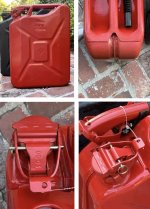
Next: 4 photos of the Wavian/Valpro can, with details of the cam-lock lid. Note the stamping of the date on the hinge. Also note the detail of the recessed welded seam.
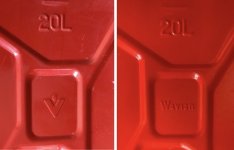
Finally: Valpro and Wavian logo stampings.
Epilogue: Sceptre is the Glock of jerrycans. Wavian is the SIG Sauer. Sceptre dint replace Wavian because it was an improvement. Sceptre replaced Wavian because it was the low bid.
Next:OG and Valpro NATO-style cans, the Blitz can, and the military version of the Sceptre can.
Next: 4 photos of the Wavian/Valpro can, with details of the cam-lock lid. Note the stamping of the date on the hinge. Also note the detail of the recessed welded seam.
Finally: Valpro and Wavian logo stampings.
Epilogue: Sceptre is the Glock of jerrycans. Wavian is the SIG Sauer. Sceptre dint replace Wavian because it was an improvement. Sceptre replaced Wavian because it was the low bid.
Attachments
-
 7ECBAB3E-193A-45A0-8988-6ABFDD2B1603.jpg132.2 KB · Views: 389
 -
 C215C6D7-DA9D-48AF-A583-CF7D838A944C.jpg123.1 KB · Views: 403
 -
 2D679D49-9256-4811-A5A2-B415C748DE78.jpg130.9 KB · Views: 406
 -
 19404F13-CF83-4421-A758-E51A7C6E5E84.jpeg24.3 KB · Views: 401
 -
 F344CD0A-FCDA-46D1-A86F-A0F084048C2F.jpeg61.8 KB · Views: 397
Last edited:
johnnygraphic
Member
Thanks for that.
I had thought about Rotopax but this thread is steering me in this direction
Sent from my iPhone using Tapatalk
Rotopax is awesome, but you have to buy into their mounting hardware. They don’t easily fit otherwise. Plus, just my humble opinion, is that they would be a pain to try and fill your tank with, especially with the larger fuel cans due to their awkward shape. They also don’t hold as much fuel as a standard 5 gallon Jerry can.
Rotopax is awesome, but you have to buy into their mounting hardware. They don’t easily fit otherwise. Plus, just my humble opinion, is that they would be a pain to try and fill your tank with, especially with the larger fuel cans due to their awkward shape. They also don’t hold as much fuel as a standard 5 gallon Jerry can.
I have one and I just strapped it onto my roof rack without issues. Did not buy their fancy mounts. We did break the CA safety nozzle when first trying to use it:jump:

mrblah
Senior Member
not a fan of the rotopax. While they don't leak, they swell ALOT to the point that it becomes difficult to use the rotopax mount. Also, its alot of money to invest in (mount + + pour attachments + can) for very little fuel. Same with the water cans.
As for metal (Wavian), my main concern was weight, rust, and damage in the mounts during transport (rattling and rubbing). Otherwise, I would have no issues purchasing these.
Scepters works well for me. Water cans can be modified for other "camp" uses. I went with scepters for fuel, mainly because they are light weight. They also don't balloon as bad as the rotopax's. I'm a fan of the scepters (the real military ones not the nanny cans). Downside is you have to invest in attachments for use, and the water cans can leave a plastic taste in the water.
So for me, if i have to purchase more cans in the future, its gonna be wavian or scepters. While, i am invested in the rotopax universe also, i don't see myself ever purchasing them again in the future.
As for metal (Wavian), my main concern was weight, rust, and damage in the mounts during transport (rattling and rubbing). Otherwise, I would have no issues purchasing these.
Scepters works well for me. Water cans can be modified for other "camp" uses. I went with scepters for fuel, mainly because they are light weight. They also don't balloon as bad as the rotopax's. I'm a fan of the scepters (the real military ones not the nanny cans). Downside is you have to invest in attachments for use, and the water cans can leave a plastic taste in the water.
So for me, if i have to purchase more cans in the future, its gonna be wavian or scepters. While, i am invested in the rotopax universe also, i don't see myself ever purchasing them again in the future.
Captain Spalding
Member
That reminds me. With regard to the Wavian cans, there are both CARB-compliant and “International” versions of the spout available. The CARB-compliant one sucks, as all CARB compliant spouts do. So go out of your way to get the international version.We did break the CA safety nozzle when first trying to use it:jump:
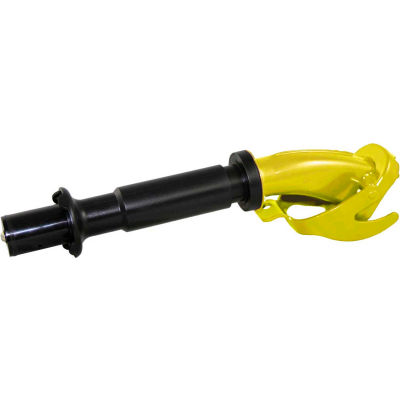
This is the CARB version. C-A-R-B = L-A-M-E.
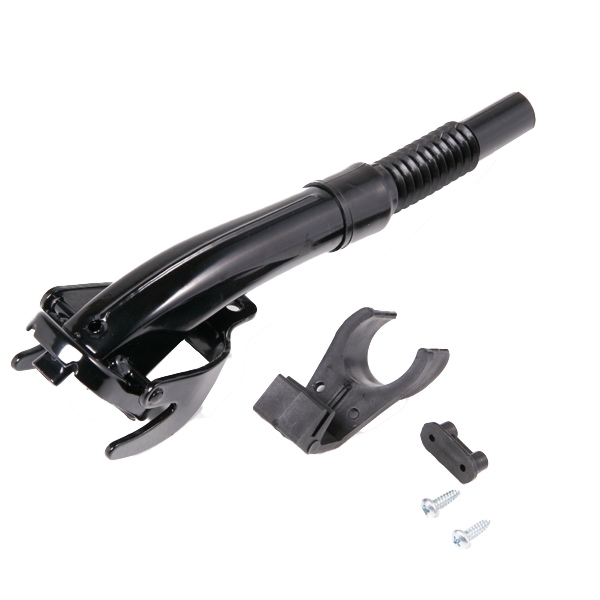
This is the one you want. The international version. The term “international is not an official term. Find them for sale by doing an image search for Wavian spout, and you’ll find them.
That reminds me. With regard to the Wavian cans, there are both CARB-compliant and “International” versions of the spout available. The CARB-compliant one sucks, as all CARB compliant spouts do. So go out of your way to get the international version.
This is the CARB version. C-A-R-B = L-A-M-E.
This is the one you want. The international version. The term “international is not an official term. Find them for sale by doing an image search for Wavian spout, and you’ll find them.
I would guess that you need to put a bag over the spout when driving or something to keep water and dirt out?

MAST4R
New member
I love vehicle optimization but cannot stand over-doing things.
The only places in the lower 48 states where I could use extra fuel are the Maze and Death Valley. Absent extra fuel, a Maze trip can mean ins and outs to Hanksville or Hite (if you are lucky for Hite to have gas). But is it worse than carrying extra fuel? How many times will one offroad in those two places? I have two cans to carry on a hitch carrier but have never used them, never took either one with me. And if I really want to plan an all-inclusive Maze trip, I would just take those and not bother with special solutions.
Now, if you do like offroading in mud in remote areas, that's the one case where I can see the need for extra fuel. This ain't no Australia, after all.
My vehicle looks pretty much stock but can run with almost every 4Runner in the desert (only UTVs outrun it in my real life experience ) and will keep up with almost all 5th gens in the rocks. On top of that, I just got 18 real mpg on a 7,000 mile trip from Phoenix to Banff/Jasper/surrounding area and the vehicle handles on road great and has no extra stuff on it to make washing it a pita.
Simplicity goes a very long way.
The only places in the lower 48 states where I could use extra fuel are the Maze and Death Valley. Absent extra fuel, a Maze trip can mean ins and outs to Hanksville or Hite (if you are lucky for Hite to have gas). But is it worse than carrying extra fuel? How many times will one offroad in those two places? I have two cans to carry on a hitch carrier but have never used them, never took either one with me. And if I really want to plan an all-inclusive Maze trip, I would just take those and not bother with special solutions.
Now, if you do like offroading in mud in remote areas, that's the one case where I can see the need for extra fuel. This ain't no Australia, after all.
My vehicle looks pretty much stock but can run with almost every 4Runner in the desert (only UTVs outrun it in my real life experience ) and will keep up with almost all 5th gens in the rocks. On top of that, I just got 18 real mpg on a 7,000 mile trip from Phoenix to Banff/Jasper/surrounding area and the vehicle handles on road great and has no extra stuff on it to make washing it a pita.
Simplicity goes a very long way.
Last edited:
Captain Spalding
Member
I love vehicle optimization but cannot stand over-doing things … Simplicity goes a very long way.
1. Not everyone who owns jerrycans plans to carry them on their vehicles.
2. If you are a fan of simplicity you’ve chosen the wrong vehicle.
Captain Spalding
Member
I would guess that you need to put a bag over the spout when driving or something to keep water and dirt out?
The spout is removed when not in use and attached to the can.
The spout is removed when not in use and attached to the can.
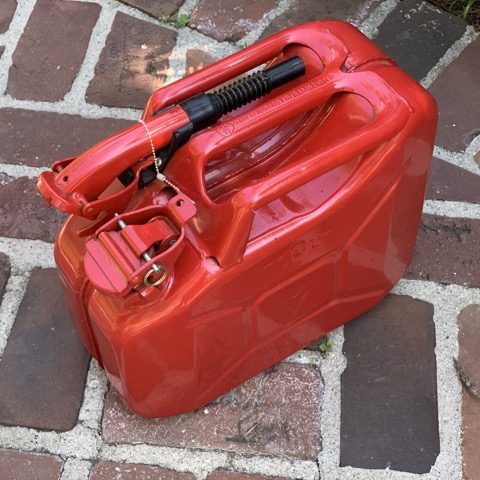
But wouldnt it still get filled with water/dirt/mud/dust etc when its just strapped to the top of the can?
I love vehicle optimization but cannot stand over-doing things.
The only places in the lower 48 states where I could use extra fuel are the Maze and Death Valley. Absent extra fuel, a Maze trip can mean ins and outs to Hanksville or Hite (if you are lucky for Hite to have gas). But is it worse than carrying extra fuel? How many times will one offroad in those two places? I have two cans to carry on a hitch carrier but have never used them, never took either one with me. And if I really want to plan an all-inclusive Maze trip, I would just take those and not bother with special solutions.
Now, if you do like offroading in mud in remote areas, that's the one case where I can see the need for extra fuel. This ain't no Australia, after all.
My vehicle looks pretty much stock but can run with almost every 4Runner in the desert (only UTVs outrun it in my real life experience ) and will keep up with almost all 5th gens in the rocks. On top of that, I just got 18 real mpg on a 7,000 mile trip from Phoenix to Banff/Jasper/surrounding area and the vehicle handles on road great and has no extra stuff on it to make washing it a pita.
Simplicity goes a very long way.
Not sure if you read my initial post and some of my specific reasons. I know everyone has their own reasons for doing things. Here are my specifics:
1-I go hunting every year and for that week or 2 it is in a very remote spot so there is literally no gas, road, or people for about 60-70 miles from camp
2-I get 14mpg so gas does not go as far as I would like and it helps to be prepared
3-It is usually always a combination of deep mud, deep snow, ice and rock as hunting seasons is always in winter. Last year friend broke a driveshaft on a ram 3500 and we had to pull it out then drive it in 2wd to town and change it in a parking lot.
4-Getting stuck out there with no communication/resources would pretty much be certain death. last year the high temp was 10 degrees. I also did have to hike it back to camp to get help from someone else with us since my friend was not prepared and half asses things, and it took 3 hours to hike 7 miles back to camp, so being prepared is key.
5-In my case I go camping for a week a few times a year in remote locations, so in warmer weather I would have water jerry cans instead of fuel and I would use the RIGd table many times as I do overnight fishing trips often. Interior space saving helps since we also have a baby now and need to bring more things.
This is just a fun rig for me anyway and I do not daily drive it, so having it geared up is no issue. I probably drive it once every 2 weeks or so when out of season(I only camp in cooler weather).
Captain Spalding
Member
But wouldnt it still get filled with water/dirt/mud/dust etc when its just strapped to the top of the can?
Hasn’t happened to me, but I guess it’s not outside the realm of possibility. I know the thought of a spout that stores inside the can appeals to you. Why not just go to Home Depot and pick one up?
Hasn’t happened to me, but I guess it’s not outside the realm of possibility. I know the thought of a spout that stores inside the can appeals to you. Why not just go to Home Depot and pick one up?
I did see scepter makes a plastic jerry can with the spout that stores inside and may do that as the back gets really dirty, covered with road salt, water and mud. It might also hold up better to road salt.
Captain Spalding
Member
Dang, you really want a self storing spout! Consumer grade Sceptre cans are not the same the military grade ones. If you’re not going to get a Sceptre military container or a Wavian can, anything you find at the FLAPS will serve your needs.I did see scepter makes a plastic jerry can with the spout that stores inside and may do that as the back gets really dirty, covered with road salt, water and mud. It might also hold up better to road salt.
It’s hard for me to envision a situation in which road salt would be an issue, unless you are carrying a fuel can all the time. Like, to the mall in the winter. ;-)
Similar threads
- Replies
- 17
- Views
- 11K

- Replies
- 0
- Views
- 295
- Replies
- 19
- Views
- 340K


