Brake Gremlin

Update on accumulator.

I came across the Pajero accumulator youtube.... It is a piston accumulator.

I am sure the Toyota accumulator is very much the same.
I read that someone was saying this is a membrane accumulator....
it is not!
This youtube is saying that the nitrogen charge is 1100psi = 76 bar.
Assuming this is correct... the Toyota will be very much the same.

https://www.youtube.com/watch?v=PAZALKtT_EA


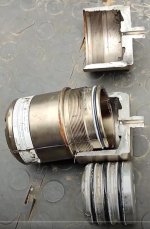
I actually know how to rebuild the piston accumulator and install a valve on top in order to recharge the 75bar.

Martin
 

Attachments

  • Screenshot 2024-02-21 at 12.19.23 PM.jpg
    Screenshot 2024-02-21 at 12.19.23 PM.jpg
    77.7 KB · Views: 1,539
Thanks,
Yes if there is an air pocket somewhere that I did not bleed in the MC then you are absolutely correct.

Yes I am in the Boston area, cold right now.
So the plan is to not run the el motor (no key) and bleed the AC manually by depressing the pedal, correct

Would you start with
1) opening the pressure line off the accumulator (the winding line with red protection from accumulator into the MC) and bleed until fluid only comes out?
However there will be residing pressure from the accumulator...Should I bleed with the accumulator pressurized or drain the accumulator first - stepping on the brakes and take off the accumulator pressure
2) close that line

3) Open the 4 lines, each at a time, certain order?

The do the ABS braking and bleed again 2) and 3) (1 not needed again).

Thanks again, Martin


Friend, don't over-think this. If you performed gravity feed, air will not push through and out of the calipers. Air rises and gets trapped at the MC which would cause pump to cycle constantly. It takes about two minutes to crack the MC line fittings. I take it that you are in the snow belt? After the first MC line bleed, drive in the snow and trigger traction control and ABS events to get the valve block to cycle. Air can get trapped inside ABS valve block. Repeat MC line cracking. Anyways, there is some good news here. Pressure sensor appears to be working. And system does eventually build up pressure which also means accumulator could be good.
 
I like the idea of forcing the ABS to kick in in case there's air in there. Some GM's will have a soft pedal until you do this. Standard bleeding procedure is to start with the caliper furthest from the master and work your way to the closest one. According to the bleeding sticky, you need the key on and pedal partially depressed for the rear brakes as the electric motor pushes the fluid out. Obviously keep the level topped off. When I replaced my lines, I followed those directions but still had a soft pedal. I found my front calipers were toast. Replaced those and followed the procedure again with no issues. Point is, don't assume the calipers are still good. Some folks seem to be changing them on a 3 or 4 year rotation, especially in the climate we live in.
 
Hi Mike,

SocalSam was suggesting to bleed the MC, not the calipers... my questions for MC bleeding were 2 posts back,
I 'll try and bleed the MC (one input line and 4 output lines at MC).

Input MC must be done with the accumulator under pressure, guess ...And probably so is the rest of the 4 out lines done (with the accumulator under pressure).

But I wanted to ask again if this is correct to be done with the key in position 2 (before engine start which runs the el pump).
There could be a lot of fluid be sprayed around.... a potential mess... I can imagine.


For the calipers I totally agree. They are a bad design if they fail that early but what can we do. Changing them is the only safe cure.
And I don't know if they contribute to soft brakes or if these are unrelated issues.

Best, Martin
 
Last edited:
maybe there is a need to hook up the toyota techstream scantool and check for those error codes. that may help with more in-depth in diagnostic.

have you look at the repair manual?

did you use your vin number to buy the replacement parts?
 
Last edited:
Hi Mike,

SocalSam was suggesting to bleed the MC, not the calipers... my questions for MC bleeding were 2 posts back,
I 'll try and bleed the MC (one input line and 4 output lines at MC).

Martin, you mentioned the 4 corners in your numbered steps so that's why I listed what I did. Bleeding at the MC would be messy if just cracking the lines near it. Some folks route tubes back into the reservoir to make easier. I would think you'd need to run the pump for MC bleeding too but this is beyond my knowledge for this particular system. Either way, I'd want to bleed to the calipers after breaking open any connection closer to the MC. One other thing I've heard but never seen is that old hoses could make for squishy brakes. I replaced my rears because they were looking tired.

Something else you could try would be to pull your calipers off the rotors, compress them completely and put some blocks of wood tightly in between the pistons to see if squish goes away. Just throwing ideas out there to narrow things down.
 
Hi Mike,

SocalSam was suggesting to bleed the MC, not the calipers... my questions for MC bleeding were 2 posts back,
I 'll try and bleed the MC (one input line and 4 output lines at MC).

Input MC must be done with the accumulator under pressure, guess ...And probably so is the rest of the 4 out lines done (with the accumulator under pressure).

But I wanted to ask again if this is correct to be done with the key in position 2 (before engine start which runs the el pump).
There could be a lot of fluid be sprayed around.... a potential mess... I can imagine...

Best, Martin

I did mine with key on engine on. Used a tool box to apply pressure to brake pedal. Then 10mm box wrench to loosen the fittings just enough for fluid to weep. It should only take a second or so cracked to get a result. Yes, some brake fluid will escape so swaddle with shop towel before starting. Once you are done, brake pedal should firm up. Then find some snow or wet leaves and trigger ABS and Traction events to get the air moving through the valve block. If pedal goes soft again, redo MC bleed. Go for it and let us know how it went.
 
Thanks SocalSam and Mike,

I'll do

-install new Accumulator- (to eliminate this part from the equation)
-MC bleeding followed by ABS braking and another MC bleeding-
-install new calipers in front-

I'll do the accumulator and MC bleeding first and report back.

Thanks for all your help.

Martin
 
Last edited:
I did the first round of MC bleeding before I do accumulator exchange or caliper exchange.

With key in on-position and my wife pushing the pedal.
I cracked the input line (that red snake line where it enters the MC)
Then I cracked the 4 output lines, rear then front (not sure if the order has any relevance).

I had plenty of paper towels and watched the reservoir level closely.
It was not very messy.

I did not notice any difference in pedal firmness I fear but I'll watch for a couple of days and do some ABS braking, then repeat the MC bleeding as it is simple to do.

Martin
 
How is stopping power? Any brake fade? Pedal feel is medium to light and feels "Japanese" which is more finesse than German firm. (I'm going to catch heck but firm is how my Merc C55 brakes feel.)
 
Thanks for asking about the firmness.

I believe the MC piston is tight, brake is not fading. Once the pedal it hit the braking is constant and pedal is 'fading'.
However the pedal feels soft in general and I don't like it. But there seems to be not much I can do about it with bleeding.

When I first bought this car the first thing I noticed was the soft brakes and I worked on the calipers in 2020, all of them. I noticed that pistons were seized so much on the front brakes that I had to replace the front calipers while the I could just reseal the rear calipers.
After that (calipers were all free with new pads) the braking was very much improved and firm.

Two/three years later the brakes were getting softer and softer and then in Year 2023 the rear brake line broke and the pump failed and left me stranded. This was not fun as I had to tow the car back home.
After repairing the broken rear line and installing a rebuilt brake motor/accumulator the brakes work(kind of) but is still too soft.
Plus I have the problem that after every second minor braking action the motor/pump is running. This at least once lead to a difficult situation on the highway when after some harder braking the brake alarm went off for about 15 seconds .
I still don't know if this is normal and how often others brake until the motor has to replenish the pressure- therefore my questions around the accumulator, no one said something.
I know as a fact that the accumulators (piston and membrane accumulators) can be leaky and nitrogen atoms can escape leading to lower fluid storage capacity and gas in the brake fluid... leading to sof brake pedal just like air in the system.
In this case the gas would then probably stay within the MC area....

Without having more success with bleeding I guess my next bet is working of the calipers.


Japanese brake feeling.... True, I was driving BMW and MB back in the days on the German Autobahn in the 80 and 90s and You could definitely not do this kind of race driving with my T4R. That might be a DNA issue- the car is simply not made for that performance. However my T4R brakes were at least factor 1.5-2 better after my last rebuilding in 2020. So I know if can be much better.

Any of your opinions would help regarding the intervals the brake motor should kick in.
And the effect of dragging brake calipers on braking and pedal softness.

Martin
 
It's normal for the ABS/master cylinder booster motor to kick on about every 3 depressions of the brake pedal and stay on for about 15 seconds max.

It kicking on every 2 depressions is not normal and it's losing pressure somewhere IMHO.
 
Thanks Auseeker,

That is the first answer indicating that something is not correct with the pressure storage?

it could be A) losing pressure from the accumulator..... or B) the pressure storage capability of the accumulator is
compromised/reduced (not enough energy is stored)
Or C) the stored pressure gets exhausted faster than it should during braking... can this happen with a seized caliper piston?

With A) the pressure storage would be normal but pressure is leaking from the accumulator (I don't know if there is a possibility that this can happen).
A leak in the accumulator would however lead to a drained accumulator at every start up of the engine... but this definitely does not happen.

So I believe I might have problem B) or C)...

Thanks for any help.

Martin
 
It's normal for the ABS/master cylinder booster motor to kick on about every 3 depressions of the brake pedal and stay on for about 15 seconds max.

It kicking on every 2 depressions is not normal and it's losing pressure somewhere IMHO.

My booster motor runs in a similar pattern. When on long freeway runs, motor does not run at all.
 
Does OP have other T4R owners near him that will let him drive their trucks and vice versa? I think experienced owner will be able to tell if something is not right fairly quickly. If there is no fading and no unexpected changes in brake pedal feel, it could be hardware is OK and OP's expectation for brake pedal feel is different from his German car experience. My '05 C55 brake pedal is firm and does not have nearly the travel as my T4R. I am not alarmed at my T4R's relative softness because the brakes have stopping power, are easy to modulate, and do not fade. There are no unexpected changes in brake pedal feel. I don't want to diminish the importance of getting the hardware right but I wonder if personal preference is in play.
 
Last edited:
As I stated a couple of times-
I had the same car brake opeerating much, much better after I replaced all calipers.
I know also that pedal firmness can be better (even though it is no comparison with the German cars I have).

SocalSam is correct it is simply the braking power that counts not the absolute firmess ( I have a 996 Porsche and that brake is like a rock). I am not hung up with the absolute firmness of my T4R.
I think that the effort to get the car to a halt is just too much and I cannot drive faster at all due to this condition, it is not safe.

The incident on the highway when the alarm went off during fast driving was very alarming to me.

My only explanation for the alarm during driving is that this had to do with the fact that the motor/pump could not replenish the pressure level as I had to do 2 sudden brake pedal pushes and this triggered the alarm.

Can I ask: Who had a similar experience with their T4R- alarm going off on the road that went away after 15 seconds (no failure of the motor)?

This makes me very suspicious and therefore I am not giving up finding answers and solutions.

My plan is
1)rebuild the front calipers and then test drive, see what happens.
2) install a brand new accumulator and check in again.


How would you proceed?

Martin
 
In your very 1st post in this thread you stated...

"I have not had a car with such complicated brake booster/ABS than the 4th Gen.
My brakes quit 3 years after I bought the 4th Gen (2002 model)."

My question is what year is your T4R actually, a 2002 or 2003, I ask because a 2002 is a 3rd Gen not a 4th gen?

That being asked, at this point I would replace the entire master cylinder/booster assembly, a bit pricey at about $1300 to $1350 +/- depending on source but it should solve all of your issues provided you get all the air out of the system after installing the assembly.

Link for the assembly for a 2003 T4R.


47050-60080 Genuine Toyota Brake Booster Assy, W/Master Cylinder
 
Last edited:
As I stated a couple of times-
I had the same car brake opeerating much, much better after I replaced all calipers.
I know also that pedal firmness can be better (even though it is no comparison with the German cars I have).

SocalSam is correct it is simply the braking power that counts not the absolute firmess ( I have a 996 Porsche and that brake is like a rock). I am not hung up with the absolute firmness of my T4R.
I think that the effort to get the car to a halt is just too much and I cannot drive faster at all due to this condition, it is not safe.

The incident on the highway when the alarm went off during fast driving was very alarming to me.

My only explanation for the alarm during driving is that this had to do with the fact that the motor/pump could not replenish the pressure level as I had to do 2 sudden brake pedal pushes and this triggered the alarm.

Can I ask: Who had a similar experience with their T4R- alarm going off on the road that went away after 15 seconds (no failure of the motor)?

This makes me very suspicious and therefore I am not giving up finding answers and solutions.

My plan is
1)rebuild the front calipers and then test drive, see what happens.
2) install a brand new accumulator and check in again.


How would you proceed?

Martin

OK, I'll accept OP is not happy with his hardware. OP's no confidence is clear. Before getting into the hardware, complete bleed to make sure air in lines is eliminated. Caliper seal is possible. Getting any of the bad caliper seal symptoms? Research caliper seal test. Lift car and look for piston retraction. Master cylinder seals would cause similar soft pedal but not individual rotor and wear issue. Leaking accumulator is also a candidate. There is a test in which pedal is pumped with engine off to test accumulator. I saw it here but I can't find the link. IIRC, the result for good accumulator is pedal going hard after a certain number of pushes. If pedal stays soft, fluid is getting past a seal somewhere. My memory is bad so do not rely on me.

On a side note, I have full confidence in my brake system which comes from being able to pull used parts and installing them. I get that this approach is not for everyone. A big part of my confidence is knowing I don't have to rely on mechanics and spend the big bucks on new parts. Anyways, our trucks are machines so there is an answer.
 
I did exchange the broken el pump/accumulator with a so called rebuilt unit for $300 on ebay last fall (i fixed the broken rear line but the system still did not work- the pump was dead). The rebuilt unit worked in a way that my dash light and sound were gone. Since then I struggle with the brake performance, try to bleed etc.
As a side observation I realized that the brake motor came on more often than I remembered and then the alarm on the highway.

I believe the soft brake and the accumulator are possibly unrelated issues as I had the soft brakes before the incident last fall but I had not the motor coming on so often (every other pedal action).

Anyhow I believe the accumulator could be suspect.
So I did test the old accumulator which I replaced with a reman unit.
(heck knows what they sold me as a reman unit... as it performs worse that the old one I removed).

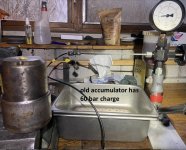
So I did pressure test this old accumulator and it had 60 bar of nitrogen charge.

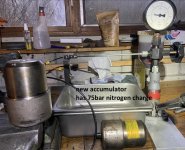
Then I tested the brand new accumulator I bought lately and it measured 75 bar charge.

This means the original accumulator lost 15 bar compared to the new one.
This is not unexpected and 60 bar (for a 75 bar accumulator) is probably the limit and should be exchanged.

So now the question is what the so called reman accumulator measures...
Its installed now and I cannot test it...but I will remove it some day and test.

Again, I think the accumulator has an influence on the amount of energy stored (how often the pump kicks in) but it should have no influence on the softness if the brake.

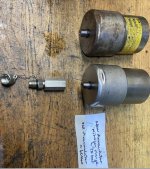
pictures attached. I machined a fitting to hock the old and new accumulator up to the hydraulic test pump.


.
 

Attachments

  • Screenshot 2024-03-02 at 9.04.11 PM.jpg
    Screenshot 2024-03-02 at 9.04.11 PM.jpg
    120.9 KB · Views: 744
  • Screenshot 2024-03-02 at 9.04.48 PM.jpg
    Screenshot 2024-03-02 at 9.04.48 PM.jpg
    135.7 KB · Views: 747
  • Screenshot 2024-03-02 at 9.05.22 PM.jpg
    Screenshot 2024-03-02 at 9.05.22 PM.jpg
    134.3 KB · Views: 761
Last edited:
OK, I'll accept OP is not happy with his hardware. OP's no confidence is clear....

Seized front caliper: I can feel that my T4R is pulling to one side when braking harder... a sign for a dragging caliper.

another idea came up.
The ABS is probably part of the equation here. Can a contaminated ABS modulator cause a soft brake? There are probably internal solenoids and valves... debis might cause malfunctioning of the brakes in general?
Has someone taken the ABS apart for cleaning purposes?

Martin
 

Members online

Forum statistics

Threads
278,307
Messages
3,554,056
Members
248,016
Latest member
Advally Service

Trending content

Back
Top