Brake pad replacement

kai920

New member
I don't have much experience with brakes. I am going to attempt the rears pads soon. So I started researching here and it seems like everyone just depresses the piston back in with a C-clamp. What about cracking the bleed valve at the same time? I am curious why it seems like no one is doing this. Isn't this bad for the system?
 
Register to hide this ad
Brake pad swaps are pretty straight forward. You shouldn't have any problems.
To answer your question, it's best to just depress the piston back in to make room for the new pads. You can open the bleeder valve and it may move more freely, but you'll want to make SURE you bleed the brakes well and get any air out that has made it's way in (and it will). It's much easier to just push the piston back in, it'll move with a little pressure and make room for the new pads.
If you cannot push it in, you may have a frozen piston, which is fairly common. You can try to force it and "break" it loose, but it may freeze back up unless you replace the entire caliper.
Good luck, hope all goes well!
 
Using the c-clamp allows the fluid to stay within the system. If you crack the bleeder, yes, it will work however you now have a mess to clean up and fluid to add into the resevoir.

A word of caution: If you have added fluid because it looks low, when you are pushing the pistons back into the caliper, check the fluid level often as you risk an overflow.

Brake systems are sealed systems in that, when everything is working correctly, you don't need to add fluid. As the pads wear out you will see the resevoir level drop however the same amount of fluid still remains within the system.

Just keep it simple and push the pistons into the calipers just like you read on the forum.
 
There is no possibility of damage to ABS by pushing the piston in without cracking the bleeder valve?
 
There is no possibility of damage to ABS by pushing the piston in without cracking the bleeder valve?

Nope. That's how we all do it. It will just push the fluid back up the system, no harm done. I've done it for years on 8-10 different vehicles. Even my wife's 08' Accord just requires you to screw in the piston itself. It literally threads itself back into the caliper forcing the fluid back up into the system. Then self adjusts back where it needs to be. Our 4runners just take a little more elbow grease!
 
Nope. That's how we all do it. It will just push the fluid back up the system, no harm done. I've done it for years on 8-10 different vehicles.

Just because you've done it before without a problem...doesn't mean it's the right way. NOT opening the bleeder valve has the potential of causing problems. So why take the chance???
 
Just because you've done it before without a problem...doesn't mean it's the right way. NOT opening the bleeder valve has the potential of causing problems. So why take the chance???

There is no risk in doing this, when the system is not under pressure (vehicle not running, foot not on the brake) the system is free flowing, this means there is no risk of damage due to fluid movement. I am not sure what it is you think will result from doing this, but if you have ever worked in a dealership, this is how TOYOTA does the brakes.

someone has mislead you, and you are passing it on to other members not in the know.
 
Man. You love to be a downer! :)

Seriously. In over 20 years of changing my own brakes and NEVER cracking the valve... I have to call "Shenanigans". You do need to be concerned about pressure, but you usually open to reservoir cap in the engine bay. It allows the fluid to expand up, and doesn't allow air into the system.


Edit: TOY2G beat me. But yea. Never had any issue. 0, Niche. Nada. None. EVERRRRRRRRRRRRRRRRRRRRRR. I crack the crap in the engine bay on the reservoir and that is all.
 
It is a sealed system. If there is dirt in the brake line, it was introduced through a busted seal on a piston and there is now fluid in direct contact with the outside world...

that makes itself pretty noticeable. We get the whole better safe than sorry, but people have different risk degree's. This isn't driving without oil and hoping your engine doesn't seize. This has never happened to me. It MIGHT happen to someone, somehow.... but I have never heard of it.

I do get that everyone has a different risk calculus.

I just think is this a silly case of going over board. If you have a ripped caliper piston seal... I think everyone gets that would be a different situation.
 
I just think is this a silly case of going over board. If you have a ripped caliper piston seal... I think everyone gets that would be a different situation.

You should actually READ what I said before you make a comment.

NO where have I ever said you MUST or ALWAYS open the bleeder valve. How could you possibly think it's going overboard. Sounds to me like it's YOU who's going overboard.

There is a chance you could end up screwing up a sensor. This is not just my opinion...I posted just TWO from the thousands in my google search. Check it out yourself. And since opening the bleeder valve is so simple..."WHY NOT". You don't even have to MOVE...The bleeder valve is right there on the caliper. It's not like it's going to take you an hour to open the bleeder valve. If it was that complicated for this simple task then I'd skip it too. I also bleed my brakes every time I replace the pads. Which is even more complicated...Do you skip that part???
 
Last edited:
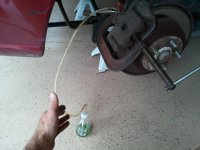
I use a bottle and clear tubing that fits tight over my bleed screw. I always get a bit of air and dark fluid, the fluid in the caliper gets funky over time, I don't like sending it back into the ABS valving. Good to get it out of the system.

The green in the bottle is Pentosin 7 from my mountain bike brakes.

I'm not sure what size this hose is, .170" ID I think. I have another bottle set up with 1/4" hose that works on bigger bleed screws. The tubing is from a hardware store, I picked up a few feet of various sizes to have around for stuff like this, kids projects, fish tanks, whatever. The bottle cap is drilled to fit the hose tight, with a tiny air hole next to the hose. That keeps it from spilling when it falls over.

I've done my rear brakes, planning on doing the fronts on the 4R for the first time over the holidays. This pic is from my son's Impreza, you can see the bubbles coming out.

 

Attachments

  • 2010-10-20 16.32.36.jpg
    2010-10-20 16.32.36.jpg
    128.9 KB · Views: 434
Brake fluid does pick up moisture over time and this will lead to a spongy pedal and reduced response. The fluid in the caliper will pick up the most dirt, and moisture, so it is good to get that stuff out of the caliper if possible. Just remember if you crack the bleeder, it is good practice to bleed the corner that you are working with before you finish.

That said brake fluid should be fully flushed periodically anyway, so if you are up on your maintenence, it is not a big deal to push the fluid back up into the system without cracking the bleeder. If the fluid is cloudy in the reservoir, it is probably time to flush the entire system anyway.
 
It is a sealed system. If there is dirt in the brake line, it was introduced through a busted seal on a piston and there is now fluid in direct contact with the outside world...

That's it in a nutshell. There are other problems that need to be addressed if you are getting dirt introduced to your brake system. No sense in doing twice the work for the same results, IMO.

...and for the record, I have yet to damage any braking system from pushing the pistons back into the calipers....and I say this having replaced pads (as well as shoes) on a "few" times across countless vehicles in my life.

If the arguement is to remove contaminated fluid from the system then why not do it correctly and flush the entire system? Two calipers is not going to clear contaminated fluid from the system whatsoever.
 
Last edited:
Thanks for all the replies. I understand both sides. I did it without bleeding, all went well. Fluid was changed less than a year ago so I wasn't too worried about that.
 

Members online

Forum statistics

Threads
278,309
Messages
3,554,066
Members
248,016
Latest member
Advally Service

Trending content

Back
Top