Check Engine light on after installing Thorley headers

mr_skittle

New member
I got a set of Thorley headers installed on my 06 V8 sometime around the beginning of 2022. Ever since, I've been chasing down one code after another. I changed the spark plugs and coils to get rid of a misfire code. I also added defoulers to the O2 sensors. The mechanic cleared some codes related to rich fuel mixture last but the darn light keeps coming back on. It otherwise is running fine.

Does anyone have suggestions on how to clear this check engine light once and for all after installing headers? Thanks!
 
Register to hide this ad
Wideband a/f sensors and a/f tune. I know this is such a CONTROVERSIAL subject but that's what it comes down to if you want those huge HP and torque gains throughout the entire spectrum. Definitely need an accurate air/fuel ratio sensor signal to dial it in instead of attempting to trick the OEM processer. Those lean/rich DTCs also disable all your skid control functions for wheeling right...
 
Wideband a/f sensors and a/f tune. I know this is such a CONTROVERSIAL subject but that's what it comes down to if you want those huge HP and torque gains throughout the entire spectrum. Definitely need an accurate air/fuel ratio sensor signal to dial it in instead of attempting to trick the OEM processer. Those lean/rich DTCs also disable all your skid control functions for wheeling right...


Thanks for the suggestion. I will share it with my mechanic and see what he thinks.

And yes, it is the case that the traction control and AWD don't function when the check engine light is on, at least in this case. I don't understand why the heck Toyota linked drive-train components to the exhaust/emissions stuff but it's a PITA!
 
Thanks for the suggestion. I will share it with my mechanic and see what he thinks.

And yes, it is the case that the traction control and AWD don't function when the check engine light is on, at least in this case. I don't understand why the heck Toyota linked drive-train components to the exhaust/emissions stuff but it's a PITA!

No problem! I had to deal with this when my cats started going bad. Enjoy those headers
 
Thanks for the suggestion. I will share it with my mechanic and see what he thinks.

And yes, it is the case that the traction control and AWD don't function when the check engine light is on, at least in this case. I don't understand why the heck Toyota linked drive-train components to the exhaust/emissions stuff but it's a PITA!

I sent you a private message I think. I doesn't show It sent. Did you get it figured out?
 
So if you can believe it, I'm getting conflicting information on dealing with my issue. I called up Doug Throrley HQ, and since CA has such strict cat converter rules, they couldn't offer anything in the way of troubleshooting. They did suggest I call Burtman Industries, which sells lots of aftermarket parts for 4runners. The person I talked to there said that "no one has really been able to hack Toyota's programming" and there isn't a tune-up program available. He did say that I need to add defoulers to all 4 of the o2 sensors. I had only added two. I'll take that step and see what happens.

But on the flip-side, a member here on the forum is saying that I need to do some tuning work to the onboard computer and that the defoulers are only a band-aid fix.

For $40 the defoulers are an easy thing to try but I'm not convinced they are going to solve the problem. I'm really at a loss here. Considering this forum is where I learned about Thorley headers, I'm surprised hardly anyone has the same issue.
 
I don't really know about the "hacking" thing, I have heard it a ton over the years but have never really seen anyone actually "hack/reprogram" a Toyota ECU of any flavor with just a OBDII connection (i.e. using a Techstream or similar Laptop Based Scantool some other models). But I have seen plenty of "plug & play" piggy back kits that work just as well for tuning Toyotas. It's mainly what is used for non-factory supercharger kits like the Magnuson units we install that no longer have TRD Flashes for them.

On a side note, have you cleaned the MAF Sensor and Throttle Body recently? Do you have any Throttle Body Spacers or other modifications that could affect intake air or fuel? What are your MAF Readings, AFR, O2, and Fuel Trim Readings?
 
What codes are you showing ?

I have the plug non fouler spacers installed and it took some tweaking. You can’t pull the sensor completely out of the exhaust stream or it will read as faulty. You have to play with the spacing of the sensor in the stream and the size of hole in the non fouler. Maybe installing up stream non foulers could correct this but not likely. When I had the original 2 stacked my obdii reader would show the voltage on the o2 sensors not change unless I was at least 40% throttle


Sent from my iPhone using Tapatalk
 
Sorry it's taken me so long to reply to your comments. The vehicle runs and drives fine and I work in the opposite direction of my mechanic so I've haven't made it a huge priority. But this weekend we towed our camper and the darn thing smelled like the nasty exhaust that this issue has been causing. That was the motivation I needed to follow up on this business.

I did install the second set of defoulers, and now have them on all 4 O2 sensors. I swung by my mechanic's shop today and had him give me the codes before he cleared them. The codes were PO138 and PO 158. Something like "O2 sensor circuit high voltage"

On a side note, have you cleaned the MAF Sensor and Throttle Body recently? Do you have any Throttle Body Spacers or other modifications that could affect intake air or fuel? What are your MAF Readings, AFR, O2, and Fuel Trim Readings?

I have not cleaned the MAF or throttle body and I do not have any add-ons that might lead to intake issues. I don't know any of the readings you mentioned. I assume you need to scan it while running and driving to get this data.?
 
What codes are you showing ?

I have the plug non fouler spacers installed and it took some tweaking. You can’t pull the sensor completely out of the exhaust stream or it will read as faulty. You have to play with the spacing of the sensor in the stream and the size of hole in the non fouler. Maybe installing up stream non foulers could correct this but not likely. When I had the original 2 stacked my obdii reader would show the voltage on the o2 sensors not change unless I was at least 40% throttle

I know I just posted this in the previous reply, but I'm trying to address each comment specifically. I did install the second set of defoulers, and now have them on all 4 O2 sensors. I swung by my mechanic's shop today and had him give me the codes before he cleared them. The codes were PO138 and PO 158. Something like "O2 sensor circuit high voltage" The 'check engine' light stayed off all day for 3 separate trips, but I'm not holding my breath that it's going to stay off. How did you tweak your non-foulers? did you actually drill out the hole bigger to modify it? The way they screw in, I can't imagine making any adjustments.
 
I know I just posted this in the previous reply, but I'm trying to address each comment specifically. I did install the second set of defoulers, and now have them on all 4 O2 sensors. I swung by my mechanic's shop today and had him give me the codes before he cleared them. The codes were PO138 and PO 158. Something like "O2 sensor circuit high voltage" The 'check engine' light stayed off all day for 3 separate trips, but I'm not holding my breath that it's going to stay off. How did you tweak your non-foulers? did you actually drill out the hole bigger to modify it? The way they screw in, I can't imagine making any adjustments.

The defouler route works, but it is not a one-size fits all solution. The issue with this method is that you can't just pull the o2 out of stream completely, the ECU is still looking for a voltage difference as your exhaust flow changes and compares it to the up-stream sensor.

The error that you're getting is more than likely caused by the fact that at low engine speeds/exhaust flow, there isn't enough exhaust hitting the sensor, causing the voltage read-out to sit stagnant until you go more throttle, this makes the ECU think that there is something wrong with the sensor circuit since it isn't "reading" all the time.

The best way to see what is going on is just to plug in a cheap OBDII reader that has live-data read-outs where you can see all 4 O2 sensors. I was able to determine that my sensor voltage down stream was not changing until I was pretty heavy into the throttle.

The writeup for the defouler method has you stacking 2 defoulers to space out the o2 sensor. This was WAYYYY to far out of the exhaust stream for me. To answer the question, yes, I had to drill out defouler inside so that the O2 head could fit in. I also ground just a little bit of the threads to expose the sensor head more than it was since initially it still didnt' fix my issue.

My suggestion would be to leave the up-stream sensors alone, since those are used to adjust the actual fuel trim, by spacing them far out of the exhaust there is potential that you are having your ECU adjust the fuel input more and more rich to compensate for the low reading it is seeing. Take out the up stream defoulers and mess around with how much your pulling the rear O2 sensors from the exhaust flow. I promise it works. Mine has been off for quite some time now after I got it dialed in.

 
The defouler route works, but it is not a one-size fits all solution. The issue with this method is that you can't just pull the o2 out of stream completely, the ECU is still looking for a voltage difference as your exhaust flow changes and compares it to the up-stream sensor.

The error that you're getting is more than likely caused by the fact that at low engine speeds/exhaust flow, there isn't enough exhaust hitting the sensor, causing the voltage read-out to sit stagnant until you go more throttle, this makes the ECU think that there is something wrong with the sensor circuit since it isn't "reading" all the time.

The best way to see what is going on is just to plug in a cheap OBDII reader that has live-data read-outs where you can see all 4 O2 sensors. I was able to determine that my sensor voltage down stream was not changing until I was pretty heavy into the throttle.

The writeup for the defouler method has you stacking 2 defoulers to space out the o2 sensor. This was WAYYYY to far out of the exhaust stream for me. To answer the question, yes, I had to drill out defouler inside so that the O2 head could fit in. I also ground just a little bit of the threads to expose the sensor head more than it was since initially it still didnt' fix my issue.

My suggestion would be to leave the up-stream sensors alone, since those are used to adjust the actual fuel trim, by spacing them far out of the exhaust there is potential that you are having your ECU adjust the fuel input more and more rich to compensate for the low reading it is seeing. Take out the up stream defoulers and mess around with how much your pulling the rear O2 sensors from the exhaust flow. I promise it works. Mine has been off for quite some time now after I got it dialed in.

I know I just posted this in the previous reply, but I'm trying to address each comment specifically. I did install the second set of defoulers, and now have them on all 4 O2 sensors. I swung by my mechanic's shop today and had him give me the codes before he cleared them. The codes were PO138 and PO 158. Something like "O2 sensor circuit high voltage" The 'check engine' light stayed off all day for 3 separate trips, but I'm not holding my breath that it's going to stay off. How did you tweak your non-foulers? did you actually drill out the hole bigger to modify it? The way they screw in, I can't imagine making any adjustments.

Sorry it's taken me so long to reply to your comments. The vehicle runs and drives fine and I work in the opposite direction of my mechanic so I've haven't made it a huge priority. But this weekend we towed our camper and the darn thing smelled like the nasty exhaust that this issue has been causing. That was the motivation I needed to follow up on this business.

I did install the second set of defoulers, and now have them on all 4 O2 sensors. I swung by my mechanic's shop today and had him give me the codes before he cleared them. The codes were PO138 and PO 158. Something like "O2 sensor circuit high voltage"


I have not cleaned the MAF or throttle body and I do not have any add-ons that might lead to intake issues. I don't know any of the readings you mentioned. I assume you need to scan it while running and driving to get this data.?

Got my headers installed in 2016 along with a URD Plug-n-Play O2 Simulator that was sold at the time.

I'm still chasing codes down. There's another thread that outlines this common problem I've participated in here:

Any V8 4runners with URD O2 simulator? p0138 p0158 p0606

Really want to keep this truck but it's running so bad right now, cant find anyone in the Houston area to help out because of emission laws. Really sucks
 
Got my headers installed in 2016 along with a URD Plug-n-Play O2 Simulator that was sold at the time.

I'm still chasing codes down. There's another thread that outlines this common problem I've participated in here:

Any V8 4runners with URD O2 simulator? p0138 p0158 p0606

Really want to keep this truck but it's running so bad right now, cant find anyone in the Houston area to help out because of emission laws. Really sucks

get rid of the simulator, make sure the up-stream sensors are installed in the same position as OEM, ensure you have no exhaust leaks at the header side, and play around with different spacings on the down-stream O2.

I'm not saying it will 100% work.. but there's a good chance that it can.

Do you have any cats welded on for this setup? Or are you just straight-piped?
 
I visited a different mechanic for a new opinion since my regular shop isn't putting any effort into helping me troubleshoot this issue. This guy got in and spent a good 10 minutes monitoring the o2 numbers while he toyed around with the throttle. The results do seem to verify aemravan idea. You could clearly see that the downstream sensors were lagging behind the front ones. The numbers were slow to increase when you throttle up and dropped quickly once you let off the throttle.

I guess it's time to crawl back under my rig and fuss around getting the upstreams defoulers taken off and then get the downstream ones off and see what I can do to increase the flow to the sensor.

I have a set of straight and 90-degree defoulers. Any ideas if one or the other set would be better to work on modifying? So aemravan, was your process just trial-and-error? Did you make your mods to the defoulers and get them all tightened in, then hook up your reader? or is there more of a realtime way to do it? Since I don't have my own reader, I'm guessing it'll have to be trial and error for me. That probably means daily visits to a shop to have them read the numbers and clear the codes.
 
I visited a different mechanic for a new opinion since my regular shop isn't putting any effort into helping me troubleshoot this issue. This guy got in and spent a good 10 minutes monitoring the o2 numbers while he toyed around with the throttle. The results do seem to verify aemravan idea. You could clearly see that the downstream sensors were lagging behind the front ones. The numbers were slow to increase when you throttle up and dropped quickly once you let off the throttle.

I guess it's time to crawl back under my rig and fuss around getting the upstreams defoulers taken off and then get the downstream ones off and see what I can do to increase the flow to the sensor.

I have a set of straight and 90-degree defoulers. Any ideas if one or the other set would be better to work on modifying? So aemravan, was your process just trial-and-error? Did you make your mods to the defoulers and get them all tightened in, then hook up your reader? or is there more of a realtime way to do it? Since I don't have my own reader, I'm guessing it'll have to be trial and error for me. That probably means daily visits to a shop to have them read the numbers and clear the codes.

I'm not sure what you're paying the tech to clear the codes and take a reading but I would think in the long run it would be cheaper to buy a reader and do the clearing and reading yourself unless you just happen to get it right the first time.

The reader would also probably be nice to have for other things in the future, for clearing future codes and diagnostics.
 
I'm not sure what you're paying the tech to clear the codes and take a reading but I would think in the long run it would be cheaper to buy a reader and do the clearing and reading yourself unless you just happen to get it right the first time.

The reader would also probably be nice to have for other things in the future, for clearing future codes and diagnostics.

So far I haven't paid anything for the code reading/clearing. Most shops around my area do it for free. I'll probably offer something if I'm going to be stopping by daily while I fiddle with things trying to get it dialed in.
 
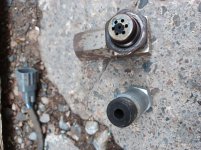
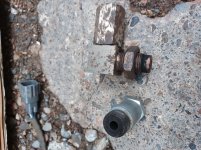
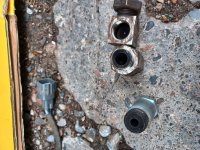
Today I started in on the trial and error path to clearing these damn codes. The first step was to take the upstream defoulers off. Then I removed the drive's side downstream defouler to compare my options and decide which one to install back into the downstream spot. As I said in a previous post, I have a set of 90degree ones and a set of straight ones. The pictures show one of each. It just so happens that the 90degree ones come apart and it offers me a second set of straight defoulers. As you can see, the removed, straight section of the 90 degree set has a noticeably larger hole and is about 1/8 of an inch shorter. I figured I'd try this options first before I start modifying any of them. You'll also notice the 90 degree set actually has part of it inside the exhaust tube while the straight options are really just spacers. You'll also notice that its depth into the pipe is adjustable because of the nut on the threads. If you want to get that tip you can spin the nut all the way up to the corner, or if you want to back it out, spin the nut down towards the tip. I really wish I could screw the O2 sensor into the corner piece but it dosen't fit. The aformentioned adjustment would really have been nice. But with the extra distance that corner adds, I'm not sure the adjustability will get the O2 sensor close enough to the pipe compared to the straight ones.

I'm not sure how much sense this makes as I try to explain it but I hope it's not total jibberish. As always, I'm open to any and all ideas and suggestions.
 

Attachments

  • 20220526_175913_50.jpg
    20220526_175913_50.jpg
    131.5 KB · Views: 602
  • 20220526_175923_50.jpg
    20220526_175923_50.jpg
    139 KB · Views: 599
  • 20220526_175934_50.jpg
    20220526_175934_50.jpg
    142.1 KB · Views: 608
The first post I made on this thread... Why are you still attempting to trick the PCM with defoulers/spacing back the sensor. This is actually retarded if you think about it.. you'll never achieve the proper a/f ratio with your new headers because this sensor is f_cking crucial in spraying the correct amount of fuel in proportion to air. Tricks won't work and the headers might as well not be there. Get the proper a/f tune via piggyback or Dyno shop or just put manifolds back on. Peace ✌️
 
The first post I made on this thread... Why are you still attempting to trick the PCM with defoulers/spacing back the sensor. This is actually retarded if you think about it.. you'll never achieve the proper a/f ratio with your new headers because this sensor is f_cking crucial in spraying the correct amount of fuel in proportion to air. Tricks won't work and the headers might as well not be there. Get the proper a/f tune via piggyback or Dyno shop or just put manifolds back on. Peace ✌️

Respectfully disagree.

The crucial sensor is the upstream sensor, this is the one that should not be messed with as it will certainly impact the A/F mixture as previously mentioned by me. The 2 upstream sensor should be left alone.

However, the only purpose of the 2 downstream sensors is to monitor the efficiency of the catalytic converter. By installing headers and getting rid/changing the converter you end throwing codes. The defouler on the downstream sensors could absolutely work to trick the ECU without any negative drawbacks (other than the obvious increase in actual emission output).

Going the route of an actual piggyback/standalone and a dynotune would absolutely be the "correct" way to do this while also gaining some performance, however, this will not fix the issue of the ECU throwing a catalytic code due to it just not being there.
 

Members online

Forum statistics

Threads
278,306
Messages
3,554,045
Members
248,016
Latest member
Advally Service

Trending content

Back
Top