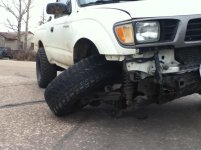
How is the moog parts so bad? There top of the line aftermarket replacements on every other vehicle. Im a service manager at Tires Plus and all my years i or my techs either one have seen or heard of ball joint problems on Toyotas till i got on the forum. Im gonna check mine tomorrow at work and make sure there tight and boots arent busted. And Im not getting into a debate over moog or oem lbjs Im just curious. Thanks for the info ahead of time.
None of us can give you definitive evidence that Moog is worse than OEM because none of us have assembled reliability data of a large enough sample size to to give a conclusions with statistical certainty.
but......... you don't need statistical evidence to draw a "likely" conclusion. Check out this thread:
http://www.toyota-4runner.org/3rd-gen-t4rs/129971-ball-joints-whered-ya-getem-how-much.html. Izzard links to a couple other threads of Moog vs OEM, etc. and I give some reasons to go with only OEM. There has been lots of discussion here about it, so search on it and read up.
Overall though, general rule (at least for high reliability vehicles like Toyota, Honda, or German cars, Subaru, etc) is that OEM is higher quality than aftermarket. Most things, aftermarket is cheaper, and there's a reason they're cheaper; cheaper materials, less testing/qualification, less engineering design time, fewer design iterations. Not a recipe for quality.
Some aftermarkets do only 1 thing, and could potentially get better at something than OEM's, like for example the audio companies. What happened in that market? Eventually those aftermarket companies that were better than the OEM (and more expensive, like Bose, Infinity, Kenwood, Alpine, Sony, etc.) struck deals with OEM to provide their product stock. Now, most vehicles other than very base low cost models have a name-brand stereo system.