Diagnosing a partially clogged cat

davidoff

New member
I think the difficulty here is "partially".

My 2000 SR5 has had trouble accelerating since I purchased it a few months ago. In the city you might not really notice, but it's there. On the highway, notably on inclines, there's no denying it. Hills on which I could easily accelerate up in my 98 Limited without even thinking about it, I'm having trouble maintaining 60mph with the pedal floored. Side note, I am aware that the 98 has a different rear end. This feels like something very different from rear end gearing.

I have run through a bunch of troubleshooting steps and repairs including:
* Checking ignition timing
* Checking valve timing (personally replaced the timing belt in Nov)
* Replaced fuel filter
* Replaced plugs
* Replaced plug wires
* Got a professional opinion regarding the state of the drivetrain

What I have left on my list are:
* Compression test
* Check for clogged cats

Today I attempted to check my cats and got interesting results. I did back to back runs on the aforementioned hill with the truck as normal, and with the O2 sensor ahead of the cats pulled. As normal, I could barely maintain 60mph with the pedal floored. With the O2 sensor pulled, I could reach 70mph and was still accelerating at the top of the hill. The pedal was still floored in that case, but it felt way more like my 98, and way more like what I'd expect.

The other bit of observation that leads me to want to believe it's an exhaust flow issue is the way the truck behaves when I get on the throttle. There's way more throw in the accelerator than feels right before the truck starts accelerating. It sounds like the motor is trying to breath harder but just can't unless I give it way more gas than I'd think is necessary, to the point that I often have to downshift in situations where I don't think I should.

My hesitation with deciding it's my cats going and spending that kind of money is that, isn't what I experienced today exactly the kind of result you'd expect from eliminating so much back pressure even in an otherwise normally functioning exhaust system? That is to say, less low end torque, more high end HP?

Any thoughts on how much faith I should put in today's test are appreciated.

Thanks.
Andy
 
Register to hide this ad
Definitely sounds like a cat to me. Sometimes you can pull them off an clean them. Though I always recommend just going ahead and buying a new one. I found one for like 115 bucks
 
Oh, and a follow up. From the manual it looks like there's just one cat, but there's also another heavily shielded section of exhaust just before the rear O2 sensor. That's not another cat, is it? You can see it in this diagram.

http://ww2.justanswer.com/uploads/TR/tracker40/2013-05-19_004621_1.gif

It is CA emissions spec.

Answered my own question. CA spec does have 2 cats. Found another diagram in the manual with the rear one clearly labeled.

Andy
 
Last edited:
Using a vacuum gauge, there are a couple of different ways to diagnose an exhaust restriction like a clogged cat.

You can monitor intake vacuum.....
https://www.youtube.com/watch?v=d-jp1IIJVVk

Or you can monitor pressure directly through an O2 sensor port but you need a fitting to make that connection....
https://www.youtube.com/watch?v=4QvR5Nqun4g

I haven't done this on T4R so can't give you expected numbers. You could search it on the forum. You could also get your baseline reading and then plug the exhaust pipe and see if it changes much.

Buckaroo
 
I've got the one off of mine you can have for the cost of shipping. I upgraded to a high flow unit and was just going to throw this one away.
 
I've got the one off of mine you can have for the cost of shipping. I upgraded to a high flow unit and was just going to throw this one away.

That's a very generous offer and I appreciate it, but it looks like the CA front converter and pipe is a different part number from the Federal part number. If I can confirm they're the same converter I'll definitely take you up on this. I'm not concerned with meeting CA emissions spec, but I do need to pass emissions here in CO and don't want to trigger a CEL or anything like that. I'll keep digging on whether or not they're actually the same part.

Thanks.
Andy
 
Using a vacuum gauge, there are a couple of different ways to diagnose an exhaust restriction like a clogged cat.

You can monitor intake vacuum.....
https://www.youtube.com/watch?v=d-jp1IIJVVk

Or you can monitor pressure directly through an O2 sensor port but you need a fitting to make that connection....
https://www.youtube.com/watch?v=4QvR5Nqun4g

I haven't done this on T4R so can't give you expected numbers. You could search it on the forum. You could also get your baseline reading and then plug the exhaust pipe and see if it changes much.

Buckaroo

Thanks. I think I have a boost gauge laying around that I use for working on my turbo vehicle that might also show vacuum. I think I also see how I could make an adapter. I am not sure when I'll get a chance to do these tests, or if I'll have numbers to compare the results to, but I'm going to look into this.

I found this in the factory service manual for a 2000 SR5:

Intake manifold vacuum / at idle speed / 60kPa (450mmHg, 17.7 in.Hg) or more

Thanks again.
Andy
 
Last edited:
I just did the intake vacuum test. I'm not entirely sure what to make of it. Note that I'm at ~5500' elevation. If the correction factors you'd use for compression testing apply to vacuum, and I'd guess they would but I really have no idea, then I'm pulling vacuum that's within spec.

My uncorrected readings were ~16.5 in.Hg at idle, staying totally steady up through ~3500RPM, then increasing to ~17.0 in.Hg at ~4500RPM.

The correction factor I'd use, if it'd apply and if it's actually right, I got from this thread: http://www.toyota-4runner.org/3rd-gen-t4rs/170087-compression-test-question.html, 0.853. That factor would move the spec from 17.7 in.Hg or more to ~15.1 in.HG or more (since the compression readings are done in PSI, I converted to PSI to apply the correction. I'm not a math wizard so maybe that was wrong and/or unnecessary).

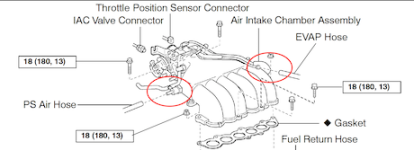
Correction factor aside, the fact that the vacuum stayed stable and even increased at higher RPMs seems to suggest there's no issue with the motor being able to breathe. This was however done in a parking lot, not with the motor under load driving down the road, which maybe could make a difference? The car was warm before I tested. I tested at two locations and got the same results. One where one of the "PS Air Hose" connects (I think), and one where the EVAP connects.

Andy
 

Attachments

  • Screen Shot 2016-01-10 at 12.40.11 PM.png
    Screen Shot 2016-01-10 at 12.40.11 PM.png
    56.3 KB · Views: 4,628
Last edited:
After doing some more digging on correction factors, I think the equation is:

Atmospheric Pressure * (Pressure To Convert / 29.92 in.Hg)

Which I got from here: Effects of Atmospheric Pressure on Vacuum Level

I got the pressure at 5500', 24.72 in.Hg, from this calculator: Altitude.org | Altitude air pressure calculator

Which would mean 17.7 in.Hg at 5500' should be ~14.6 in.Hg.

Comparing that to charts like the one here: Air - Altitude, Density and Specific Volume seems to suggest that calculation is correct (ex: 17.7 * .827 = 14.6).

I think this is correct but I don't claim to have done more than hacked at this and correlated it with other sources to help validate it.

If that's all correct, then my vacuum readings are good. So that's...something? Now I want to check my back pressure. Gotta build an adapter.

Andy
 
I took my truck into a local place that only does mufflers to have my cats tested. Paid them $20 and it took 20 min to find out they were just fine. They measure inside the exhaust pre and post-cat to see if there is any back pressure.
 
I took my truck into a local place that only does mufflers to have my cats tested. Paid them $20 and it took 20 min to find out they were just fine. They measure inside the exhaust pre and post-cat to see if there is any back pressure.

Thanks. I'll check my local muffler place to see if they do this test.

Andy
 
I checked with a local muffler place that appears to be well respected, and I think I was speaking to the owner or the manager over the phone. He said they don't do back pressure tests anymore because they're "unreliable", which in the context of the conversation I took to mean there are other tests that are more definitive more often.

I explained to him what was going on with my truck and how it felt with the forward oxygen sensor out, and he was assured that I have a restriction in the exhaust, most likely the cats. The impression I got was that in his opinion, if the performance of the vehicle was noticeably better with the sensor out, that was definitely a sign of restriction in the exhaust.

At this point I think I'm going to bite the bullet and get some magnaflow replacements. I need to get quotes for getting them welded in though. Depending on how much it all tallies up to, I might just get the direct fit and do it myself. I'll bump this thread again once the work is done to pass on results.

Thanks for all the input on this.

Andy
 
Last edited:
I got the replacements welded in last Wed (Magnaflow 447105 and 447205) and my power and gas mileage issues are resolved, without question. The truck drives the way it should now, which is awesome. I have driven it both around town, to/from work and just got back from the mountains which took me over 70 and 91 in CO, including elevations over 10,000'. These were all serious problem areas before.

The guy who did the weld work said the forward cat was falling apart and looked obviously damaged. I didn't see it myself but he said it was the kind of damage he sees on cars that have misfires for a long period of time. I'm not sure exactly what he meant by that but my guess is that he's talking about unspent fuel making it into the cat and igniting there (anyone know?).

Anyway, problem solved. My takeaway is that if you pull the forward O2 sensor and things get better, you have an exhaust restriction.

Thanks again to everyone who provided input on this.
Andy
 
Last edited:
I am glad that you got it resolved. The cat gets hot normally (>1000F) when it is converting emissions and unburned fuel. When the engine misfires, a lot more unburned fuel is generated which gets the cat even hotter, to the point that the honeycomb element can melt and obstruct exhaust flow. Even if the element doesn't melt, misfires can foul the element and it will not perform properly resulting in catalytic converter efficiency codes (like P0430). Cats don't die on their own, they are murdered by misfires.

Buckaroo
 
Bringing this back because I think I have a clogged cat also. I've been having lower power then I think I should have for what I have. I have 4.88 gears in my 2000 and my other 1999 4runner with 4.30 gears that used to have everything on it that is on the 2000 now seemed to have more power. The engine also starts to vibrate more and isn't as smooth at 2300rpm and higher. Gas mileage is pretty bad also. I average about 13-15mpg on the freeway. Any tiny hill I also lose speed and it struggles to get up without downshifting. I got a heat gun and tested the temp before and after the cat. Before at idle it was about 350F and after the cat it was about 240F. Everything i've read says it should be hotter after the cat. I think next i'll remove the front O2 sensor and see how it feels.
I've also replaced my O2 sensors, TPS, spark plugs, fuel filter, and injectors and it helped a little but nothing crazy. I also checked timing by pulling back the timing cover and everything looked to be lined up correctly.
Anyone recommend what new cat I should get if I need one? Magnaflow seems to be on the higher end. There's aFe Power which is a little cheaper but also seems nice. There's also Walker which is even cheaper. Is it worth it to go with something like the Magnaflow or aFe Power?
 
Last edited:
I decided on getting the aFe Power one. I'll get it installed and let you guys know how it is after. I really hope this fixes my power issues.
 
Can you post side by side pics of the OEM and AFE cat? The AFE is 409 stainless which is great but it looks awfully small compared to my Walker. From research it seems like it's an inverse relation. Smaller cat = higher flow. That's how they achieve that performance image. But then your exhaust is stinkier and it will be noticeably louder under your floorboards.
 
Can you post side by side pics of the OEM and AFE cat? The AFE is 409 stainless which is great but it looks awfully small compared to my Walker. From research it seems like it's an inverse relation. Smaller cat = higher flow. That's how they achieve that performance image. But then your exhaust is stinkier and it will be noticeably louder under your floorboards.

Yea i'll get some pics once I get the OEM one off. Once I drive it around for a bit i'll post if I notice any sound or smell differences. Not many people seem to have this one so there wasn't much info on it out there. https://www.youtube.com/watch?si=r0_rvytCTJ1dw7Ce&v=9y4hW-ORjDE&feature=youtu.be This was the only video I could find on it.
 

Members online

Forum statistics

Threads
278,310
Messages
3,554,080
Members
248,016
Latest member
Advally Service

Trending content

Back
Top