Thanks for that explanation. Most drivers have little knowledge of the fuel system and sometimes refer to old automotive hearsay. Can you clear up some of these?
1. Will any damage occur if the engine runs out of gas while driving at highway speed?
2. Will the fuel pump overheat and be destroyed?
3. Will water from the bottom of the tank get sucked up into the engine and damage it?
4. Will sludge/rust from the bottom of the tank get drawn up and clog the fuel filter?
Thanks.
-Not really. Modern computer controlled engines are pretty good at protecting themselves to a rather decent degree, usually when you're running low on fuel the pump will start "sputtering" which will start to kill the fuel pressure and the engine usually just starts running rough, misfiring, and then just turning off. When we do EFI services where we hook up a pressurized can of cleaner to then engine, sometimes we don't get to the ignition by the time the vehicle starts sputtering and it'll just die. Hasn't harmed anything made in the last two or three decades as far as I've seen.
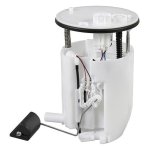
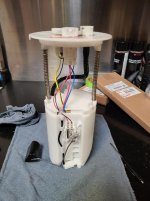
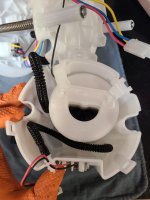
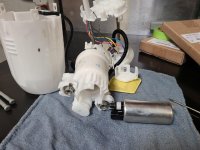
-If you mean "will the fuel pump overheat and be destroyed- IF the fuel level is run too low?" The answer is "it is possible." Modern (anything made from like the early 2000's up) Toyotas use a fuel pump housing to sit the fuel pump in as well as the fuel level sender; it's designed to hold fuel in a "reservoir" that the fuel pump physically sits in. (looks like the attached picture, though this picture doesn't show the filter sock. It's a wide, flat sock that mounts to that hose fitting by the fuel level float.) As you can see the housing is like a big cup, that "cup" will hold a decent amount of fuel that gets circulated into the engine when the fuel level is low. This is specifically to keep the pump as cool as possible at all fuel levels, even with say a cup or so of fuel in that "reservoir" it would take a lot of heat and time to get the liquid fuel and plastic housing to get hot enough to thermally degrade the pump in any significant manner before you ran out of fuel and the engine shut off. Now I don't have any real evidence for that opinion, I haven't tried to measure those things; instinctually once you see and understand how it fits in the tank and works, as well as understanding how fluid pumps work, it just becomes sort of intuitive that it is designed to prevent that.
-Yeah, sure. You would have to have a significant amount of water in your fuel tank and have that tank sit for a while for all the fuel to separate to have standing water in the fuel that could hydro-lock an engine. Though once it's been agitated some, that emulsion of fuel and water would make it's way into the engine which could cause issues after a long time.
-Rust? Only if you have a vehicle with a steel tank whose resin/plastic coating has failed. Sludge and debris? Yeah, it's entirely possible as that's why you have a fuel filter sock on the inlet of the fuel pump. Once you're driving and sloshing fuel around in the tank, it'll get that debris floating around and it could get sucked into the filter. But keep in mind that in tank pumps have a large, flat, rectangular fuel sock filter. It allows the filter to get fairly dirty before it starts affecting flow requirements of the pump. Most fuel tanks I've pulled (quiet a few going over 100k when we get some vehicles for the fuel pump recall) the amount of sediment that settles at the bottle of the tank is barely enough to fill up a tablespoon. I do suppose though in other places in the country the fuel quality may not be as good and you can get a lot of stuff in the tank, but I honestly haven't seen it personally.
Hope that answers things for you?

 layball: